
Report Feature
Dental CBCT Market Trends and Forecast
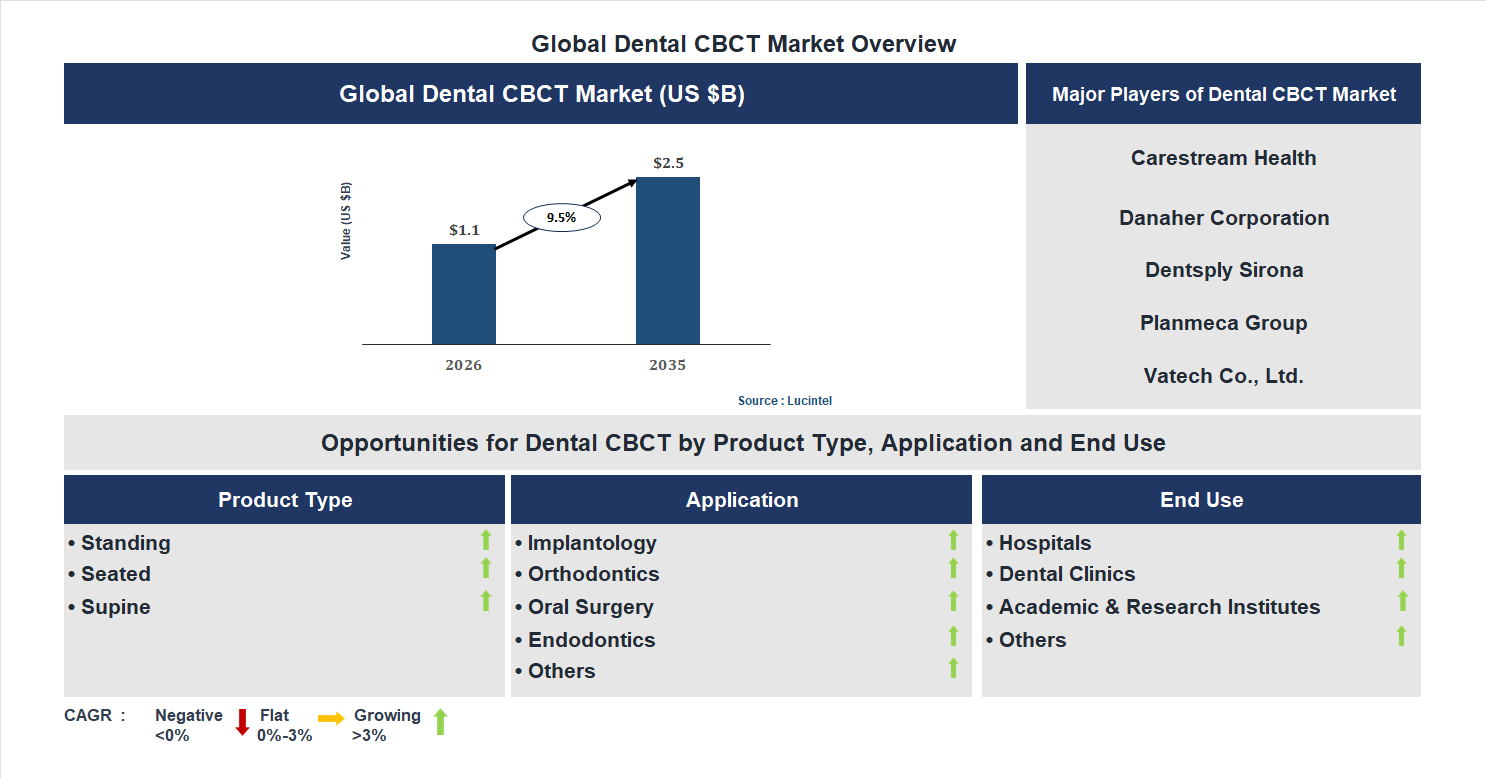
The future of the global dental CBCT market looks promising with opportunities in the hospital, dental clinic, and academic & research institute markets. The global dental CBCT market is expected to reach an estimated $2.5 billion by 2035 with a CAGR of 9.5% from 2026 to 2035. The major drivers for this market are the increasing demand for accurate dental imaging, the rising adoption of advanced diagnostic technologies, and the growing focus on minimally invasive dental procedures.• Lucintel forecasts that, within the product type category, standing is expected to witness the highest growth over the forecast period.
• Within the end use category, dental clinic is expected to witness the highest growth.
• In terms of region, North America is expected to witness the highest growth over the forecast period. Gain valuable insights for your business decisions with our comprehensive 150+ page report. Sample figures with some insights are shown below.
Emerging Trends in the Dental CBCT Market
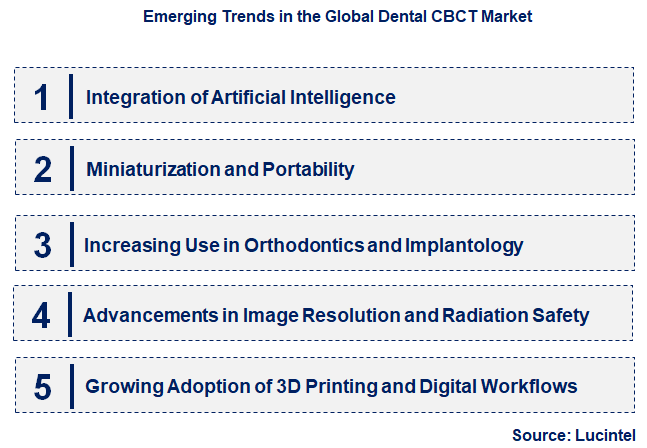
The dental CBCT market is experiencing rapid growth driven by technological advancements, increasing demand for precise diagnostic tools, and a shift towards minimally invasive procedures. As dental practices seek more accurate imaging solutions, the market is evolving with innovative products and expanding applications. These developments are transforming how dental professionals diagnose, plan, and treat various oral health conditions, ultimately improving patient outcomes. The following key trends highlight the major shifts shaping this dynamic market landscape, reflecting both technological progress and changing consumer and provider preferences.• Integration of Artificial Intelligence: AI is increasingly incorporated into CBCT systems to enhance image analysis and diagnostic accuracy. Machine learning algorithms assist in identifying abnormalities, reducing human error, and expediting diagnosis. This integration improves workflow efficiency and enables personalized treatment planning, making dental imaging more precise and accessible. As AI continues to evolve, it will further streamline clinical decision-making and expand the capabilities of CBCT technology.
• Miniaturization and Portability: The development of smaller, portable CBCT units allows for greater flexibility in clinical settings. Compact devices facilitate on-site imaging in various dental practices, including small clinics and mobile units, without compromising image quality. This trend enhances accessibility, especially in remote or underserved areas, and reduces patient discomfort by enabling quicker, more convenient scans. The portability of CBCT systems is expected to broaden their adoption across diverse healthcare environments.
• Increasing Use in Orthodontics and Implantology: CBCT imaging is becoming essential in orthodontic treatment planning and dental implant procedures. Its ability to provide 3D visualization of bone structure and surrounding tissues improves accuracy in placement and alignment. This trend leads to better treatment outcomes, reduced complications, and more predictable results. As demand for cosmetic and restorative dentistry grows, the use of CBCT in these specialties is set to expand further.
• Advancements in Image Resolution and Radiation Safety: Manufacturers are focusing on enhancing image resolution while minimizing radiation exposure. High-resolution imaging allows for detailed visualization of fine structures, aiding in early diagnosis and precise treatment. Concurrently, innovations in dose reduction techniques ensure patient safety, encouraging wider adoption. These improvements balance diagnostic quality with safety considerations, making CBCT a more attractive option for routine use.
• Growing Adoption of 3D Printing and Digital Workflows: The integration of CBCT imaging with 3D printing and digital dentistry workflows is revolutionizing treatment planning and prosthetic fabrication. Accurate 3D models derived from CBCT scans enable customized solutions, such as surgical guides and prostheses, with higher precision. This synergy reduces treatment time, improves fit and function, and enhances patient satisfaction. As digital workflows become standard, the market is shifting towards more efficient, personalized, and cost-effective dental care solutions. In summary, these emerging trends are significantly reshaping the dental CBCT market by enhancing diagnostic capabilities, expanding accessibility, and integrating advanced digital technologies. This evolution is driving improved clinical outcomes, patient safety, and operational efficiency, positioning CBCT as an indispensable tool in modern dentistry.
Recent Development in the Dental CBCT Market
The dental CBCT market is experiencing rapid growth driven by technological advancements, increasing demand for precise dental imaging, and expanding applications in dental diagnostics and treatment planning. As dental practices adopt more sophisticated imaging solutions, the market is poised for significant expansion. Innovations in imaging quality, reduction in radiation exposure, and integration with digital workflows are further fueling this growth. These developments are transforming dental diagnostics, improving patient outcomes, and creating new opportunities for industry stakeholders.• Advancements in Imaging Technology: Enhanced resolution and reduced radiation exposure are making CBCT more accessible and safer, encouraging wider adoption among dental professionals. These technological improvements lead to more accurate diagnoses, better treatment planning, and improved patient safety. As imaging quality continues to improve, the market will see increased demand from dental clinics, hospitals, and research institutions, fostering innovation and competition.
• Rising Demand for Cosmetic and Orthodontic Procedures: The increasing popularity of cosmetic dentistry and orthodontics drives the need for detailed 3D imaging. CBCT provides precise visualization of dental structures, aiding in treatment planning and outcome prediction. This demand boosts sales of CBCT devices, especially in regions with growing dental tourism and aesthetic procedures. The trend supports market expansion and encourages manufacturers to develop specialized imaging solutions.
• Integration with Digital Dentistry Workflows: The integration of CBCT with CAD/CAM systems and digital workflows enhances treatment efficiency and accuracy. This synergy allows for seamless planning, designing, and manufacturing of dental restorations and implants. As digital dentistry gains traction, the demand for compatible CBCT systems increases, fostering innovation and creating new revenue streams for technology providers. This integration also improves patient experience and clinical outcomes.
• Expanding Applications in Implantology and Endodontics: CBCTs ability to provide detailed 3D images makes it essential for implant placement, root canal treatments, and other complex procedures. Its use reduces surgical risks and improves success rates. The expanding scope of applications in these fields encourages investment in advanced CBCT systems, driving market growth. As practitioners recognize its benefits, adoption rates are expected to rise, further solidifying CBCTs role in comprehensive dental care.
• Increasing Adoption in Emerging Markets: Growing awareness, rising healthcare infrastructure, and increasing dental expenditure are boosting CBCT adoption in emerging economies. These markets offer significant growth potential due to unmet needs and expanding dental services. Local manufacturers and international players are investing in these regions, fostering market penetration. This trend not only broadens access to advanced dental imaging but also accelerates overall market growth and innovation. The recent developments in the dental CBCT market are significantly enhancing diagnostic precision, treatment planning, and patient outcomes. Technological innovations, expanding applications, and growing adoption in emerging markets are collectively driving market growth. These opportunities are fostering increased competition, innovation, and integration within the industry. As a result, the market is poised for sustained expansion, benefiting dental professionals, patients, and industry stakeholders through improved imaging solutions and broader access to advanced dental care.
Strategic Growth Opportunities in the Dental CBCT Market
The dental CBCT market is experiencing rapid expansion driven by technological advancements, increasing demand for precise diagnostics, and growing awareness of oral health. The integration of CBCT imaging into routine dental practices enhances treatment planning and patient outcomes. Market players are focusing on innovation, strategic partnerships, and expanding applications across various dental specialties. This growth presents significant opportunities for stakeholders to capitalize on emerging trends and meet the rising global demand for advanced dental imaging solutions.• Market Penetration in Emerging Economies: Expanding dental healthcare infrastructure and rising awareness in developing countries are creating new opportunities for CBCT adoption. Increasing disposable income and the growing prevalence of dental disorders drive demand for advanced imaging solutions. Companies are focusing on affordable, portable CBCT devices tailored for emerging markets, which can significantly boost market penetration and revenue growth.
• Technological Innovation and Miniaturization: Continuous advancements in imaging technology are leading to more compact, high-resolution CBCT systems. Innovations such as lower radiation doses, faster scan times, and enhanced image quality improve clinical outcomes and patient comfort. Miniaturization allows for easier integration into dental clinics, expanding accessibility and enabling broader application across various dental procedures.
• Expansion of Application Areas in Dental Specialties: CBCT technology is increasingly used beyond general dentistry, including orthodontics, implantology, endodontics, and oral surgery. Its ability to provide 3D visualization enhances diagnostic accuracy and treatment planning. As awareness grows among specialists, the demand for tailored CBCT solutions for specific procedures is expected to rise, opening new revenue streams and market segments.
• Strategic Partnerships and Collaborations: Collaborations between CBCT manufacturers, dental clinics, and research institutions foster innovation and market expansion. Partnerships facilitate the development of customized solutions, training programs, and distribution networks. These alliances help companies strengthen their market presence, accelerate product adoption, and stay competitive amid evolving technological and regulatory landscapes.
• Regulatory Approvals and Reimbursement Policies: Favorable regulatory approvals and reimbursement frameworks are crucial for market growth. Clear guidelines and insurance coverage encourage dental practitioners to adopt CBCT technology, reducing out-of-pocket costs for patients. Streamlining approval processes and advocating for reimbursement policies will further accelerate adoption, especially in regions where cost remains a barrier. The overall impact of these growth opportunities is poised to significantly enhance the reach and capabilities of the dental CBCT market. By leveraging technological innovations, expanding applications, and fostering strategic collaborations, the market can achieve sustained growth. Addressing regulatory and economic factors will also be vital in ensuring widespread adoption, ultimately improving diagnostic precision and patient care worldwide.
Dental CBCT Market Driver and Challenges
The dental CBCT market is influenced by a variety of technological, economic, and regulatory factors that shape its growth trajectory. Advances in imaging technology have enhanced diagnostic accuracy, while increasing awareness of oral health and the demand for minimally invasive procedures drive market expansion. Economic factors such as rising healthcare expenditure and the growing adoption of advanced dental equipment further propel growth. However, regulatory challenges related to radiation safety standards and high equipment costs pose significant hurdles. Additionally, technological limitations and the need for skilled professionals impact market development. Understanding these drivers and challenges is essential for stakeholders aiming to capitalize on emerging opportunities and address potential barriers effectively. The factors responsible for driving the dental CBCT market include:• Technological Advancements: The continuous development of high-resolution imaging and 3D visualization tools has significantly improved diagnostic capabilities. These innovations enable precise treatment planning for complex dental procedures, such as implant placement and orthodontics. As technology becomes more sophisticated and affordable, dental practitioners are increasingly adopting CBCT systems, leading to market growth. Moreover, integration with digital workflows and software enhancements further streamlines clinical processes, making CBCT an indispensable tool in modern dentistry. The ongoing evolution of imaging technology promises to expand applications and improve patient outcomes, fueling sustained market demand.
• Rising Prevalence of Dental Disorders: The increasing incidence of dental issues such as cavities, periodontal diseases, and oral cancers is a major driver. As awareness about oral health improves globally, more patients seek advanced diagnostic solutions. CBCT provides detailed 3D imaging that aids in early detection and precise treatment planning, reducing complications and improving prognosis. The aging population also contributes to higher dental health needs, necessitating advanced imaging modalities. This growing prevalence directly correlates with increased demand for CBCT systems across dental clinics, hospitals, and specialty centers, supporting market expansion.
• Growing Adoption of Minimally Invasive Procedures: The shift towards minimally invasive dentistry emphasizes the importance of accurate diagnostics to preserve tissue and reduce patient discomfort. CBCT imaging plays a crucial role in planning and executing such procedures, including implantology, endodontics, and orthodontics. Its ability to provide detailed anatomical insights minimizes surgical risks and enhances treatment success rates. As practitioners increasingly adopt minimally invasive techniques, the reliance on CBCT technology intensifies. This trend is driven by patient preferences for less painful treatments and the desire for faster recovery, thereby boosting market growth.
• Increasing Healthcare Expenditure and Awareness: Rising healthcare spending worldwide, especially in emerging economies, facilitates the adoption of advanced dental technologies like CBCT. Governments and private insurers are investing more in dental care infrastructure, promoting access to sophisticated diagnostic tools. Additionally, public awareness campaigns about oral health benefits encourage patients to seek advanced diagnostics, further driving demand. The affordability of CBCT systems is improving with technological innovations, making them accessible to a broader range of dental practices. This economic and awareness boost significantly contributes to the expanding market landscape.
• Expansion of Dental Service Providers: The proliferation of dental clinics, specialty centers, and hospitals equipped with advanced imaging technology is a key driver. As the number of dental practitioners increases, so does the demand for reliable diagnostic tools like CBCT. Strategic collaborations, acquisitions, and investments in new clinics foster market growth. Additionally, the rising trend of dental tourism in certain regions encourages clinics to adopt cutting-edge technology to attract international patients. This expansion enhances market penetration and accelerates adoption rates, supporting overall industry growth. The challenges in the dental CBCT market are:
• Regulatory and Safety Concerns: Stringent regulations regarding radiation exposure and safety standards pose significant barriers. Governments and health authorities enforce strict guidelines to minimize patient and operator risks, which can delay product approvals and increase compliance costs. Manufacturers must invest heavily in safety features and certification processes, impacting pricing and market entry. Additionally, concerns about cumulative radiation doses may limit the frequency of CBCT scans, affecting clinical utility. Navigating complex regulatory landscapes across different regions remains a challenge, potentially hindering rapid market expansion.
• High Equipment Costs and Reimbursement Issues: The substantial capital investment required for CBCT systems limits adoption among small and mid-sized dental practices. High purchase and maintenance costs, coupled with limited reimbursement policies in some regions, reduce affordability and profitability. This financial barrier restricts widespread deployment, especially in developing countries. Moreover, inconsistent insurance coverage and reimbursement rates for CBCT procedures discourage practitioners from investing in the technology, thereby constraining market growth.
• Technological Limitations and Skill Gap: Despite advancements, CBCT systems still face limitations such as image artifacts, limited soft tissue contrast, and radiation dose concerns. These technical issues can affect diagnostic accuracy and clinical outcomes. Additionally, the need for specialized training to operate CBCT equipment and interpret images creates a skill gap among dental professionals. Lack of adequate training programs hampers effective utilization, leading to underuse or misuse of technology. Addressing these technological and educational challenges is crucial for maximizing the benefits of CBCT in dental practice. In summary, the dental CBCT market is driven by technological innovations, increasing oral health awareness, and the adoption of minimally invasive procedures. Economic growth and expanding dental service infrastructure further support market expansion. However, regulatory hurdles, high costs, and technological limitations pose significant challenges. Overcoming these barriers through regulatory compliance, cost reduction, and professional training will be essential for sustained growth. Overall, the markets future depends on balancing technological progress with strategic efforts to address these challenges, ensuring broader access and improved patient care.
List of Dental CBCT Companies
Companies in the market compete on the basis of product quality offered. Major players in this market focus on expanding their manufacturing facilities, R&D investments, infrastructural development, and leverage integration opportunities across the value chain. With these strategies dental CBCT companies cater increasing demand, ensure competitive effectiveness, develop innovative products & technologies, reduce production costs, and expand their customer base. Some of the dental CBCT companies profiled in this report include-• Carestream Health
• Danaher Corporation
• Dentsply Sirona
• Planmeca Group
• Vatech Co., Ltd.
• J. Morita Mfg. Corp.
• Asahi Roentgen Ind. Co., Ltd.
• Cefla S.C.
• PreXion Corporation
• CurveBeam LLC
Dental CBCT Market by Segment
The study includes a forecast for the global dental CBCT market by product type, application, end use, and region.Dental CBCT Market by Product Type [Value from 2019 to 2035]:
• Standing
• Seated
• Supine
Dental CBCT Market by Application [Value from 2019 to 2035]:
• Implantology
• Orthodontics
• Oral Surgery
• Endodontics
• Others
Dental CBCT Market by End Use [Value from 2019 to 2035]:
• Hospitals
• Dental Clinics
• Academic & Research Institutes
• Others
Dental CBCT Market by Region [Value from 2019 to 2035]:
• North America
• Europe
• Asia Pacific
• The Rest of the World
Country Wise Outlook for the Dental CBCT Market
The dental CBCT market has experienced significant growth driven by technological advancements, increasing adoption in dental practices, and rising awareness of 3D imaging benefits. As healthcare systems evolve and the demand for precise diagnostics increases, countries are investing in innovative solutions to improve patient outcomes. The markets development varies across regions, influenced by regulatory policies, technological infrastructure, and healthcare expenditure. Recent trends include the integration of AI, the miniaturization of devices, and expanding applications beyond dentistry. These developments reflect a global shift towards more accurate, efficient, and minimally invasive dental imaging solutions, shaping the future landscape of dental diagnostics worldwide.• United States: The US market has seen rapid adoption of advanced CBCT systems, driven by technological innovations such as AI integration and improved image resolution. Increasing awareness among dental practitioners about the benefits of 3D imaging has led to widespread use in implant planning, orthodontics, and endodontics. Regulatory approvals and reimbursement policies are favorable, encouraging market growth. Major players are focusing on miniaturized, portable devices to enhance usability and patient comfort. Additionally, the integration of CBCT with digital workflows and CAD/CAM systems is expanding its applications, making it a vital tool in modern dental practices.
• China: Chinas dental CBCT market is expanding swiftly due to rising dental healthcare awareness and increasing disposable income. The government’s focus on healthcare infrastructure development and technological modernization has facilitated market growth. Local manufacturers are investing in affordable, compact CBCT devices to cater to a large population with diverse needs. The adoption of CBCT in dental clinics is increasing, especially in urban areas, supported by growing dental tourism. Additionally, collaborations with international companies are bringing advanced imaging technologies to China, further boosting the market.
• Germany: Germanys market is characterized by high technological adoption and stringent regulatory standards. The focus on precision and safety has led to the integration of advanced features like low-dose imaging and enhanced software capabilities. The country’s strong healthcare infrastructure and emphasis on research and development support continuous innovation in CBCT technology. Dental clinics and hospitals are increasingly adopting CBCT for complex procedures such as implantology and maxillofacial surgery. Moreover, Germany is a hub for medical device manufacturing, contributing to the development of cutting-edge CBCT systems with improved diagnostic accuracy.
• India: The Indian dental CBCT market is witnessing rapid growth due to increasing awareness of advanced dental diagnostics and expanding dental care infrastructure. Rising disposable incomes and a growing middle class are driving demand for high-quality imaging solutions. Local manufacturers are offering cost-effective CBCT devices to cater to a large, price-sensitive market. The adoption of CBCT is increasing in urban centers, supported by a rising number of dental colleges and clinics. Government initiatives to improve healthcare access and the growing prevalence of dental diseases are further propelling market expansion.
• Japan: Japans market is characterized by high technological sophistication and a focus on minimally invasive procedures. The adoption of CBCT is driven by advancements in imaging quality, dose reduction, and integration with other digital dental technologies. The aging population has increased demand for precise diagnostics in implantology and oral surgery. Japan’s strict regulatory environment ensures high safety standards, fostering innovation in low-dose and high-resolution CBCT systems. The market is also seeing increased use of AI and machine learning to enhance diagnostic capabilities, making Japan a leader in advanced dental imaging solutions.

Features of the Global Dental CBCT Market
Market Size Estimates: Dental CBCT market size estimation in terms of value ($B). Trend and Forecast Analysis: Market trends (2019 to 2025) and forecast (2026 to 2035) by various segments and regions. Segmentation Analysis: Dental CBCT market size by product type, application, end use, and region in terms of value ($B). Regional Analysis: Dental CBCT market breakdown by North America, Europe, Asia Pacific, and Rest of the World. Growth Opportunities: Analysis of growth opportunities in different product types, applications, end uses, and regions for the dental CBCT market. Strategic Analysis: This includes M&A, new product development, and competitive landscape of the dental CBCT market. Analysis of competitive intensity of the industry based on Porter’s Five Forces model.
FAQ
Q1. What is the market size and growth forecast for dental CBCT market? Answer: The global dental CBCT market is expected to reach an estimated $2.5 billion by 2035 and grow with a CAGR of 9.5% from 2026 to 2035. Q2. What are the major drivers influencing the growth of the dental CBCT market? Answer: The major drivers for this market are the increasing demand for accurate dental imaging, the rising adoption of advanced diagnostic technologies, and the growing focus on minimally invasive dental procedures. Q3. What are the major segments for dental CBCT market? Answer: The future of the dental CBCT market looks promising with opportunities in the hospital, dental clinic, and academic & research institute markets. Q4. Who are the key dental CBCT market companies? Answer: Some of the key dental CBCT companies are as follows:• Carestream Health
• Danaher Corporation
• Dentsply Sirona
• Planmeca Group
• Vatech Co., Ltd.
• J. Morita Mfg. Corp.
• Asahi Roentgen Ind. Co., Ltd.
• Cefla S.C.
• PreXion Corporation
• CurveBeam LLC Q5. Which dental CBCT market segment will be the largest in future? Answer: Lucintel forecasts that, within the product type category, standing is expected to witness the highest growth over the forecast period. Q6. In dental CBCT market, which region is expected to be the largest in next 5 years? Answer: In terms of region, North America is expected to witness the highest growth over the forecast period. Q7. Do we receive customization in this report? Answer: Yes, Lucintel provides 10% customization without any additional cost.
Table of Contents
List of Figures
List of Tables
Methodology
- In-depth interviews of the major players in this market
- Detailed secondary research from competitors’ financial statements and published data
- Extensive searches of published works, market, and database information pertaining to industry news, company press releases, and customer intentions
- A compilation of the experiences, judgments, and insights of Lucintel’s professionals, who have analyzed and tracked this market over the years.


Buy Now
Choose a license that fits your team. Instant PDF delivery.
Prices exclude taxes. Instant delivery. Custom licensing available on request.
Key Questions
- • What are some of the most promising, high-growth opportunities for the dental CBCT market by product type (standing, seated, and supine), application (implantology, orthodontics, oral surgery, endodontics, and others), end use (hospitals, dental clinics, academic & research institutes, and others), and region (North America, Europe, Asia Pacific, and the Rest of the World)?
- • Which segments will grow at a faster pace and why?
- • Which region will grow at a faster pace and why?
- • What are the key factors affecting market dynamics? What are the key challenges and business risks in this market?
- • What are the business risks and competitive threats in this market?
- • What are the emerging trends in this market and the reasons behind them?
- • What are some of the changing demands of customers in the market?
- • What are the new developments in the market? Which companies are leading these developments?
- • Who are the major players in this market? What strategic initiatives are key players pursuing for business growth?
- • What are some of the competing products in this market and how big of a threat do they pose for loss of market share by material or product substitution?
- • What M&A activity has occurred in the last 7 years and what has its impact been on the industry? For any questions related to Dental CBCT Market, Dental CBCT Market Size, Dental CBCT Market Growth, Dental CBCT Market Analysis, Dental CBCT Market Report, Dental CBCT Market Share, Dental CBCT Market Trends, Dental CBCT Market Forecast, Dental CBCT Companies, write Lucintel analyst at email: helpdesk@lucintel.com. We will be glad to get back to you soon.


