
Market Report · July 29, 2026

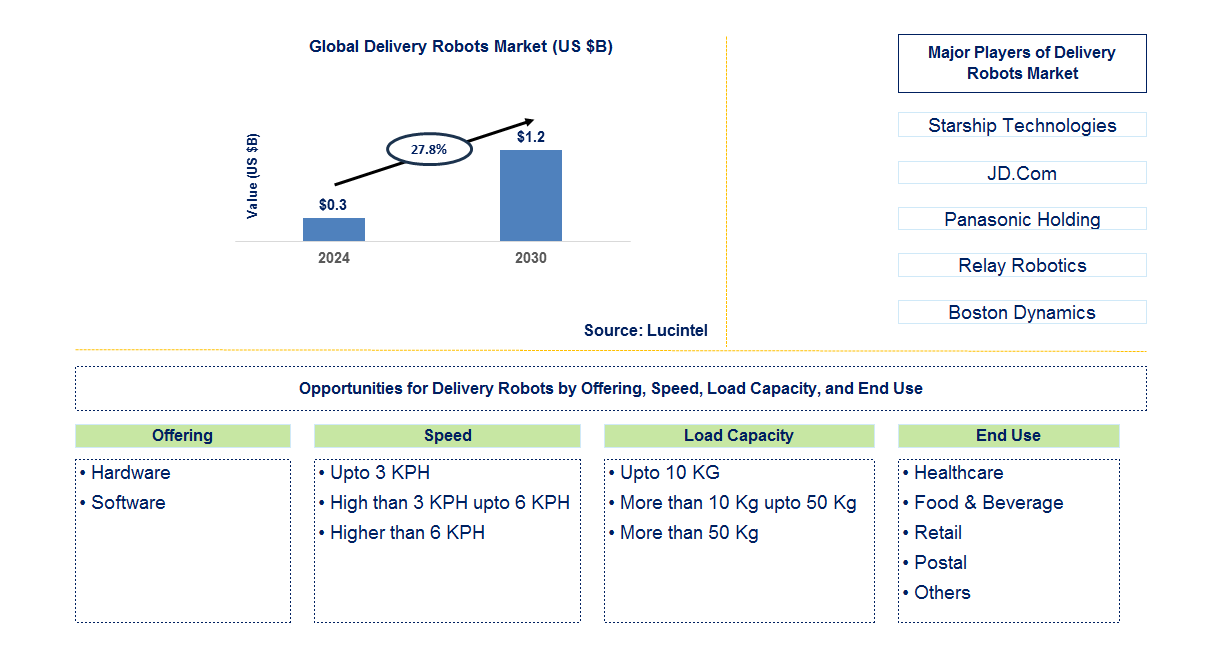
Key data points: The market size in 2030 = $1.2 billion, growth forecast = 27.8% annually next 6 years. Scroll below to get more insights. This market report covers trends, opportunities, and forecast in the global delivery robots market to 2030 by offering (hardware and software), speed (upto 3 kph, high than 3 kph upto 6 kph, and higher than 6 kph), load capacity (upto 10 kg, more than 10 kg upto 50 kg, and more than 50 kg), end use (healthcare, food & beverage, retail, postal, and others), and region (North America, Europe, Asia Pacific, and the Rest of the World)
We'll send your sample report shortly.
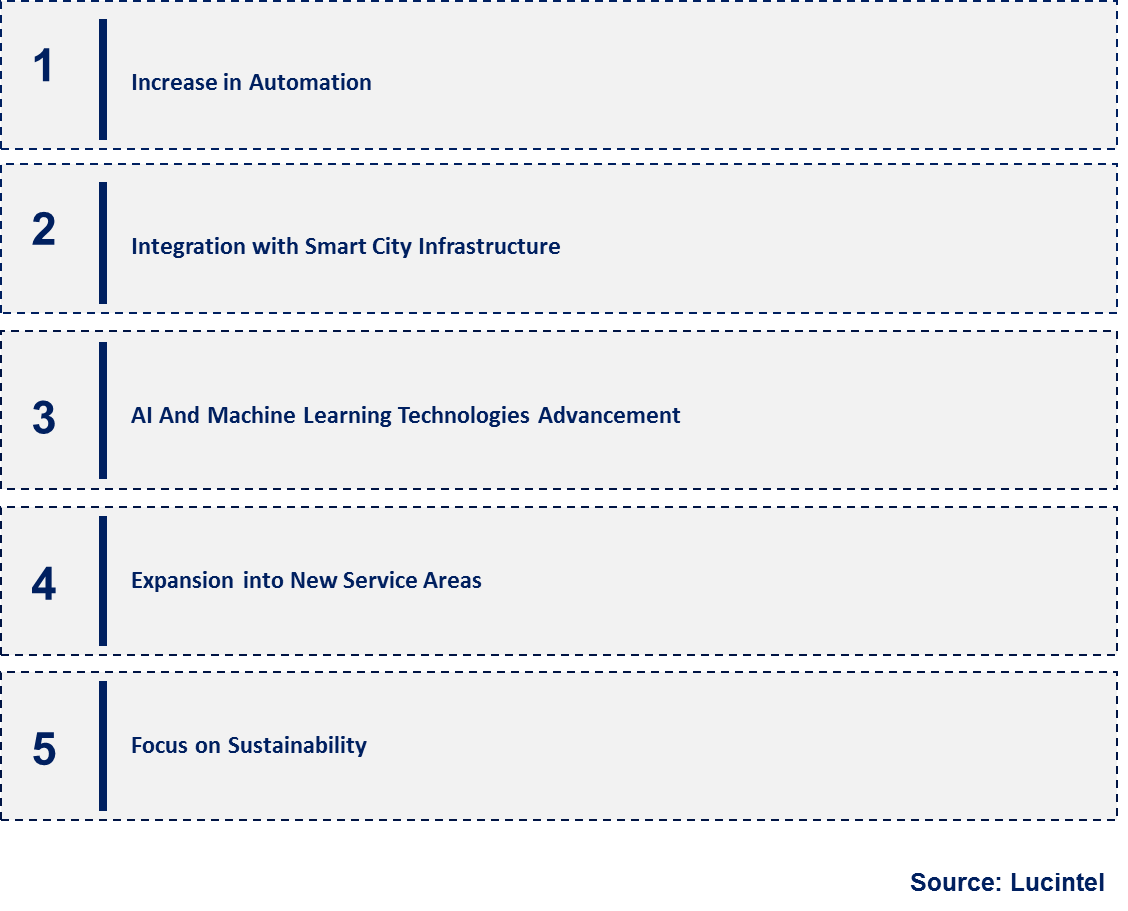
• Increase in Automation: With AI improvement and machine learning delivery robots have become highly autonomous. Such technologies enable robots to navigate through complex environments, optimize delivery routes and undertake works with low human intervention. This trend improves operational efficiency while reducing labor costs thus making them a better option for last mile delivery.
• Integration with Smart City Infrastructure: Delivery robots are increasingly integrated with smart traffic management systems as well as IoT sensors in smart cities. Therefore, traffic is dynamic along the robotics’ paths hence improving on the speed and efficiency of deliveries via route adjustments made based on real time data. In this way, by becoming part of urban infrastructure requires a means through which they can effectively maneuver around cities without delays occurring.
• AI And Machine Learning Technologies Advancement: The abilities of delivery robots are greatly enhanced due to AI and machine learning progress. Improved algorithms for navigation, obstacle detection and decision-making make these machines more reliable and effective. As a result of this change, such appliances broaden their range of application scenarios during transportation deliveries adapting to changes to happen around them.
• Expansion into New Service Areas: In addition to urban locations; delivery robots now also operate in suburban or rural regions that have few population density. Technological advancements alongside infrastructure developments have enabled wider acceptance of robot operation across different atmospheric conditions other than those experienced within urban areas only but also those previously thought impossible especially in remote locations that were hitherto considered unreachable markets where it is proving difficult or costly enough for traditional methods like using vans trucks etc., so robotic helpings can solve issues linked with lack public support outlying regions creating demand opportunities variety new geographies raising overall presence.
• Focus on Sustainability: There is a rising trend of eco-friendly robots. They include energy conservative designs, use of environmentally friendly components and the employment of renewable energy sources. This movement fits into broader environmental goals and regulatory pressures, appeals to conscious consumers who care about the environment and at the same time reduces carbon footprints in logistics. These are major trends that have helped increase efficiency levels, expand service areas and deal with ecological problems in delivery robots markets. The improvement in automation and AI has enhanced operational capabilities while integration with smart infrastructure plus a preference for sustainable approaches aligns them more closely with metropolitan and environmental targets. Consequently, these trends drive innovation as well as growth within the delivery robot industry.
• Developments in Navigation Systems: The latest innovations regarding navigation technologies such as GPS enhancement, LiDAR, computer vision etc., have made robots more efficient during their tasks. This helps provide accurate and reliable navigation across complicated environments hence decreasing service duration leading to an increase in work productivity.
• Increased investments in autonomous vehicles: Companies are making huge investments into creating fully autonomous last-mile delivery vehicles. As a result, this increased funding has pushed for innovative designs, safety characteristics coupled up with operational features that assist scale out the use of delivery robots’ business to meet growing demand for efficient logistic solutions.
• E-Commerce Platform Partnerships: That is a major development in integrating e-commerce platforms that streamline delivery and improve order fulfillment. In that regard, partnerships between manufacturers of robots and online retailers are making last-mile deliveries more efficient as they provide seamless solutions for handling increasing order volumes.
• Regulatory Advances: When it comes to the deployment of delivery robots, regulatory frameworks keep on evolving. Recently, several approvals and guidelines from different regulators have been made in favor of robots’ use across wider areas where safety issues are addressed and operational practices harmonized.
• User Interaction Features Improvements: Enhancements of user interaction features make delivery robot more users friendly. This includes advanced interfaces for customer communication, improved safety protocols, interactive elements that would enhance the overall delivery experience hence create a positive public perception. These recent developments are advancing the market for delivery robots through improved technology capabilities, increase in their scope of operation and better integration with existing logistics systems. Growth is being driven by navigation innovation, increased investments and support from regulations while partnerships and improvement on user interaction help to enhance overall effectiveness as well as adoption of the delivery robots.
• Expansion into New Markets: Penetrating emerging markets or those that lack delivery services offers tremendous growth potential for this type of automation. By targeting regions with growing e-commerce and logistics needs companies can appeal to new customers besides addressing these areas’ challenges on service availability thereby allowing expansion into such markets which will lift adoption rates greatly.
• Leveraging Advanced Technologies: Companies must invest in AI technologies such as machine learning or robotics to improve abilities within delivery robot products. They help with navigation architecture obstacle avoidance techniques operational efficiency among others which assist firms offering superior last mile solutions that will enable them keep on competing in the market.
• Developing Sustainable Solutions: The need for environmental friendly delivery methods is increasing. Companies can gain a competitive advantage by developing machines that rely on renewable power sources, give off limited amounts of pollution and are made from sustainable materials to meet consumer demands as well as regulators’ policies thus contributing towards a greener planet.
• Partnering with Key Stakeholders: For instance, e-commerce platforms, logistics providers and technology companies have the ability to improve upon the functionality and extend the coverage area of these robots. Combining forces may produce integrated systems intended for streamlining deliveries while enhancing service quality levels and also enlarging overall market opportunities at stake.
• Enhancing Customer Engagement: To grow in this market it is important to focus on improving customer interaction and satisfaction with respect to delivery robots. Intuitive interfaces are recommended among other ways of customizing services offered through robotics during delivery all of which could help enhance public perception regarding these bots thereby encouraging broader acceptance. These growth opportunities are shaping the delivery robots market by expanding reach, enhancing technological capabilities, and aligning with sustainability and customer preferences. Therefore, by taking advantage of advanced technologies, entering new markets as well as forming strategic partnerships organizations will be able to exploit new trends leading substantial growth within the sector of Delivery Robots.
• Technology Advancement: The growth of delivery robotics is being driven by latest technological advancements in the area of robotics, AI and machine learning. These technologies enhance navigation, obstacle detection and decision making capabilities that makes robots more efficient and reliable in the last mile delivery operations.
• Increased e-commerce demand - E-commerce has grown exponentially over the years hence there is need for efficient delivery solutions. Delivery robots are scalable and cost-effective solutions to handle escalating online orders volume as well as addressing issues related to last-mile delivery thus improving the service speed.
• Urbanization and Populations Growth – Increasing urbanization and population density have created a logistical challenge in city areas. Delivery robots solve this problem by helping navigate through congested regions, thereby reducing time taken for delivering goods in populous areas hence increasing efficiency.
• Customers preference for contactless delivery – Contactless deliveries are on high demand accelerated by COVID-19 pandemic which means a lot of deployment of these autonomous vehicles will be expected. In line with customers’ preferences and health safety concerns, these robots offer a safe sanitary alternative to traditional modes of transporting goods from one place to another.
• Supportive Government Policies: Statutory bodies are now updating their policies to accommodate this new technology. Recent regulatory approvals & guidelines simplify the process of deployment while also addressing operational standards ensuring that safety issues are fully addressed thus boosting the market forward. Challenges in the delivery robots market are:
• Regulatory Issues – Navigating through these complex, varying regulations is not an easy task. It implies that meeting local requirements or having all relevant permits can sometimes cause delays hence leading to extra expenses influencing expansion abilities and scalability for robot-delivered services providers.
• Infrastructure Constraints - Operationalizing such a business model may be a challenge due to poor infrastructure such as lack of pavements or roads so that autonomous mobility units can operate. Therefore, addressing these challenges ensures proper deployment for different sites.
• Public Acceptance/Concerns about Safety - Public acceptance would be key towards successful integration into society. In the process of robot adoption and growth in this market, negative perception or accidents can slow down the pace at which it happens. The advent of technology, rising e-commerce demand, and urbanization are driving the delivery robots market on one hand, while regulatory hurdles, infrastructure limitations and public acceptance concerns pose significant challenges. A balance therefore needs to be struck between these factors in order to navigate through the market successfully and achieve a sustainable growth of delivery robot industry.
• Starship Technologies
• JD.Com
• Panasonic Holding
• Relay Robotics
• Boston Dynamics
• Nuro
• Eliport
• Kiwibot
• Ottonomy.IO
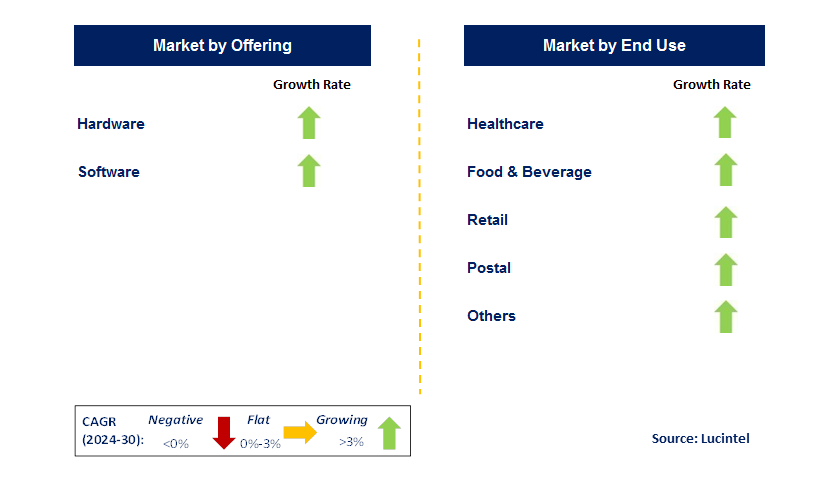
• Hardware
• Software
• Upto 3 KPH
• High than 3 KPH upto 6 KPH
• Higher than 6 KPH
• Upto 10 KG
• More than 10 Kg upto 50 Kg
• More than 50 Kg
• Healthcare
• Food & Beverage
• Retail
• Postal
• Others
• North America
• Europe
• Asia Pacific
• The Rest of the World
• United States: In America especially on campuses or inside towns have seen dramatic rise in the use of delivery robots. Some companies such as Starship Technologies and Amazon have been using bots that travel through sidewalks to deliver groceries or parcels. Also, there has been improvement in navigation systems; AI-driven route optimization has been developed as well as better public acceptance. These aspects foster delivery efficiencies hence allowing other users on board.
• China: In China, delivery bots are being integrated into advanced techs like 5G network or artificial intelligence (AI). Meituan, JD.com among others have started utilizing such autonomous machines for last mile services in crowded cities. Enhancements spotted include sophisticated obstacle avoidance devices, larger load sizes then cooperation with smart city programs take place among others. The Chinese market is dynamic thanks to its robust e-commerce sector upon which it lies and hi-tech infrastructure.
• Germany: In both urban areas and suburbs of Germany tests of unmanned rovers used for conveyance are being carried out today by specialized firms like Hermes or Postmates; their focus here is on route optimization along with better interaction with passersby. Lately they improved this by incorporating more security features into them while integrating them within existing supply chains for overall efficiency gains hence reducing transit times.
• India: India has slowly embraced the use of delivery robots particularly in tech-savvy cities within its borders. For instance Dunzo start-up operates on robotic last-mile distributions lines even though there still remain challenges like infrastructure or regulatory barriers towards such options. Some recent developments include testing programs and cooperation with local authorities to refine self-driving delivery systems that tackle the peculiarities of Indian cities.
• Japan: It is worth to remember here, that Japan is a world leader in robotics and automation, and ZMP, Panasonic, are examples of companies producing new generation robots for order delivery purposes. Additionally they make use of advanced robotics technologies; navigation systems have been improved so as to enable collaboration with retail or logistics firms, among others. The aim is to integrate these machines into existing infrastructures while expanding their capabilities for both metropolitan and rural deliveries.


• Starship Technologies
• JD.com
• Panasonic Holding
• Relay Robotics
• Boston Dynamics
• Nuro
• Eliport
• Kiwibot
• Ottonomy.IO Q6. Which delivery robots market segment will be the largest in future? Answer: Lucintel forecasts that more than 10 kg upto 50 kg is expected to witness highest growth over the forecast period due to its increasing adoption in warehouses, e-commerce, and logistics centers. Q7. In delivery robots market, which region is expected to be the largest in next 5 years? Answer: APAC is expected to witness highest growth over the forecast period. Q.8 Do we receive customization in this report? Answer: Yes, Lucintel provides 10% customization without any additional cost.


Choose a license that fits your team. Instant PDF delivery.
Prices exclude taxes. Instant delivery. Custom licensing available on request.
Market Report · July 29, 2026
Market Report · July 20, 2026
Market Report · July 20, 2026
Trusted partner for strategic intelligence and business growth


Receive a complimentary market analysis tailored to your industry. Our analysts will identify key growth opportunities and competitive dynamics specific to your business.

Market size, growth rate, and key trend analysis for your specific sector.

Top competitor positioning and market share analysis.

Strategic recommendations backed by data-driven insights.
Get curated market intelligence and competitive moves straight to your inbox.
By subscribing, you agree to receive our monthly insights. Unsubscribe anytime.
Receive a complimentary market analysis tailored to your industry. Our analysts will identify key growth opportunities and competitive dynamics specific to your business.
Market size, growth rate, and key trend analysis for your specific sector.
Top competitor positioning and market share analysis.
Strategic recommendations backed by data-driven insights.
Get curated market intelligence, emerging trends, and competitive moves straight to your inbox each month.
By subscribing, you agree to receive our monthly insights. Unsubscribe anytime.
We'll send your sample report shortly.