
Market Report · July 31, 2026

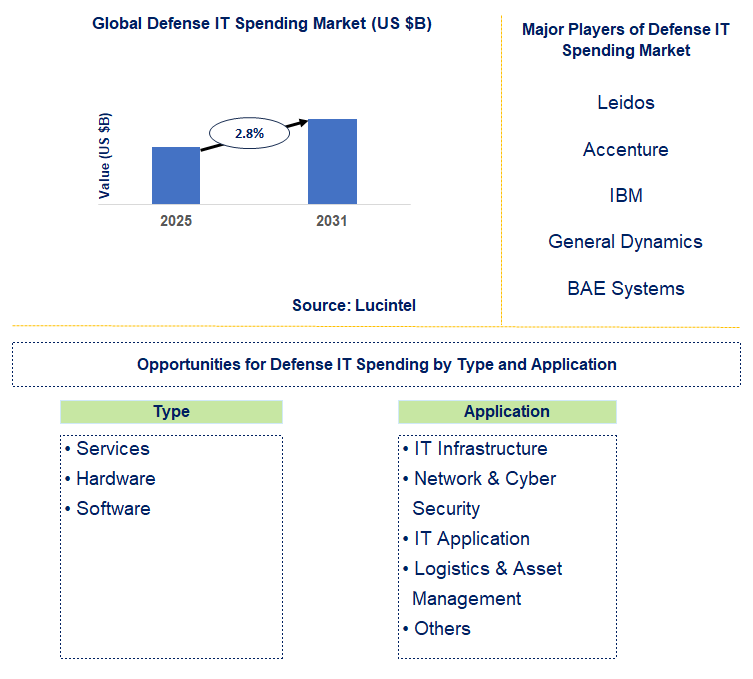
Key data points: The growth forecast = 2.8% annually for the next 7 years. Scroll below to get more insights. This market report covers Trends, opportunities and forecasts in defense IT spending market to 2031 by type (services, hardware, and software), application (IT infrastructure, network & cyber security, IT application, logistics & asset management, and others), and region (North America, Europe, Asia Pacific, and the Rest of the World)
We'll send your sample report shortly.
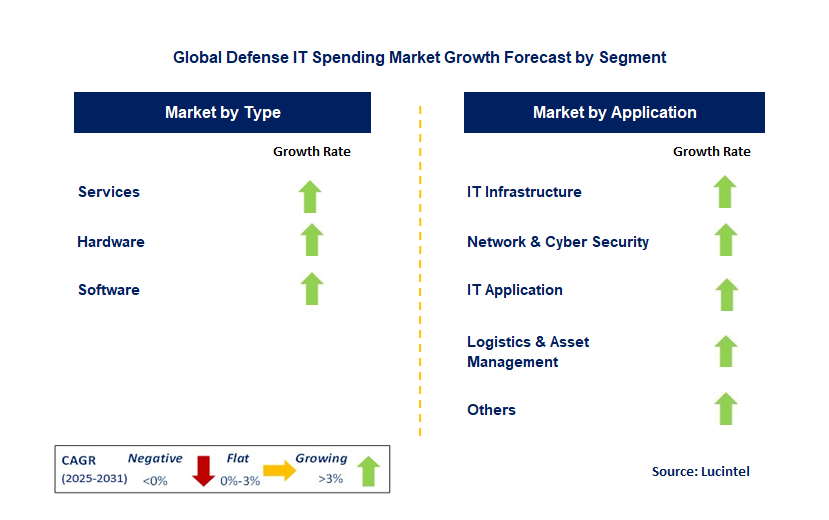
• Lucintel forecasts that, within the type category, software is expected to witness the highest growth over the forecast period.
• Within the application category, network & cyber security is expected to witness the highest growth.
• In terms of region, APAC is expected to witness the highest growth over the forecast period.
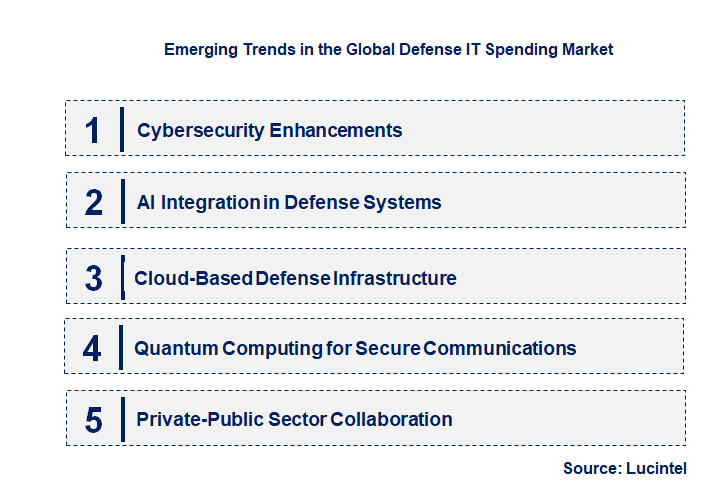
• Cybersecurity Enhancements: Governments are investing heavily in cybersecurity to protect military networks from cyber threats. Advanced threat detection systems, encryption technologies, and AI-driven cybersecurity frameworks are being implemented to strengthen national security. This trend ensures better protection of defense data and enhances operational resilience.
• AI Integration in Defense Systems: AI-powered analytics and autonomous systems are revolutionizing defense operations. Military forces are adopting AI for threat detection, decision-making, and predictive analytics. This trend enhances combat effectiveness and enables faster response times in dynamic warfare environments.
• Cloud-Based Defense Infrastructure: The adoption of cloud computing in defense IT is increasing, enabling secure data storage and real-time information sharing. Cloud-based defense systems enhance operational efficiency and improve coordination among military branches. This trend is crucial for modernizing military operations and ensuring seamless communication.
• Quantum Computing for Secure Communications: Quantum computing is emerging as a key trend in defense IT, providing advanced encryption methods for secure communication. Governments are investing in quantum research to develop unbreakable cryptographic systems. This trend enhances data security and ensures secure military communications.
• Private-Public Sector Collaboration: Governments are collaborating with private technology firms to develop advanced defense IT solutions. This trend is driving innovation in cybersecurity, AI, and cloud-based defense systems. Increased investment in public-private partnerships ensures rapid technological advancements and strengthens national defense capabilities. These trends are transforming the defense IT spending market, enhancing cybersecurity, operational efficiency, and military intelligence. As technology continues to evolve, defense IT investments will play a crucial role in modern warfare and national security.
• Expansion of AI-Based Defense Systems: Nations are increasing investments in AI-powered defense technologies to improve threat detection and autonomous operations. AI-driven analytics enhance decision-making processes and provide strategic advantages in military operations.
• Advancements in Cybersecurity Frameworks: Governments are strengthening cybersecurity frameworks to counter cyber threats and protect military networks. Investments in encryption technologies and AI-driven threat detection systems are improving cybersecurity resilience.
• Adoption of Cloud Computing in Defense Operations: Defense organizations are transitioning to cloud-based infrastructure to enhance data security and enable real-time information sharing. Cloud computing improves operational efficiency and ensures secure communication across military units.
• Development of Secure Communication Networks: Governments are investing in next-generation communication networks to ensure secure military transmissions. Advances in encryption technologies and quantum computing are playing a crucial role in enhancing secure communication capabilities.
• Increased Investment in Military IoT Systems: The integration of IoT in defense operations is gaining momentum, enabling real-time monitoring and automated decision-making. Military IoT systems enhance logistics, surveillance, and battlefield operations through connected devices and sensors. These key developments are driving innovation in the defense IT spending market. As technology continues to evolve, investments in AI, cybersecurity, and cloud computing will play a vital role in shaping modern defense strategies.
• Enhanced Cybersecurity Solutions: The growing threat of cyberattacks is creating opportunities for advanced cybersecurity solutions in defense operations. Governments are investing in AI-driven threat detection and blockchain-based security systems to strengthen national security.
• AI-Based Military Intelligence Systems: AI is transforming military intelligence by providing predictive analytics and automated decision-making capabilities. Investments in AI-powered surveillance and reconnaissance systems are enhancing defense capabilities and operational efficiency.
• Cloud-Based Data Management for Defense: The demand for secure and scalable cloud-based data management solutions is rising. Defense organizations are adopting cloud computing for efficient data storage, real-time communication, and secure information sharing.
• Quantum Encryption for Secure Defense Communications: Quantum encryption technology is emerging as a crucial solution for secure military communications. Governments are investing in quantum research to develop unbreakable cryptographic systems, ensuring data security and protection against cyber threats.
• Integration of IoT in Military Operations: The increasing use of IoT in defense applications is enhancing real-time monitoring, automation, and data-driven decision-making. Investments in connected defense systems are improving logistics, surveillance, and battlefield operations. These growth opportunities are shaping the future of the defense IT spending market. As nations invest in cybersecurity, AI, and quantum computing, digital transformation will continue to play a crucial role in modern defense strategies.
• Leidos
• Accenture
• IBM
• General Dynamics
• BAE Systems
• DXC
• Dell
• Northrop Grumman
• Unisys
• Atos
• Services
• Hardware
• Software
• It Infrastructure
• Network & Cyber Security
• It Application
• Logistics & Asset Management
• Others
• North America
• Europe
• Asia Pacific
• The Rest of the World
• United States: The United States is expanding its defense IT budget to enhance cybersecurity, artificial intelligence, and cloud computing integration. The Department of Defense is investing in next-generation command and control systems, aiming to improve interoperability across military branches. Recent initiatives also focus on strengthening cybersecurity defenses to counter cyber threats and safeguard critical defense infrastructure.
• China: China is accelerating its defense IT spending with a focus on AI, quantum computing, and network security. The government is prioritizing indigenous technology development to reduce reliance on foreign systems. Recent advancements include investments in AI-driven autonomous systems and the development of secure communication networks to enhance military intelligence and operational efficiency.
• Germany: Germany is modernizing its defense IT infrastructure by upgrading cybersecurity frameworks and adopting cloud-based solutions. The country is increasing collaboration between government and private defense firms to develop advanced digital warfare capabilities. Recent investments include secure communication networks and AI-powered defense analytics to enhance situational awareness and decision-making processes.
• India: India is focusing on strengthening its defense IT infrastructure through increased investments in cybersecurity and digital warfare capabilities. Government initiatives aim to develop indigenous defense technologies while enhancing secure communication networks. Recent advancements include the integration of AI in military operations and the implementation of blockchain-based security systems to protect critical defense data.
• Japan: Japan is enhancing its defense IT spending to fortify cybersecurity defenses and improve information-sharing capabilities. The government is investing in AI-driven threat detection systems and cloud-based defense networks. Recent developments include partnerships with private technology firms to enhance cybersecurity resilience and protect military infrastructure from cyber threats.


• Leidos
• Accenture
• IBM
• General Dynamics
• BAE Systems
• DXC
• Dell
• Northrop Grumman
• Unisys
• Atos Q5. Which defense IT spending market segment will be the largest in future? Answer: Lucintel forecasts that, within the type category, software is expected to witness the highest growth over the forecast period. Q6. In defense IT spending market, which region is expected to be the largest in next 5 years? Answer: In terms of region, APAC is expected to witness the highest growth over the forecast period. Q7. Do we receive customization in this report? Answer: Yes, Lucintel provides 10% customization without any additional cost.


Choose a license that fits your team. Instant PDF delivery.
Prices exclude taxes. Instant delivery. Custom licensing available on request.
Market Report · July 31, 2026
Market Report · July 31, 2026
Market Report · July 31, 2026
Trusted partner for strategic intelligence and business growth


Receive a complimentary market analysis tailored to your industry. Our analysts will identify key growth opportunities and competitive dynamics specific to your business.

Market size, growth rate, and key trend analysis for your specific sector.

Top competitor positioning and market share analysis.

Strategic recommendations backed by data-driven insights.
Get curated market intelligence and competitive moves straight to your inbox.
By subscribing, you agree to receive our monthly insights. Unsubscribe anytime.
Receive a complimentary market analysis tailored to your industry. Our analysts will identify key growth opportunities and competitive dynamics specific to your business.
Market size, growth rate, and key trend analysis for your specific sector.
Top competitor positioning and market share analysis.
Strategic recommendations backed by data-driven insights.
Get curated market intelligence, emerging trends, and competitive moves straight to your inbox each month.
By subscribing, you agree to receive our monthly insights. Unsubscribe anytime.
We'll send your sample report shortly.