
Market Report · May 18, 2026

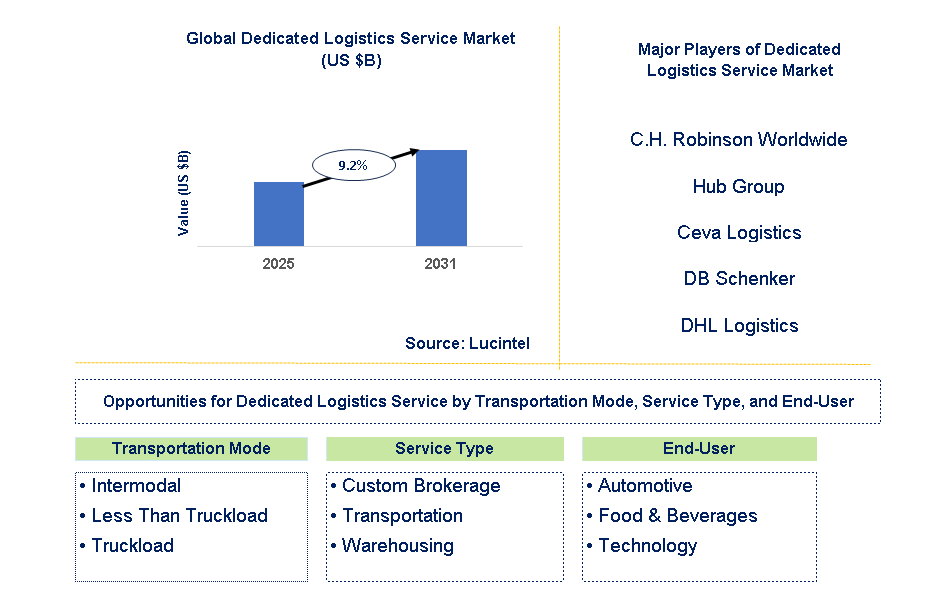
Key data points: The growth forecast = 9.2% annually for the next 7 years. Scroll below to get more insights. This market report covers Trends, opportunities and forecasts in dedicated logistics service market to 2031 by transportation mode (intermodal, less than truckload, and truckload), service type (custom brokerage, transportation, and warehousing), end use (automotive, food & beverages, and technology), and region (North America, Europe, Asia Pacific, and the Rest of the World)
We'll send your sample report shortly.
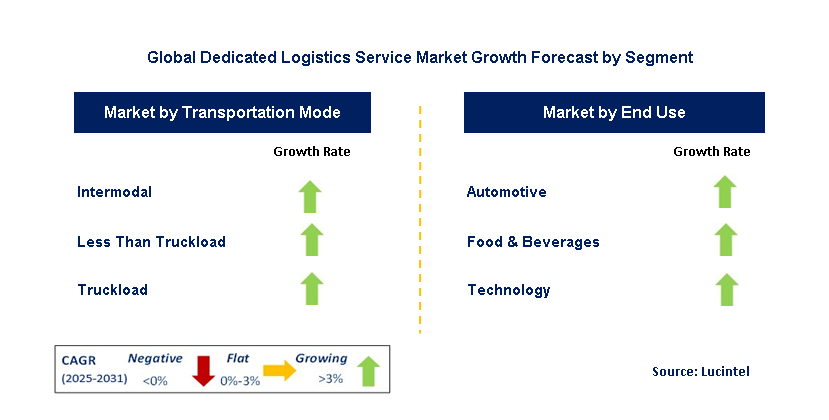
• Lucintel forecasts that, within the transportation mode category, intermodal is expected to witness the highest growth over the forecast period.
• Within the end use category, automotive will remain the largest segment due to growing need for specialized handling of parts & components.
• In terms of region, APAC will remain the largest region over the forecast period due to rapid industrialization, the expanding trade networks, and significant infrastructure investments in this region.
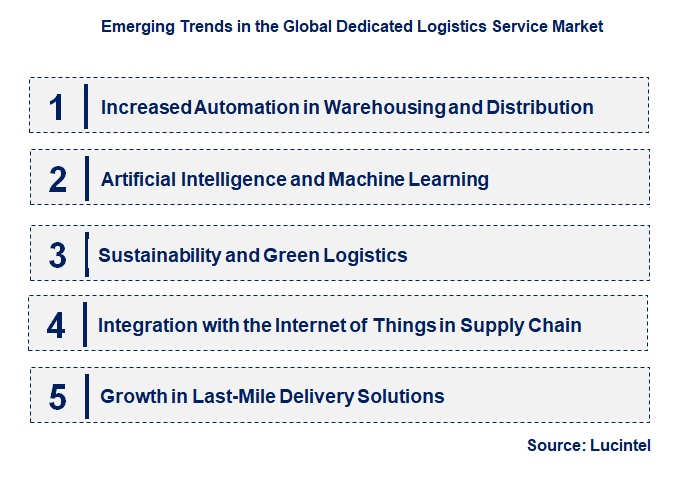
• Increased Automation in Warehousing and Distribution: Warehousing and distribution techniques have gained increased automation in them. With the help of robotics, autonomous vehicles, automated sorting systems, and many other technologies, these processes are now simplified and less error-prone. Increased efficiency not only enables them but also improves accuracy and cuts cost. With the boost of demand due to e-commerce and global trade, such aspects of automation are essential for meeting the demand for faster services.
• Artificial Intelligence and Machine Learning: Artificial intelligence (AI) and machine learning (ML) are becoming integral to dedicated logistics services. These technologies enable logistics providers to optimize supply chain operations, predict demand, and make data-driven decisions. AI-powered algorithms are used to improve route planning, inventory management, and warehouse operations, enhancing overall efficiency. The use of AI and ML is helping businesses reduce operational costs while improving service quality.
• Sustainability and Green Logistics: With increasing pressures to reduce the impact on the environment, more companies engaged in logistics have been implementing the concept of sustainability into their respective operations. This includes introducing electric cars, energy-efficient warehouses, and green packaging solutions. As companies and consumers request for eco-friendly practices, dedicated logistics service providers are investing in sustainable solutions to reduce their carbon footprint. Sustainability is now becoming a critical competitive advantage in the logistics market that compels companies to innovate, as it reduces environmental impact.
• Integration with the Internet of Things in Supply Chain: IoT integration into supply chain management helps in revolutionizing logistics. IoT-capable devices, sensors, and tracking machines provide real-time visibility of products in stock, shipments, and machinery performance. Logistics service providers can thus track and optimize how their operations run for almost zero delay and enhanced security when fueled by IoT. IoT, therefore, is driving efficiency and enhancing customer experience based on smarter supply chain management.
• Growth in Last-Mile Delivery Solutions: As e-commerce grows, demand for last-mile delivery solutions will continue to increase. Companies have adopted dedicated logistics services to boost the speed and reliability of last-mile delivery. This involves drones, autonomous vehicles, and local distribution hubs for shorter delivery time and lower cost. As the consumers are asking for faster delivery, last-mile logistics has been the focal area for companies who want to keep pace with their competitors. Emerging trends are transforming the dedicated logistics service market. Automation, AI, sustainability, IoT, and last-mile delivery solutions are some of the factors driving change in the market. These innovations allow logistics providers to be more efficient, reduce costs, and meet the increasing demands of consumers and businesses alike. As these trends continue to evolve, they will reshape the logistics industry, making it more efficient, responsive, and sustainable.
• Automation and Robotics: The dedicated logistics service market has made automation a significant focus. Companies are introducing robotics and automated systems in warehouses and distribution centers to improve operational efficiency. These technologies allow for quicker sorting, packing, and inventory management, saving labor costs and reducing errors. Automation also makes it easier to scale up operations, which enables logistics providers to meet growing demand while improving the delivery of service.
• Expansion in E-Commerce Logistics Services: With the explosive rise of e-commerce, the pressure for specialized services has increased with the demand to manage high volumes of small shipment. Companies require dedicated logistics companies that can come up with flexible solutions to solve the complexity related to managing their high volumes. Logistics companies will improve their expertise by providing solutions in advanced warehousing, order fulfillment, and last-mile delivery. The attention is on how fast, accurately, and with flexibility, delivery can be affected to meet shoppers' expectations over the internet.
• Data Analytics Integration for Optimization: The integration of data analytics is helping logistics companies optimize their operations. Logistics providers can improve route planning, inventory management, and demand forecasting by analyzing data from various sources, including IoT sensors, tracking systems, and customer feedback. This data-driven approach enhances supply chain efficiency, reduces costs, and improves customer satisfaction by providing more accurate delivery estimates and personalized services.
• Multimodal Transportation Solutions Growth: Dedicated logistics service providers are increasingly adopting multimodal transportation solutions, which combine different modes of transport, such as rail, road, air, and sea, to optimize efficiency and reduce costs. It is more flexible, cost-effective, and sustainable. By integrating multimodal solutions into their offerings, logistics providers can better serve industries that require complex transportation networks and meet the growing demand for fast, reliable deliveries.
• Sustainability and Green Logistics: Sustainability is the new buzzword for the dedicated logistics service market. Logistics companies are going green; using electric vehicles, route optimization to reduce fuel consumption, green warehouses, and sustainable packaging materials. Companies are also focusing on reduction in waste in every step of the supply chain. This helps companies in meeting statutory regulations but also lets environmentally sensitive consumers and businesses clamor for it. These advancements are shaping the dedicated logistics service market through the drive of automation, e-commerce logistics, data optimization, multimodal transportation, and sustainability. These developments will help logistics service providers to come up with even more efficient, flexible, and sustainable solutions to meet the dynamic demands of the customers and the industries. In the future of the logistics industry, these technologies will continue to evolve.
• E-Commerce Fulfillment Services: The fast growth in e-commerce and online shopping has created a huge growth opportunity for logistics services that are especially dedicated to this business. Logistics providers are now offering customized solutions to handle inventory management, order fulfillment, and last-mile delivery to ensure timely and efficient service. Partnering with companies in the e-commerce industry enables logistics providers to focus on more of these growing demands for fast and accurate deliveries and improved customer experiences.
• Pharmaceutical and Healthcare Logistics: The pharmaceutical and healthcare industries demand very specialized logistics solutions for the transportation of temperature-sensitive and time-critical products. Dedicated logistics services are necessary to ensure safe and efficient delivery of medicines, medical devices, and equipment. Logistics providers can take advantage of the growing demand for healthcare logistics services by offering specialized handling, tracking, and security measures.
• Automotive Logistics Solutions: The automobile industry needs very complex, global logistics solutions in terms of part and finished vehicle transportation. Dedicated logistics services may help support the demand by providing inventory management, supply chain optimization, and transportation with tailored solutions that cater to the specific needs of the automobile industry. Thus, logistics service providers can aid automobile manufacturers in streamlining their supply chains and cutting costs.
• Cold Chain Logistics: Cold chain logistics, which includes the transportation of temperature-sensitive goods, is one of the major growth opportunities for dedicated logistics providers. With an increasing demand for perishable goods, such as food and pharmaceuticals, companies are looking for specialized logistics solutions to ensure safe and efficient delivery of products. By offering cold storage, tracking systems, and temperature-controlled transportation, logistics providers can meet the growing demand for cold chain solutions.
• Last-Mile Delivery Innovation: Last-mile delivery is an important area of emphasis for logistics service providers that wish to expand their service portfolios. Logistics companies can increase delivery speeds, lower costs, and respond to consumer demand for fast and reliable service through innovative solutions like drones, autonomous vehicles, and local distribution hubs. Significant growth opportunities in the dedicated logistics service market exist through the demand for efficient last-mile solutions. With growth opportunities across e-commerce fulfillment, healthcare logistics, automotive logistics, cold chain logistics, and last-mile delivery innovation, these are the primary drivers of growth for the dedicated logistics service market. As businesses continue to require customized solutions addressing specific supply chain needs, opportunities will shape future logistics services while fostering innovation in improving overall efficiency.
• C.H. Robinson Worldwide
• Hub Group
• Ceva Logistics
• DB Schenker
• DHL Logistics
• Expeditors International of Washington
• Fedex Corporation
• Intermodal
• Less Than Truckload
• Truckload
• Custom Brokerage
• Transportation
• Warehousing
• North America
• Europe
• Asia Pacific
• The Rest of the World
• United States: Dedicated logistics service market in the United States has gained considerably high; consequently, more and more companies will opt for advanced technologies to streamline supply chain activities. E-commerce has catapulted the demand for bespoke logistics solutions, most visibly last mile. Businesses are also applying automation and data analytics to improve inventory management, route optimization, and operational efficiency. The big boys of logistics companies like XPO Logistics and UPS are also investing in innovations such as robotics, artificial intelligence, and cloud-based platforms in order to give more bespoke services that cater to industry-specific needs.
• China: China's dedicated logistics service market is growing fast with the growth of the country's massive e-commerce sector and rising industrialization. Companies are adopting customized logistics solutions to improve their supply chain capabilities, particularly in the automotive, electronics, and consumer goods industries. Government support for infrastructure development, such as the Belt and Road Initiative, has also helped improve transportation networks, which in turn has contributed to the DLS market. The integration of smart technologies, such as AI and the Internet of Things (IoT), is helping logistics providers offer more efficient and responsive services to meet the increasing demands of consumers and industries.
• Germany: Germany's DLS market is growing, especially in sectors like automotive, manufacturing, and pharmaceuticals. German logistics providers focus on precision, efficiency, and quality, thus embracing innovative solutions, like automation, robotics, and data analytics, that optimize supply chain performance. Due to its central location in Europe, this country is a prime logistics hub for international logistics, which further fuels dedicated logistics services. Deutsche Post DHL Group addresses this by ensuring sustainable operations and digital solutions that enhance efficiency and reduce environmental impacts. Germany is a leading player in the DLS market, with high-quality logistics services and infrastructure.
• India: Dedicated logistics service is growing rapidly in India, influenced by the booming e-commerce industry, increasing industrialization, and government initiatives like the "Make in India" campaign. Business houses are opting for dedicated logistics providers to help them streamline operations by offering tailored solutions for managing transportation, warehousing, and inventory. Growth in retail, pharmaceuticals, and automotive industries is driving the demand for logistics services in India. Moreover, investments in infrastructure in the form of highways, ports, and rail networks are enhancing the overall efficiency of logistics services, which are contributing to the growth of the market.
• Japan: The dedicated logistics service market in Japan is growing, with companies taking on innovative solutions in logistics as an aging population and labor shortages raise the pressure on efficiency in supply chain management. Logistics service providers are targeting automation, robotics, and AI as a solution to these challenges and improve productivity. Japan has an advanced technological infrastructure and strong manufacturing sector that demand dedicated logistics services. Additionally, with a growing emphasis on sustainability, many Japanese logistics companies are integrating green practices, such as electric vehicles and energy-efficient warehouses, into their operations to meet environmental goals.


• C.H. Robinson Worldwide
• Hub Group
• Ceva Logistics
• DB Schenker
• DHL Logistics
• Expeditors International of Washington
• Fedex Corporation Q5. Which dedicated logistics service market segment will be the largest in future? Answer: Lucintel forecasts that, within the transportation mode category, intermodal is expected to witness the highest growth over the forecast period. Q6. In dedicated logistics service market, which region is expected to be the largest in next 5 years? Answer: In terms of region, APAC will remain the largest region over the forecast period due to rapid industrialization, the expanding trade networks, and significant infrastructure investments in this region. Q7. Do we receive customization in this report? Answer: Yes, Lucintel provides 10% customization without any additional cost.


Choose a license that fits your team. Instant PDF delivery.
Prices exclude taxes. Instant delivery. Custom licensing available on request.
Market Report · May 18, 2026
Market Report · May 18, 2026
Market Report · May 18, 2026
Trusted partner for strategic intelligence and business growth


Receive a complimentary market analysis tailored to your industry. Our analysts will identify key growth opportunities and competitive dynamics specific to your business.

Market size, growth rate, and key trend analysis for your specific sector.

Top competitor positioning and market share analysis.

Strategic recommendations backed by data-driven insights.
Get curated market intelligence and competitive moves straight to your inbox.
By subscribing, you agree to receive our monthly insights. Unsubscribe anytime.
Receive a complimentary market analysis tailored to your industry. Our analysts will identify key growth opportunities and competitive dynamics specific to your business.
Market size, growth rate, and key trend analysis for your specific sector.
Top competitor positioning and market share analysis.
Strategic recommendations backed by data-driven insights.
Get curated market intelligence, emerging trends, and competitive moves straight to your inbox each month.
By subscribing, you agree to receive our monthly insights. Unsubscribe anytime.
We'll send your sample report shortly.