
Decorative Flat Glass Market Trends and Forecast
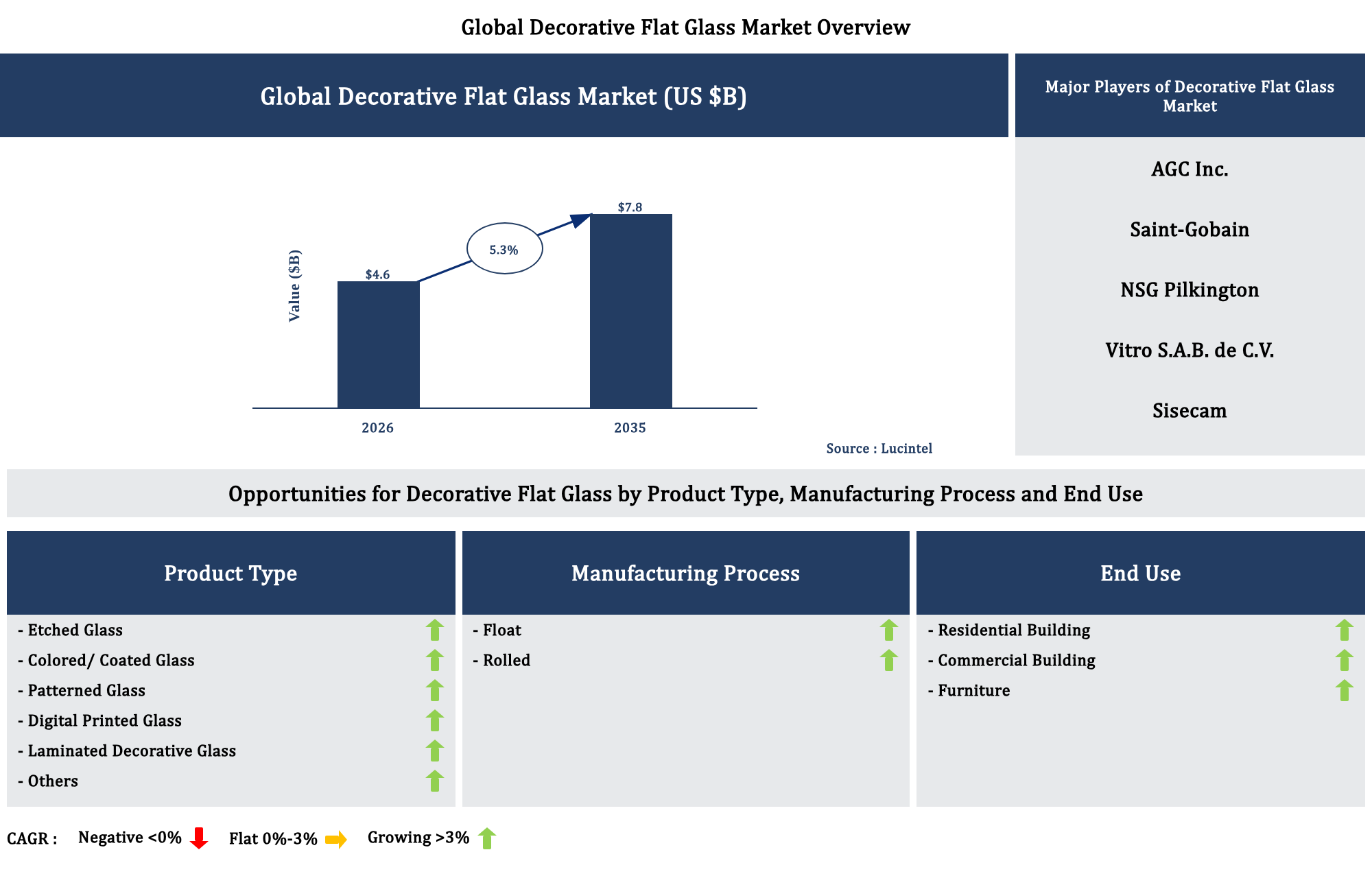
The future of the global decorative flat glass market looks promising with opportunities in the residential building, commercial building, and furniture markets. The global decorative flat glass market is expected to reach an estimated $7,865 million by 2035 with a CAGR of 5.3% from 2026 to 2035. The major drivers for this market are the increasing use in furniture & partitions, the growing need for modern interior design, and the rising popularity of aesthetic glass décor.
• Lucintel forecasts that, within the product type category, laminated decorative glass is expected to witness higher growth over the forecast period.
• Within the end use category, residential building is expected to witness the highest growth.
• In terms of region, APAC is expected to witness the highest growth over the forecast period.
Gain valuable insights for your business decisions with our comprehensive 150+ page report. Sample figures with some insights are shown below.
Emerging Trends in the Decorative Flat Glass Market
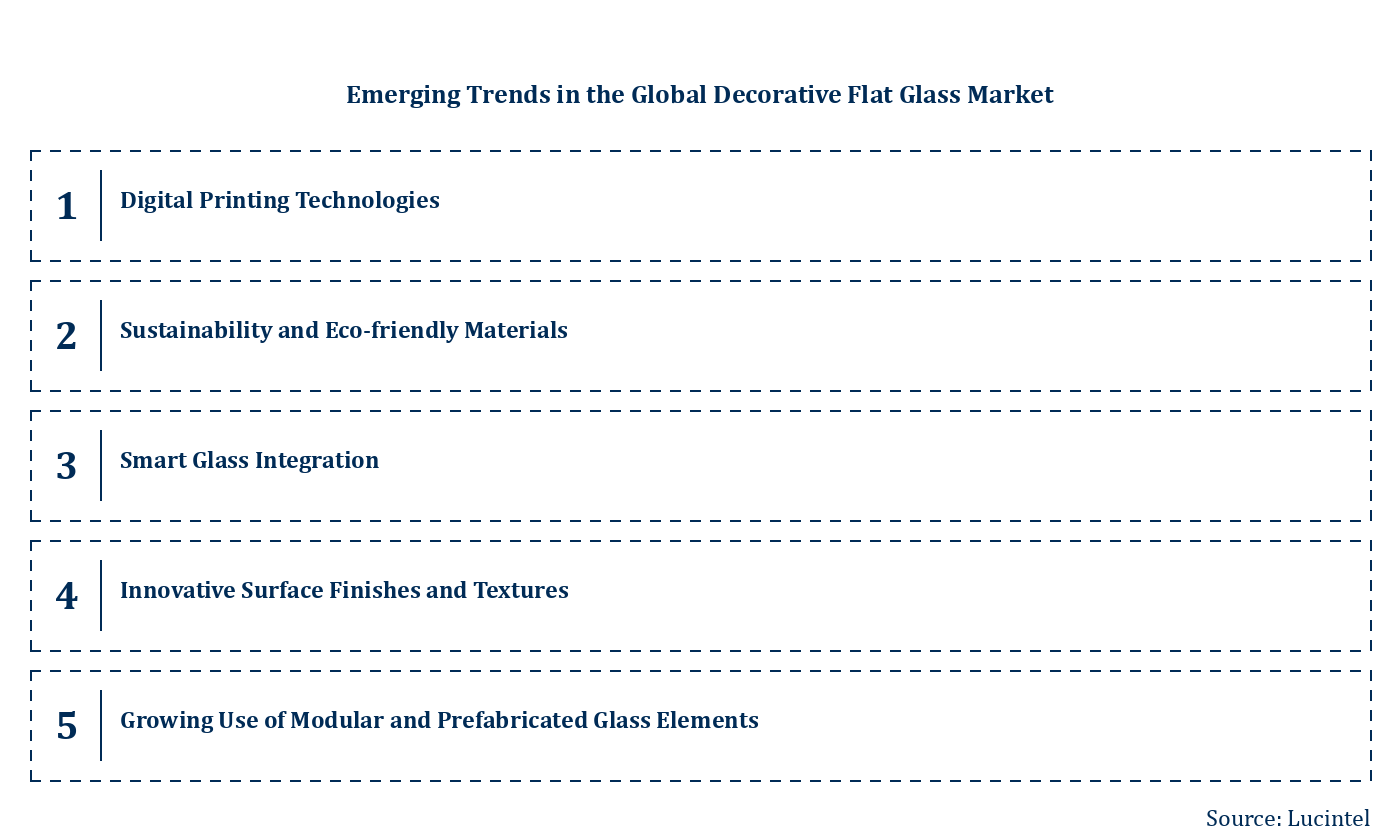
The decorative flat glass market is experiencing rapid evolution driven by technological advancements, changing consumer preferences, and sustainability initiatives. As architects, designers, and homeowners seek innovative and aesthetically appealing solutions, the market is adapting to meet these demands. Emerging trends are shaping the future landscape, influencing product development, manufacturing processes, and market strategies. These developments are not only enhancing the visual appeal and functionality of glass products but also promoting eco-friendly practices. Understanding these key trends is essential for stakeholders aiming to stay competitive and capitalize on new opportunities in this dynamic industry.
• Digital Printing Technologies: The adoption of digital printing in decorative flat glass allows for highly customized and intricate designs. This technology enables manufacturers to produce detailed patterns, images, and textures directly onto glass surfaces, offering clients personalized options. It reduces production time and costs compared to traditional methods, making bespoke designs more accessible. As digital printing advances, the market benefits from increased versatility, enabling innovative applications in interior and exterior decor, thus expanding market reach and customer satisfaction.
• Sustainability and Eco-Friendly Materials: Growing environmental concerns are pushing the market toward sustainable practices. Manufacturers are increasingly using eco-friendly raw materials, such as recycled glass and low-emission coatings. Energy-efficient production processes and the development of recyclable decorative glass products are gaining prominence. These initiatives not only reduce the carbon footprint but also appeal to environmentally conscious consumers. The shift toward sustainability is reshaping product offerings and encouraging industry-wide adoption of green practices, aligning market growth with global environmental goals.
• Smart Glass Integration: The integration of smart glass technologies into decorative flat glass is a significant trend. These glasses can change transparency, color, or opacity with electrical stimuli, offering dynamic aesthetic and functional benefits. Applications include privacy control, mood lighting, and energy efficiency in buildings. The incorporation of smart features enhances user experience and adds value to decorative glass products. As technology becomes more affordable and reliable, smart glass is poised to revolutionize interior design and architectural applications, creating new market segments and opportunities.
• Innovative Surface Finishes and Textures: The market is witnessing a surge in unique surface finishes and textures, such as frosted, etched, and 3D patterns. These finishes add depth, tactile appeal, and visual interest to glass surfaces, catering to modern design trends. Advances in manufacturing techniques enable the creation of complex textures that enhance aesthetic appeal and functionality, such as glare reduction or increased privacy. This trend allows designers to customize spaces more effectively, driving demand for decorative glass with distinctive surface treatments across residential, commercial, and hospitality sectors.
• Growing Use of Modular and Prefabricated Glass Elements: The demand for modular and prefabricated decorative glass components is increasing due to the construction industry‘s focus on efficiency and cost-effectiveness. These ready-to-install elements facilitate faster project completion and ensure consistent quality. They are used in partitions, facades, and interior decor, offering flexibility and design consistency. The trend supports sustainable construction practices by reducing waste and labor costs. As the market shifts toward modular solutions, manufacturers are innovating to develop versatile, easy-to-handle glass products that meet diverse architectural needs.
These emerging trends are fundamentally transforming the decorative flat glass market by enhancing customization, sustainability, technological integration, and manufacturing efficiency. They are enabling the industry to meet evolving aesthetic and functional demands while aligning with environmental and technological advancements. As a result, the market is becoming more innovative, sustainable, and responsive to customer needs, paving the way for continued growth and diversification.
Recent Developments in the Decorative Flat Glass Market
The decorative flat glass market is experiencing rapid growth driven by technological advancements, increasing demand in architecture and interior design, and a shift towards sustainable building materials. Innovations in manufacturing processes and design versatility are expanding applications across commercial, residential, and decorative sectors. Market players are focusing on eco-friendly solutions and customization options to meet evolving consumer preferences. These developments are reshaping the industry landscape, creating new opportunities for growth and competition, and influencing global market dynamics significantly.
• Growing Demand for Aesthetic and Functional Glass Solutions: The increasing preference for visually appealing and durable glass in architecture and interior design is boosting market growth. Consumers and designers seek innovative, customizable, and sustainable glass options, which are driving manufacturers to develop advanced coatings, textures, and finishes. This trend enhances the market’s scope, encouraging product diversification and expanding applications across various sectors, ultimately leading to higher adoption rates and revenue growth.
• Technological Innovations in Manufacturing Processes: Advances such as automated cutting, tempering, and coating technologies are improving efficiency and quality in glass production. These innovations reduce costs, minimize waste, and enable the creation of complex, high-performance decorative glass products. As a result, manufacturers can meet increasing demand for bespoke designs and eco-friendly options, strengthening their competitive edge and expanding market share in both domestic and international markets.
• Rising Adoption in Architectural and Interior Applications: Decorative flat glass is increasingly used in facades, partitions, and interior décor, driven by urbanization and modernization trends. Its versatility, aesthetic appeal, and functional benefits like insulation and safety features make it a preferred choice for architects and designers. This growing adoption is fueling market expansion, encouraging innovation in design and functionality, and opening new avenues for manufacturers to cater to diverse project requirements.
• Focus on Sustainable and Eco-Friendly Glass Solutions: The shift towards environmentally sustainable building materials is influencing the market significantly. Manufacturers are developing recyclable, energy-efficient, and low-emission glass products to meet regulatory standards and consumer preferences. This focus on sustainability not only enhances brand reputation but also opens up new market segments, including green building certifications, thereby driving overall market growth and encouraging eco-conscious innovation.
• Expansion of Applications in Commercial and Residential Sectors: The increasing use of decorative flat glass in retail spaces, offices, and homes is a key growth driver. Its ability to combine aesthetics with functionality, such as privacy and light control, makes it highly desirable. Market players are investing in product development tailored to these sectors, which boosts demand and broadens the market scope. This expansion supports sustained growth, diversification of product offerings, and increased competitiveness across the industry.
The overall impact of these developments is a dynamic, innovative market characterized by increased product diversity, sustainability focus, and expanding application areas. These factors are driving growth, attracting new entrants, and reshaping competitive strategies, ultimately leading to a more robust and resilient decorative flat glass industry.
Strategic Growth Opportunities in the Decorative Flat Glass Market
The decorative flat glass market is experiencing rapid expansion driven by increasing demand in architectural, interior design, and automotive sectors. Innovations in manufacturing, sustainable materials, and customization options are creating new opportunities for growth. Market players are focusing on technological advancements and strategic collaborations to capture emerging segments. As consumer preferences shift towards aesthetic and functional enhancements, the market‘s potential for innovation and expansion continues to grow, promising significant revenue opportunities and competitive advantages for industry stakeholders.
• Growing Demand for Customized and Patterned Glass: The increasing preference for personalized and decorative glass solutions in residential and commercial spaces is fueling market growth. Consumers and designers seek unique patterns, textures, and finishes to enhance aesthetic appeal. Manufacturers are investing in advanced printing and etching technologies to meet these demands, expanding product portfolios. This trend is expected to drive innovation, increase sales, and open new avenues in interior design, retail, and hospitality sectors.
• Expansion of Architectural Applications in Commercial Buildings: The rising adoption of decorative flat glass in commercial architecture is a key growth driver. It is used for facades, interior partitions, and skylights, offering aesthetic appeal combined with energy efficiency. Developers and architects prefer glass that provides both visual impact and functional benefits like insulation and daylighting. This trend encourages manufacturers to develop innovative, sustainable, and high-performance glass products, boosting market revenue and broadening application scopes.
• Technological Advancements in Manufacturing Processes: Innovations such as digital printing, laser etching, and chemical treatments are transforming the decorative flat glass industry. These technologies enable intricate designs, high durability, and cost-effective production. As manufacturers adopt automation and eco-friendly processes, product quality and customization capabilities improve. This enhances competitiveness and allows for the creation of complex, high-value designs, thereby expanding market reach and meeting diverse customer needs across various sectors.
• Rising Focus on Sustainable and Energy-Efficient Glass Solutions: Environmental concerns and energy regulations are prompting demand for eco-friendly decorative glass options. Manufacturers are developing low-emissivity coatings, recycled glass products, and energy-efficient designs that reduce carbon footprint. These sustainable solutions appeal to environmentally conscious consumers and builders. The integration of green technologies not only supports regulatory compliance but also enhances brand reputation, driving market growth and encouraging innovation in sustainable decorative flat glass products.
• Increasing Adoption in Automotive and Transportation Sectors: Decorative flat glass is gaining traction in automotive interiors and transportation applications for aesthetic and functional purposes. It is used for sunroofs, interior panels, and display screens, offering customization and enhanced user experience. Advances in lightweight, shatterproof, and UV-protective glass materials are expanding its use. This diversification into automotive markets presents new revenue streams, encourages technological innovation, and supports overall market growth through increased application diversity.
The overall market outlook is positively influenced by these growth opportunities, promising increased innovation, sustainability, and application diversity. As industry players capitalize on these trends, the decorative flat glass market is poised for substantial expansion, benefiting from technological progress and evolving consumer preferences. This dynamic environment fosters competitive advantages and long-term growth prospects for stakeholders across sectors.
Decorative Flat Glass Market Driver and Challenges
The decorative flat glass market is influenced by a variety of technological, economic, and regulatory factors that shape its growth trajectory. Innovations in manufacturing processes, increasing demand for aesthetic and functional building materials, and evolving safety standards are key drivers. Economic conditions such as urbanization and infrastructure development further propel market expansion. Conversely, regulatory challenges related to environmental sustainability and material safety pose hurdles. Market players must navigate these complex dynamics to capitalize on opportunities while addressing potential risks. Understanding these drivers and challenges is essential for strategic planning and sustainable growth in the competitive landscape of decorative flat glass.
The factors responsible for driving the decorative flat glass market include:-
• Technological Advancements: The development of innovative manufacturing techniques, such as low-emissivity coatings and digital printing, has significantly enhanced the aesthetic and functional qualities of decorative flat glass. These advancements enable customization, improve energy efficiency, and reduce production costs, making the products more attractive to architects and interior designers. As technology continues to evolve, the market benefits from increased product diversity and improved performance, fueling demand across residential, commercial, and industrial sectors.
• Growing Construction and Infrastructure Development: Rapid urbanization and infrastructure projects worldwide are driving demand for decorative flat glass. Modern buildings increasingly incorporate large glass facades, decorative partitions, and interior glass features to enhance aesthetics and natural lighting. The expansion of commercial spaces, hotels, and retail outlets further boosts market growth. Governments‘ investments in smart cities and sustainable infrastructure also promote the adoption of energy-efficient and visually appealing glass solutions, creating a robust market environment.
• Rising Consumer Preference for Aesthetic and Customizable Designs: Consumers and designers are increasingly seeking personalized and visually striking glass solutions. The ability to customize patterns, colors, and finishes allows for unique interior and exterior designs, elevating the appeal of decorative flat glass. This trend is driven by a desire for distinctive spaces and the influence of modern architectural styles. As aesthetic considerations become paramount, manufacturers are innovating to meet these demands, thereby expanding market opportunities.
• Environmental Regulations and Sustainability Initiatives: Stringent environmental policies and a global push towards sustainability influence the market significantly. Manufacturers are adopting eco-friendly production processes, using recyclable materials, and developing energy-efficient glass products. These initiatives not only comply with regulations but also appeal to environmentally conscious consumers and businesses. The shift towards green building certifications, such as LEED, encourages the use of sustainable decorative glass, fostering market growth while addressing ecological concerns.
The challenges in the decorative flat glass market are:
• Fluctuating Raw Material Prices: The market heavily depends on raw materials like silica sand, soda ash, and other chemicals, whose prices are subject to volatility due to geopolitical tensions, supply chain disruptions, and environmental regulations. Rising costs can impact profit margins and lead to increased product prices, potentially reducing competitiveness. Manufacturers must manage procurement strategies carefully to mitigate these risks and maintain market stability.
• Stringent Regulatory Standards: Increasing safety, environmental, and quality standards impose compliance burdens on manufacturers. Regulations related to chemical emissions, energy consumption, and product safety require continuous adaptation and investment in R&D. Non-compliance can result in legal penalties, product recalls, and damage to brand reputation, posing significant challenges for market participants to innovate within regulatory frameworks.
• High Competition and Market Fragmentation: The market is highly competitive with numerous regional and international players. This fragmentation leads to price wars, reduced profit margins, and the constant need for innovation. Smaller firms often struggle to keep pace with technological advancements and regulatory requirements, risking market share loss. Consolidation and strategic alliances are common responses, but intense competition remains a persistent challenge for sustainable growth.
The decorative flat glass market is shaped by technological innovations, increasing construction activities, consumer preferences, and sustainability initiatives, which collectively drive growth. However, raw material price fluctuations, regulatory compliance, and intense competition pose significant challenges. Navigating these factors requires strategic agility and innovation. Overall, the market‘s future depends on balancing these drivers and challenges to foster sustainable development and capitalize on emerging opportunities.
List of Decorative Flat Glass Companies
Companies in the market compete on the basis of product quality offered. Major players in this market focus on expanding their manufacturing facilities, R&D investments, infrastructural development, and leverage integration opportunities across the value chain. With these strategies decorative flat glass companies cater increasing demand, ensure competitive effectiveness, develop innovative products & technologies, reduce production costs, and expand their customer base. Some of the decorative flat glass companies profiled in this report include-
• AGC Inc.
• Saint-Gobain
• NSG Pilkington
• Vitro S.A.B. de C.V.
• Sisecam
• Guardian Industries
• S. A. Bendheim Co., Inc.
Decorative Flat Glass Market by Segment
The study includes a forecast for the global decorative flat glass market by product type, manufacturing process, end use, and region.
Decorative Flat Glass Market by Product Type [Value from 2019 to 2035]:
• Etched Glass
• Colored/ Coated Glass
• Patterned Glass
• Digital Printed Glass
• Laminated Decorative Glass
• Others
Decorative Flat Glass Market by Manufacturing Process [Value from 2019 to 2035]:
• Float
• Rolled
Decorative Flat Glass Market by End Use [Value from 2019 to 2035]:
• Residential Building
• Commercial Building
• Furniture
Decorative Flat Glass Market by Region [Value from 2019 to 2035]:
• North America
• Europe
• Asia Pacific
• The Rest of the World
Country Wise Outlook for the Decorative Flat Glass Market
The decorative flat glass market has experienced significant growth driven by increasing demand for aesthetic and functional glass solutions across various industries. Innovations in manufacturing, sustainability initiatives, and expanding applications in architecture, interior design, and automotive sectors have shaped recent trends. Countries are adopting new technologies and standards to enhance product quality and environmental impact. The competitive landscape is evolving with new entrants and collaborations, reflecting a dynamic global market. These developments are influencing supply chains, pricing, and consumer preferences, making the market more innovative and responsive to emerging needs.
• United States: The U.S. market has seen a surge in demand for energy-efficient and eco-friendly decorative flat glass, driven by stringent environmental regulations and consumer preferences. Technological advancements in coating and lamination techniques have improved product durability and aesthetics. The growth of the construction and automotive sectors has further boosted market expansion. Companies are investing in R&D to develop smart glass solutions with enhanced functionalities such as UV protection and self-cleaning features. Additionally, the adoption of sustainable manufacturing practices is gaining momentum, aligning with green building standards.
• China: China remains the largest market for decorative flat glass, with rapid urbanization and infrastructure development fueling demand. Innovations in low-emissivity and reflective coatings have enhanced product performance. The country is witnessing increased production capacity and technological upgrades to meet international quality standards. Domestic manufacturers are expanding their product portfolios to include customized and high-end decorative glass. Government initiatives promoting green building materials and sustainable construction practices are also supporting market growth. Export opportunities are expanding as Chinese manufacturers improve quality and design capabilities.
• Germany: Germany‘s market is characterized by a focus on high-quality, innovative decorative flat glass solutions, driven by strict EU regulations and sustainability goals. The adoption of energy-efficient and environmentally friendly products is prominent in architectural applications. German companies are investing in advanced manufacturing technologies, including automation and digital printing, to offer customized designs. The emphasis on eco-certifications and sustainable sourcing is shaping product development. The market also benefits from a strong automotive sector, which demands specialized decorative glass for vehicle interiors. Collaboration with research institutions is fostering innovation in functional and aesthetic glass products.
• India: The Indian decorative flat glass market is experiencing rapid growth due to urbanization, infrastructure development, and increasing disposable incomes. The demand for aesthetically appealing and affordable glass solutions is rising in residential and commercial projects. Local manufacturers are adopting new technologies to improve product quality and variety. The government’s focus on affordable housing and smart city initiatives is further boosting demand. Additionally, the market is witnessing a shift towards sustainable and energy-efficient glass products, driven by environmental awareness. The expansion of retail and hospitality sectors is also contributing to increased consumption of decorative glass.
• Japan: Japan‘s market emphasizes high-performance, durable, and innovative decorative flat glass, driven by technological advancements and aesthetic preferences. The country is investing in smart glass and energy-efficient solutions to meet stringent environmental standards. Japanese manufacturers are integrating cutting-edge technologies such as digital printing and surface treatments to offer unique designs. The automotive and architectural sectors are key drivers, with a focus on safety, functionality, and aesthetics. Sustainability practices, including recycling and eco-friendly production, are integral to market growth. The demand for customized and high-end decorative glass continues to rise, supported by a mature consumer base and advanced manufacturing capabilities.
Features of the Global Decorative Flat Glass Market
Market Size Estimates: Decorative flat glass market size estimation in terms of value ($M).
Trend and Forecast Analysis: Market trends (2019 to 2025) and forecast (2026 to 2035) by various segments and regions.
Segmentation Analysis: Decorative flat glass market size by product type, manufacturing process, end use, and region in terms of value ($M).
Regional Analysis: Decorative flat glass market breakdown by North America, Europe, Asia Pacific, and Rest of the World.
Growth Opportunities: Analysis of growth opportunities in different product type, manufacturing process, end use, and regions for the decorative flat glass market.
Strategic Analysis: This includes M&A, new product development, and competitive landscape of the decorative flat glass market.
Analysis of competitive intensity of the industry based on Porter’s Five Forces model.
FAQ
Q1. What is the decorative flat glass market size?
Answer: The global decorative flat glass market is expected to reach an estimated $7,865 million by 2035.
Q2. What is the growth forecast for decorative flat glass market?
Answer: The global decorative flat glass market is expected to grow with a CAGR of 5.3% from 2026 to 2035.
Q3. What are the major drivers influencing the growth of the decorative flat glass market?
Answer: The major drivers for this market are the increasing use in furniture & partitions, the growing need for modern interior design, and the rising popularity of aesthetic glass décor.
Q4. What are the major segments for decorative flat glass market?
Answer: The future of the decorative flat glass market looks promising with opportunities in the residential building, commercial building, and furniture markets.
Q5. Who are the key decorative flat glass market companies?
Answer: Some of the key decorative flat glass companies are as follows:
• AGC Inc.
• Saint-Gobain
• NSG Pilkington
• Vitro S.A.B. de C.V.
• Sisecam
• Guardian Industries
• S. A. Bendheim Co., Inc.
Q6. Which decorative flat glass market segment will be the largest in future?
Answer: Lucintel forecasts that, within the product type category, laminated decorative glass is expected to witness higher growth over the forecast period.
Q7. In decorative flat glass market, which region is expected to be the largest in next 8 years?
Answer: In terms of region, APAC is expected to witness the highest growth over the forecast period.
Q8. Do we receive customization in this report?
Answer: Yes, Lucintel provides 10% customization without any additional cost.
This report answers following 11 key questions:
Q.1. What are some of the most promising, high-growth opportunities for the decorative flat glass market by product type (etched glass, colored/ coated glass, patterned glass, digital printed glass, laminated decorative glass, and others), manufacturing process (float and rolled), end use (residential building, commercial building, and furniture), and region (North America, Europe, Asia Pacific, and the Rest of the World)?
Q.2. Which segments will grow at a faster pace and why?
Q.3. Which region will grow at a faster pace and why?
Q.4. What are the key factors affecting market dynamics? What are the key challenges and business risks in this market?
Q.5. What are the business risks and competitive threats in this market?
Q.6. What are the emerging trends in this market and the reasons behind them?
Q.7. What are some of the changing demands of customers in the market?
Q.8. What are the new developments in the market? Which companies are leading these developments?
Q.9. Who are the major players in this market? What strategic initiatives are key players pursuing for business growth?
Q.10. What are some of the competing products in this market and how big of a threat do they pose for loss of market share by material or product substitution?
Q.11. What M&A activity has occurred in the last 5 years and what has its impact been on the industry?
For any questions related to Decorative Flat Glass Market, Decorative Flat Glass Market Size, Decorative Flat Glass Market Growth, Decorative Flat Glass Market Analysis, Decorative Flat Glass Market Report, Decorative Flat Glass Market Share, Decorative Flat Glass Market Trends, Decorative Flat Glass Market Forecast, Decorative Flat Glass Companies, write Lucintel analyst at email: helpdesk@lucintel.com. We will be glad to get back to you soon.