
Report Feature
Smart Material Market Trends and Forecast
The future of the smart material market looks promising with opportunities in the industrial, aerospace and defense, automotive, electrical and electronics, healthcare, and food and beverage industries. The global smart material market is expected to grow with a CAGR of 12% to 14% from 2023 to 2028. The major drivers for this market are growing adoption of smart material products among various end use industries, growing use of artificial intelligence which requires smart materials in different devices, and rapid technological advancement in material science.
The future of the smart material market looks promising with opportunities in the industrial, aerospace and defense, automotive, electrical and electronics, healthcare, and food and beverage industries. The global smart material market is expected to grow with a CAGR of 12% to 14% from 2023 to 2028. The major drivers for this market are growing adoption of smart material products among various end use industries, growing use of artificial intelligence which requires smart materials in different devices, and rapid technological advancement in material science.
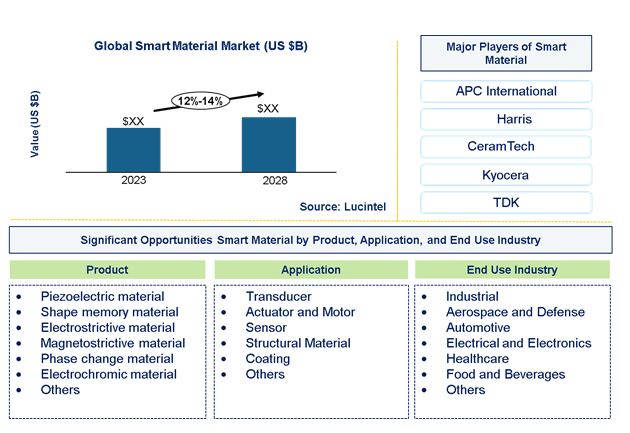
A more than 150-page report is developed to help in your business decisions. Sample figures with some insights are shown below. To learn the scope, benefits, companies researched and other details of the global smart material market report, please download the report brochure.
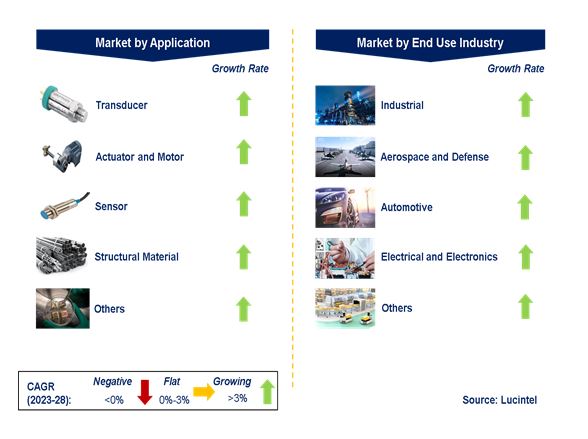
Smart Material Market by Segment
The study includes a forecast for the global smart material market by product, application, end use industry, and region, as follows:
Smart Material Market by Product [Value ($B) Shipment Analysis from 2017 to 2028]:
The study includes a forecast for the global smart material market by product, application, end use industry, and region, as follows:
Smart Material Market by Product [Value ($B) Shipment Analysis from 2017 to 2028]:
- Piezoelectric Material
- Shape Memory Material
- Electrostrictive Material
- Magnetostrictive Material
- Phase Change Material
- Electrochromic Material
- Others
Smart Material Market by Application [Value ($B) Shipment Analysis from 2017 to 2028]:
- Transducer
- Actuator and Motor
- Sensor
- Structural Material
- Coating
- Others
Smart Material Market by End Use Industry [Value ($B) Shipment Analysis from 2017 to 2028]:
- Industrial
- Aerospace and Defense
- Automotive
- Electrical and Electronics
- Healthcare
- Food and Beverages
- Others
Smart Material Market by Region [Value ($B) Shipment Analysis from 2017 to 2028]:
- North America
- Europe
- Asia Pacific
- The Rest of the World
List of Smart Material Companies
Companies in the market compete on the basis of product quality offered. Major players in this market focus on expanding their manufacturing facilities, R&D investments, infrastructural development, and leverage integration opportunities across the value chain. With these strategies smart material companies cater toincreasing demand, ensure competitive effectiveness, develop innovative products & technologies, reduce production costs, and expand their customer base. Some of the smart material companies profiled in this report include.
Companies in the market compete on the basis of product quality offered. Major players in this market focus on expanding their manufacturing facilities, R&D investments, infrastructural development, and leverage integration opportunities across the value chain. With these strategies smart material companies cater toincreasing demand, ensure competitive effectiveness, develop innovative products & technologies, reduce production costs, and expand their customer base. Some of the smart material companies profiled in this report include.
- APC International
- Harris Corporation
- CeramTech GmbH
- Kyocera Corporation
- TDK Corporation
- Noliac
- Ametek
Smart Material Market Insights
- Lucintel forecasts that sensor material will remain the largest segment over the forecast period due to its various advantages such as good frequency response, availability in the desired shape, negligible phase shift, and ease of handling.
- Aerospace and defense is expected to remain the largest segment by end use industry due to the wide usage of smart material as nanorobots, sensors, and combat suits in the military and defense.
- North America will remain the largest region due to increasing government investment in aerospace and defense, which influence the drive for smart materials, and rising exports of advanced products in the region.
Features of the Smart Material Market
- Market Size Estimates: Smart material market size estimation in terms of value ($B)
- Trend And Forecast Analysis: Market trends (2017-2022) and forecast (2023-2028) by various segments and regions.
- Segmentation Analysis: Smart material market size by various segments, such as by product, application, end use industry, and region
- Regional Analysis: Smart material market breakdown by North America, Europe, Asia Pacific, and the Rest of the World.
- Growth Opportunities: Analysis on growth opportunities in different by product, application, end use industry, and regions for the smart material market.
- Strategic Analysis: This includes M&A, new product development, and competitive landscape for the smart material market.
- Analysis of competitive intensity of the industry based on Porter’s Five Forces model.
FAQ
Q1. What is the smart material market size?
Answer: The global smart material market is expected to reach an estimated $xx billion by 2028.
Q2. What is the growth forecast for smart material market?
Answer: The global smart material market is expected to grow with a CAGR of 12% to 14% from 2023 to 2028.
Q3. What are the major drivers influencing the growth of the smart material market?
Answer: The major drivers for this market are growing adoption of smart material products among various end use industries, growing use of artificial intelligence which requires smart materials in different devices, and rapid technological advancement in material science.
Q4. What are the major segments for smart material market?
Answer: The future of the smart material market looks promising with opportunities in the industrial, aerospace and defense, automotive, electrical and electronics, healthcare, and food and beverages industries.
Q5. Who are the key smart material companies?
Answer: Some of the key smart material companies are as follows:
Q1. What is the smart material market size?
Answer: The global smart material market is expected to reach an estimated $xx billion by 2028.
Q2. What is the growth forecast for smart material market?
Answer: The global smart material market is expected to grow with a CAGR of 12% to 14% from 2023 to 2028.
Q3. What are the major drivers influencing the growth of the smart material market?
Answer: The major drivers for this market are growing adoption of smart material products among various end use industries, growing use of artificial intelligence which requires smart materials in different devices, and rapid technological advancement in material science.
Q4. What are the major segments for smart material market?
Answer: The future of the smart material market looks promising with opportunities in the industrial, aerospace and defense, automotive, electrical and electronics, healthcare, and food and beverages industries.
Q5. Who are the key smart material companies?
Answer: Some of the key smart material companies are as follows:
- APC International
- Harris Corporation
- CeramTech GmbH
- Kyocera Corporation
- TDK Corporation
- Noliac
- Ametek
Q6. Which smart material segment will be the largest in future?
Answer: Lucintel forecasts that sensor material will remain the largest segment over the forecast period due to its various advantages such as good frequency response, availability in the desired shape, negligible phase shift, and easy to handle.
Q7. In smart material market, which region is expected to be the largest in next 5 years?
Answer: North America will remain the largest region due to increasing government investment in aerospace and defense, which influence the drive for smart materials, and rising exports of advanced products in the region.
Q8. Do we receive customization in this report?
Answer: Yes, Lucintel provides 10% Customization Without any Additional Cost.
Answer: Lucintel forecasts that sensor material will remain the largest segment over the forecast period due to its various advantages such as good frequency response, availability in the desired shape, negligible phase shift, and easy to handle.
Q7. In smart material market, which region is expected to be the largest in next 5 years?
Answer: North America will remain the largest region due to increasing government investment in aerospace and defense, which influence the drive for smart materials, and rising exports of advanced products in the region.
Q8. Do we receive customization in this report?
Answer: Yes, Lucintel provides 10% Customization Without any Additional Cost.
Table of Contents
1. Executive Summary
6.2 Emerging Trends in the Global Smart Material Market
4.1 Global Smart Material Market by Region
4.2.1 North American Smart Material Market by Application: Transducer, Actuator and Motor, Sensor, Structural Material, Coating, and Others
4.2.2 North American Smart Material Market by End Use Industry: Industrial, Aerospace and Defense, Automotive, Electrical and Electronics, Healthcare, Food and Beverages, and Others
4.3.1 European Smart Material Market by Application: Transducer, Actuator and Motor, Sensor, Structural Material, Coating, and Others
4.3.2 European Smart Material Market by End Use Industry: Industrial, Aerospace and Defense, Automotive, Electrical and Electronics, Healthcare, Food and Beverages, and Others
4.4.1 APAC Smart Material Market by Application: Transducer, Actuator and Motor, Sensor, Structural Material, Coating, and Others
4.4.2 APAC Smart Material Market by End Use Industry: Industrial, Aerospace and Defense, Automotive, Electrical and Electronics, Healthcare, Food and Beverages, and Others
6.1.1 Growth Opportunities for the Global Smart Material Market by Product
6.1.2 Growth Opportunities for the Global Smart Material Market by Application
6.1.3 Growth Opportunities for the Global Smart Material Market by End Use Industry
6.1.4 Growth Opportunities for the Global Smart Material Market by Region
Methodology
Lucintel has been in the business of market research and management consulting since 2000 and has published over 1000 market intelligence reports in various markets / applications and served over 1,000 clients worldwide. This study is a culmination of four months of full-time effort performed by Lucintel's analyst team. The analysts used the following sources for the creation and completion of this valuable report:
- In-depth interviews of the major players in this market
- Detailed secondary research from competitors’ financial statements and published data
- Extensive searches of published works, market, and database information pertaining to industry news, company press releases, and customer intentions
- A compilation of the experiences, judgments, and insights of Lucintel’s professionals, who have analyzed and tracked this market over the years.
Extensive research and interviews are conducted across the supply chain of this market to estimate market share, market size, trends, drivers, challenges, and forecasts. Below is a brief summary of the primary interviews that were conducted by job function for this report.

Thus, Lucintel compiles vast amounts of data from numerous sources, validates the integrity of that data, and performs a comprehensive analysis. Lucintel then organizes the data, its findings, and insights into a concise report designed to support the strategic decision-making process. The figure below is a graphical representation of Lucintel’s research process.

Buy Now
Choose a license that fits your team. Instant PDF delivery.
Prices exclude taxes. Instant delivery. Custom licensing available on request.
Key Questions
- • What are some of the most promising, high-growth opportunities for the smart material market by product (piezoelectric material, shape memory material, electrostrictive material, magnetostrictive material, phase change material, electrochromic material, and others), application (transducer, actuator and motor, sensor, structural material, coating, and others), end use industry (industrial, aerospace and defense, automotive, electrical and electronics, healthcare, food and beverages, and others), and region (North America, Europe, Asia Pacific, and the Rest of the World)?
- • Which segments will grow at a faster pace and why?
- • Which region will grow at a faster pace and why?
- • What are the key factors affecting market dynamics? What are the key challenges and business risks in this market?
- • What are the business risks and competitive threats in this market?
- • What are the emerging trends in this market and the reasons behind them?
- • What are some of the changing demands of customers in the market?
- • What are the new developments in the market? Which companies are leading these developments?
- • Who are the major players in this market? What strategic initiatives are key players pursuing for business growth?
- • What are some of the competing products in this market and how big of a threat do they pose for loss of market share by material or product substitution?
- • What M&A activity has occurred in the last 5 years and what has its impact been on the industry? For any questions related to smart material market or related to smart material companies, smart material market size, smart material market share, smart material analysis, write Lucintel analyst at email: helpdesk@lucintel.com we will be glad to get back to you soon.


