
Report Feature
Serial Peripheral Interface NAND Market Trends and Forecast
In the recent past, the serial peripheral interface NAND technology has been modified about a traditional SLC NAND technology, giving way for more advanced MLC NAND, TLC NAND, and QLC NAND technologies that have emphasized higher storage densities, reduced cost, and superior read/write performance. In addition, there is a shift from legacy SPI interfaces to high-speed interfaces that have better error correction and data integrity features, hence, ensuring higher performance and reliability in consumer electronics and industrial applications.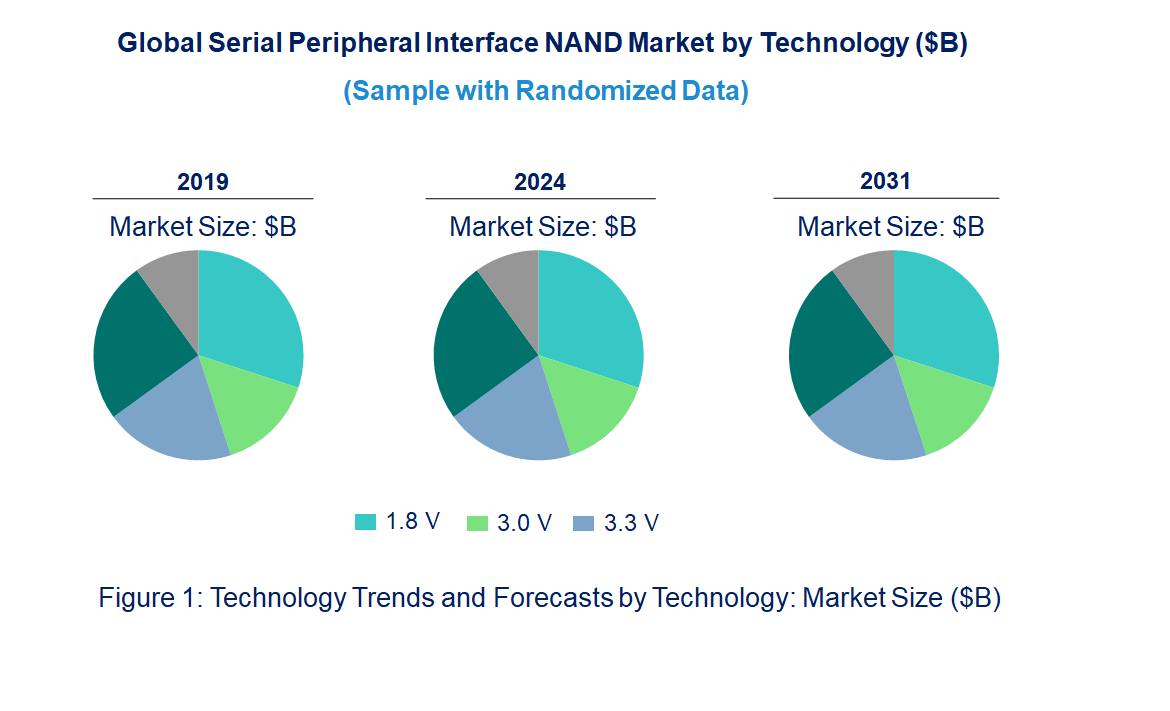
Emerging Trends in the Serial Peripheral Interface NAND Market
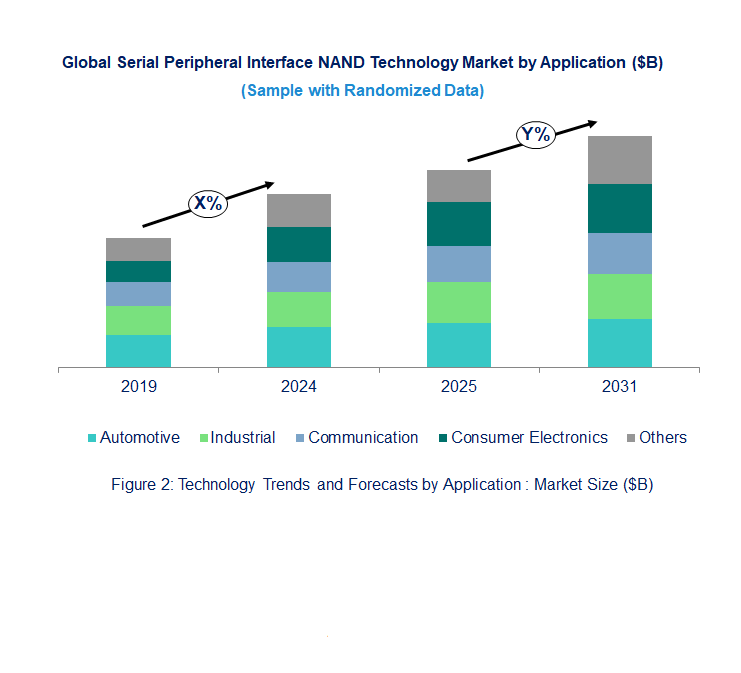
Serial Peripheral Interface NAND technology is being highly advanced by increasing demand for faster data transfer rates, higher storage capacities, and cost efficiency across consumer electronics, automotive, and industrial applications. Innovations are targeted toward performance, reliability, and compatibility improvements, ensuring improved integration, lower power consumption, and higher durability. Here are five key emerging trends that are shaping this technology landscape.• Shift from SLC to MLC, TLC, and QLC NAND: There is a significant shift from the traditional Single-Level Cell (SLC) NAND technology to Multi-Level Cell (MLC), Triple-Level Cell (TLC), and Quad-Level Cell (QLC) technologies. These advancements offer greater storage densities, lower costs, and better scalability while maintaining better overall performance and capacity efficiency.
• Growing use of High-Speed SPI Interfaces: SPI interfaces are being developed to enhance the data transfer rate further. Technologies that support high clock rates and signal integrity contribute to faster communication, better throughput, and reduced latency, a factor that is of utmost importance in applications requiring real-time data processing.
• Focus on Energy Efficiency and Low-Power Consumption: Manufacturers are focusing on energy efficiency through the advancement of low-power NAND designs and energy-efficient SPI interfaces. It is very useful in battery-powered devices, portable electronics, and IoT applications where energy conservation is the most critical.
• Improved Error Correction and Data Integrity Features: There is an increasing trend of using advanced error correction technologies, such as BCH (Bose-Chaudhuri-Hocquenghem) and LDPC (Low-Density Parity Check). These will ensure better data integrity and protection against corruption, an important feature in applications that are highly dependent on reliability, such as in the automotive and industrial fields.
• Security Features Integration within SPI NAND Technology: Security enhancements are becoming a priority for newer technologies, which incorporate encryption and authentication mechanisms directly into NAND interfaces. Data breaches are prevented, and data will be in compliance with cybersecurity standards, which is very important for consumer electronics, automotive, and industrial applications. These emerging trends in serial peripheral interface NAND technology are driving innovations that enhance storage efficiency, performance, and energy sustainability. The shift to higher storage densities, faster interfaces, robust error correction, and built-in security measures ensures compatibility and scalability across various sectors. This is resulting in more reliable, cost-effective, and adaptable solutions across consumer electronics, automotive, industrial, and IoT applications.
Serial Peripheral Interface NAND Market : Industry Potential, Technological Development, and Compliance Considerations
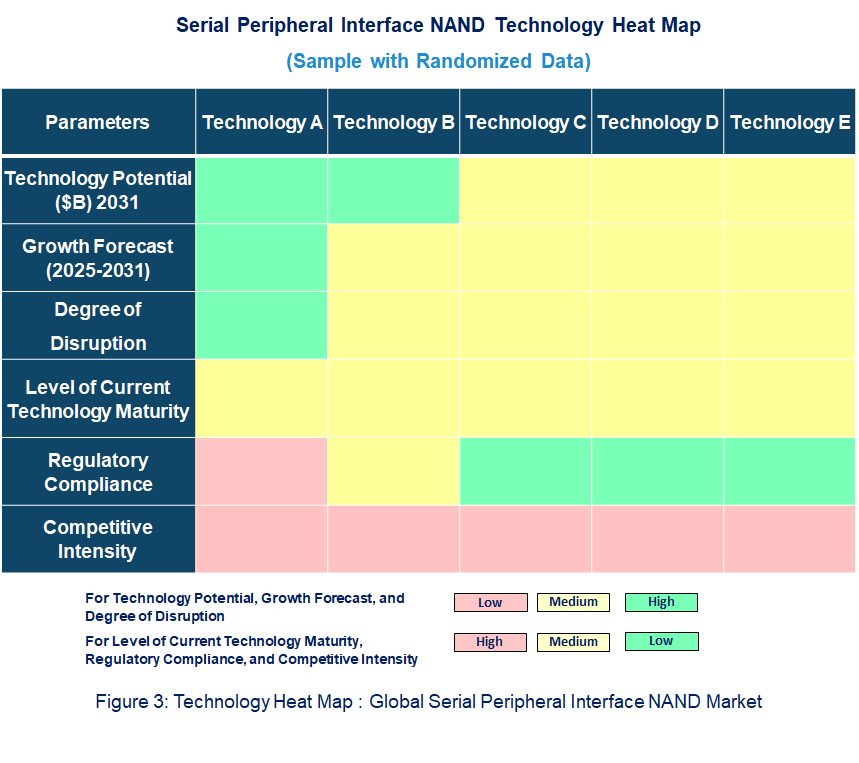
The serial peripheral interface (SPI) NAND technology is one of the key components in modern electronics that offers fast, reliable, and scalable storage solutions to diverse sectors such as consumer electronics, automotive, and industrial applications. In terms of speed, capacity, and energy efficiency, SPI NAND technology continues to evolve to fulfill growing demands for higher performance, cost efficiency, and long-term reliability.• Technology Potential: SPI NAND technology comes with huge potential scalability along with integration in applications on data-intensive applications. Thus, it provides larger capacity storage, faster read-writes, and energy-consuming power. This allows accommodating the needs of devices in consumer electronics, industrial equipment, automotive systems, as well as IoT applications. Innovations regarding technologies in multi-level cells (MLC, TLC, QLC) enhance storage density to reduce costs.
• Degree of Disruption: The development of advanced interface technologies and memory types further disrupts the SPI NAND market. Replacing traditional solutions with high-speed interfaces along with integrated error correction mechanisms means better performance, higher reliability, and lower cross-cell interference. The improvements consequently lead to huge savings in operational costs and improved device performance.
• Level of Current Technology Maturity: SPI NAND technology is quite mature and has penetrated the market quite deeply into both consumer and industrial markets. Further work has been aimed at continued speed enhancement for interfaces, improvements in data integrity, and increased energy efficiency.
• Regulatory Compliance: SPI NAND technology meets the global requirements for industries and automotive safety compliance: ISO, JEDEC, and automotive specifications, among others.
Recent Technological development in Serial Peripheral Interface NAND Market by Key Players
THE Serial Peripheral Interface NAND technology market is growing at a healthy pace due to increasing demands for faster, more reliable, and cost-effective storage solutions. The focus areas of key semiconductor companies revolve around increasing storage densities, power consumption reduction, improving data integrity, and addressing applications requirements in consumer electronics, automotive, industrial, and IoT domains. Continuous advancements in interface speed, scalability, and security ensure better performance and integration across applications. Some of the key developments by the market leaders are mentioned below:• Micron Technology: Micron Technology further advances its SPI NAND offerings by focusing on higher-density memory solutions and optimized read/write performance. Its latest products provide cost-effective storage solutions with enhanced error correction features for reliable data integrity across consumer and industrial applications.
• ISSI (Integrated Silicon Solution Inc.): ISSI is investing in SPI NAND technologies that deliver higher performance with improved cost-efficiency. Their products focus on faster interfaces and robust error correction mechanisms, ensuring compliance with stringent industrial and automotive data requirements.
• Toshiba: Toshiba has introduced high-capacity SPI NAND memory modules designed for consumer electronics and automotive applications. Their technology focuses on maximizing speed and scalability while maintaining energy efficiency and cost optimization.
• Microchip Technology: Microchip Technology focuses on ensuring compatibility and integration with existing systems, improving the speed and reliability of SPI interfaces. Their products are specifically designed for automotive and industrial applications and have been focused more on performance and long-term reliability.
• Cypress Semiconductor: Cypress develops high-speed advanced SPI NAND interfaces that work with low-power designs to perform high-speed read-write operations, which makes it good for energy-efficient consumer electronic devices and portable equipment. Macronix is investing in high-density SPI NAND storage technologies, focusing on scalability and performance. Their solutions are designed for applications that require fast read/write speeds and robust data integrity across consumer and industrial markets.
• Winbond Electronics: Winbond Electronics focuses on delivering cost-effective SPI NAND solutions with high memory density and reliability. Their technology ensures compatibility across consumer electronics and industrial sectors, offering scalable storage solutions.
• GigaDevice: GigaDevice is constantly innovating SPI NAND integration while keeping performance and cost efficiency. Their solutions are designed to meet the needs of consumer electronics and IoT with fast, reliable storage interfaces.
• ATO Solution: ATO Solution offers its customized SPI NAND products by targeting industrial and automotive applications with high reliability, data integrity, and performance optimization, ensuring long-term stability and efficient operation. Recent advancements in SPI NAND technology from these major players reveal a pattern of increasing storage density, greater speed, reduced energy consumption, and strong error correction mechanisms. Innovations ensure that the technologies remain current and fulfill the demands of consumers, industrial, and automotive markets to ensure scalability, cost efficiency, and long-term reliability.
Serial Peripheral Interface NAND Market Driver and Challenges
The serial peripheral interface NAND technology market is rapidly changing with the growing demand for faster, more efficient, and scalable storage solutions in various sectors, such as consumer electronics, automotive, and industrial applications. Technological innovations drive significant opportunities, but there are challenges in terms of cost optimization, integration, and performance consistency. The factors responsible for driving the serial peripheral interface NAND market include:• Increased Storage Density and Scalability: The demand for higher storage capacity drives MLC, TLC, and QLC technologies, which enable storing more data within smaller form factors, and reduce costs to help applications in consumer electronics and IoT.
• Faster Data Transfer Interfaces: Continuous innovation in SPI interfaces provides for higher-speed data transfer rates and lower latency. Fast communication is essential for real-time applications in automotive, industrial, and consumer electronics, thus providing better performance and quicker processing.
• Energy Efficiency Innovations: Increased demand for energy efficiency in portable and battery-driven devices drives companies to innovate low-power SPI NAND solutions. This focus minimizes energy consumption, thereby prolonging the life of the battery in consumer electronics, IoT devices, and portable tools.
• Advanced Error Correction Technologies: Implementation of robust error correction technologies such as BCH and LDPC ensures data integrity and reliability. These technologies are of extreme importance in applications where data accuracy and system stability are of utmost importance, like automotive and industrial systems.
• Integration with IoT and Smart Systems: SPI NAND technology is increasingly integrated with IoT and real-time analytics platforms, enabling predictive maintenance and remote monitoring. This enhances operational efficiency, reduces downtime, and improves scalability across industrial and consumer markets. Challenges
• Limited Data Throughput: SPI NAND typically offers lower data transfer speeds compared to parallel NAND interfaces due to its narrower data bus. This can be a bottleneck in high-performance applications like multimedia or real-time systems, where faster read/write speeds are critical.
• Complex Error Correction Requirements: SPI NAND often requires more advanced error correction codes (ECC) due to higher bit error rates in smaller geometry NAND cells. Implementing robust ECC in host controllers adds complexity to system design and can increase processing overhead. Demand for higher storage capacity, faster interfaces, and energy efficiency is shaping the market for SPI NAND technology. Advanced error correction, scalability, and integration with the Internet of Things are factors that fuel innovation to meet the needs of better performance, cost efficiency, and compatibility across different sectors, which results in robust, scalable, and adaptable storage solutions customized to meet evolving industry and consumer needs.
List of Serial Peripheral Interface NAND Companies
Companies in the market compete based on product quality offered. Major players in this market focus on expanding their manufacturing facilities, R&D investments, infrastructural development, and leverage integration opportunities across the value chain. With these strategies serial peripheral interface NAND companies cater to increasing demand, ensure competitive effectiveness, develop innovative products & technologies, reduce production costs, and expand their customer base. Some of the serial peripheral interface NAND companies profiled in this report include.• Micron Technology
• Issi
• Toshiba
• Microchip Technology
• Cypress Semiconductor
• Macronix
Serial Peripheral Interface NAND Market by Technology
• Technology Readiness by Technology Type: The technology readiness varies for 1.8 V, 3.0 V, and 3.3 V solutions across consumer, industrial, and automotive markets. The 1.8 V is very mature in energy-conscious devices such as low-power consumer electronics and IoT sensors that prefer cost and efficiency. The 3.0 V technology is robust in terms of integration in applications requiring a balance between performance and cost, such as mid-range consumer electronics and industrial machinery. 3.3 V is very mature and flexible and is widely used in automotive, consumer electronics, and industrial applications due to its compatibility with existing infrastructure and superior data integrity. Laser 1.8 V technology is very compact and energy-efficient, whereas 3.0 V interfaces are balanced between speed and scalability. 3.3 V solutions remain in high demand in demanding applications requiring high reliability and data transmission accuracy, such as automotive control systems and enterprise-grade industrial hardware. Together, these technologies meet the increasingly critical requirements for speed, energy efficiency, scalability, and compatibility, which are bound to ensure their adoption across the globe and continuous innovation in markets worldwide.
• Competitive Intensity and Regulatory Compliance: The competitive intensity of the 1.8 V, 3.0 V, and 3.3 V markets will be driven by the demand for storage density, performance, and cost efficiency. Solutions that are 1.8 V have lower power consumption but suffer from performance trade-offs. The 3.0 V technology has remained a middle ground where there is a balance between speed, scalability, and cost efficiency, which attracts both consumer and industrial markets. It should be noted that 3.3 V remains popular across automotive and high-performance, driven by compatibility and robustness across devices. Regulations on compliance technologies include JEDEC, ISO, and energy efficiency specifications to ensure data integrity, safety, and environmental compatibility. Thus, companies need to reach industrial, consumer, as well as automotive certifications through strict compliance for reliable integrations and compatibility around the world. As competition increases, firms emphasize cost efficiency, performance, and compliance with environmental and safety standards, leading to technological refinement across industries and ensuring higher product acceptance globally.
• Disruption Potential by Technology Type: The 1.8 V, 3.0 V, and 3.3 V technologies all have different disruption potential. The 1.8 V technology allows for power efficiency and low power usage, but is not ideal in terms of performance in large-capacity applications. The 3.0 V technology balances speed and energy efficiency, making it very appropriate for most consumer electronics. The 3.3 V technology is still largely used in automobiles and industry applications due to its higher compatibility and better integrity of data. As fast interfaces and more storage density demands are created, companies look to improve 1.8 V technology for maximum energy efficiency and cost benefits. For the 3.0 V solutions, performance and scalability across various industrial and consumer sectors continue to be in focus. 3.3 V technology is very common because of its flexibility and universality for application in various devices and tools with a long-term reliability in performance. These technologies evolving, being evolved continuously to match the requirements of performance, cost, and integration, hence creating an environment of competition and innovation in dif
Serial Peripheral Interface NAND Market Trend and Forecast by Technology [Value from 2019 to 2031]:
• 1.8 V
• 3.0 V
• 3.3 V
Serial Peripheral Interface NAND Market Trend and Forecast by Application [Value from 2019 to 2031]:
• Automotive
• Industrial
• Communication
• Consumer Electronics
• Others
Serial Peripheral Interface NAND Market by Region [Value from 2019 to 2031]:
• North America
• Europe
• Asia Pacific
• The Rest of the World
• Latest Developments and Innovations in the Serial Peripheral Interface NAND Technologies
• Companies / Ecosystems
• Strategic Opportunities by Technology Type
Features of the Global Serial Peripheral Interface NAND Market
Market Size Estimates: Serial peripheral interface NAND market size estimation in terms of ($B). Trend and Forecast Analysis: Market trends (2019 to 2024) and forecast (2025 to 2031) by various segments and regions. Segmentation Analysis: Technology trends in the global serial peripheral interface NAND market size by various segments, such as application and technology in terms of value and volume shipments. Regional Analysis: Technology trends in the global serial peripheral interface NAND market breakdown by North America, Europe, Asia Pacific, and the Rest of the World. Growth Opportunities: Analysis of growth opportunities in different application, technologies, and regions for technology trends in the global serial peripheral interface NAND market. Strategic Analysis: This includes M&A, new product development, and competitive landscape for technology trends in the global serial peripheral interface NAND market. Analysis of competitive intensity of the industry based on Porter’s Five Forces model.Table of Contents
Methodology
- In-depth interviews of the major players in this market
- Detailed secondary research from competitors’ financial statements and published data
- Extensive searches of published works, market, and database information pertaining to industry news, company press releases, and customer intentions
- A compilation of the experiences, judgments, and insights of Lucintel’s professionals, who have analyzed and tracked this market over the years.


Buy Now
Choose a license that fits your team. Instant PDF delivery.
Prices exclude taxes. Instant delivery. Custom licensing available on request.
Key Questions
- • What are some of the most promising potential, high-growth opportunities for the technology trends in the global serial peripheral interface NAND market by technology (1.8 v, 3.0 v, and 3.3 v), application (automotive, industrial, communication, consumer electronics, and others), and region (North America, Europe, Asia Pacific, and the Rest of the World)?
- • Which technology segments will grow at a faster pace and why?
- • Which regions will grow at a faster pace and why?
- • What are the key factors affecting dynamics of different technology? What are the drivers and challenges of these technologies in the global serial peripheral interface NAND market?
- • What are the business risks and threats to the technology trends in the global serial peripheral interface NAND market?
- • What are the emerging trends in these technologies in the global serial peripheral interface NAND market and the reasons behind them?
- • Which technologies have potential of disruption in this market?
- • What are the new developments in the technology trends in the global serial peripheral interface NAND market? Which companies are leading these developments?
- • Who are the major players in technology trends in the global serial peripheral interface NAND market? What strategic initiatives are being implemented by key players for business growth?
- • What are strategic growth opportunities in this serial peripheral interface NAND technology space?
- • What M & A activities did take place in the last five years in technology trends in the global serial peripheral interface NAND market?


