
Report Feature
Quantum-Enhanced Homomorphic Encryption Market Trends and Forecast
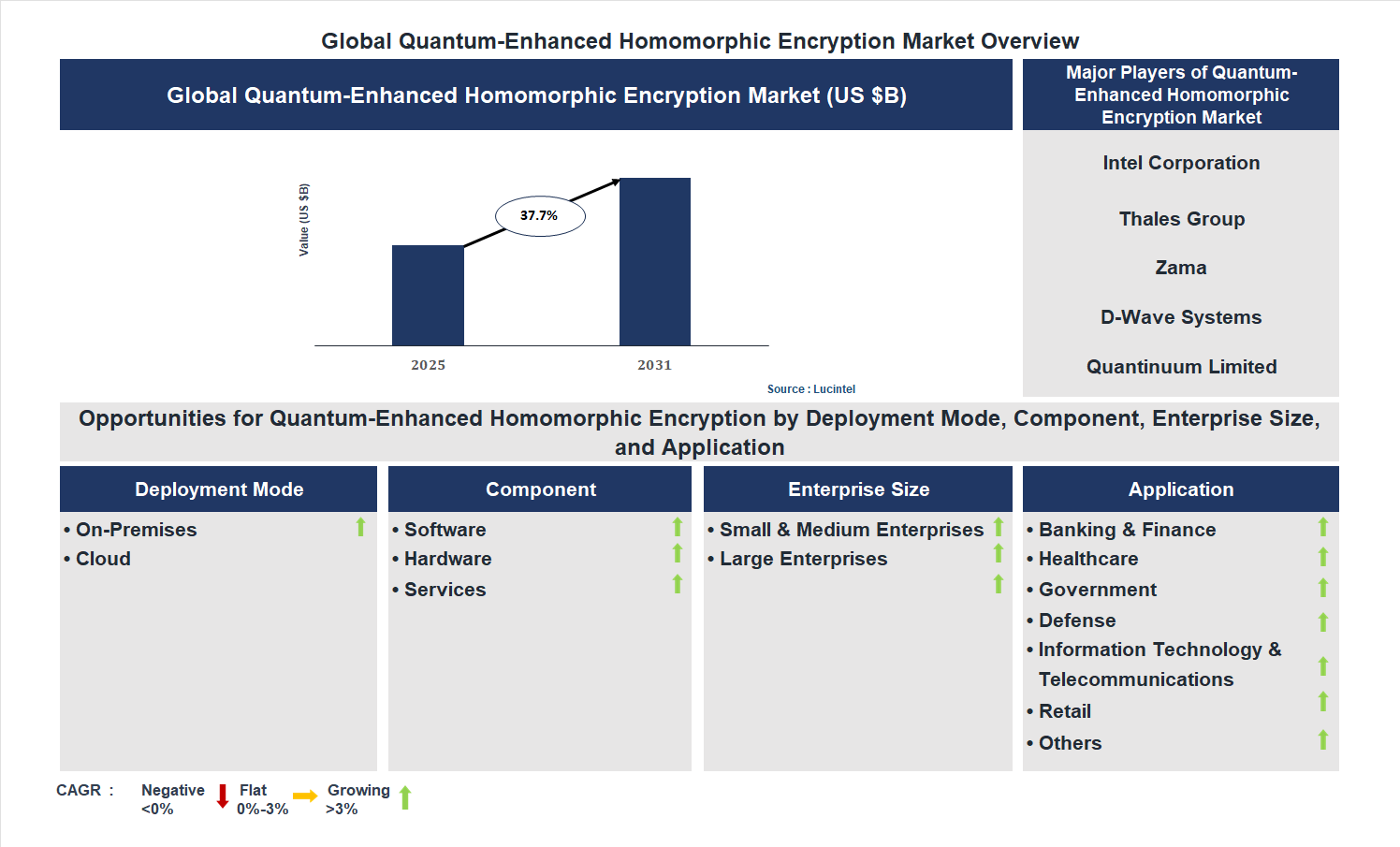
The future of the global quantum-enhanced homomorphic encryption market looks promising with opportunities in the banking & finance, healthcare, government, defense, information technology & telecommunication, and retail markets. The global quantum-enhanced homomorphic encryption market is expected to grow with a CAGR of 37.7% from 2025 to 2031. The major drivers for this market are the increasing need for quantum-resistant data protection, the rising demand for secure encrypted computation, and the growing adoption of advanced cryptographic frameworks.• Lucintel forecasts that, within the deployment mode category, cloud is expected to witness higher growth over the forecast period.
• Within the application category, banking & finance is expected to witness the highest growth.
• In terms of region, APAC is expected to witness the highest growth over the forecast period. Gain valuable insights for your business decisions with our comprehensive 150+ page report. Sample figures with some insights are shown below.
Emerging Trends in the Quantum-Enhanced Homomorphic Encryption Market
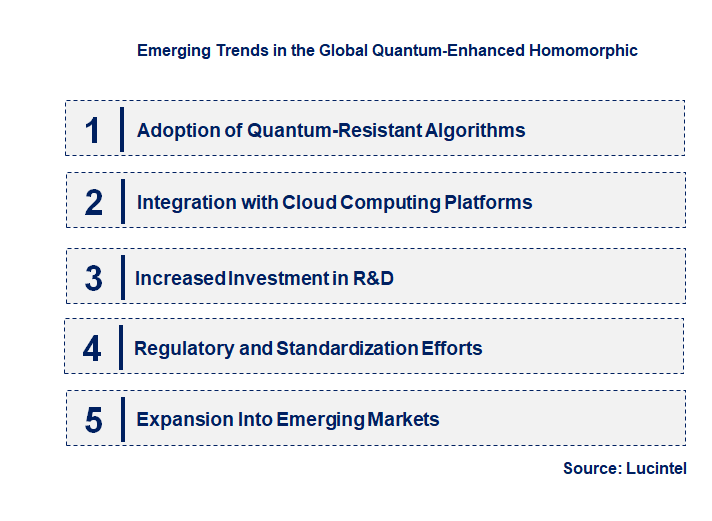
The quantum-enhanced homomorphic encryption market is experiencing rapid growth driven by advancements in quantum computing and the increasing need for secure data transmission. As organizations seek to protect sensitive information against emerging cyber threats, the integration of quantum technologies into encryption methods is becoming essential. This market is characterized by innovative research, strategic collaborations, and a focus on practical applications across industries such as finance, healthcare, and government. The evolving landscape reflects a shift towards more robust, scalable, and future-proof encryption solutions that leverage quantum principles. These developments are set to redefine data security standards and influence global cybersecurity strategies.• Adoption of Quantum-Resistant Algorithms: The market is witnessing a shift towards algorithms designed to withstand quantum attacks. As quantum computers threaten traditional encryption, researchers are developing quantum-resistant homomorphic encryption schemes. This trend enhances data security by ensuring that sensitive information remains protected even in the presence of powerful quantum adversaries. The adoption of these algorithms is crucial for industries handling confidential data, such as banking and healthcare, and is expected to accelerate as quantum computing matures.
• Integration with Cloud Computing Platforms: Cloud service providers are increasingly integrating quantum-enhanced homomorphic encryption into their platforms. This allows clients to perform computations on encrypted data without exposing sensitive information, ensuring privacy and compliance. The trend boosts the adoption of secure cloud solutions, especially for organizations dealing with large volumes of confidential data. It also promotes the development of scalable, user-friendly encryption tools that facilitate widespread use across various sectors.
• Increased Investment in R&D: Governments, private firms, and academic institutions are significantly increasing investments in research and development of quantum encryption technologies. This funding accelerates the creation of more efficient, practical, and cost-effective homomorphic encryption schemes. The focus on R&D is driving innovation, reducing implementation barriers, and fostering collaborations that push the boundaries of current capabilities. This trend ensures the market remains at the forefront of technological advancements and prepares it for commercial deployment.
• Regulatory and Standardization Efforts: As quantum encryption technologies evolve, regulatory bodies and industry consortia are working to establish standards and guidelines. These efforts aim to ensure interoperability, security, and compliance across different platforms and applications. Standardization facilitates trust and adoption among organizations and governments, providing a clear framework for deploying quantum-enhanced encryption solutions. This trend is vital for creating a secure, unified ecosystem that supports global data protection initiatives.
• Expansion into Emerging Markets: The market is expanding into emerging economies where digital transformation is rapidly progressing. These regions are adopting quantum-enhanced homomorphic encryption to secure expanding digital infrastructures, financial transactions, and government data. The trend is driven by increasing awareness of cybersecurity threats and the need for advanced protection measures. It also opens new opportunities for local innovation and collaboration, fostering a more inclusive global market for quantum encryption solutions. In summary, these trends are collectively reshaping the quantum-enhanced homomorphic encryption market by fostering innovation, enhancing security, and expanding adoption across sectors and regions. They are laying the foundation for a future where data privacy and security are robust enough to withstand the challenges posed by quantum computing, ultimately transforming how sensitive information is protected worldwide.
Recent Development in the Quantum-Enhanced Homomorphic Encryption Market
The quantum-enhanced homomorphic encryption market is experiencing rapid growth driven by advancements in quantum computing and increasing demand for secure data processing. As organizations seek to protect sensitive information against emerging cyber threats, quantum encryption technologies are becoming vital. Recent developments reflect significant progress in algorithm efficiency, hardware integration, and industry adoption. These innovations are shaping the future landscape of secure communications and data privacy, making the market highly dynamic. Stakeholders are investing heavily in research and development to stay ahead in this competitive environment. The following key developments highlight the current trajectory and future potential of this evolving market.• Advancements in Algorithm Efficiency: Researchers have developed more efficient quantum algorithms for homomorphic encryption, reducing computational overhead and enabling faster data processing. This improvement enhances practical usability and broadens application scope, attracting more industry players to adopt quantum encryption solutions. The increased efficiency also lowers costs, making the technology more accessible to small and medium enterprises, thereby expanding the market base.
• Hardware Integration Breakthroughs: Innovations in quantum hardware, including more stable qubits and scalable quantum processors, have facilitated the integration of quantum homomorphic encryption into existing systems. These hardware improvements increase reliability and performance, encouraging organizations to implement quantum encryption for sensitive data. As hardware becomes more robust and affordable, deployment barriers decrease, accelerating market growth and fostering new use cases.
• Industry-Specific Applications: Several sectors, such as finance, healthcare, and government, are adopting quantum homomorphic encryption for secure data sharing and processing. Tailored solutions for these industries have demonstrated the technology’s practical benefits, boosting market confidence. This sector-specific focus is driving demand, leading to increased investments and partnerships, which further propel market expansion.
• Regulatory and Standardization Initiatives: Governments and industry bodies are establishing standards and regulations for quantum encryption technologies. These initiatives aim to ensure interoperability, security, and compliance, fostering trust among users. Clear regulatory frameworks are attracting institutional investments and encouraging organizations to adopt quantum-enhanced encryption solutions, thus fueling market development.
• Strategic Collaborations and Investments: Major tech firms, startups, and research institutions are forming strategic alliances to accelerate innovation in quantum homomorphic encryption. Significant investments are being made in R&D, pilot projects, and commercialization efforts. These collaborations are driving technological breakthroughs, expanding market reach, and establishing a competitive landscape that benefits consumers and enterprises alike. In summary, recent developments in the quantum-enhanced homomorphic encryption market are significantly advancing the technology’s efficiency, hardware integration, industry applications, regulatory support, and collaborative efforts. These factors collectively are accelerating market adoption, reducing costs, and expanding the scope of secure quantum data processing solutions. As a result, the market is poised for substantial growth, transforming how sensitive information is protected in the digital age.
Strategic Growth Opportunities in the Quantum-Enhanced Homomorphic Encryption Market
The quantum-enhanced homomorphic encryption market is poised for significant expansion as advancements in quantum computing and cryptography reshape data security paradigms. Increasing demand for secure data processing across industries such as finance, healthcare, government, and cloud services drives innovation in encryption technologies. As organizations seek to protect sensitive information against emerging quantum threats, the market presents numerous growth opportunities across various applications. These developments are expected to enhance data privacy, enable secure cloud computing, and foster new business models, ultimately transforming the landscape of digital security and data management.• Financial Services: Enhanced Data Security : Quantum homomorphic encryption allows secure processing of financial transactions and sensitive data without decryption, reducing fraud risk and ensuring compliance with data privacy regulations. This boosts customer trust and operational efficiency in banking and investment sectors.
• Healthcare: Secure Data Sharing : The technology facilitates safe sharing of patient records and medical data across healthcare providers, improving collaboration and research while maintaining strict privacy standards. It accelerates medical innovation and personalized treatment approaches.
• Government & Defense: Confidential Data Handling : Governments can utilize quantum homomorphic encryption to protect classified information and secure communications. It enhances national security by enabling secure data analysis and intelligence sharing without risking exposure.
• Cloud Computing: Secure Data Processing : Cloud service providers adopt this encryption to offer clients secure, privacy-preserving data processing solutions. It fosters growth in cloud adoption by addressing security concerns associated with remote data handling.
• Internet of Things (IoT): Data Privacy & Security : As IoT devices proliferate, quantum encryption ensures secure data transmission and processing across interconnected devices. It safeguards critical infrastructure and personal data from cyber threats. In summary, these growth opportunities are significantly impacting the quantum-enhanced homomorphic encryption market by expanding its application scope, increasing adoption across sectors, and strengthening data security frameworks. This evolution is driving innovation, fostering trust in digital ecosystems, and positioning the market for sustained growth amid emerging quantum computing challenges.
Quantum-Enhanced Homomorphic Encryption Market Driver and Challenges
The quantum-enhanced homomorphic encryption market is influenced by a range of technological, economic, and regulatory factors. Advances in quantum computing are pushing the boundaries of data security, prompting the development of more robust encryption methods. Economic growth in digital sectors fuels demand for secure data transmission and storage solutions. Regulatory frameworks are evolving to address privacy concerns and cybersecurity standards, impacting market dynamics. Additionally, increasing investments in research and development by governments and private entities are accelerating innovation. However, the market also faces challenges such as technological complexity, high implementation costs, and regulatory uncertainties, which could hinder widespread adoption. Understanding these drivers and challenges is essential for stakeholders to navigate this rapidly evolving landscape. The factors responsible for driving the quantum-enhanced homomorphic encryption market include:• Technological Advancements: Rapid progress in quantum computing and cryptography technologies is enabling the development of more secure encryption methods. Quantum-enhanced algorithms offer the potential to perform complex computations securely on encrypted data, which is crucial for sectors like finance, healthcare, and government. These innovations are attracting investments and fostering collaborations among tech companies and research institutions, thereby accelerating market growth. As quantum hardware becomes more accessible, the adoption of quantum-enhanced encryption solutions is expected to increase, providing a significant competitive edge to early adopters.
• Growing Data Security Concerns: With the exponential increase in data generation, organizations face escalating risks of cyberattacks and data breaches. Traditional encryption methods are vulnerable to quantum attacks, creating a pressing need for quantum-resistant solutions. Quantum-enhanced homomorphic encryption offers the ability to perform computations on encrypted data without decryption, ensuring data privacy and security. This capability is particularly vital for sensitive data in banking, healthcare, and government sectors, driving demand for advanced encryption solutions that can withstand future quantum threats.
• Increasing Adoption of Cloud Computing: The proliferation of cloud services has transformed data management, but it also introduces new security challenges. Quantum-enhanced homomorphic encryption enables secure data processing in cloud environments by allowing computations on encrypted data, thus maintaining confidentiality. As organizations seek to leverage cloud computing while complying with stringent data privacy regulations, the demand for such advanced encryption techniques is rising. This trend is further supported by the need for secure multi-party computations and data sharing across distributed networks, fueling market expansion.
• Regulatory and Privacy Frameworks: Governments and regulatory bodies are implementing stricter data protection laws, such as GDPR and CCPA, emphasizing the importance of data security and privacy. These regulations compel organizations to adopt advanced encryption methods to ensure compliance. Quantum-enhanced homomorphic encryption aligns with these requirements by providing secure data processing capabilities that protect user privacy. The evolving regulatory landscape is thus a significant driver, encouraging industries to invest in quantum-resistant encryption solutions to avoid penalties and reputational damage.
• Strategic Investments and Collaborations: Increased funding from governments, venture capitalists, and private enterprises is fueling innovation in quantum cryptography. Strategic partnerships between technology firms, academic institutions, and industry players are accelerating research and commercialization efforts. These collaborations facilitate knowledge sharing, resource pooling, and development of scalable solutions, which are critical for market growth. Moreover, government initiatives and grants aimed at quantum technology development are creating a conducive environment for startups and established companies to innovate, thereby expanding the market landscape. The challenges facing this quantum-enhanced homomorphic encryption market include:
• Technological Complexity: Developing and implementing quantum-enhanced homomorphic encryption involves sophisticated quantum algorithms and hardware, which are still in nascent stages. The complexity of integrating quantum technologies with existing classical systems poses significant technical hurdles. Additionally, ensuring the reliability, scalability, and interoperability of these solutions requires extensive research and development. This complexity can delay deployment timelines and increase costs, making it difficult for organizations to adopt these solutions at scale, thereby hindering market growth.
• High Implementation Costs: The deployment of quantum-enhanced encryption solutions demands substantial investment in quantum hardware, specialized infrastructure, and skilled personnel. These costs are often prohibitive for small and medium-sized enterprises, limiting market accessibility. Furthermore, the need for continuous updates and maintenance to keep pace with technological advancements adds to the financial burden. High implementation costs can slow down adoption rates, especially in regions with limited budgets for cybersecurity investments, impacting overall market expansion.
• Regulatory Uncertainty: The evolving regulatory landscape surrounding quantum technologies and data security creates ambiguity for market participants. Lack of clear standards and guidelines for quantum encryption can lead to compliance challenges and legal risks. Organizations may hesitate to invest heavily in solutions that might become obsolete or non-compliant due to future regulatory changes. This uncertainty hampers innovation and slows down the adoption of quantum-enhanced homomorphic encryption, posing a significant barrier to market growth. In summary, the quantum-enhanced homomorphic encryption market is driven by technological innovations, increasing data security needs, cloud computing adoption, regulatory pressures, and strategic investments. However, it faces challenges related to technological complexity, high costs, and regulatory uncertainties. These factors collectively shape the market's trajectory, requiring stakeholders to navigate a landscape of rapid innovation and evolving standards. While the potential for secure quantum-resistant data processing is immense, overcoming these hurdles is essential for widespread adoption and long-term growth.
List of Quantum-Enhanced Homomorphic Encryption Companies
Companies in the market compete on the basis of product quality offered. Major players in this market focus on expanding their manufacturing facilities, R&D investments, infrastructural development, and leverage integration opportunities across the value chain. With these strategies quantum-enhanced homomorphic encryption companies cater increasing demand, ensure competitive effectiveness, develop innovative products & technologies, reduce production costs, and expand their customer base. Some of the quantum-enhanced homomorphic encryption companies profiled in this report include-• Intel Corporation
• Thales Group
• Zama
• D-Wave Systems
• Quantinuum Limited
• QnuLabs
• Rigetti Computing
• SandboxAQ
• Duality Technologies
• Post-Quantum Security
Quantum-Enhanced Homomorphic Encryption Market by Segment
The study includes a forecast for the global quantum-enhanced homomorphic encryption market by deployment mode, component, enterprise size, application, and region.Quantum-Enhanced Homomorphic Encryption Market by Deployment Mode [Value from 2019 to 2031]:
• On-Premises
• Cloud
Quantum-Enhanced Homomorphic Encryption Market by Component [Value from 2019 to 2031]:
• Software
• Hardware
• Services
Quantum-Enhanced Homomorphic Encryption Market by Enterprise Size [Value from 2019 to 2031]:
• Small & Medium Enterprises
• Large Enterprises
Quantum-Enhanced Homomorphic Encryption Market by Application [Value from 2019 to 2031]:
• Banking & Finance
• Healthcare
• Government
• Defense
• Information Technology & Telecommunications
• Retail
• Others
Quantum-Enhanced Homomorphic Encryption Market by Region [Value from 2019 to 2031]:
• North America
• Europe
• Asia Pacific
• The Rest of the World
Country Wise Outlook for the Quantum-Enhanced Homomorphic Encryption Market
The quantum-enhanced homomorphic encryption market is experiencing rapid growth driven by advancements in quantum computing and increasing demand for secure data transmission. As organizations seek to protect sensitive information against emerging cyber threats, countries are investing heavily in research and development. The market's evolution is marked by technological breakthroughs, regulatory support, and expanding applications across sectors such as finance, healthcare, and government. These developments reflect a global race to harness quantum encryption's potential, with each country adopting unique strategies to lead in this innovative field.• United States: The US leads in quantum research, with major tech firms and government agencies investing heavily in quantum encryption. Recent advancements include the development of scalable quantum key distribution networks and partnerships between academia and industry to commercialize quantum homomorphic encryption solutions. Regulatory frameworks are being established to ensure secure deployment, and pilot projects are underway to test real-world applications in finance and defense sectors.
• China: China has made significant strides in quantum communication infrastructure, including the launch of quantum satellites and extensive fiber-optic networks for secure data transmission. The government has prioritized quantum encryption as a national security priority, resulting in rapid deployment of quantum key distribution systems. Chinese research institutions are pioneering algorithms for quantum homomorphic encryption, aiming to integrate these into existing communication networks to enhance security.
• Germany: Germany is focusing on integrating quantum encryption into its industrial and governmental infrastructure. The country has launched several collaborative projects between research institutes and industry to develop practical quantum homomorphic encryption applications. Recent developments include the deployment of pilot quantum networks and the creation of standards to facilitate interoperability and commercialization of quantum encryption technologies.
• India: India is rapidly advancing its quantum research capabilities, with government initiatives supporting startups and research institutions in quantum cryptography. Recent developments include the establishment of dedicated quantum labs and pilot projects for secure communication in government and banking sectors. India is also investing in workforce development to build expertise in quantum homomorphic encryption, aiming to become a regional leader in quantum cybersecurity.
• Japan: Japan has been investing in quantum technology research, with a focus on secure communication networks for critical infrastructure. Recent advancements include the deployment of experimental quantum encryption links and collaborations with international partners to develop standards and protocols. The country is also exploring the integration of quantum homomorphic encryption into existing 5G and IoT networks to enhance data security and privacy.

Features of the Global Quantum-Enhanced Homomorphic Encryption Market
Market Size Estimates: Quantum-enhanced homomorphic encryption market size estimation in terms of value ($B). Trend and Forecast Analysis: Market trends (2019 to 2024) and forecast (2025 to 2031) by various segments and regions. Segmentation Analysis: Quantum-enhanced homomorphic encryption market size by various segments, such as by deployment mode, component, enterprise size, application, and region in terms of value ($B). Regional Analysis: Quantum-enhanced homomorphic encryption market breakdown by North America, Europe, Asia Pacific, and Rest of the World. Growth Opportunities: Analysis of growth opportunities in different deployment mode, components, enterprise sizes, applications, and regions for the quantum-enhanced homomorphic encryption market. Strategic Analysis: This includes M&A, new product development, and competitive landscape of the quantum-enhanced homomorphic encryption market. Analysis of competitive intensity of the industry based on Porter’s Five Forces model.
FAQ
Q1. What is the growth forecast for quantum-enhanced homomorphic encryption market? Answer: The global quantum-enhanced homomorphic encryption market is expected to grow with a CAGR of 37.7% from 2025 to 2031. Q2. What are the major drivers influencing the growth of the quantum-enhanced homomorphic encryption market? Answer: The major drivers for this market are the increasing need for quantum-resistant data protection, the rising demand for secure encrypted computation, and the growing adoption of advanced cryptographic frameworks. Q3. What are the major segments for quantum-enhanced homomorphic encryption market? Answer: The future of the quantum-enhanced homomorphic encryption market looks promising with opportunities in the banking & finance, healthcare, government, defense, information technology & telecommunication, and retail markets. Q4. Who are the key quantum-enhanced homomorphic encryption market companies? Answer: Some of the key quantum-enhanced homomorphic encryption companies are as follows:• Intel Corporation
• Thales Group
• Zama
• D-Wave Systems
• Quantinuum Limited
• QnuLabs
• Rigetti Computing
• SandboxAQ
• Duality Technologies
• Post-Quantum Security Q5. Which quantum-enhanced homomorphic encryption market segment will be the largest in future? Answer: Lucintel forecasts that, within the deployment mode category, cloud is expected to witness higher growth over the forecast period. Q6. In quantum-enhanced homomorphic encryption market, which region is expected to be the largest in next 5 years? Answer: In terms of region, APAC is expected to witness the highest growth over the forecast period. Q7. Do we receive customization in this report? Answer: Yes, Lucintel provides 10% customization without any additional cost.
Table of Contents
List of Figures
List of Tables
Methodology
- In-depth interviews of the major players in this market
- Detailed secondary research from competitors’ financial statements and published data
- Extensive searches of published works, market, and database information pertaining to industry news, company press releases, and customer intentions
- A compilation of the experiences, judgments, and insights of Lucintel’s professionals, who have analyzed and tracked this market over the years.


Buy Now
Choose a license that fits your team. Instant PDF delivery.
Prices exclude taxes. Instant delivery. Custom licensing available on request.
Key Questions
- • What are some of the most promising, high-growth opportunities for the quantum-enhanced homomorphic encryption market by deployment mode (on-premises and cloud), component (software, hardware, and services), enterprise size (small & medium enterprises and large enterprises), application (banking & finance, healthcare, government, defense, information technology & telecommunications, retail, and others), and region (North America, Europe, Asia Pacific, and the Rest of the World)?
- • Which segments will grow at a faster pace and why?
- • Which region will grow at a faster pace and why?
- • What are the key factors affecting market dynamics? What are the key challenges and business risks in this market?
- • What are the business risks and competitive threats in this market?
- • What are the emerging trends in this market and the reasons behind them?
- • What are some of the changing demands of customers in the market?
- • What are the new developments in the market? Which companies are leading these developments?
- • Who are the major players in this market? What strategic initiatives are key players pursuing for business growth?
- • What are some of the competing products in this market and how big of a threat do they pose for loss of market share by material or product substitution?
- • What M&A activity has occurred in the last 5 years and what has its impact been on the industry? For any questions related to Quantum-Enhanced Homomorphic Encryption Market, Quantum-Enhanced Homomorphic Encryption Market Size, Quantum-Enhanced Homomorphic Encryption Market Growth, Quantum-Enhanced Homomorphic Encryption Market Analysis, Quantum-Enhanced Homomorphic Encryption Market Report, Quantum-Enhanced Homomorphic Encryption Market Share, Quantum-Enhanced Homomorphic Encryption Market Trends, Quantum-Enhanced Homomorphic Encryption Market Forecast, Quantum-Enhanced Homomorphic Encryption Companies, write Lucintel analyst at email: helpdesk@lucintel.com. We will be glad to get back to you soon.


