
Report Feature
Military Transport Market
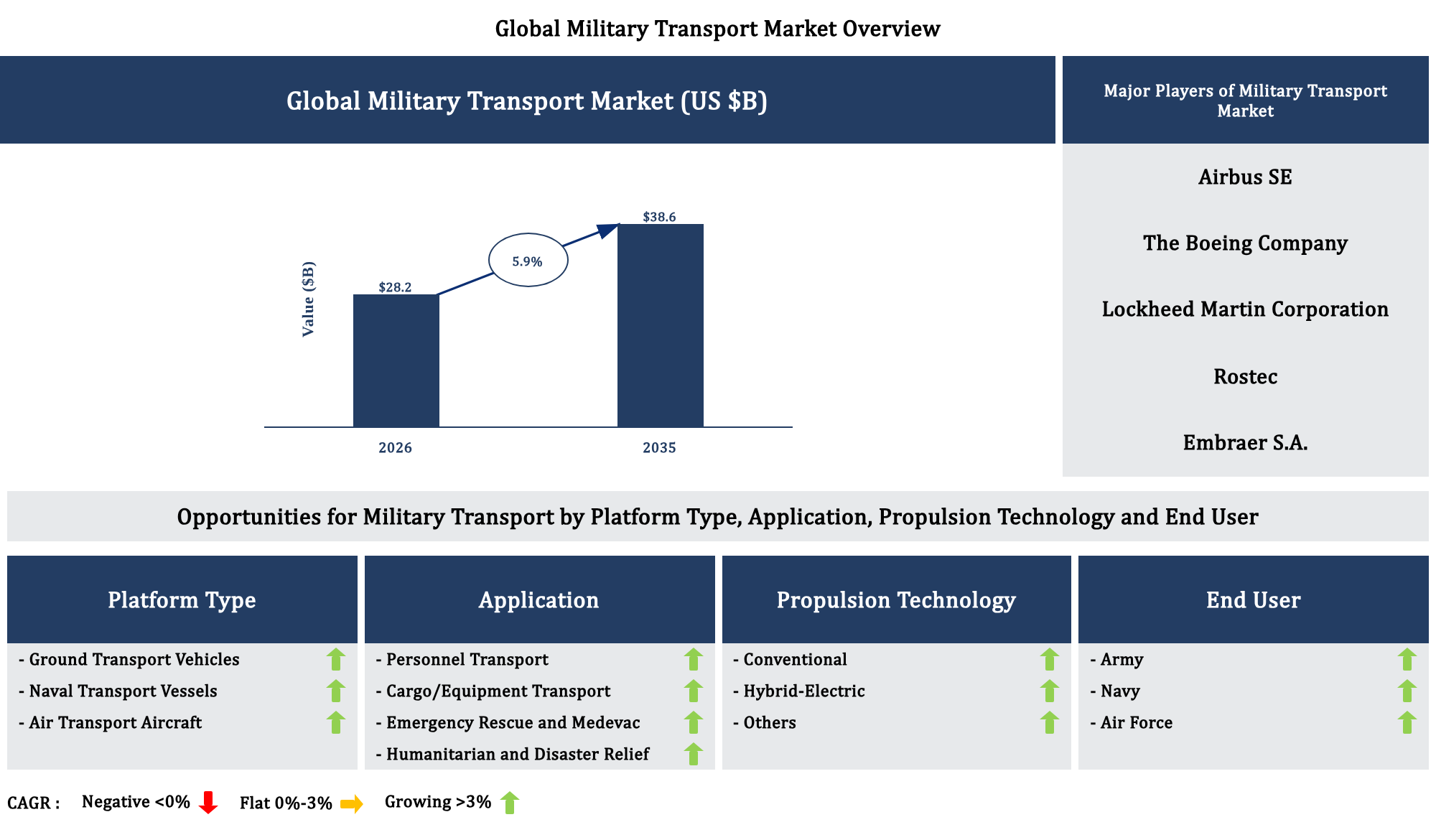
The future of the global military transport market looks promising with opportunities in the army, navy and air force markets. The global military transport market is expected to reach an estimated $38.6 billion by 2035 with a CAGR of 5.9% from 2026 to 2035. The major drivers for this market are growing global demand for strategic and tactical airlift capabilities, a shift in operations toward swift deployment within distributed warfare contexts and the upgrading and renewal of aging military transport fleets.• Lucintel forecasts that, within the platform type category, ground transport vehicles will remain the largest segment over the forecast period as they offer versatile, cost-effective, and deployable mobility for troops and equipment across diverse terrains.
• Within the end user category, army will remain the largest segment due to the fact that the fact that extensive requirements for line-haul trucks, fuel bowsers, and engineering equipment.
• In terms of regions, North America will remain the largest region over the forecast period due to the increasing number of startups and continuous government support in the region.
Gain valuable insights for your business decisions with our comprehensive 150+ page report.
Emerging Trends in the Military Transport Market
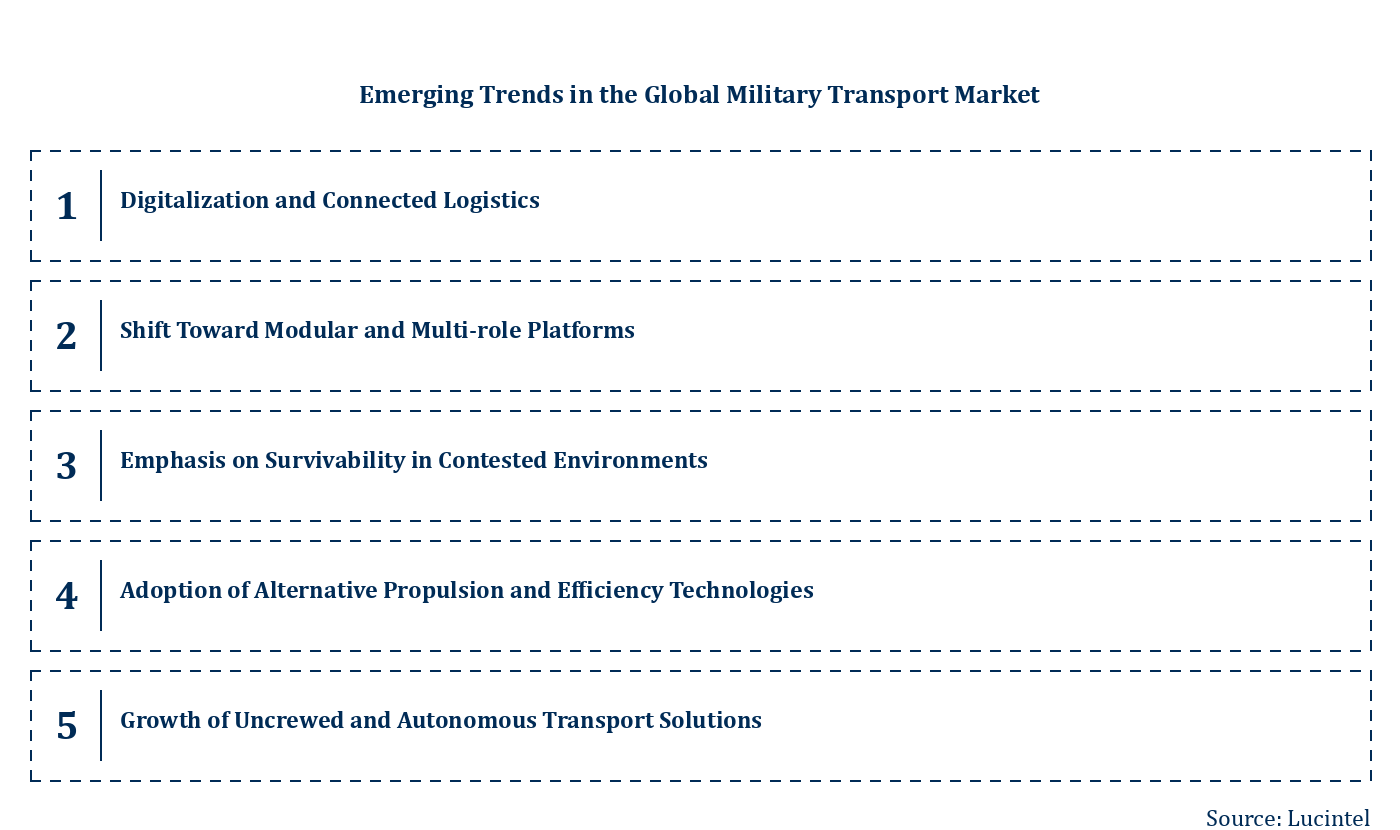
The military transport market is undergoing a profound transformation driven by rapid advances in digitalization, evolving threat environments, and increasing pressure to optimize lifecycle costs. Armed forces are demanding platforms that combine greater range, payload, and survivability with improved connectivity and mission flexibility across land, air, and sea domains. At the same time, geopolitical tensions are accelerating modernization programs and joint logistics initiatives among allies, while fiscal constraints require smarter procurement and sustainment strategies. These dynamics are spawning new concepts such as modular transport fleets, data-driven maintenance, and alternative propulsion, which are reshaping future requirements and procurement roadmaps globally.• Digitalization and Connected Logistics: The military transport market is increasingly integrating advanced digital technologies such as IoT sensors, secure cloud connectivity, and AI-driven analytics to create real-time visibility across strategic and tactical supply chains. Connected platforms enable predictive maintenance, dynamic route optimization, and responsive load planning, reducing downtime and mission risk. Commanders gain better situational awareness of inventory, fuel, and asset status, enhancing readiness and resilience. This trend also supports interoperability across joint and coalition operations by sharing standardized logistics data, enabling more efficient use of transport capacity and accelerating decision-making in contested and rapidly changing environments.
• Shift Toward Modular and Multi-Role Platforms: Armed forces are prioritizing modular military transport platforms that can be rapidly reconfigured for cargo, troop movement, medical evacuation, airborne early warning, or special operations roles. This multi-role focus allows militaries to field smaller, more flexible fleets while maintaining a broad mission set. Modular interiors, roll-on/roll-off mission kits, and standardized interfaces reduce reconfiguration time and simplify training and maintenance. The trend supports faster adaptation to evolving operational needs, from humanitarian assistance to high-intensity conflict, and improves lifecycle value by enabling platforms to remain relevant through incremental mission-system upgrades rather than complete fleet replacements.
• Emphasis on Survivability in Contested Environments: The military transport market is seeing rising demand for transport assets that can survive and operate within anti-access and area-denial environments. This includes improved defensive aids suites, signature management, hardened communications, and in some cases low observable design features. Enhanced self-protection systems such as missile warning, directed infrared countermeasures, and active protection for ground vehicles are becoming essential. The trend reflects the growing likelihood that transport platforms will operate under threat rather than in permissive air and surface domains, driving procurement decisions toward systems that balance payload and range with survivability and mission assurance.
• Adoption of Alternative Propulsion and Efficiency Technologies: Sustainability, fuel security, and operating cost pressures are driving interest in more efficient propulsion within the military transport market, including hybrid-electric systems, advanced turbofan and turboprop engines, and alternative fuels. Improved powertrain efficiency extends range, reduces logistics burdens for fuel resupply, and lowers lifecycle emissions. Militaries are also exploring hybrid drive for tactical logistics vehicles to enable silent watch and reduced acoustic signatures. While fully electric heavy transport remains technically challenging, incremental gains in efficiency and power management are becoming key evaluation criteria, aligning operational resilience with broader national energy and climate objectives.
• Growth of Uncrewed and Autonomous Transport Solutions: Uncrewed aerial, ground, and maritime vehicles are rapidly emerging as complementary assets in the military transport market, particularly for high-risk or routine resupply tasks. Autonomous convoys, cargo drones, and unmanned surface vessels can reduce personnel exposure, support last-mile delivery in contested areas, and maintain logistics flows when manned platforms are constrained. Advances in sense-and-avoid technologies, secure autonomy software, and resilient communications are enabling larger payloads and longer ranges. This trend is reshaping concepts of operations, with mixed fleets of crewed and uncrewed transports promising greater flexibility, survivability, and efficiency across strategic, operational, and tactical logistics.
Recent Developments in the Military Transport Market
The military transport market is undergoing a period of accelerated transformation driven by evolving threat environments, rapid technology innovation, and shifting defense budgets among allied and competing nations. Armed forces are prioritizing faster, more survivable, and more flexible transport platforms to support dispersed operations, humanitarian missions, and strategic deterrence. Recent developments span from next‑generation airlifters and tactical vehicles to digital logistics and autonomous systems, each reshaping how militaries move personnel, equipment, and supplies. These changes are influencing procurement strategies, industrial partnerships, and lifecycle support models, redefining the role of military transport in modern joint and coalition operations.• Modernization of Strategic and Tactical Airlift Fleets: Defense ministries are investing heavily in upgrading or replacing aging airlift platforms with more capable aircraft that offer extended range, higher payloads, and improved avionics. Programs centered on new tactical airlifters and strategic transporters enhance rapid deployment capacity and interoperability across allied forces. These modernization efforts reduce maintenance burdens, improve mission readiness, and allow for more efficient global mobility. The impact is a more responsive airlift capability that can support high‑tempo operations as well as humanitarian and disaster relief missions in austere and contested environments.
• Integration of Autonomous and Uncrewed Transport Systems: Militaries are increasingly testing and fielding uncrewed aerial and ground systems for cargo delivery, last‑mile resupply, and high‑risk logistics missions. Autonomous transport platforms reduce exposure of personnel to enemy fire, hazardous terrain, and contaminated areas while enabling continuous operations. Developments in sense‑and‑avoid technologies, secure communications, and mission planning software are improving reliability and safety. The impact is a gradual shift toward hybrid fleets that combine crewed and uncrewed assets, enhancing flexibility, lowering operational risk, and opening new concepts of operation for distributed and expeditionary logistics.
• Digitization and Data‑Driven Logistics for Military Transport: The military transport market is seeing rapid adoption of digital infrastructure, including real‑time tracking, predictive maintenance, and AI‑enabled route optimization. Connected platforms and sensors feed data into logistics management systems, enabling commanders to monitor cargo flows, asset utilization, and readiness with greater accuracy. Predictive analytics reduce unplanned downtime and improve spare parts planning, cutting lifecycle costs. The impact is a more transparent and resilient transport network that can adapt quickly to changing operational requirements, improve on‑time delivery performance, and support joint, combined, and coalition logistics chains.
• Focus on Survivability and Operations in Contested Environments: Recent programs emphasize enhanced defensive systems, reduced signatures, and hardened communications for transport platforms operating in anti‑access and area‑denial environments. Upgrades include electronic warfare suites, missile warning and countermeasure systems, ballistic and blast protection for vehicles, and secure, resilient networking. This shift reflects recognition that transport assets are high‑value targets that must survive in near‑peer conflict scenarios. The impact is a new generation of transports capable not only of carrying heavier loads but also of operating closer to the front line, sustaining forces in high‑threat theaters with reduced vulnerability.
• Emphasis on Sustainability and Fuel Efficiency in Military Transport: Defense organizations are increasingly linking fleet renewal and infrastructure planning to sustainability objectives, focusing on reduced fuel consumption, alternative fuels, and lighter materials. New engines, aerodynamic improvements, and hybrid or electric drive concepts in ground transport are being explored to decrease logistical fuel demand. This reduces the vulnerability of long fuel supply lines and lowers operating costs over the platform lifecycle. The impact is a gradual greening of the military transport market, where efficiency and sustainability are seen not only as environmental goals but also as operational advantages that enhance endurance and strategic reach.
Strategic Growth Opportunities in the Military Transport Market
The military transport market is entering a transformative growth phase as armed forces modernize fleets, adopt multi-domain concepts, and prepare for high-intensity as well as asymmetric conflicts. Demand is rising for platforms and systems that can move personnel, equipment, and supplies quickly and securely across contested and remote theaters. Emerging technologies such as digital twins, autonomous systems, advanced materials, and data-driven logistics are reshaping how military transport assets are deployed and sustained. Strategic growth opportunities span applications including troop transport, cargo and heavy-lift operations, medical evacuation, special operations support, and command, control, communications, computers, intelligence, surveillance, and reconnaissance integration.• Troop Transport and Rapid Deployment: Growth in expeditionary operations and alliance commitments is driving investment in aircraft, ships, and ground vehicles optimized for rapid troop movement and strategic airlift. Modern platforms offer greater range, survivability, and interoperability, enabling faster force projection and rotational deployments. Upgrades such as modular seating, improved protection, and digital mission planning tools enhance readiness and reduce deployment timelines. This application presents a key opportunity for vendors delivering adaptable, multi-role transport solutions that can support both crisis response and sustained operations in diverse environments.
• Cargo and Heavy-Lift Operations: Expanding requirements for moving heavy armor, engineering equipment, and humanitarian relief supplies are boosting demand for heavy-lift aircraft, sealift vessels, and high-capacity ground transport. Innovations in payload management, air-droppable systems, and roll-on/roll-off configurations are increasing operational flexibility and throughput. Digital logistics platforms that optimize routing, load planning, and real-time tracking further amplify the value of modern heavy-lift capabilities. Companies that can integrate advanced materials, fuel efficiency, and automation into cargo transport solutions will capture growth as militaries seek to reduce costs while improving strategic and tactical lift performance.
• Medical Evacuation and Aeromedical Support: The emphasis on casualty survival, forward medical care, and resilient health support chains is elevating the importance of dedicated and modular medical evacuation platforms. Military transport assets configured for intensive care, telemedicine connectivity, and rapid reconfiguration between roles offer significant operational advantages. Growth opportunities center on integrating medical-grade power, life-support systems, and patient monitoring into fixed-wing, rotary-wing, and ground transport vehicles. Vendors that align with military medical doctrines and interoperability standards will benefit from rising investment in protected medical evacuation capabilities across joint and coalition operations.
• Special Operations and Covert Mobility: Special operations forces require discreet, versatile transport platforms for infiltration, exfiltration, and resupply in denied or politically sensitive areas. This application is driving demand for low-signature aircraft, high-speed small boats, specialized ground vehicles, and modular mission kits. Enhancements such as advanced noise reduction, radar cross-section management, and secure communications bolster survivability and mission success. The need for rapid reconfiguration between intelligence gathering, strike support, and logistics roles creates room for innovative platform designs. Suppliers delivering highly adaptable, low-observable transport solutions are positioned for strong growth in this niche segment.
• C4ISR-Enabled Transport and Networked Logistics: The convergence of transport platforms with Command, Control, Communications, Computers, Intelligence, Surveillance, and Reconnaissance systems is transforming military mobility into a data-rich, networked capability. Growth is driven by integrating sensors, secure communications, and edge computing into aircraft, ships, and vehicles so they function as mobile nodes in a broader battlespace network. This enables dynamic rerouting, predictive maintenance, and real-time situational awareness for logistics commanders. Companies that offer open-architecture solutions, cyber resilience, and seamless integration with joint and coalition C4ISR frameworks will gain a competitive edge as militaries prioritize connected, intelligent transport fleets.
Military Transport Market Drivers and Challenges
The global military transport market is influenced by a multifaceted mix of technological innovation, evolving security doctrines, and shifting geopolitical landscapes. Growing demand for rapid force projection, modernization of legacy fleets, and integration of digital systems are among the leading catalysts for investment. At the same time, the market faces constraints linked to budget cycles, complex procurement regulations, and supply chain vulnerabilities. Economic conditions, industrial base maturity, and regulatory alignment between allies further shape competitive dynamics. Stakeholders must balance capability, cost, and interoperability as they respond to emerging threats, humanitarian missions, and coalition operations worldwide.The factors responsible for driving the military transport market include:
• Rising Geopolitical Tensions and Defense Modernization: Heightened geopolitical rivalries, regional conflicts, and strategic competition are compelling governments to strengthen rapid deployment and strategic mobility capabilities. Defense ministries are prioritizing modernization of airlift, sealift, and land-based transport assets to support expeditionary operations, deterrence postures, and allied commitments. This trend accelerates replacement of aging fleets with more capable platforms that offer extended range, higher payloads, and improved survivability. As countries seek to project power and respond quickly to crises, investment in military transport systems becomes central to national defense strategies, sustaining long-term demand across multiple segments.
• Growth in Multinational Operations and Humanitarian Missions: The expanding scope of multinational peacekeeping, disaster relief, and humanitarian assistance operations is boosting requirements for reliable military transport capacity. Armed forces are expected to move troops, equipment, and critical supplies rapidly into austere or damaged environments, often in coordination with international organizations and civil agencies. This operational reality drives demand for versatile platforms capable of short takeoff and landing, interoperability with allied systems, and efficient loading and unloading. As climate-related disasters and complex emergencies increase, the strategic value of military transport assets in non-combat roles rises, broadening mission profiles and justifying continuous fleet enhancements.
• Technological Advancements in Platforms and Logistics Systems: Continuous innovation in propulsion, materials, avionics, and digital logistics is transforming the effectiveness of military transport assets. New-generation aircraft, ships, and ground vehicles leverage lighter composites, more efficient engines, and advanced navigation and communications systems to extend range and improve fuel efficiency. Parallel advances in logistics software, predictive maintenance, and real-time tracking optimize fleet utilization and mission planning. The integration of autonomous and remotely piloted capabilities further expands operational options, especially for high-risk resupply missions. These technological improvements not only enhance mission success rates but also reduce life cycle costs, strengthening the investment case for modern transport solutions.
• Emphasis on Joint, Networked, and Interoperable Forces: Modern defense concepts increasingly rely on joint operations across land, sea, air, cyber, and space domains, which depend heavily on agile and interoperable military transport. Forces must move seamlessly between theaters, bases, and coalition partners, requiring standardized interfaces, communication protocols, and load configurations. Programs focused on joint logistics, integrated command and control, and shared infrastructure encourage procurement of transport platforms that can operate within allied networks and meet common standards. This emphasis on interoperability supports collaborative development, joint procurement initiatives, and long-term upgrade pathways, stimulating steady demand for transport solutions that can evolve with future operational concepts.
• Defense Industrial Policies and Offset Agreements: Many governments use military transport procurement as a tool to develop domestic industrial capabilities and secure technology transfer. Offset agreements, local assembly requirements, and co-production deals encourage global manufacturers to invest in regional supply chains, maintenance hubs, and engineering centers tied to transport programs. These policies create additional incentives to launch or expand military transport projects, as they promise economic benefits, skilled jobs, and industrial know-how alongside enhanced defense capabilities. As countries seek greater self-reliance and export potential, transport platforms that can be localized, upgraded, and integrated into broader industrial strategies gain competitive advantage and attract sustained funding.
The challenges facing this military transport market include:
• High Acquisition, Operating, and Sustainment Costs: Military transport platforms, particularly strategic airlift and large naval vessels, require substantial capital outlays, extensive infrastructure, and long-term maintenance commitments. Cost overruns, rising material prices, and complex integration requirements can strain defense budgets and delay fleet renewal. Operating expenses, such as fuel, crew training, and depot-level support, further burden military finances, especially for countries with limited resources. These financial pressures force difficult trade-offs between transport capabilities and other defense priorities, sometimes leading to smaller fleets, extended use of aging equipment, or reliance on leased commercial capacity, which can undermine readiness and strategic autonomy.
• Complex Procurement Processes and Regulatory Constraints: Defense procurement for military transport assets is often slow, highly regulated, and politically sensitive. Lengthy tendering procedures, compliance with export control regimes, and evolving certification standards for safety and airworthiness can delay program timelines and increase uncertainty for suppliers. Interservice rivalries and shifting political priorities may alter requirements mid-program, leading to redesigns and further delays. Additionally, multinational programs intended to share costs and promote interoperability introduce coordination challenges among participating nations. These factors can reduce market responsiveness, discourage innovation, and limit the ability of armed forces to quickly field new transport capabilities in response to emerging threats and operational lessons.
• Supply Chain Vulnerabilities and Technological Dependence: The military transport market relies on complex global supply chains for engines, avionics, specialized materials, and electronic components, many of which are concentrated in a small number of countries or vendors. Geopolitical tensions, trade restrictions, pandemics, and logistical disruptions can affect availability, increase lead times, and raise costs. Dependence on foreign technology and critical subsystems poses risks to program continuity and upgrade paths, particularly when export licenses or technology transfer approvals are uncertain. These vulnerabilities may force governments to reconsider sourcing strategies, invest in domestic production, or redesign platforms, adding time and expense while constraining the pace of modernization across the transport fleet.
Overall, the military transport market is shaped by a dynamic balance between escalating operational demands and structural constraints. Drivers such as geopolitical tensions, joint operations, technological advances, and industrial policies underpin sustained interest in modern, interoperable transport fleets. At the same time, high life cycle costs, complex procurement regimes, and supply chain dependencies limit the speed and scale of modernization. Market participants that can deliver cost-effective, upgradeable, and interoperable solutions while managing regulatory and sourcing risks are best positioned to succeed. Strategic collaboration between governments and industry will remain essential to align capability goals with fiscal realities and evolving threat environments.
List of Military Transport Market Companies
Companies in the market compete on the basis of product quality offered. Major players in this market focus on expanding their manufacturing facilities, R&D investments, infrastructural development, and leverage integration opportunities across the value chain. Through these strategies military transport market companies cater increasing demand, ensure competitive effectiveness, develop innovative products & technologies, reduce production costs, and expand their customer base. Some of the military transport market companies profiled in this report include-• Airbus SE
• The Boeing Company
• Lockheed Martin Corporation
• Rostec
• Embraer S.A.
Military Transport Market by Segment
The study includes a forecast for the global military transport market by platform type, application, propulsion technology, end user, and region.Military Transport Market by Platform Type [Value ($B) and Volume (Million Units) from 2019 to 2035]:
• Ground Transport Vehicles
• Naval Transport Vessels
• Air Transport Aircraft
Military Transport Market by Application [Value ($B) and Volume (Million Units) from 2019 to 2035]:
• Personnel Transport
• Cargo/Equipment Transport
• Emergency Rescue and Medevac
• Humanitarian and Disaster Relief
Military Transport Market by Propulsion Technology [Value ($B) and Volume (Million Units) from 2019 to 2035]:
• Conventional
• Hybrid-Electric
• Others
Military Transport Market by End User [Value ($B) and Volume (Million Units) from 2019 to 2035]:
• Army
• Navy
• Air Force
Military Transport Market by Region [Value ($B) and Volume (Million Units) from 2019 to 2035]:
• North America
• Europe
• Asia Pacific
• The Rest of the World
Country Wise Outlook for the Military Transport Market
The global military transport market is undergoing rapid transformation as major defense powers modernize fleets, harden logistics against contested environments, and integrate digital technologies. Heightened geopolitical tensions, renewed emphasis on rapid force projection, and lessons from recent conflicts are driving investment in strategic and tactical airlift, heavy-lift helicopters, sealift, and next-generation ground logistics vehicles. Across the United States, China, Germany, India, and Japan, governments are prioritizing resilient supply chains, multi-domain operations, and interoperability with allies or partner forces. These countries are also pursuing incremental upgrades to legacy platforms while funding entirely new air, land, and sea transport programs.• United States: The United States is focusing on modernizing its airlift and sealift fleets while enhancing survivability in contested environments. Key developments include lifecycle upgrades for the C-17 and C-130J, expansion of the KC-46A tanker fleet, and investment in Next Generation Air-Refueling and future vertical lift transport concepts. The US Navy is addressing sealift readiness through recapitalization initiatives and chartered commercial capacity. Digital logistics, autonomous resupply systems, and prepositioned stocks are being prioritized to support Indo-Pacific operations, Arctic access, and rapid reinforcement of NATO allies.
• China: China is rapidly expanding and diversifying its military transport capabilities to support power projection and sustained operations beyond its borders. The People’s Liberation Army Air Force is growing its fleet of Y-20 heavy transport aircraft and advancing extended-range and specialized variants. Maritime transport modernization includes new large amphibious assault ships and enhanced roll-on/roll-off and civilian-military dual-use shipping. China is improving logistics command, strategic airlift to support overseas bases and peacekeeping missions, and infrastructure in the Western Theater and maritime approaches, aiming to reduce dependence on foreign logistics nodes.
• Germany: Germany is strengthening its military transport capacity within the NATO framework, emphasizing interoperability and readiness. Recent developments include continued integration and utilization of the A400M airlifter, with upgrades for tactical roles such as low-level flight, airdrop, and medical evacuation. Germany is also investing in rail and road mobility for heavy armor movement across Europe and supporting multinational initiatives like the Strategic Airlift Capability. Efforts to improve spare parts availability, maintenance throughput, and digital logistics management are central to sustaining deployment readiness and rapid reinforcement on NATO’s eastern flank.
• India: India is prioritizing indigenous and diversified military transport solutions to support rapid deployment along its land borders and across the Indian Ocean Region. Key programs include the induction and operational expansion of C-17 and C-130J fleets, the continued use and modernization of Russian-origin platforms, and collaboration with foreign partners for medium transport aircraft development. India is investing in tactical airlift to high-altitude airfields, advanced logistics hubs, and hardened infrastructure near sensitive border areas. The government is also encouraging domestic industry participation in transport aircraft, helicopters, and logistics vehicle production under self-reliance initiatives.
• Japan: Japan is upgrading its military transport capabilities to support island defense, humanitarian response, and deeper cooperation with US and regional partners. The Japan Air Self-Defense Force continues to expand and refine operations with the Kawasaki C-2 transport aircraft, improving payload, range, and interoperability. Amphibious and sealift capabilities are being strengthened to move troops and equipment across dispersed islands, including through new amphibious ships and optimized use of civilian assets. Japan is enhancing logistics resilience against missile and cyber threats, investing in prepositioned stocks, and integrating advanced command-and-control systems to support rapid, coordinated transport operations.

Feature of Military Transport Market
Market Size Estimates: Military transport market size estimation in terms of value ($B).Trend and Forecast Analysis: Market trends (2019 to 2025) and forecast (2026 to 2035) by various segments and regions.
Segmentation Analysis: Military transport market size by various segments, such as by platform type, application, propulsion technology, end user and region in terms of value ($B).
Regional Analysis: Military transport market breakdown by North America, Europe, Asia Pacific, and the Rest of the World.
Growth Opportunities: Analysis of growth opportunities in different platform type, application, propulsion technology, end user and regions for the military transport market.
Strategic Analysis: This includes M&A, new product development, and competitive landscape of the military transport market.
Analysis of competitive intensity of the industry based on Porter's Five Forces model.
If you are looking to expand your business in this or adjacent markets, then contact us. We have done hundreds of strategic consulting projects in market entry, opportunity screening, due diligence, supply chain analysis, M&A, and more.

FAQ
Q1. What is the military transport market size?Answer: The global military transport market is expected to reach an estimated $38.6 billion by 2035.
Q2. What is the growth forecast for military transport market?
Answer: The global military transport market is expected to grow with a CAGR of 5.9% from 2026 to 2035.
Q3. What are the major drivers influencing the growth of the military transport market?
Answer: The major drivers for this market are growing global demand for strategic and tactical airlift capabilities, a shift in operations toward swift deployment within distributed warfare contexts and the upgrading and renewal of aging military transport fleets.
Q4. What are the major segments for military transport market?
Answer: The future of the military transport market looks promising with opportunities in the army, navy, and air force markets.
Q5. Who are the key military transport market companies?
Answer: Some of the key military transport market companies are as follows:
• Airbus SE
• The Boeing Company
• Lockheed Martin Corporation
• Rostec
• Embraer S.A.
Q6. Which military transport market segment will be the largest in future?Answer: Lucintel forecasts that, within the platform type category, ground transport vehicles will remain the largest segment over the forecast period.
Q7. In military transport market, which region is expected to be the largest in next 9 years?
Answer: In terms of region, North America is expected to witness the highest growth over the forecast period.
Q8. Do we receive customization in this report?
Answer: Yes, lucintel provides 10% customization without any additional cost.
Table of Contents
List of Figures
List of Tables
Methodology
- In-depth interviews of the major players in this market
- Detailed secondary research from competitors’ financial statements and published data
- Extensive searches of published works, market, and database information pertaining to industry news, company press releases, and customer intentions
- A compilation of the experiences, judgments, and insights of Lucintel’s professionals, who have analyzed and tracked this market over the years.


Buy Now
Choose a license that fits your team. Instant PDF delivery.
Prices exclude taxes. Instant delivery. Custom licensing available on request.
Key Questions
- • What are some of the most promising, high-growth opportunities for the military transport market by platform type (ground transport vehicles, naval transport vessels, and air transport aircraft), application (personnel transport, cargo/equipment transport, emergency rescue and medevac, and humanitarian and disaster relief), propulsion technology (conventional, hybrid-electric, and others), end user (army, navy, and air force), and region (North America, Europe, Asia Pacific, and the Rest of the World)?
- • Which segments will grow at a faster pace and why?
- • Which region will grow at a faster pace and why?
- • What are the key factors affecting market dynamics? What are the key challenges and business risks in this market?
- • What are the business risks and competitive threats in this market?
- • What are the emerging trends in this market and the reasons behind them?
- • What are some of the changing demands of customers in the market?
- • What are the new developments in the market? Which companies are leading these developments?
- • Who are the major players in this market? What strategic initiatives are key players pursuing for business growth?
- • What are some of the competing products in this market and how big of a threat do they pose for loss of market share by material or product substitution?
- • What M&A activity has occurred in the last 9 years, and what has its impact been on the industry? For any questions related to Military Transport Market Size, Military Transport Market Growth, Military Transport Market Analysis, Military Transport Market Report, Military Transport Market Share, Military Transport Market Trends, Military Transport Market Forecast, Military Transport Market Companies, Military Transport Market, write Lucintel analyst at email: helpdesk@lucintel.com. We will be glad to get back to you soon.


