Mammalian Polyclonal IgG Antibody Market Report: Trends, Forecast and Competitive Analysis to 2031

Key data points: The growth forecast = 5% annually for the next 7 years. Scroll below to get more insights. This market report covers trends, opportunities and forecasts in mammalian polyclonal IgG antibody market to 2031 by type (goat, rabbit, horse, mouse, and others), product (cardiac markers, metabolic markers, renal markers, and others), application (ELISA, immunoturbidometry, immunoelectrophoresis, antibody identification, immunohistochemistry, immunocytochemistry, and western blotting), end use (pharmaceutical & biotechnology companies, hospitals, diagnostic centers, and academic & research centers), and region (North America, Europe, Asia Pacific, and the Rest of the World)

Publisher: Lucintel Published: January 2026
See Pricing

Download Sample Report

| ✨ New Download Sample report — Get instant insights! | ✨ New Download Sample report — Get instant insights!

Mammalian Polyclonal IgG Antibody Market Report: Trends, Forecast and Competitive Analysis to 2031

Report Feature

Mammalian Polyclonal IgG Antibody Market Trends and Forecast

The future of the global mammalian polyclonal IgG antibody market looks promising with opportunities in the pharmaceutical & biotechnology company, hospital, diagnostic center, and academic & research center markets. The global mammalian polyclonal IgG antibody market is expected to grow with a CAGR of 5% from 2025 to 2031. The major drivers for this market are the increasing demand for therapeutic antibody production, the rising use of polyclonal antibodies in diagnostics, and the growing research in immunology & vaccine development.

• Lucintel forecasts that, within the type category, mouse is expected to witness the highest growth over the forecast period.

• Within the end use category, pharmaceutical & biotechnology company is expected to witness the highest growth.

• In terms of region, APAC is expected to witness the highest growth over the forecast period. Gain valuable insights for your business decisions with our comprehensive 150+ page report. Sample figures with some insights are shown below.
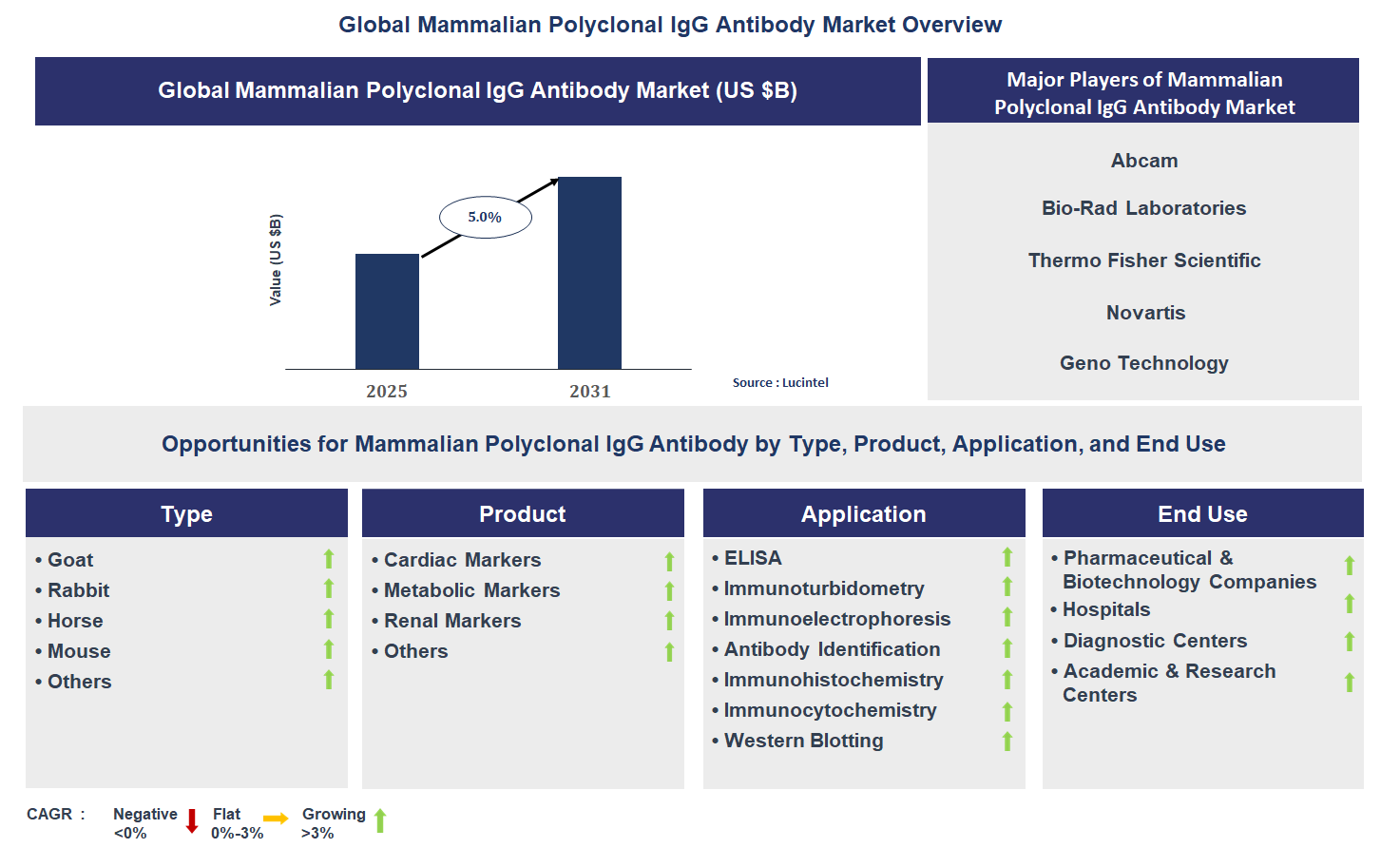
Mammalian Polyclonal IgG Antibody Market Trends and Forecast

Emerging Trends in the Mammalian Polyclonal IgG Antibody Market

Emerging trends in mammalian polyclonal IgG antibody market focus on customization, conjugation innovations, and purity enhancements to meet precision medicine needs. These evolutions boost versatility across research and therapeutics.

• ADC Conjugation Expansion: Integration with drug payloads targets cancers precisely via mammalian IgG scaffolds. Impacts elevate therapeutic indices, minimize off-target effects, and accelerate approvals for solid tumor treatments.

• Custom Service Boom: Tailored polyclonals from patient samples enable personalized models. Revolutionizes drug screening, improves reproducibility, and supports immunotherapy pipelines effectively.

• High-Purity Formulations: Affinity-purified IgG fractions reduce non-specific binding. Enhances assay sensitivity in IHC and ELISA, streamlining diagnostics and research workflows globally.

• High-Throughput Production: Automated platforms scale rabbit and goat IgG yields rapidly. Cuts timelines, lowers costs, and meets surging biotech demands sustainably.

• Therapeutic Diversification: Polyclonals target infectious and autoimmune via multi-epitope binding. Fortifies vaccines, antitoxins, and combo therapies against emerging threats. These trends transform polyclonals into versatile, high-performance tools, bridging research to clinic. Market pivots toward integrated, patient-centric platforms redefining antibody utility worldwide.
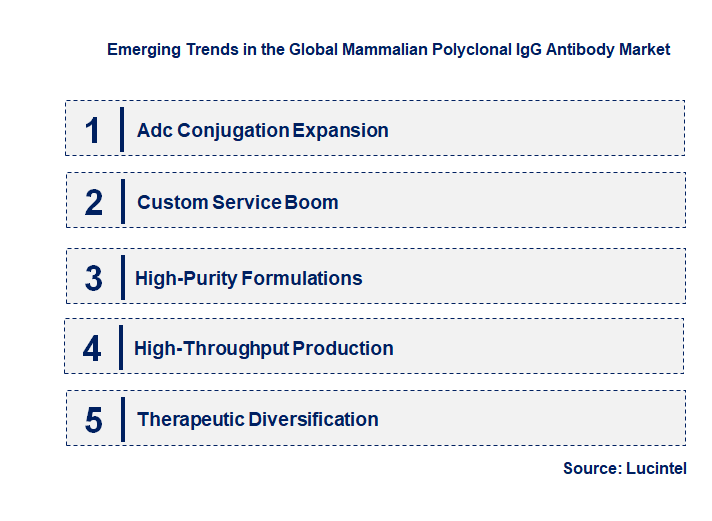
Emerging Trends in the Mammalian Polyclonal IgG Antibody Market

Recent Development in the Mammalian Polyclonal IgG Antibody Market

Recent developments of mammalian polyclonal IgG antibody market, highlight launches, expansions, and collaborations fortifying polyclonal infrastructures for advanced applications.

• Cosmo Bio Launch: New polyclonal portfolio targets biomedical research and diagnostics comprehensively. Broadens reagent access, accelerates studies, and elevates lab efficiencies.

• Twist Bioscience Expansion: CHO express antibodies streamline biotherapeutic screening innovatively. Speeds candidate selection, optimizes early discovery, and fuels ADC pipelines.

• Daiichi Sankyo Investment: Pfaffenhofen site upgrade pioneers advanced therapy production. Scales capacities, enhances innovations, and anchors European manufacturing.

• Piramal Facility Enhancement: ADC suites bolster high-quality conjugate capabilities strategically. Supports global demands, refines processes, and drives therapeutic outputs.

• GenScript Innovations: Novel polyclonals advance custom development services dynamically. Empowers researchers, diversifies applications, and boosts market competitiveness. These strides amplify scalability and precision, embedding polyclonals as R&D cornerstone while catalyzing therapeutic breakthroughs.

Strategic Growth Opportunities in the Mammalian Polyclonal IgG Antibody Market

The mammalian polyclonal IgG antibody market‘s growth exploits applications demanding multi-epitope affinity, from assays to therapies.

• Research Tools Dominance: Western blot and IHC reagents enable precise protein detection. Accelerates discoveries, validates targets, and fuels biotech pipelines.

• Diagnostics ELISA Surge: High-avidity IgG quantifies biomarkers reliably. Improves disease screenings, supports point-of-care, and enhances early interventions.

• Therapeutics Cancer Targeting: Polyclonals trigger ADCC in oncology effectively. Potentiates immunotherapies, overcomes resistances, and expands treatment arsenals.

• Infectious Disease Antitoxins: Broad neutralization combats pathogens potently. Bolsters vaccines, treats outbreaks, and fortifies public health defenses.

• Biotech Customization: Patient-derived models simulate diseases accurately. Optimizes screening, personalizes meds, and bridges preclinical gaps. Application diversifications solidify polyclonals‘ indispensability, amplifying efficiencies and outcomes across health sectors globally.

Mammalian Polyclonal IgG Antibody Market Driver and Challenges

Major drivers and challenges in mammalian polyclonal IgG antibody market involve R&D surges, diagnostic booms, production advances, regulatory alignments, offset by costs, variability, and ethics. The factors responsible for driving the mammalian polyclonal IgG antibody market include: 1. Chronic Disease Prevalence: Rising cancers and autoimmunes demand versatile diagnostics. Propels reagent volumes, therapeutic explorations, and precision strategies. 2. Biotech R&D Investments: Funds fuel custom polyclonal innovations robustly. Accelerates discoveries, partnerships, and high-throughput platforms. 3. Diagnostic Assay Demand: ELISA and IHC expansions require reliable IgG. Drives purity enhancements, scalability, and lab adoptions. 4. ADC Therapeutic Shift: Conjugates leverage IgG scaffolds effectively. Unlocks targeted deliveries, combo potentials, and market premiums. 5. Customization Services Rise: Tailored antibodies meet research niches dynamically. Boosts revenues, client retentions, and competitive edges. Challenges in the mammalian polyclonal IgG antibody market are: 1. Production Cost Barriers: Complex mammalian processes inflate expenses. Constrains accessibility, demands efficiencies, and automation pushes. 2. Batch Variability Issues: Inherent polyclonal heterogeneity challenges reproducibility. Necessitates rigorous QC, validations, and standardization. 3. Ethical Sourcing Concerns: Animal welfare scrutiny pressures alternatives. Spurs recombinant shifts, policy adaptations, and sustainable practices. Drivers eclipse challenges decisively, igniting innovative expansions. Polyclonals evolve as agile pillars, powering precision health frontiers sustainably.18 𝕏 posts56 web pages

List of Mammalian Polyclonal IgG Antibody Companies

Companies in the market compete on the basis of product quality offered. Major players in this market focus on expanding their manufacturing facilities, R&D investments, infrastructural development, and leverage integration opportunities across the value chain. With these strategies mammalian polyclonal IgG antibody companies cater increasing demand, ensure competitive effectiveness, develop innovative products & technologies, reduce production costs, and expand their customer base. Some of the mammalian polyclonal IgG antibody companies profiled in this report include-

• Abcam

• Bio-Rad Laboratories

• Thermo Fisher Scientific

• Novartis

• Geno Technology

• Merck

• Cell Signaling Technologies

• F. Hoffmann-La Roche

• Stemcell Technologies

• Phoenix Pharmaceuticals

Mammalian Polyclonal IgG Antibody Market by Segment

The study includes a forecast for the global mammalian polyclonal IgG antibody market by type, product, application, end use, and region.

Mammalian Polyclonal IgG Antibody Market by Type [Value from 2019 to 2031]:


• Goat

• Rabbit

• Horse

• Mouse

• Others

Mammalian Polyclonal IgG Antibody Market by Product [Value from 2019 to 2031]:


• Cardiac Markers

• Metabolic Markers

• Renal Markers

• Others

Mammalian Polyclonal IgG Antibody Market by Application [Value from 2019 to 2031]:


• ELISA

• Immunoturbidometry

• Immunoelectrophoresis

• Antibody Identification

• Immunohistochemistry

• Immunocytochemistry

• Western Blotting

Mammalian Polyclonal IgG Antibody Market by Region [Value from 2019 to 2031]:


• North America

• Europe

• Asia Pacific

• The Rest of the World

Country Wise Outlook for the Mammalian Polyclonal IgG Antibody Market

The mammalian polyclonal IgG antibody market expands amid surging demands for precision diagnostics, research tools, and therapeutics targeting chronic diseases. Facility investments, product launches, and partnerships enhance production scalability and customization across regions.

• United States: United States leads with Cosmo Bio launching specialized polyclonal ranges for research and diagnostics, alongside Twist Bioscience expanding high-throughput IgG portfolios. Robust biotech hubs drive custom services and ADC integrations, accelerating oncology and infectious disease applications nationwide.

• China: China bolsters Asia-Pacific dominance through genomic initiatives and manufacturing expansions supporting polyclonal production. Rising healthcare investments enable scalable diagnostics and therapeutic developments, fostering self-reliant supply chains for global partnerships.

• Germany: Germany advances via Daiichi Sankyo‘s major site expansion in Pfaffenhofen for advanced therapies including polyclonals. Precision engineering strengthens ADC capabilities, positioning Europe as innovation hub for high-quality antibody solutions.

• India: India accelerates with Piramal Pharma‘s ADC manufacturing enhancements and Bharat Serums‘ polyclonal facilities. Cost-effective expansions bridge therapeutic gaps, empowering oncology and vaccine research amid government biotech support.

• Japan: Japan leverages aging demographics for polyclonal advancements in regenerative and chronic care. Strategic alliances integrate novel production, enhancing research reagents and diagnostics aligned with national health priorities.

Lucintel Analytics Dashboard

Features of the Global Mammalian Polyclonal IgG Antibody Market

Market Size Estimates: Mammalian polyclonal IgG antibody market size estimation in terms of value ($B). Trend and Forecast Analysis: Market trends (2019 to 2024) and forecast (2025 to 2031) by various segments and regions. Segmentation Analysis: Mammalian polyclonal IgG antibody market size by various segments, such as by type, product, application, end use, and region in terms of value ($B). Regional Analysis: Mammalian polyclonal IgG antibody market breakdown by North America, Europe, Asia Pacific, and Rest of the World. Growth Opportunities: Analysis of growth opportunities in different types, products, applications, end uses, and regions for the mammalian polyclonal IgG antibody market. Strategic Analysis: This includes M&A, new product development, and competitive landscape of the mammalian polyclonal IgG antibody market. Analysis of competitive intensity of the industry based on Porter’s Five Forces model.

Lucintel Consulting Services

FAQ

Q1. What is the growth forecast for mammalian polyclonal IgG antibody market? Answer: The global mammalian polyclonal IgG antibody market is expected to grow with a CAGR of 5% from 2025 to 2031. Q2. What are the major drivers influencing the growth of the mammalian polyclonal IgG antibody market? Answer: The major drivers for this market are the increasing demand for therapeutic antibody production, the rising use of polyclonal antibodies in diagnostics, and the growing research in immunology & vaccine development. Q3. What are the major segments for mammalian polyclonal IgG antibody market? Answer: The future of the mammalian polyclonal IgG antibody market looks promising with opportunities in the pharmaceutical & biotechnology company, hospital, diagnostic center, and academic & research center markets. Q4. Who are the key mammalian polyclonal IgG antibody market companies? Answer: Some of the key mammalian polyclonal IgG antibody companies are as follows:

• Abcam

• Bio-Rad Laboratories

• Thermo Fisher Scientific

• Novartis

• Geno Technology

• Merck

• Cell Signaling Technologies

• F. Hoffmann-La Roche

• Stemcell Technologies

• Phoenix Pharmaceuticals Q5. Which mammalian polyclonal IgG antibody market segment will be the largest in future? Answer: Lucintel forecasts that, within the type category, mouse is expected to witness the highest growth over the forecast period. Q6. In mammalian polyclonal IgG antibody market, which region is expected to be the largest in next 5 years? Answer: In terms of region, APAC is expected to witness the highest growth over the forecast period. Q7. Do we receive customization in this report? Answer: Yes, Lucintel provides 10% customization without any additional cost.

Table of Contents

1. Executive Summary
15.1 Competitive Analysis Overview

List of Figures

Figure 9.1: Trends and Forecast for the North American Mammalian Polyclonal IgG Antibody Market (2019-2031) Figure 9.2: North American Mammalian Polyclonal IgG Antibody Market by Type in 2019, 2024, and 2031 Figure 9.3: Trends of the North American Mammalian Polyclonal IgG Antibody Market ($B) by Type (2019-2024) Figure 9.4: Forecast for the North American Mammalian Polyclonal IgG Antibody Market ($B) by Type (2025-2031) Figure 9.5: North American Mammalian Polyclonal IgG Antibody Market by Product in 2019, 2024, and 2031 Figure 9.6: Trends of the North American Mammalian Polyclonal IgG Antibody Market ($B) by Product (2019-2024) Figure 9.7: Forecast for the North American Mammalian Polyclonal IgG Antibody Market ($B) by Product (2025-2031) Figure 9.8: North American Mammalian Polyclonal IgG Antibody Market by Application in 2019, 2024, and 2031 Figure 9.9: Trends of the North American Mammalian Polyclonal IgG Antibody Market ($B) by Application (2019-2024) Figure 9.10: Forecast for the North American Mammalian Polyclonal IgG Antibody Market ($B) by Application (2025-2031) Figure 9.11: North American Mammalian Polyclonal IgG Antibody Market by End Use in 2019, 2024, and 2031 Figure 9.12: Trends of the North American Mammalian Polyclonal IgG Antibody Market ($B) by End Use (2019-2024) Figure 9.13: Forecast for the North American Mammalian Polyclonal IgG Antibody Market ($B) by End Use (2025-2031) Figure 9.14: Trends and Forecast for the United States Mammalian Polyclonal IgG Antibody Market ($B) (2019-2031) Figure 9.15: Trends and Forecast for the Mexican Mammalian Polyclonal IgG Antibody Market ($B) (2019-2031) Figure 9.16: Trends and Forecast for the Canadian Mammalian Polyclonal IgG Antibody Market ($B) (2019-2031)
Figure 10.1: Trends and Forecast for the European Mammalian Polyclonal IgG Antibody Market (2019-2031) Figure 10.2: European Mammalian Polyclonal IgG Antibody Market by Type in 2019, 2024, and 2031 Figure 10.3: Trends of the European Mammalian Polyclonal IgG Antibody Market ($B) by Type (2019-2024) Figure 10.4: Forecast for the European Mammalian Polyclonal IgG Antibody Market ($B) by Type (2025-2031) Figure 10.5: European Mammalian Polyclonal IgG Antibody Market by Product in 2019, 2024, and 2031 Figure 10.6: Trends of the European Mammalian Polyclonal IgG Antibody Market ($B) by Product (2019-2024) Figure 10.7: Forecast for the European Mammalian Polyclonal IgG Antibody Market ($B) by Product (2025-2031) Figure 10.8: European Mammalian Polyclonal IgG Antibody Market by Application in 2019, 2024, and 2031 Figure 10.9: Trends of the European Mammalian Polyclonal IgG Antibody Market ($B) by Application (2019-2024) Figure 10.10: Forecast for the European Mammalian Polyclonal IgG Antibody Market ($B) by Application (2025-2031) Figure 10.11: European Mammalian Polyclonal IgG Antibody Market by End Use in 2019, 2024, and 2031 Figure 10.12: Trends of the European Mammalian Polyclonal IgG Antibody Market ($B) by End Use (2019-2024) Figure 10.13: Forecast for the European Mammalian Polyclonal IgG Antibody Market ($B) by End Use (2025-2031) Figure 10.14: Trends and Forecast for the German Mammalian Polyclonal IgG Antibody Market ($B) (2019-2031) Figure 10.15: Trends and Forecast for the French Mammalian Polyclonal IgG Antibody Market ($B) (2019-2031) Figure 10.16: Trends and Forecast for the Spanish Mammalian Polyclonal IgG Antibody Market ($B) (2019-2031) Figure 10.17: Trends and Forecast for the Italian Mammalian Polyclonal IgG Antibody Market ($B) (2019-2031) Figure 10.18: Trends and Forecast for the United Kingdom Mammalian Polyclonal IgG Antibody Market ($B) (2019-2031)
Figure 11.1: Trends and Forecast for the APAC Mammalian Polyclonal IgG Antibody Market (2019-2031) Figure 11.2: APAC Mammalian Polyclonal IgG Antibody Market by Type in 2019, 2024, and 2031 Figure 11.3: Trends of the APAC Mammalian Polyclonal IgG Antibody Market ($B) by Type (2019-2024) Figure 11.4: Forecast for the APAC Mammalian Polyclonal IgG Antibody Market ($B) by Type (2025-2031) Figure 11.5: APAC Mammalian Polyclonal IgG Antibody Market by Product in 2019, 2024, and 2031 Figure 11.6: Trends of the APAC Mammalian Polyclonal IgG Antibody Market ($B) by Product (2019-2024) Figure 11.7: Forecast for the APAC Mammalian Polyclonal IgG Antibody Market ($B) by Product (2025-2031) Figure 11.8: APAC Mammalian Polyclonal IgG Antibody Market by Application in 2019, 2024, and 2031 Figure 11.9: Trends of the APAC Mammalian Polyclonal IgG Antibody Market ($B) by Application (2019-2024) Figure 11.10: Forecast for the APAC Mammalian Polyclonal IgG Antibody Market ($B) by Application (2025-2031) Figure 11.11: APAC Mammalian Polyclonal IgG Antibody Market by End Use in 2019, 2024, and 2031 Figure 11.12: Trends of the APAC Mammalian Polyclonal IgG Antibody Market ($B) by End Use (2019-2024) Figure 11.13: Forecast for the APAC Mammalian Polyclonal IgG Antibody Market ($B) by End Use (2025-2031) Figure 11.14: Trends and Forecast for the Japanese Mammalian Polyclonal IgG Antibody Market ($B) (2019-2031) Figure 11.15: Trends and Forecast for the Indian Mammalian Polyclonal IgG Antibody Market ($B) (2019-2031) Figure 11.16: Trends and Forecast for the Chinese Mammalian Polyclonal IgG Antibody Market ($B) (2019-2031) Figure 11.17: Trends and Forecast for the South Korean Mammalian Polyclonal IgG Antibody Market ($B) (2019-2031) Figure 11.18: Trends and Forecast for the Indonesian Mammalian Polyclonal IgG Antibody Market ($B) (2019-2031)
Figure 12.1: Trends and Forecast for the ROW Mammalian Polyclonal IgG Antibody Market (2019-2031) Figure 12.2: ROW Mammalian Polyclonal IgG Antibody Market by Type in 2019, 2024, and 2031 Figure 12.3: Trends of the ROW Mammalian Polyclonal IgG Antibody Market ($B) by Type (2019-2024) Figure 12.4: Forecast for the ROW Mammalian Polyclonal IgG Antibody Market ($B) by Type (2025-2031) Figure 12.5: ROW Mammalian Polyclonal IgG Antibody Market by Product in 2019, 2024, and 2031 Figure 12.6: Trends of the ROW Mammalian Polyclonal IgG Antibody Market ($B) by Product (2019-2024) Figure 12.7: Forecast for the ROW Mammalian Polyclonal IgG Antibody Market ($B) by Product (2025-2031) Figure 12.8: ROW Mammalian Polyclonal IgG Antibody Market by Application in 2019, 2024, and 2031 Figure 12.9: Trends of the ROW Mammalian Polyclonal IgG Antibody Market ($B) by Application (2019-2024) Figure 12.10: Forecast for the ROW Mammalian Polyclonal IgG Antibody Market ($B) by Application (2025-2031) Figure 12.11: ROW Mammalian Polyclonal IgG Antibody Market by End Use in 2019, 2024, and 2031 Figure 12.12: Trends of the ROW Mammalian Polyclonal IgG Antibody Market ($B) by End Use (2019-2024) Figure 12.13: Forecast for the ROW Mammalian Polyclonal IgG Antibody Market ($B) by End Use (2025-2031) Figure 12.14: Trends and Forecast for the Middle Eastern Mammalian Polyclonal IgG Antibody Market ($B) (2019-2031) Figure 12.15: Trends and Forecast for the South American Mammalian Polyclonal IgG Antibody Market ($B) (2019-2031) Figure 12.16: Trends and Forecast for the African Mammalian Polyclonal IgG Antibody Market ($B) (2019-2031)

List of Tables

Table 6.1: Attractiveness Analysis for the Global Mammalian Polyclonal IgG Antibody Market by Application Table 6.2: Market Size and CAGR of Various Application in the Global Mammalian Polyclonal IgG Antibody Market (2019-2024) Table 6.3: Market Size and CAGR of Various Application in the Global Mammalian Polyclonal IgG Antibody Market (2025-2031) Table 6.4: Trends of ELISA in the Global Mammalian Polyclonal IgG Antibody Market (2019-2024) Table 6.5: Forecast for ELISA in the Global Mammalian Polyclonal IgG Antibody Market (2025-2031) Table 6.6: Trends of Immunoturbidometry in the Global Mammalian Polyclonal IgG Antibody Market (2019-2024) Table 6.7: Forecast for Immunoturbidometry in the Global Mammalian Polyclonal IgG Antibody Market (2025-2031) Table 6.8: Trends of Immunoelectrophoresis in the Global Mammalian Polyclonal IgG Antibody Market (2019-2024) Table 6.9: Forecast for Immunoelectrophoresis in the Global Mammalian Polyclonal IgG Antibody Market (2025-2031) Table 6.10: Trends of Antibody Identification in the Global Mammalian Polyclonal IgG Antibody Market (2019-2024) Table 6.11: Forecast for Antibody Identification in the Global Mammalian Polyclonal IgG Antibody Market (2025-2031) Table 6.12: Trends of Immunohistochemistry in the Global Mammalian Polyclonal IgG Antibody Market (2019-2024) Table 6.13: Forecast for Immunohistochemistry in the Global Mammalian Polyclonal IgG Antibody Market (2025-2031) Table 6.14: Trends of Immunocytochemistry in the Global Mammalian Polyclonal IgG Antibody Market (2019-2024) Table 6.15: Forecast for Immunocytochemistry in the Global Mammalian Polyclonal IgG Antibody Market (2025-2031) Table 6.16: Trends of Western Blotting in the Global Mammalian Polyclonal IgG Antibody Market (2019-2024) Table 6.17: Forecast for Western Blotting in the Global Mammalian Polyclonal IgG Antibody Market (2025-2031)
Table 9.1: Trends of the North American Mammalian Polyclonal IgG Antibody Market (2019-2024) Table 9.2: Forecast for the North American Mammalian Polyclonal IgG Antibody Market (2025-2031) Table 9.3: Market Size and CAGR of Various Type in the North American Mammalian Polyclonal IgG Antibody Market (2019-2024) Table 9.4: Market Size and CAGR of Various Type in the North American Mammalian Polyclonal IgG Antibody Market (2025-2031) Table 9.5: Market Size and CAGR of Various Product in the North American Mammalian Polyclonal IgG Antibody Market (2019-2024) Table 9.6: Market Size and CAGR of Various Product in the North American Mammalian Polyclonal IgG Antibody Market (2025-2031) Table 9.7: Market Size and CAGR of Various Application in the North American Mammalian Polyclonal IgG Antibody Market (2019-2024) Table 9.8: Market Size and CAGR of Various Application in the North American Mammalian Polyclonal IgG Antibody Market (2025-2031) Table 9.9: Market Size and CAGR of Various End Use in the North American Mammalian Polyclonal IgG Antibody Market (2019-2024) Table 9.10: Market Size and CAGR of Various End Use in the North American Mammalian Polyclonal IgG Antibody Market (2025-2031) Table 9.11: Trends and Forecast for the United States Mammalian Polyclonal IgG Antibody Market (2019-2031) Table 9.12: Trends and Forecast for the Mexican Mammalian Polyclonal IgG Antibody Market (2019-2031) Table 9.13: Trends and Forecast for the Canadian Mammalian Polyclonal IgG Antibody Market (2019-2031)
Table 10.1: Trends of the European Mammalian Polyclonal IgG Antibody Market (2019-2024) Table 10.2: Forecast for the European Mammalian Polyclonal IgG Antibody Market (2025-2031) Table 10.3: Market Size and CAGR of Various Type in the European Mammalian Polyclonal IgG Antibody Market (2019-2024) Table 10.4: Market Size and CAGR of Various Type in the European Mammalian Polyclonal IgG Antibody Market (2025-2031) Table 10.5: Market Size and CAGR of Various Product in the European Mammalian Polyclonal IgG Antibody Market (2019-2024) Table 10.6: Market Size and CAGR of Various Product in the European Mammalian Polyclonal IgG Antibody Market (2025-2031) Table 10.7: Market Size and CAGR of Various Application in the European Mammalian Polyclonal IgG Antibody Market (2019-2024) Table 10.8: Market Size and CAGR of Various Application in the European Mammalian Polyclonal IgG Antibody Market (2025-2031) Table 10.9: Market Size and CAGR of Various End Use in the European Mammalian Polyclonal IgG Antibody Market (2019-2024) Table 10.10: Market Size and CAGR of Various End Use in the European Mammalian Polyclonal IgG Antibody Market (2025-2031,) Table 10.11: Trends and Forecast for the German Mammalian Polyclonal IgG Antibody Market (2019-2031) Table 10.12: Trends and Forecast for the French Mammalian Polyclonal IgG Antibody Market (2019-2031) Table 10.13: Trends and Forecast for the Spanish Mammalian Polyclonal IgG Antibody Market (2019-2031) Table 10.14: Trends and Forecast for the Italian Mammalian Polyclonal IgG Antibody Market (2019-2031) Table 10.15: Trends and Forecast for the United Kingdom Mammalian Polyclonal IgG Antibody Market (2019-2031)
Table 11.1: Trends of the APAC Mammalian Polyclonal IgG Antibody Market (2019-2024) Table 11.2: Forecast for the APAC Mammalian Polyclonal IgG Antibody Market (2025-2031) Table 11.3: Market Size and CAGR of Various Type in the APAC Mammalian Polyclonal IgG Antibody Market (2019-2024) Table 11.4: Market Size and CAGR of Various Type in the APAC Mammalian Polyclonal IgG Antibody Market (2025-2031) Table 11.5: Market Size and CAGR of Various Product in the APAC Mammalian Polyclonal IgG Antibody Market (2019-2024) Table 11.6: Market Size and CAGR of Various Product in the APAC Mammalian Polyclonal IgG Antibody Market (2025-2031) Table 11.7: Market Size and CAGR of Various Application in the APAC Mammalian Polyclonal IgG Antibody Market (2019-2024) Table 11.8: Market Size and CAGR of Various Application in the APAC Mammalian Polyclonal IgG Antibody Market (2025-2031) Table 11.9: Market Size and CAGR of Various End Use in the APAC Mammalian Polyclonal IgG Antibody Market (2019-2024) Table 11.10: Market Size and CAGR of Various End Use in the APAC Mammalian Polyclonal IgG Antibody Market (2025-2031) Table 11.11: Trends and Forecast for the Japanese Mammalian Polyclonal IgG Antibody Market (2019-2031) Table 11.12: Trends and Forecast for the Indian Mammalian Polyclonal IgG Antibody Market (2019-2031) Table 11.13: Trends and Forecast for the Chinese Mammalian Polyclonal IgG Antibody Market (2019-2031) Table 11.14: Trends and Forecast for the South Korean Mammalian Polyclonal IgG Antibody Market (2019-2031) Table 11.15: Trends and Forecast for the Indonesian Mammalian Polyclonal IgG Antibody Market (2019-2031)

Methodology

Lucintel has been in the business of market research and management consulting since 2000 and has published over 1000 market intelligence reports in various markets / applications and served over 1,000 clients worldwide. This study is a culmination of four months of full-time effort performed by Lucintel's analyst team. The analysts used the following sources for the creation and completion of this valuable report:
  • In-depth interviews of the major players in this market
  • Detailed secondary research from competitors’ financial statements and published data 
  • Extensive searches of published works, market, and database information pertaining to industry news, company press releases, and customer intentions
  • A compilation of the experiences, judgments, and insights of Lucintel’s professionals, who have analyzed and tracked this market over the years.
Extensive research and interviews are conducted across the supply chain of this market to estimate market share, market size, trends, drivers, challenges, and forecasts. Below is a brief summary of the primary interviews that were conducted by job function for this report.
 
Thus, Lucintel compiles vast amounts of data from numerous sources, validates the integrity of that data, and performs a comprehensive analysis. Lucintel then organizes the data, its findings, and insights into a concise report designed to support the strategic decision-making process. The figure below is a graphical representation of Lucintel’s research process. 
 

Buy Now

Choose a license that fits your team. Instant PDF delivery.

Market Report

1 User PDF

$4,850
Buy Now

Market Report

2-5 Users PDF

$6,700
Buy Now

Market Report

Corporate PDF

$8,850
Buy Now

Market Report

Global PDF

$10,000
Buy Now

Prices exclude taxes. Instant delivery. Custom licensing available on request.

Key Questions

  • What are some of the most promising, high-growth opportunities for the mammalian polyclonal IgG antibody market by type (goat, rabbit, horse, mouse, and others), product (cardiac markers, metabolic markers, renal markers, and others), application (ELISA, immunoturbidometry, immunoelectrophoresis, antibody identification, immunohistochemistry, immunocytochemistry, and western blotting), end use (pharmaceutical & biotechnology companies, hospitals, diagnostic centers, and academic & research centers), and region (North America, Europe, Asia Pacific, and the Rest of the World)?
  • Which segments will grow at a faster pace and why?
  • Which region will grow at a faster pace and why?
  • What are the key factors affecting market dynamics? What are the key challenges and business risks in this market?
  • What are the business risks and competitive threats in this market?
  • What are the emerging trends in this market and the reasons behind them?
  • What are some of the changing demands of customers in the market?
  • What are the new developments in the market? Which companies are leading these developments?
  • Who are the major players in this market? What strategic initiatives are key players pursuing for business growth?
  • What are some of the competing products in this market and how big of a threat do they pose for loss of market share by material or product substitution?
  • What M&A activity has occurred in the last 5 years and what has its impact been on the industry? For any questions related to Mammalian Polyclonal IgG Antibody Market, Mammalian Polyclonal IgG Antibody Market Size, Mammalian Polyclonal IgG Antibody Market Growth, Mammalian Polyclonal IgG Antibody Market Analysis, Mammalian Polyclonal IgG Antibody Market Report, Mammalian Polyclonal IgG Antibody Market Share, Mammalian Polyclonal IgG Antibody Market Trends, Mammalian Polyclonal IgG Antibody Market Forecast, Mammalian Polyclonal IgG Antibody Companies, write Lucintel analyst at email: helpdesk@lucintel.com. We will be glad to get back to you soon.
Why Choose Us

The Lucintel Advantage

Trusted partner for strategic intelligence and business growth

25+ Years Excellence

25+ Years Excellence

Quarter century of proven expertise in management consulting and market research across global markets.
Game-Changer Ideas

Game-Changer Ideas

Innovative strategies and actionable insights that help clients become the smartest in their industry.
Global Reach

Global Reach

Extensive coverage across 50+ industries and markets worldwide with localized expertise.
Start Your Growth Journey

Get Your Free
Market Intelligence
Briefing

Receive a complimentary market analysis tailored to your industry. Our analysts will identify key growth opportunities and competitive dynamics specific to your business.

Custom Market Snapshot

Market size, growth rate, and key trend analysis for your specific sector.

Competitive Landscape Overview

Top competitor positioning and market share analysis.

Growth Opportunity Identification

Strategic recommendations backed by data-driven insights.

Subscribe

Subscribe to our Newsletter

Get curated market intelligence and competitive moves straight to your inbox.

By subscribing, you agree to receive our monthly insights. Unsubscribe anytime.

Industry Trends Market Signals Opportunities Competitor Moves