
Report Feature
K-12 Instruction Material Trends and Forecast
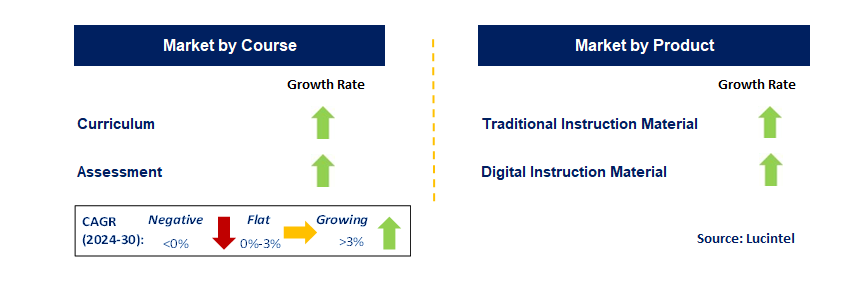
The future of the global k-12 instruction material market looks promising with opportunities in the traditional instruction material and digital instruction material markets. The global k-12 instruction material market is expected to grow with a CAGR of 6.7% from 2024 to 2030. The major drivers for this market are easy accessibility to educational content, rise of virtual classroom training, and increasing demand for adaptive learning.• Lucintel forecasts that, within the type category, the curriculum will remain the larger segment over the forecast period.
• Within the application category, digital instruction material will remain the larger segment.
• In terms of region, North America will remain the largest region over the forecast period. A more than 150-page report is developed to help in your business decisions.

Emerging Trends in the K-12 Instruction Material Market
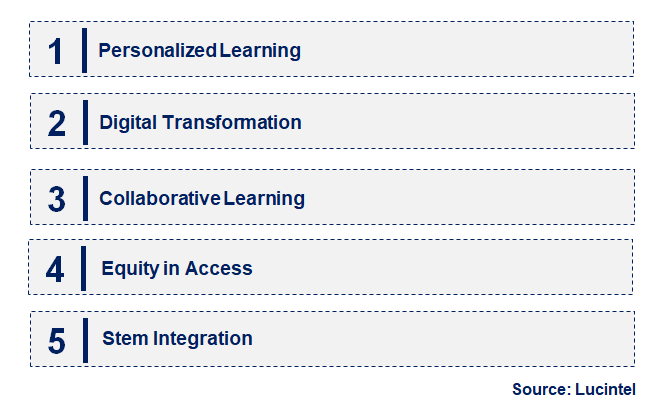
The following trends indicate a commitment toward learning experiences at a broader scale using innovative methodologies and resources to also serve diverse student populations. As changes are being adapted within the educational setup, institutions build more engaging and effective learning environments.• Personalized Learning: Personalized learning is meant to offer education suitable to the learning needs of individual students. According to the use of data analytics and AI, the educators can personalize the learning materials to suit the pace as well as style of the students. It fosters engagement and leads towards better academic performance, and in this manner, education becomes relevant and effective to the diverse range of learners. Since the personalization empowers the learners to control their learning journey, this encourages students to be more self-motivated and responsible.
• Digital Transformation: Digital change in K-12 education is rewriting the instructional materials by adopting e-books, online tests, and interactive learning materials. The change facilitates accessibility and brings it up-to-date in a manner that will be applicable in real time to keep the students abreast with the latest concepts. Digital transformation also supports remote and blended learning settings, making education more flexible. This makes it easy for institutions to offer education using technology in current ever-evolving conditions.
• Collaborative Learning: Collaborative learning indeed is on the rise and emphasizes teamwork and interaction between peers. Instructional materials designed for group activities promote communication as well as thinking critically. An approach such as this not only aids the learning process but also readies students to experience reality when collaborative work occurs in real life, making them much better prepared to face real-life challenges in the near future. By encouraging collaboration, teachers are fostering qualities that the children should possess in their life-their personal or professional life.
• Equity in Access: There is also an increasing focus on equal access for all educational resources to less privileged populations. For instance, programs for better research resources at the underfunded schools to improve academic quality, help address disparity in educational opportunities. It promotes inclusiveness in that context and change the educational scenario toward greater balance. In this respect, by equity, education works continuously toward a future where all students could succeed.
• Stem Integration: An important feature of integration into instructional materials is the inclusion of STEM education in K-12 curricula. Science, technology, engineering, and mathematics education can be relied on to produce hands-on learning experiences. This prepares the workforce for the future technological world. Innovation and critical thinking skills are enhanced in order to help realize tomorrow's challenges and opportunities. Educational institutions are hence adjusting their curricula to prepare students better for future demands. This market for K-12 instruction reflects trends toward more personalized, technology-driven, and collaborative educational practices. School districts increasingly show a greater focus on using more digital tools, fostering more social-emotional learning, and increasing emphasis on STEM-integrated education to make learning environments more engaging and effective. These changes relate to the intensive learning environment and prepare school students better for 21st-century challenges while staying relevant and impactful.
Recent Developments in the K-12 Instruction Material Market
Current key trends in the K-12 instruction material market are further illustrations of the strong forces of change that are exerted by technology, innovative teaching strategies, and changes in educational policies. The trends affect virtually every aspect of education delivery and experience across the world. As a result of adopting these trends, the schools and their educators have begun setting up more effective and engaging learning environments for students.• Digital Learning Platforms: Digital learning platforms are transforming the way instructional material is delivered. They allow for interactive content and learning paths that have increased student engagement. Their uptake has been facilitated, even during a pandemic, to ensure that education can be more flexible and available to more students. By leveraging technology, educators can have more tailored learning experiences, catering to unique needs.
• Growing Adoption of Open Educational Resources (OER): Open Educational Resources are gaining momentum, allowing teachers to access better quality resources for free. This trend fosters collaboration among educators and encourages customization of materials; long termedly, this helps richen resources available in schools of lower budgets and supports equitable opportunities to learn.
• Focus on Social-Emotional Learning (SEL): Incorporating SEL components within instructional materials is on the rise. In this regard, the students are expected to acquire skills such as empathy and resilience so that they can face a comprehensive educational experience. Schools, in this way, create a more sensitive environment for all students by addressing the issues that concern emotional well-being at the same time as academics. SEL is gradually turning into a component that cannot be omitted from any form of education.
• Gamification in Learning: Gamification strategies are now even used in teaching aids; games make learning easy and interesting. Teachers use gamification to attract students and make them "sticky." This promises positive results for engagement and enthusiasm, making for an enjoyable class. Since gamification is on the rise, it is also helping students enjoy learning more.
• Collaborative Technologies: Adoption of collaborative technologies has transformed the ways in which a student interacts with instructional materials. Technologies that facilitate group projects and real-time feedback foster peer learning and development of community. The approach increases educational outcomes and equips students with necessary skills in handling collaborative workspaces in their future careers. In this respect, these technologies are creating a more dynamic, interactive experience for the learner. Key trends of K-12 instruction material market are transforming education delivery. Digital learning platforms, increased reliance on OERs, new focus on SEL, gamification, and collaborative technologies are all making learning more engaging and accessible for students. As these changes occur, they help create a more inclusive and effective learning environment that benefits students and educators.
Strategic Growth Opportunities for K-12 Instruction Material Market
The K-12 instructional material market is one area of tremendous growth opportunity, driven by the relentless march of technology and changing needs in education. Seizing such opportunities may mean improvements in learning experiences and outcomes in a number of contexts, thus opening the door to a more imaginative and responsive educational future.• Integration with EdTech: EdTech integration in K-12 is full of promise for growth. Personalized learning and data-driven instruction will ensure higher engagement and better results for students through all-inclusive platforms. Future expansion in this arena is going to be tremendous with increased demand for innovative educational technologies as more schools take it up. Thus, schools are becoming more capable of fulfilling the various needs of their students.
• Mobile Learning Applications: As the prevalence of mobile technology increases, with more and more people owning mobile devices, there is potential for developing applications based on mobile learning. It can involve an application that allows students to access instructional materials at any time, in any place, or facilitate the learning environment. Since the number of students who use mobile devices is increasing rapidly, this field has prospects to expand so widely that every learner shall have education that is accessible as well as highly interactive.
• Adaptive Learning Systems: Adaptive learning systems become exciting opportunities in the K-12 market, exploiting data to tailor content delivery based on student progress and more personalized learning experiences for a better student outcome. Adaptation in learning to significant academic performance improvement is supported through enhanced engagement and outcomes. All the more that schools begin integrating such adaptive learning systems; varied forms of learning needs will have a seat in schools.
• Design Interactive Content: The creation of interactive contents for K-12 is an emerging opportunity. The multimedia resource materials, including videos and simulations, are very engaging and easier to understand for the students. This trend hence falls into the need for effective instructional materials that will interest learners and help in boosting their understanding. As the trend of providing more interactive content increases, then so does the process of learning.
• Teacher Training: Another key strategic growth opportunity lies in investments into teacher training programs to maximally utilize new and emerging instructional material. As learning resources evolve, teachers have to learn how to incorporate such materials into their instructional practices for improved learning experiences and outcomes that lead to improved student learning results. Professional development can ensure the educators learn to navigate an increasingly changing education environment. With technological advancements and evolving need for education, K-12 offers a vast array of avenues for instruction material. A few growth areas include EdTech integration, mobile learning applications, adaptive learning systems, development of interactive content, and teacher training programs. To that end, improvement in educational process and outcomes can also be done by the stakeholders eventually making the learning environment all the more effective for students.
K-12 Instruction Material Market Driver and Challenges
The K-12 instructional material market operates with a wide array of drivers and challenges within itself, consisting of factors incorporating or impelled by technology, economy, and regulation. The schools and teachers moving through this volatile landscape seek to know about these elements so that they would be capable of responding appropriately according to the change. This analysis sets down upon those major drivers that push forward growth and challenge that may affect in the sector. The factors responsible for driving the k-12 instruction material market include: 1. Advancements in Technology: Technological changes are transforming the content of K-12 instructional materials and making it possible to incorporate more interactive and engaging content. E-books, educational apps, and online platforms have eased access and personalization. It gives educators an opportunity to teach students better since they are different, engaging them and helping them learn optimally while also simplifying education. There is more demand for digital learning solutions. 2. Government Initiatives: Policies such as development of digital infrastructure and provision of funding for resources are improving the implementation of educational technology in K-12, thus accelerating its market. The policies that enhance digital infrastructure and provide funds for resources enable schools to use effective learning materials, thus ensuring a higher equalizing effect on the learning atmosphere to provide quality access of educational resources to all students regardless of the socio-economic background. 3. Focus on SEL: The value of social-emotional learning or SEL is finally receiving recognition across the board, and this impacts the type of instructional materials that are developed. There is increasing emphasis on the provision of curricula to include aspects of SEL in them to be able to cater to the emotional and psychological balance of students. This inclusion develops a holistic approach in the delivery of education, which results in a healthier learning setting that upholds rigorous academic studies combined with personal growth. Challenges in the k-12 instruction material market are: 1. Financing Problems: Probably, one of the challenges is the budget. Most K-12 institutions have limited funding allocated to them. Consequently, school budgets mean that they have limited money to invest in adopting new technologies or instructional materials, hence unable to offer quality education efficiently. This financial squeeze can exacerbate resource disparities, particularly for disadvantaged regions, which has a direct impact on the learning opportunities and outcomes of students in these regions. 2. Resistance to change: Teacher opposition to change can even cause delays in the adoption of new instructional materials. Some teachers may resist new technologies or teaching practices in the classroom. This usually is a result of lack of proper training, fear of something unknown, or just downright contentment with what they are good at, therefore developing slowly and affecting the implementation of educational reforms less. The K-12 instruction material market can be driven by even more complex interplay of drivers and challenges. On the one hand, technological advancements push the growth and innovation; increased demand for digital solutions; support from the government; and SEL and STEM education emphasize these factors. On the other hand, budget constraints, resistance to the notion of change, and the hurdles of regulatory issues pose important challenges. Effective navigation across these elements is more than relevant to those concerned with enhancing educational practices and boosting student outcomes in this changing landscape..List of K-12 Instruction Material Companies
Companies in the market compete on the basis of product quality offered. Major players in this market focus on expanding their manufacturing facilities, R&D investments, infrastructural development, and leverage integration opportunities across the value chain. Through these strategies k-12 instruction material companies cater increasing demand, ensure competitive effectiveness, develop innovative products & technologies, reduce production costs, and expand their customer base. Some of the k-12 instruction material companies profiled in this report include-• Carnegie Learning
• Cengage Learning
• D2L
• Discovery Education
• Follett
• Gakken Holdings
• Hachette Book
K-12 Instruction Material by Segment
The study includes a forecast for the global k-12 instruction material by course, product, and region.K-12 Instruction Material Market by Course [Analysis by Value from 2018 to 2030]:
• Curriculum
• Assessment
K-12 Instruction Material Market by Product [Analysis by Value from 2018 to 2030]:
• Traditional Instruction Material
• Digital Instruction Material
K-12 Instruction Material Market by Region [Analysis by Value from 2018 to 2030]:
• North America
• Europe
• Asia Pacific
• The Rest of the World
Country Wise Outlook for the K-12 Instruction Material Market
Recently, markets changing so fast by different approaches in the United States, China, Germany, India, and Japan, who could integrate all of these digital resources and innovative methodologies into instructions to enrich the learning experiences of K-12 instructions. These changes reflect the global aspirations towards more personal, available, and engaging learning practices to meet changing needs during a constantly evolving world. As such, the trends will suggest a transformation of epochs in education with a focus on flexibility and inclusivity .• United States: The United States has transitioned toward digital and blended learning environments, although this is primarily due to the effects of the pandemic. Schools throughout the globe embrace interactive platforms and learning technologies that are made adaptable to different needs. In achieving a balance on equity in education, underfunded schools are facilitated with the right resources. The trend improves quality, but it "sets a higher threshold of expectation for all students to succeed in 21st-century expectations."
• China: China is taking a strong lead on digital education as the government attaches much importance to integrating technology in classrooms. The focus on online learning platform and digital resource development is not only an initiative aimed at increasing educational equity but also forms part of a bigger program to try and increase educational equality. To promote STEM education and professionalize the workforce, there are specialized instructional materials under development. Thus, these innovations push China to the top in terms of educational innovation, while students will be more equipped for their future.
• Germany: Enhancing digital infrastructure in schools will enable Germany to adopt the initiatives, such as "DigitalPakt Schule," because it means providing the school with all necessary tools for effective teaching using digitalization. Collaborative materials are being used increasingly in learning as they allow interaction and student participation since learning can be interactive in a classroom. Improving the situation concerning digital resources will make Germany's education system competitive and responsive to the modern needs of learners.
• India: Given its digitized initiatives and localized content, India's K-12 education space is expanding rapidly. The National Education Policy has picked up on this increased need for digital literacy and innovative pedagogy. There is a rising tide of EdTech start-ups diversifying the instructional material for students to meet different needs in different regions. Its impact is not just on the quality but also on gap-filling that makes access more effective so that maximum students can learn through effectively delivered lessons.
• Japan: The K-12 market in Japan is transforming through the GIGA School Program-the aim is to connect each student, digitalizing life at school. It promotes active learning and access to resources. Global citizenship education is also becoming quite important, and thus, instructional materials on international understanding are also developed. These factors together ensure that a generation is ready in Japan, as smart in technology as any other part of the world.

Features of the Global K-12 Instruction Material Market
Market Size Estimates: K-12 instruction material market size estimation in terms of value ($B). Trend and Forecast Analysis: Market trends (2018 to 2023) and forecast (2024 to 2030) by various segments and regions. Segmentation Analysis: K-12 instruction material market size by course, product, and region in terms of value ($B). Regional Analysis: K-12 instruction material market breakdown by North America, Europe, Asia Pacific, and Rest of the World. Growth Opportunities: Analysis of growth opportunities in different courses, products, and regions for the k-12 instruction material market. Strategic Analysis: This includes M&A, new product development, and competitive landscape of the k-12 instruction material market. Analysis of competitive intensity of the industry based on Porter’s Five Forces model.If you are looking to expand your business in this market or adjacent markets, then contact us. We have done hundreds of strategic consulting projects in market entry, opportunity screening, due diligence, supply chain analysis, M & A, and more.

FAQ
Q1. What is the growth forecast for the k-12 instruction material market? Answer: The global k-12 instruction material market is expected to grow with a CAGR of 6.7% from 2024 to 2030. Q2. What are the major drivers influencing the growth of the k-12 instruction material market? Answer: The major drivers for this market are easy accessibility to educational content, the rise of virtual classroom training, and the increasing demand for adaptive learning. Q3. What are the major segments for the k-12 instruction material market? Answer: The future of the k-12 instruction material market looks promising with opportunities in the traditional instruction material and digital instruction material markets. Q4. Who are the key k-12 instruction material market companies? Answer: Some of the key k-12 instruction material companies are as follows:• Carnegie Learning
• Cengage Learning
• D2L
• Discovery Education
• Follett
• Gakken Holdings
• Hachette Book Q5. Which k-12 instruction material market segment will be the largest in the future? Answer: Lucintel forecasts that curriculum will remain the larger segment over the forecast period. Q6. In the k-12 instruction material market, which region is expected to be the largest in the next 5 years? Answer: North America will remain the largest region over the forecast period. Q.7 Do we receive customization in this report? Answer: Yes, Lucintel provides 10% customization without any additional cost.
Table of Contents
Methodology
- In-depth interviews of the major players in this market
- Detailed secondary research from competitors’ financial statements and published data
- Extensive searches of published works, market, and database information pertaining to industry news, company press releases, and customer intentions
- A compilation of the experiences, judgments, and insights of Lucintel’s professionals, who have analyzed and tracked this market over the years.


Buy Now
Choose a license that fits your team. Instant PDF delivery.
Prices exclude taxes. Instant delivery. Custom licensing available on request.
Key Questions
- • What are some of the most promising, high-growth opportunities for the k-12 instruction material market by course (curriculum and assessment), product (traditional instruction material and digital instruction material), and region (North America, Europe, Asia Pacific, and the Rest of the World)?
- • Which segments will grow at a faster pace and why?
- • Which region will grow at a faster pace and why?
- • What are the key factors affecting market dynamics? What are the key challenges and business risks in this market?
- • What are the business risks and competitive threats in this market?
- • What are the emerging trends in this market and the reasons behind them?
- • What are some of the changing demands of customers in the market?
- • What are the new developments in the market? Which companies are leading these developments?
- • Who are the major players in this market? What strategic initiatives are key players pursuing for business growth?
- • What are some of the competing products in this market and how big of a threat do they pose for loss of market share by material or product substitution?
- • What M&A activity has occurred in the last 5 years and what has its impact been on the industry? For any questions related toK-12 instruction material market, K-12 instruction material market size, K-12 instruction material market growth, K-12 instruction material market analysis, K-12 instruction material market report, K-12 instruction material market share, K-12 instruction material market trends, K-12 instruction material market forecast, K-12 instruction material companies, write Lucintel analyst at email: helpdesk@lucintel.com. We will be glad to get back to you soon.


