
Report Feature
Infrastructure Specialty Silicone Market Market Trends and Forecast
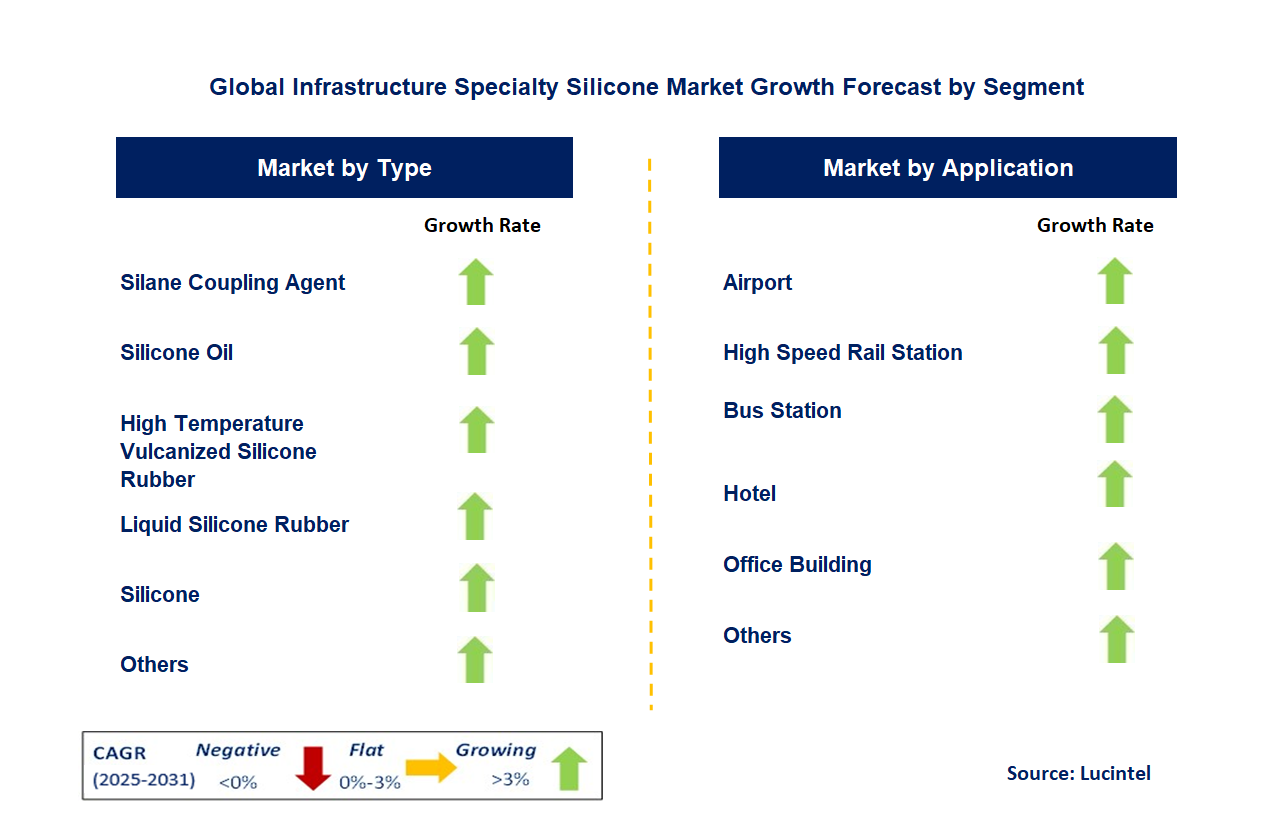
The future of the global infrastructure specialty silicone market looks promising with opportunities in the airport, high speed rail station, bus station, hotel and office building markets. The global infrastructure specialty silicone market is expected to grow with a CAGR of 7.1% from 2025 to 2031. The major drivers for this market are growing need for weather-resistant solution, increasing regulations and safety standard, and rising focus on sustainability. Lucintel forecasts that, within the type category, high temperature vulcanized is expected to witness the highest growth over the forecast period. Within the application category, office building is expected to witness the highest growth. In terms of region, APAC is expected to witness the highest growth over the forecast period. Gain valuable insights for your business decisions with our comprehensive 150+ page report. Sample figures with some insights are shown below.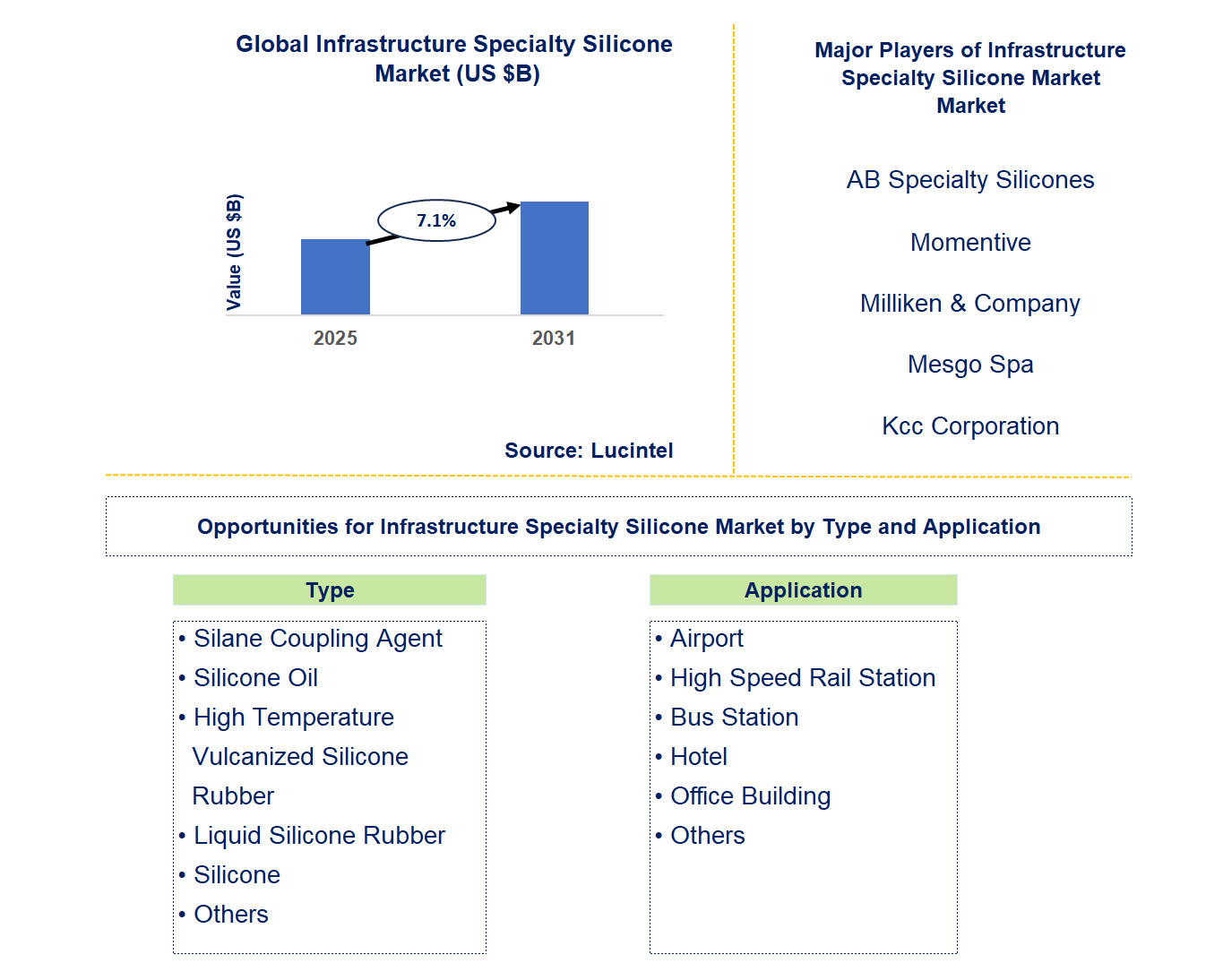
Emerging Trends in the Infrastructure Specialty Silicone Market
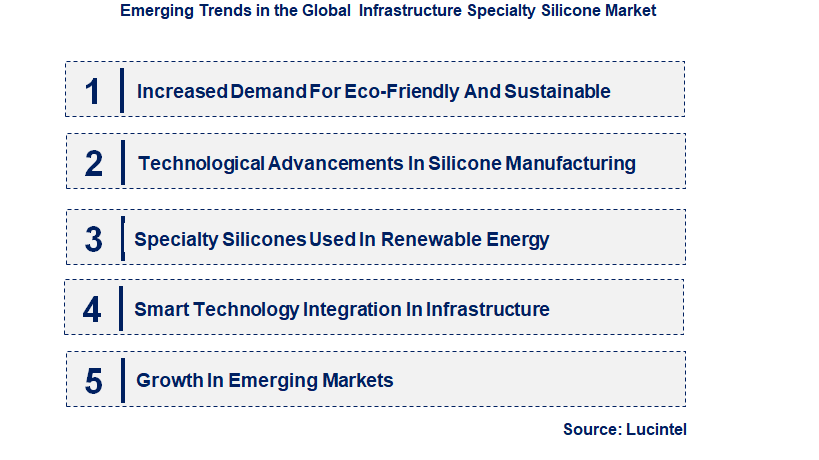
Specialty silicones are evolving through the adoption of new technologies, materials, and sustainability goals. Among the key trends transforming the infrastructure specialty silicone market include the following:• Increased Demand for Eco-Friendly And Sustainable Solutions: Growing environmental concerns make eco-friendly and sustainable infrastructure solutions increasingly in demand. Specialty silicones are preferred because of energy efficiency, durability, and low environmental impact. Silicones are being used in energy-efficient buildings, renewable energy systems, and green construction materials. There is a growing concern of the government and industries toward green building codes and regulations that promote the use of silicones in environment-friendly projects. Manufacturers have to develop products with high performance and environmental responsibility in line with this trend.
• Technological Advancements in Silicone Manufacturing: Technological advancements in silicone manufacturing, including the use of advanced additives, 3D printing, and automation, are improving the efficiency and precision of silicone production. These innovations are making it easier to produce specialty silicones with tailored properties for specific infrastructure applications. For example, 3D printing allows for custom shapes and designs for construction materials, while automation reduces production costs. These technologies are allowing the manufacturers to capture growing specialty silicones demand and react to new opportunities in the infrastructure sector.
• Specialty Silicones Used in Renewable Energy: Renewable energy is an important driver for the infrastructure specialty silicone market. Silicones are used in solar panels, wind turbines, and energy storage systems as they can resist the weathering process and remain long-lasting. In solar energy, specialty silicones are applied to sealing, encapsulation, and insulation for enhanced performance and durability of solar cells. Countries are becoming more aggressive in demanding cleaner energy sources; hence, silicones used in renewable energy systems are also bound to grow with new market expansion opportunities.
• Smart Technology Integration in Infrastructure: The need for high-performance silicone materials is driven by the integration of smart technologies into infrastructure projects. Specialty silicones are being used in sensors, smart windows, and coatings that enhance the functionality of smart buildings and cities. Such materials are required for energy-efficient and connected infrastructure systems, which in turn contribute to the development of smart cities. As technology evolves, the demand for silicones with specialized properties, such as self-healing capabilities or conductivity, is expected to increase, creating new growth opportunities in the market.
• Growth in Emerging Markets: Emerging markets, particularly in Asia and Africa, are experiencing rapid urbanization and industrialization, which is driving the demand for infrastructure specialty silicones. Specialty silicones are being used in construction, automotive, and electronics applications in these regions where performance and durability are critical. The growing infrastructure development and increasing consumer demand for high-quality products in emerging markets are expanding the reach of specialty silicones. Companies are focusing on cost-effective solutions and local manufacturing to meet the needs of these markets. Emerging trends are thus changing the infrastructure specialty silicone market dynamics to make demand for a greener solution higher, make technological innovations, and help grow in renewable energy as well as emerging markets. The market is changing due to companies' focus on developing high-performance and eco-friendly silicones, given the changes that are taking place in infrastructure landscapes.
Recent Development in the Infrastructure Specialty Silicone Market
Some of the key influences on the growth and change of the infrastructure specialty silicone market include technological developments, sustainable efforts, and growing into other markets.• Development of Sustainable Silicone Products: In response to increasing environmental issues, manufacturers have started focusing on developing sustainable specialty silicones. This includes silicones derived from renewable sources or designed with increased energy efficiency and durability. The shift toward sustainability is aligned with global efforts to reduce the carbon footprint of construction and industrial processes. These products are becoming essentials in eco-friendly construction projects, renewable energy systems, and energy-efficient buildings, further driving the growth of the market.
• Growth of Silicone Applications in Renewable Energy: Growth of silicone applications in renewable energy is one of the major developments in the market. The increasing application of silicones in the manufacture of solar panels, wind turbines, and energy storage systems is an emerging trend, driven by a global need for cleaner energy sources and material requirements to meet the environmental stress of these renewable energy applications. As renewable energy continues to grow, the demand for specialty silicones will increase, offering new opportunities for market players.
• Adoption of Smart Silicone Materials: The adoption of smart silicone materials in infrastructure projects is revolutionizing the market. These materials are used in sensors, coatings, and insulation, which make buildings and infrastructure more energy-efficient and connected. The demand for high-performance silicones, especially in smart buildings and cities, is being driven by the integration of smart technologies into urban infrastructure. This development is opening new avenues for the application of silicones in next-generation infrastructure systems.
• Growth of Infrastructure Projects in Emerging Markets: The emerging markets are increasingly important for the growth of the infrastructure specialty silicone market. Rapid urbanization and industrialization in countries such as India, China, and Brazil require high-performing construction materials. Infrastructural developments in these areas are opening new avenues for silicone manufacturers, who are developing a local manufacturing base to capture the spiraling demand for specialty silicones in construction and automotive as well as electronics applications.
• Increased R&D Focus: In the infrastructure specialty silicone market, firms are spending lavishly on research and development for better performance of their products. This includes the development of silicones with improved temperature stability, UV resistance, and self-healing characteristics. Innovations in silicone formulations expand the scope of applications for silicones, from construction materials to parts for automobiles and renewable energy systems. This emphasis on R&D is helping companies stay competitive and keep pace with changing demands in the infrastructure sector. These recent developments are moulding the future of the infrastructure specialty silicone market. Sustainable solutions, energy-efficient products, and high-performance materials are in great demand; this is where the market is expanding rapidly. Technological advancement and R&D investments are driving innovation, while the growth of infrastructure projects in emerging markets presents new opportunities for expansion.
Strategic Growth Opportunities in the Infrastructure Specialty Silicone Market
Strategic growth opportunities in the infrastructure specialty silicone market are emerging across various applications, fueled by technological advancements and market demand for more sustainable and high-performance solutions.• Increase in Green Building and Sustainable Construction: With the emphasis on sustainability at governmental and industrial levels, green building materials are being used more widely. Specialty silicones provide a good performance of energy efficiency, durability, and weather resistance in green construction. Development of ecologically friendly silicone solutions for construction applications can help tap the increasing demand for energy-efficient buildings, providing immense growth potential.
• Renewable Energy: The renewable energy market is an application area that will drive demand for specialty silicones, especially in solar and wind energy systems. Silicones are used in encapsulants, coatings, and adhesives for solar panels, and seals and gaskets for wind turbines. Countries are shifting towards clean energy, so this application area presents a promising growth opportunity for the silicone market.
• Rise of Smart Infrastructure and Smart Cities: The integration of smart technologies into infrastructure projects is creating new opportunities for specialty silicones. Silicones are used in sensors, coatings, and electronics for smart buildings and cities. Companies that focus on developing silicone materials for smart infrastructure applications, such as energy-efficient systems and connected devices, can tap into the growing demand for these technologies.
• Adopting Silicones in Emerging Countries: Growing infrastructure development has fast-tracked some emerging markets mainly in Asia and Africa, to offer opportunities in emerging markets for manufacturers. Companies can explore these markets mainly through cost-sensitive solutions and regional production capabilities for capturing market space. Silicones are in large demand for construction and electronics and automotive-related applications in growing markets.
• Innovations in Silicone Formulations and Technologies: Advancements in silicone formulations, including self-healing and high-temperature resistant silicones, are creating new growth opportunities across industries. By investing in R&D and developing new products with enhanced properties, companies can stay competitive and meet the evolving demands of infrastructure projects. These strategic growth opportunities are bringing change to the infrastructure specialty silicone market through innovational forces in development, expanding markets through new uses, and, as a consequence, growth. Increasing demand and reliance from companies in related sectors on technological capabilities and emerging market geographies will serve to sustain an increasing demand level for specialty silicones in future.
Infrastructure Specialty Silicone Market Driver and Challenges
Technological, economic, and regulatory factors all have a hand in shaping the infrastructure specialty silicone market. All these drivers also come with their respective challenges. The factors responsible for driving the infrastructure specialty silicone market include: 1. Technological Advancements in Silicone Manufacturing: New production techniques for silicones, including automation and 3D printing, improve efficiency and reduce costs. This is enabling companies to produce high-performance silicones for a broader range of infrastructure applications, thus driving market growth. 2. Sustainability Trends in Construction and Energy: The demand for sustainable building materials and energy-efficient solutions is driving the growth of specialty silicones. Their durability, weather resistance, and low environmental impact make them ideal for use in green construction and renewable energy systems. 3. Urbanization and Infrastructure Development: There is growth in rapid urbanization, particularly in emerging markets. The requirements of specialty silicones, as construction materials, are growing because infrastructure projects account for a major share in emerging markets. 4. Government Regulations and Incentives: Energy efficiency and environmental impact regulations are very stringent, and this is driving industries to more sustainable solutions. This has led to increased usage of specialty silicones in construction, automotive, and renewable energy applications. 5. Increased Demand in Renewable Energy: Renewable energy is one of the major driving forces for the silicone market. Silicones play a crucial role in solar panels, wind turbines, and energy storage systems, and this demand will be on the increase as the world shifts to clean energy sources. Challenges in the infrastructure specialty silicone market are: 1. High Production Costs: The specialty silicones could be expensive, especially with raw materials and production processes. This could deter growth in the market, especially in sensitive price regions. 2. Regulatory and Compliance Barriers: The regulatory requirements for silicone products are very stringent, and it varies from region to region. Fulfilling all these requirements is costly and takes more time before the product hits the market. 3. Supply Chain and Raw Materials Constraints: Availability and cost of raw materials may impact the stability and price orientation of the supply chain of silicone production. Disruptions in supply chains or raw material cost fluctuations might influence market dynamics. The driving forces for this infrastructure specialty silicone market are technological improvements, sustainability endeavors, and legislation support. Despite these drivers, there are challenges on the horizon regarding high production cost, regulatory compliance issues, and limited supply chain and supply chain problems. With proper focus on innovation and efficiency, the market shall overcome these challenges.List of Infrastructure Specialty Silicone Market Companies
Companies in the market compete on the basis of product quality offered. Major players in this market focus on expanding their manufacturing facilities, R&D investments, infrastructural development, and leverage integration opportunities across the value chain. With these strategies infrastructure specialty silicone market companies cater increasing demand, ensure competitive effectiveness, develop innovative products & technologies, reduce production costs, and expand their customer base. Some of the infrastructure specialty silicone market companies profiled in this report include-• AB Specialty Silicones
• Momentive
• Milliken & Company
• Mesgo Spa
• Kcc Corporation
• Bellofram Group Of Companies
• Chemsil Silicones Inc.
• Cht Germany Gmbh
• Dow
• Supreme Silicones
Infrastructure Specialty Silicone Market Market by Segment
The study includes a forecast for the global infrastructure specialty silicone market market by type, application, and region.Infrastructure Specialty Silicone Market by Type [Value from 2019 to 2031]:
• Silane Coupling Agent
• Silicone Oil
• High Temperature Vulcanized Silicone Rubber
• Liquid Silicone Rubber
• Silicone
• Others
Infrastructure Specialty Silicone Market by Application [Value from 2019 to 2031]:
• Airport
• High Speed Rail Station
• Bus Station
• Hotel
• Office Building
• Others
Infrastructure Specialty Silicone Market by Region [Value from 2019 to 2031]:
• North America
• Europe
• Asia Pacific
• The Rest of the World
Country Wise Outlook for the Infrastructure Specialty Silicone Market
The infrastructure specialty silicone market has gone through several innovations that are driven by the growing demands in various industries, such as construction, automotive, electronics, and renewable energy. These innovation changes can be seen particularly in the United States, China, Germany, India, and Japan, as some rely on technological advancements, environmental factors, and increased industrial production in driving the market. Specialty silicones have proven to be durable, flexible, and resistant to extreme climatic conditions, among others, making them necessary for infrastructure projects. Governments and industrial sectors in these countries are investing in new applications and manufacturing capabilities to contribute to the growth and diversification of the global market.• United States: Construction and automotive sectors have shown an increase in demand for infrastructure specialty silicones in the United States. The use of specialty silicones for sustainable building materials has been on the rise in the U.S., with special application in energy-efficient construction, sealants, and coatings. Market growth has been spurred by the development of green building codes and regulations, because silicone products support energy conservation and longer-lasting materials. Moreover, 3D printing with silicone materials is changing the production process in favor of efficiency. Specialty silicones for the automotive industry are also in demand due to their weather resistance and durability in vehicle components.
• China: The infrastructure specialty silicone market in China is rapidly growing due to the country's increasing construction, automotive, and electronics sectors. The large infrastructure development projects of the country, such as urbanization, require high-performance silicones. Advanced silicone materials are being adopted by China to be used in coatings, sealants, and adhesives, enhancing the durability and longevity of infrastructure. The Chinese manufacturers are targeting economical production of cost-effective silicone goods in a thriving market. Furthermore, more demanding environmental regulations tend to opt for eco-friendly solutions and more durable materials; it makes specialty silicones in large demand for various energy-efficient and green technology applications.
• Germany: Germany spearheads the development and applications of specialty silicones for applications in infrastructural facilities. Specialty silicones are being used in weatherproofing and sealing applications for energy systems in Germany, with a focus on renewable energy in solar and wind energy. High-performance silicone materials for seals and gaskets for vehicles also support the automotive industry in Germany. Additionally, Germany has made enormous investments in R&D for improving the performance of silicones. Silicones are known to resist extreme conditions, UV, and temperature differences. The strong environmental laws in Germany make the demand for sustainable materials for infrastructure rise and also longer-lasting materials.
• India: Specialty silicone in Indian infrastructure is also rapidly growing as it grows with industrialization and urbanization. With the country focusing on modernizing its infrastructural usage, the demand for specialty silicones in construction materials, coatings, and sealants is on the increase. With increasing interest in energy-efficient buildings, silicones are getting integrated into constructions due to their durability and resistance to weather conditions. Indian automotive is also increasingly adopting specialty silicones for car seals and gaskets contributing to market growth. The further increasing demand for silicone solutions due to initiatives by the government of India is to develop more sustainable and minimize environmental degradation also contributes to it.
• Japan: The performance and sustainability improvement of its construction and automotive sectors are utilizing the infrastructure specialty silicones by Japan. It being one of the largest producers of electronics uses the specialty silicones mainly for the purpose of insulation properties in electronic devices and components. The country’s focus on building resilient and energy-efficient infrastructure, especially in earthquake-prone areas, is increasing the demand for specialty silicones in construction materials. Japan is also investing in developing new silicone formulations with enhanced durability and temperature resistance for use in high-tech applications. Additionally, Japan’s automotive sector is embracing silicones for their lightweight, high-performance qualities in various vehicle components.

Features of the Global Infrastructure Specialty Silicone Market
Market Size Estimates: Infrastructure specialty silicone market size estimation in terms of value ($B). Trend and Forecast Analysis: Market trends (2019 to 2024) and forecast (2025 to 2031) by various segments and regions. Segmentation Analysis: Infrastructure specialty silicone market size by type, application, and region in terms of value ($B). Regional Analysis: Infrastructure specialty silicone market breakdown by North America, Europe, Asia Pacific, and Rest of the World. Growth Opportunities: Analysis of growth opportunities in different type, application, and regions for the infrastructure specialty silicone market. Strategic Analysis: This includes M&A, new product development, and competitive landscape of the infrastructure specialty silicone market. Analysis of competitive intensity of the industry based on Porter’s Five Forces model.
FAQ
Q1. What is the growth forecast for infrastructure specialty silicone market? Answer: The global infrastructure specialty silicone market is expected to grow with a CAGR of 7.1% from 2025 to 2031. Q2. What are the major drivers influencing the growth of the infrastructure specialty silicone market? Answer: The major drivers for this market are growing need for weather-resistant solution, increasing regulations and safety standard, and rising focus on sustainability. Q3. What are the major segments for infrastructure specialty silicone market? Answer: The future of the infrastructure specialty silicone market looks promising with opportunities in the airport, high speed rail station, bus station, hotel and office building markets. Q4. Who are the key infrastructure specialty silicone market companies? Answer: Some of the key infrastructure specialty silicone market companies are as follows:• AB Specialty Silicones
• Momentive
• Milliken & Company
• Mesgo Spa
• Kcc Corporation
• Bellofram Group Of Companies
• Chemsil Silicones Inc.
• Cht Germany Gmbh
• Dow
• Supreme Silicones Q5. Which infrastructure specialty silicone market segment will be the largest in future? Answer: Lucintel forecasts that high temperature vulcanized is expected to witness the highest growth over the forecast period. Q6. In infrastructure specialty silicone market, which region is expected to be the largest in next 5 years? Answer: APAC is expected to witness the highest growth over the forecast period. Q7. Do we receive customization in this report? Answer: Yes, Lucintel provides 10% customization without any additional cost.
Table of Contents
Methodology
- In-depth interviews of the major players in this market
- Detailed secondary research from competitors’ financial statements and published data
- Extensive searches of published works, market, and database information pertaining to industry news, company press releases, and customer intentions
- A compilation of the experiences, judgments, and insights of Lucintel’s professionals, who have analyzed and tracked this market over the years.


Buy Now
Choose a license that fits your team. Instant PDF delivery.
Prices exclude taxes. Instant delivery. Custom licensing available on request.
Key Questions
- • What are some of the most promising, high-growth opportunities for the infrastructure specialty silicone market by type (silane coupling agent, silicone oil, high temperature vulcanized silicone rubber, liquid silicone rubber, silicone, and others), application (airport, high speed rail station, bus station, hotel, office building, and others), and region (North America, Europe, Asia Pacific, and the Rest of the World)?
- • Which segments will grow at a faster pace and why?
- • Which region will grow at a faster pace and why?
- • What are the key factors affecting market dynamics? What are the key challenges and business risks in this market?
- • What are the business risks and competitive threats in this market?
- • What are the emerging trends in this market and the reasons behind them?
- • What are some of the changing demands of customers in the market?
- • What are the new developments in the market? Which companies are leading these developments?
- • Who are the major players in this market? What strategic initiatives are key players pursuing for business growth?
- • What are some of the competing products in this market and how big of a threat do they pose for loss of market share by material or product substitution?
- • What M&A activity has occurred in the last 5 years and what has its impact been on the industry? For any questions related to Infrastructure Specialty Silicone Market Market, Infrastructure Specialty Silicone Market Market Size, Infrastructure Specialty Silicone Market Market Growth, Infrastructure Specialty Silicone Market Market Analysis, Infrastructure Specialty Silicone Market Market Report, Infrastructure Specialty Silicone Market Market Share, Infrastructure Specialty Silicone Market Market Trends, Infrastructure Specialty Silicone Market Market Forecast, Infrastructure Specialty Silicone Market Companies, write Lucintel analyst at email: helpdesk@lucintel.com. We will be glad to get back to you soon.


