
Report Feature
Household Appliances Market Trends and Forecast
The future of the global household appliances market looks promising with opportunities in the online and offline markets. The global household appliances market is expected to reach an estimated $1,015 billion by 2035 with a CAGR of 5.2% from 2026 to 2035. The major drivers for this market are the increasing demand for premium & multifunctional appliances, the rising demand for smart connected home appliances, and the growing technological advancements in appliance features.• Lucintel forecasts that, within the product type category, refrigeration equipment is expected to witness higher growth over the forecast period.
• Within the distribution channel category, offline is expected to witness the highest growth.
• In terms of region, APAC is expected to witness the highest growth over the forecast period.
Gain valuable insights for your business decisions with our comprehensive 150+ page report. Sample figures with some insights are shown below.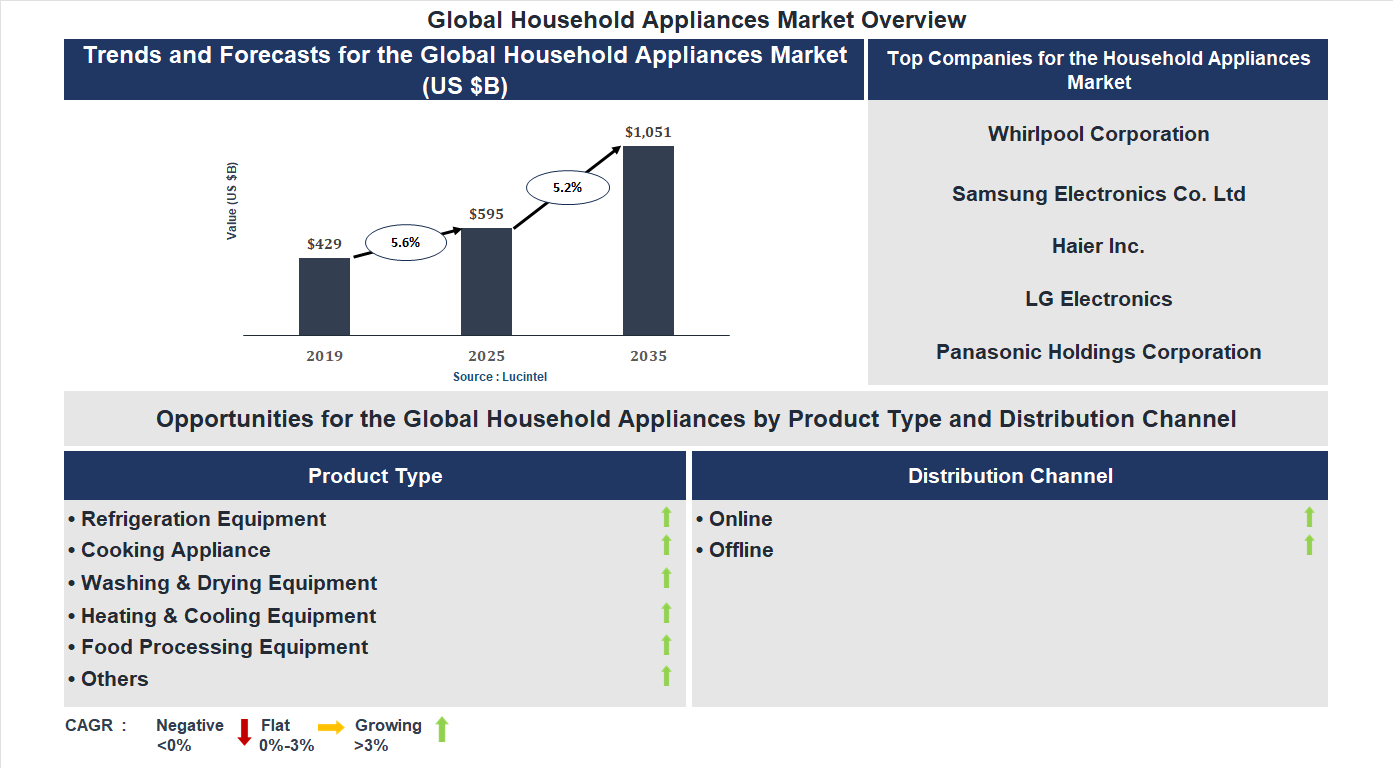
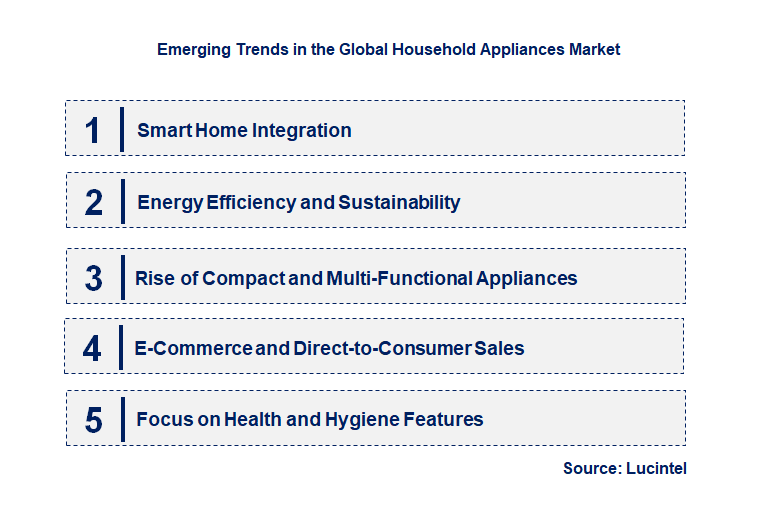
Emerging Trends in the Household Appliances Market
The household appliances market is experiencing rapid transformation driven by technological innovation, changing consumer preferences, and sustainability concerns. As households seek more efficient, connected, and eco-friendly solutions, manufacturers are adapting to meet these evolving demands. The integration of smart technology, focus on energy efficiency, and the rise of sustainable products are shaping the future landscape of this industry. These trends are not only influencing product development but also altering marketing strategies, distribution channels, and consumer engagement. Understanding these key developments is essential for stakeholders aiming to stay competitive and capitalize on emerging opportunities in this dynamic market.• Smart Home Integration: The adoption of IoT-enabled appliances is revolutionizing household convenience and control. Connected devices allow users to operate appliances remotely, automate routines, and receive real-time updates, enhancing user experience. This trend is driven by advancements in wireless technology and increasing consumer demand for automation. It is leading to the development of integrated ecosystems where appliances communicate seamlessly, offering personalized and efficient household management. As a result, manufacturers are investing heavily in smart features, creating a more interconnected and user-centric market landscape.
• Energy Efficiency and Sustainability: Consumers are increasingly prioritizing energy-saving appliances to reduce utility bills and environmental impact. Manufacturers are responding by designing products with higher energy ratings, eco-friendly materials, and sustainable manufacturing processes. This trend is supported by stricter regulations and incentives promoting green appliances. The focus on sustainability is also influencing product lifecycle management, including recyclability and reduced carbon footprint. As a result, energy-efficient appliances are gaining market share, encouraging innovation and fostering a shift towards more environmentally responsible consumption.
• Rise of Compact and Multi-Functional Appliances: Space constraints and multifunctional needs are driving demand for compact, versatile appliances suitable for small living spaces. These products combine multiple functions, such as washer-dryer units or microwave ovens with convection features, to maximize utility in limited areas. This trend caters to urban dwellers and those seeking convenience without sacrificing space. Manufacturers are designing innovative, space-saving solutions that appeal to modern lifestyles, leading to increased product diversity and customization options. This shift is transforming the market by emphasizing practicality and adaptability.
• E-commerce and Direct-to-Consumer Sales: The growth of online retail channels is significantly impacting how household appliances are marketed and sold. Consumers now prefer the convenience of purchasing appliances online, supported by detailed product information, reviews, and virtual demonstrations. Direct-to-consumer models enable brands to build stronger relationships, offer personalized services, and gather valuable customer data. This trend is reshaping distribution strategies, reducing reliance on traditional brick-and-mortar stores, and fostering competitive pricing. As e-commerce continues to expand, it is driving innovation in delivery, installation, and after-sales support.
• Focus on Health and Hygiene Features: The COVID-19 pandemic has heightened consumer awareness of health and hygiene, influencing appliance features. Products such as air purifiers, sterilizing dishwashers, and washing machines with antimicrobial technology are gaining popularity. These appliances help maintain cleaner living environments and reduce the spread of germs. Manufacturers are incorporating advanced filtration systems, UV sterilization, and smart hygiene monitoring. This trend is creating new market segments and emphasizing the importance of health-centric features, ultimately shaping product development priorities and consumer expectations in the household appliances industry.
These emerging trends are collectively reshaping the household appliances market by fostering innovation, emphasizing sustainability, and enhancing consumer convenience. The integration of smart technology, eco-friendly designs, space-efficient solutions, digital sales channels, and health-focused features are driving growth and competitiveness. As these developments continue to evolve, they are creating a more connected, sustainable, and consumer-centric industry landscape, offering new opportunities for manufacturers and retailers alike.
Recent Developments in the Household Appliances Market
The household appliances market is experiencing rapid innovation driven by technological advancements, changing consumer preferences, and sustainability concerns. Companies are investing heavily in smart, energy-efficient, and eco-friendly products to meet evolving demands. The integration of IoT and AI is transforming user experiences, while sustainability initiatives are shaping product development. Market players are also expanding into emerging markets, creating new growth avenues. These developments are collectively reshaping the landscape, offering significant opportunities for growth and competitive advantage in the global household appliances sector.• Smart Appliances Integration: The adoption of IoT-enabled appliances is revolutionizing household convenience and efficiency. Consumers now prefer devices that can be controlled remotely via smartphones or voice commands, enhancing user experience. Manufacturers are developing smart refrigerators, washing machines, and ovens that offer real-time monitoring, maintenance alerts, and energy management. This trend boosts product differentiation, increases customer engagement, and opens new revenue streams. As smart home adoption accelerates, the market is poised for substantial growth driven by technological innovation and consumer demand for connected living.
• Energy-Efficient and Eco-Friendly Products: Rising environmental awareness is prompting manufacturers to prioritize energy-efficient appliances. These products reduce electricity consumption, lower carbon footprints, and comply with stringent regulations. Innovations include inverter motors, eco-friendly materials, and water-saving features. Consumers are increasingly willing to pay a premium for sustainable options, which enhances brand loyalty and market share. Governments are also offering incentives for energy-efficient appliances, further stimulating demand. This focus on sustainability is shaping a greener, more responsible market landscape with long-term growth prospects.
• Expansion into Emerging Markets: Emerging economies present significant growth opportunities due to rising disposable incomes and urbanization. Companies are tailoring products to meet local needs, preferences, and price points, often through affordable, durable designs. Distribution channels are expanding, and marketing strategies are localized to increase penetration. This expansion not only boosts sales volumes but also diversifies revenue streams. As infrastructure and living standards improve, demand for household appliances is expected to surge, making emerging markets a critical focus for global players seeking sustained growth.
• Innovation in Product Design and Functionality: Continuous innovation is driving the development of multifunctional, space-saving, and aesthetically appealing appliances. Features like touch controls, voice recognition, and customizable settings enhance user experience. Manufacturers are investing in R&D to create appliances that are more intuitive, versatile, and stylish, aligning with modern lifestyles. This innovation attracts tech-savvy consumers and differentiates brands in a competitive market. As design and functionality evolve, consumer satisfaction and brand loyalty increase, fueling market expansion and higher sales.
• Focus on Sustainability and Circular Economy: Companies are adopting circular economy principles by designing appliances for longevity, recyclability, and easy repair. This approach reduces waste and environmental impact, aligning with consumer values and regulatory standards. Initiatives include using recyclable materials, offering take-back programs, and developing modular appliances. Sustainability-focused branding appeals to eco-conscious consumers, fostering brand trust and loyalty. The shift towards sustainable practices is transforming industry standards, encouraging innovation, and creating new market segments centered on eco-friendly and sustainable household appliances.
These developments are significantly transforming the household appliances market by fostering innovation, sustainability, and market expansion. The integration of smart technology, eco-friendly products, and focus on emerging markets are driving growth and competitiveness. Continuous product innovation and sustainability initiatives are enhancing consumer engagement and brand loyalty. Overall, these opportunities are creating a dynamic, resilient market poised for sustained growth, with companies that adapt quickly gaining a strategic advantage in the evolving global landscape.
Strategic Growth Opportunities in the Household Appliances Market
The household appliances market is experiencing rapid growth driven by technological advancements, changing consumer lifestyles, and increasing urbanization. Innovations in smart technology, energy efficiency, and connectivity are transforming traditional appliances into integrated, intelligent systems. Market players are focusing on product differentiation and expanding into emerging markets to capture new customer segments. The evolving landscape presents significant opportunities for growth, driven by consumer demand for convenience, sustainability, and innovative features that enhance daily living experiences.• Increasing Adoption of Smart Appliances: The integration of IoT and AI technologies into household appliances is creating new growth avenues. Consumers seek connected devices that offer remote control, automation, and energy management, leading manufacturers to develop smart refrigerators, washing machines, and ovens. This trend enhances user convenience, improves energy efficiency, and provides data-driven insights, fostering brand loyalty and opening up new revenue streams in the competitive market.
• Rising Demand for Energy-Efficient Appliances: Consumers and governments are prioritizing sustainability, prompting a shift toward energy-efficient household appliances. Manufacturers are innovating with eco-friendly materials and technologies that reduce power consumption and carbon footprint. This demand is driven by rising energy costs and environmental awareness, encouraging product differentiation and compliance with regulations. The focus on energy efficiency is expected to boost sales and market share for brands offering sustainable solutions.
• Growth of Compact and Portable Appliances: Urbanization and space constraints are fueling demand for compact, portable household appliances. Consumers prefer smaller, multifunctional devices that save space without compromising performance. This trend is particularly prominent in apartment living and among younger demographics. Manufacturers are developing innovative, space-saving designs for appliances like mini-fridges, handheld vacuum cleaners, and portable air purifiers, creating new market segments and expanding customer reach.
• Expansion into Emerging Markets: Rapid urbanization, rising disposable incomes, and improving infrastructure in developing regions are creating substantial growth opportunities. Companies are tailoring products to meet local needs, preferences, and price points, often through strategic partnerships and localized marketing. Expanding into these markets allows brands to diversify revenue streams, increase market share, and establish a competitive presence in regions with high growth potential, ultimately driving global market expansion.
• Emphasis on Sustainable and Eco-Friendly Products: Consumers are increasingly prioritizing environmentally responsible appliances that minimize waste and energy use. Manufacturers are adopting sustainable practices, such as using recyclable materials and reducing packaging waste. Eco-labeling and certifications influence purchasing decisions, encouraging brands to innovate with green technologies. This focus on sustainability not only aligns with consumer values but also helps companies meet regulatory standards, fostering long-term growth and a positive brand image in the household appliances market.
The overall market outlook is positively influenced by these growth opportunities, which collectively drive innovation, consumer engagement, and expansion into new regions. Embracing technological advancements and sustainability trends will enable market players to strengthen their competitive edge, meet evolving consumer demands, and sustain long-term growth in the dynamic household appliances industry.
Household Appliances Market Driver and Challenges
The household appliances market is influenced by a complex interplay of technological advancements, economic conditions, and regulatory frameworks. Rapid innovation in smart and energy-efficient appliances drives consumer demand, while economic factors such as disposable income levels and inflation impact purchasing power. Regulatory policies aimed at sustainability and safety standards shape product development and market entry strategies. Additionally, global supply chain dynamics and environmental concerns further influence market growth and challenges. Understanding these multifaceted drivers and challenges is essential for stakeholders to navigate the evolving landscape effectively and capitalize on emerging opportunities.The factors responsible for driving the household appliances market include:-
• Technological Innovation: The integration of smart technology and IoT in household appliances enhances user convenience, energy efficiency, and connectivity. Consumers increasingly seek appliances that can be remotely controlled and offer advanced features, prompting manufacturers to invest in R&D. This technological evolution not only improves product differentiation but also opens new revenue streams, accelerating market growth. As smart home ecosystems expand, appliances become integral, further fueling demand and innovation in the sector.
• Rising Urbanization and Changing Lifestyles: Rapid urbanization leads to smaller living spaces and a preference for compact, multifunctional appliances. Modern lifestyles demand time-saving, energy-efficient, and user-friendly products, prompting manufacturers to develop innovative solutions. The shift towards nuclear families and dual-income households increases the need for convenient household appliances, boosting sales across various categories such as washing machines, refrigerators, and kitchen appliances.
• Increasing Focus on Energy Efficiency and Sustainability: Consumers and regulators are prioritizing energy-efficient appliances to reduce carbon footprints and utility bills. Governments worldwide implement stricter energy standards and eco-labeling requirements, encouraging manufacturers to develop environmentally friendly products. This trend not only aligns with global sustainability goals but also provides a competitive advantage, driving innovation and market expansion in energy-efficient household appliances.
• Economic Growth and Rising Disposable Income: Economic stability and growth in emerging markets increase consumers‘ purchasing power, enabling higher expenditure on household appliances. As disposable incomes rise, consumers are more willing to invest in premium, feature-rich, and durable appliances. This economic trend supports market expansion, especially in developing regions, and encourages manufacturers to introduce innovative, high-quality products tailored to affluent consumers.
The challenges in the household appliances market are:
• Supply Chain Disruptions and Raw Material Shortages: Global supply chain issues, exacerbated by geopolitical tensions and the COVID-19 pandemic, have led to delays and increased costs for raw materials and components. These disruptions hinder production schedules, inflate manufacturing costs, and result in product shortages, affecting market growth and profitability. Manufacturers must adapt by diversifying suppliers and optimizing logistics, which can be resource-intensive and complex.
• Regulatory and Safety Standards Compliance: Stringent safety, environmental, and energy regulations vary across regions, posing compliance challenges for manufacturers. Meeting diverse standards requires significant investment in R&D, testing, and certification processes, which can delay product launches and increase costs. Non-compliance risks legal penalties and damage to brand reputation, making regulatory navigation a critical challenge in maintaining market competitiveness.
• Intense Market Competition and Price Pressures: The household appliances sector is highly competitive, with numerous global and local players vying for market share. Price wars and promotional strategies often erode profit margins, compelling companies to innovate while controlling costs. Differentiating products through features and branding becomes essential, but the pressure to offer affordable options limits profit potential and complicates strategic planning.
The household appliances market is shaped by rapid technological advancements, evolving consumer preferences, and sustainability initiatives, which drive growth and innovation. However, supply chain issues, regulatory complexities, and fierce competition pose significant challenges. These factors collectively influence market dynamics, requiring stakeholders to adapt swiftly and strategically. Successful navigation of these drivers and challenges will determine the market‘s future trajectory, with opportunities for growth amid ongoing technological and economic shifts.
List of Household Appliances Companies
Companies in the market compete on the basis of product quality offered. Major players in this market focus on expanding their manufacturing facilities, R&D investments, infrastructural development, and leverage integration opportunities across the value chain. With these strategies household appliances companies cater increasing demand, ensure competitive effectiveness, develop innovative products & technologies, reduce production costs, and expand their customer base. Some of the household appliances companies profiled in this report include-• Whirlpool Corporation
• Samsung Electronics Co. Ltd
• Haier Inc.
• LG Electronics
• Panasonic Holdings Corporation
Household Appliances Market by Segment
The study includes a forecast for the global household appliances market by product type, distribution channel, and region.Household Appliances Market by Product Type [Value from 2019 to 2035]:
• Refrigeration Equipment
• Cooking Appliance
• Washing & Drying Equipment
• Heating & Cooling Equipment
• Food Processing Equipment
• Others
Household Appliances Market by Distribution Channel [Value from 2019 to 2035]:
• Online
• Offline
Household Appliances Market by Region [Value from 2019 to 2035]:
• North America
• Europe
• Asia Pacific
• The Rest of the World
Country Wise Outlook for the Household Appliances Market
The household appliances market has experienced significant shifts driven by technological innovation, changing consumer preferences, and global supply chain dynamics. As countries adapt to new economic conditions and sustainability goals, their markets are evolving uniquely. Advances in smart technology, energy efficiency, and eco-friendly products are shaping the landscape. Regulatory changes and the rise of e-commerce also influence market strategies. These developments reflect broader trends toward automation, sustainability, and digital integration, impacting manufacturers, retailers, and consumers across the globe. Here is a country-specific overview of recent developments in the household appliances market for the United States, China, Germany, India, and Japan.• United States: The U.S. household appliances market has seen a surge in smart appliances with IoT integration, enhancing convenience and energy management. Consumers are increasingly prioritizing energy-efficient and eco-friendly products, driven by regulatory incentives and environmental awareness. E-commerce sales continue to grow rapidly, shifting traditional retail dynamics. Major brands are investing in AI-powered appliances and voice-controlled devices. The market also witnesses a rising demand for compact and multi-functional appliances suitable for urban living. Supply chain disruptions have prompted companies to diversify sourcing strategies and increase local manufacturing.
• China: China‘s household appliances market is expanding rapidly, fueled by urbanization and rising disposable incomes. The focus is on smart appliances with advanced connectivity features, catering to tech-savvy consumers. Domestic brands are gaining ground against international competitors through innovation and competitive pricing. The government promotes energy-saving and environmentally friendly appliances, influencing product development. E-commerce platforms like Alibaba and JD.com dominate sales channels, facilitating direct-to-consumer models. Additionally, there is a growing trend toward integrated home automation systems, combining appliances with smart home ecosystems.
• Germany: The German market emphasizes energy efficiency and sustainability, aligning with EU regulations. There is a strong demand for high-quality, durable appliances with eco-friendly features. Innovations in washing machines, refrigerators, and dishwashers include water and energy-saving technologies. The market is also witnessing increased adoption of smart appliances that can be remotely controlled and monitored. German consumers favor brands with a reputation for reliability and environmental responsibility. Retailers are focusing on omnichannel strategies, blending online and offline experiences. The push for circular economy practices influences product design and recycling initiatives.
• India: The Indian household appliances market is experiencing rapid growth due to rising urbanization, income levels, and internet penetration. Consumers are increasingly adopting energy-efficient and affordable appliances, especially in tier 2 and tier 3 cities. The market is witnessing a shift toward smart appliances, although affordability remains a key factor. Local brands are expanding their presence, competing with international players through innovative features and pricing strategies. E-commerce platforms like Flipkart and Amazon are vital sales channels. The government’s initiatives promoting electrification and sustainable energy use are also impacting product offerings, with a focus on inverter technology and solar-compatible appliances.
• Japan: Japan‘s household appliances market is characterized by high technological innovation and a focus on energy conservation. Smart appliances with AI capabilities are prevalent, enhancing user experience and efficiency. The market emphasizes compact, space-saving designs suitable for small living spaces. Eco-friendly and energy-efficient products are in high demand, supported by strict government regulations. Japanese consumers prefer high-quality, durable appliances with advanced features. The industry is also exploring robotics and automation to improve household convenience. Retailers are integrating online and offline channels, and there is a growing interest in sustainable and recyclable products, aligning with Japan’s environmental commitments.

Features of the Global Household Appliances Market
Market Size Estimates: Household appliances market size estimation in terms of value ($B).Trend and Forecast Analysis: Market trends (2019 to 2025) and forecast (2026 to 2035) by various segments and regions.
Segmentation Analysis: Household appliances market size by product type, distribution channel, and region in terms of value ($B).
Regional Analysis: Household appliances market breakdown by North America, Europe, Asia Pacific, and Rest of the World.
Growth Opportunities: Analysis of growth opportunities in different product type, distribution channel, and regions for the household appliances market.
Strategic Analysis: This includes M&A, new product development, and competitive landscape of the household appliances market.
Analysis of competitive intensity of the industry based on Porter’s Five Forces model.

FAQ
Q1. What is the household appliances market size?Answer: The global household appliances market is expected to reach an estimated $1,015 billion by 2035.
Q2. What is the growth forecast for household appliances market?
Answer: The global household appliances market is expected to grow with a CAGR of 5.2% from 2026 to 2035.
Q3. What are the major drivers influencing the growth of the household appliances market?
Answer: The major drivers for this market are the increasing demand for premium & multifunctional appliances, the rising demand for smart connected home appliances, and the growing technological advancements in appliance features.
Q4. What are the major segments for household appliances market?
Answer: The future of the household appliances market looks promising with opportunities in the online and offline markets.
Q5. Who are the key household appliances market companies?
Answer: Some of the key household appliances companies are as follows:
• Whirlpool Corporation
• Samsung Electronics Co. Ltd
• Haier Inc.
• LG Electronics
• Panasonic Holdings Corporation
Q6. Which household appliances market segment will be the largest in future?Answer: Lucintel forecasts that, within the product type category, refrigeration equipment is expected to witness higher growth over the forecast period.
Q7. In household appliances market, which region is expected to be the largest in next 8 years?
Answer: In terms of region, APAC is expected to witness the highest growth over the forecast period.
Q8. Do we receive customization in this report?
Answer: Yes, Lucintel provides 10% customization without any additional cost.
Table of Contents
List of Figures
List of Tables
Methodology
- In-depth interviews of the major players in this market
- Detailed secondary research from competitors’ financial statements and published data
- Extensive searches of published works, market, and database information pertaining to industry news, company press releases, and customer intentions
- A compilation of the experiences, judgments, and insights of Lucintel’s professionals, who have analyzed and tracked this market over the years.


Buy Now
Choose a license that fits your team. Instant PDF delivery.
Prices exclude taxes. Instant delivery. Custom licensing available on request.
Key Questions
- • What are some of the most promising, high-growth opportunities for the household appliances market by product type (refrigeration equipment, cooking appliance, washing & drying equipment, heating & cooling equipment, food processing equipment, and others), distribution channel (online and offline), and region (North America, Europe, Asia Pacific, and the Rest of the World)?
- • Which segments will grow at a faster pace and why?
- • Which region will grow at a faster pace and why?
- • What are the key factors affecting market dynamics? What are the key challenges and business risks in this market?
- • What are the business risks and competitive threats in this market?
- • What are the emerging trends in this market and the reasons behind them?
- • What are some of the changing demands of customers in the market?
- • What are the new developments in the market? Which companies are leading these developments?
- • Who are the major players in this market? What strategic initiatives are key players pursuing for business growth?
- • What are some of the competing products in this market and how big of a threat do they pose for loss of market share by material or product substitution?
- • What M&A activity has occurred in the last 5 years and what has its impact been on the industry? For any questions related to Household Appliances Market, Household Appliances Market Size, Household Appliances Market Growth, Household Appliances Market Analysis, Household Appliances Market Report, Household Appliances Market Share, Household Appliances Market Trends, Household Appliances Market Forecast, Household Appliances Companies, write Lucintel analyst at email: helpdesk@lucintel.com. We will be glad to get back to you soon.


