
Report Feature
HMC and HBM Market Trends and Forecast
The future of the global HMC and HBM market looks promising with opportunities in the graphics, high performance computing, networking, and data center markets. The global HMC and HBM market is expected to reach an estimated $16,349 million by 2035 with a CAGR of 18.6% from 2026 to 2035. The major drivers for this market are the rising demand for high-performance processors, the increasing use in supercomputing systems, and the growing need for faster memory.• Lucintel forecasts that, within the memory type category, hbm is expected to witness higher growth over the forecast period.
• Within the application category, data center is expected to witness the highest growth.
• In terms of region, APAC is expected to witness the highest growth over the forecast period.
Gain valuable insights for your business decisions with our comprehensive 150+ page report. Sample figures with some insights are shown below.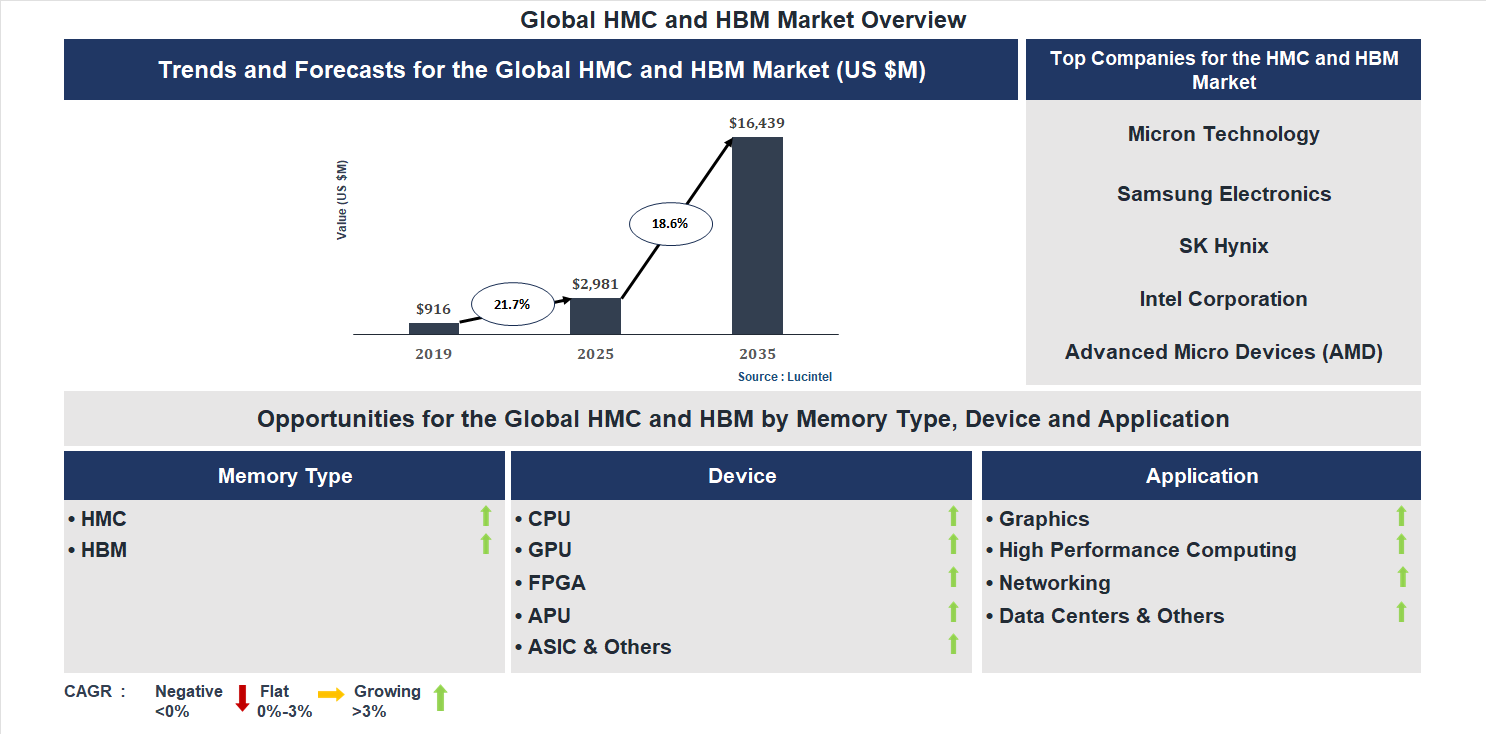
Emerging Trends in the HMC and HBM Market
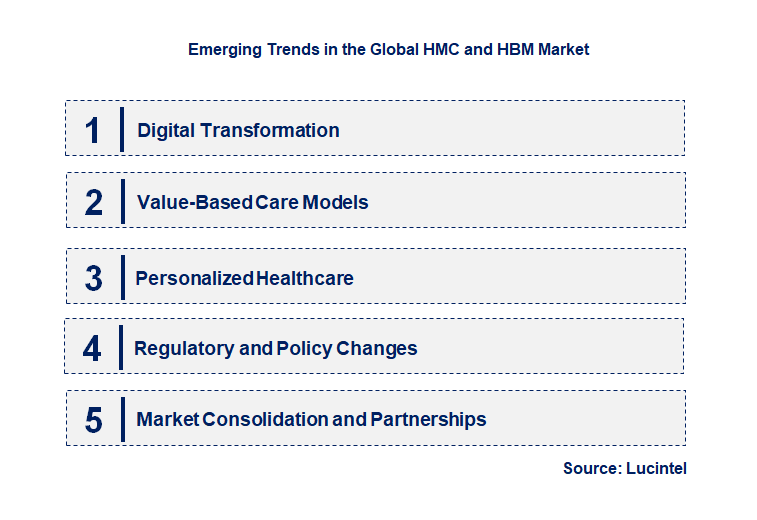
The HMC and HBM market is experiencing rapid transformation driven by technological advancements, shifting consumer expectations, and evolving regulatory landscapes. These changes are fostering innovation, improving efficiency, and enhancing patient outcomes. As the industry adapts to these new dynamics, several key trends are emerging that will shape the future of healthcare management and business models. Understanding these trends is crucial for stakeholders aiming to stay competitive and deliver value in this evolving environment.• Digital Transformation: The integration of digital technologies such as AI, telemedicine, and electronic health records is revolutionizing healthcare management. Digital tools enable real-time data sharing, improve patient engagement, and streamline administrative processes. This shift enhances decision-making, reduces costs, and increases access to care, especially in remote areas. As digital adoption accelerates, healthcare providers are becoming more efficient and patient-centric, leading to better health outcomes and operational agility.
• Value-Based Care Models: The focus is shifting from volume to value, emphasizing quality outcomes over service quantity. Value-based care incentivizes providers to deliver efficient, effective treatments that improve patient health while controlling costs. This trend encourages the adoption of outcome measurement tools and integrated care pathways. It fosters collaboration among providers, enhances patient satisfaction, and aligns financial incentives with health improvements, fundamentally transforming traditional fee-for-service models.
• Personalized Healthcare: Advances in genomics, data analytics, and wearable devices are enabling highly personalized treatment plans. Tailoring healthcare to individual genetic profiles and lifestyle factors improves efficacy and reduces adverse effects. This trend promotes proactive health management and preventive care, reducing long-term costs. Personalized healthcare also enhances patient engagement and satisfaction, as treatments are more aligned with individual needs, leading to better adherence and outcomes.
• Regulatory and Policy Changes: Governments and regulatory bodies are implementing new policies to promote transparency, data security, and quality standards. These changes include stricter data privacy laws, reimbursement reforms, and incentives for innovation. Such policies influence market dynamics by encouraging compliance and fostering innovation. They also aim to reduce fraud, improve patient safety, and ensure equitable access, shaping the strategic decisions of healthcare organizations and investors.
• Market Consolidation and Partnerships: Increasing mergers, acquisitions, and strategic alliances are shaping the competitive landscape. Larger entities seek to expand their service offerings, leverage economies of scale, and enhance technological capabilities. Partnerships between healthcare providers, tech firms, and payers foster innovation and integrated care delivery. This consolidation improves resource utilization, broadens access, and accelerates the adoption of new models, ultimately creating a more resilient and efficient healthcare ecosystem.
These emerging trends are fundamentally reshaping the HMC and HBM market by fostering innovation, improving efficiency, and prioritizing patient-centered care. Digital transformation, value-based models, personalized healthcare, regulatory reforms, and market consolidation are driving a more integrated, efficient, and responsive healthcare landscape. These developments are positioning the industry for sustainable growth and better health outcomes in the future.
Recent Developments in the HMC and HBM Market
The HMC and HBM markets are experiencing rapid advancements driven by technological innovation and increasing demand for high-performance computing solutions. These developments are shaping the future landscape, offering new opportunities for manufacturers and consumers alike. As industries such as AI, data centers, and gaming expand, the integration of advanced memory solutions becomes crucial. This report highlights five key recent developments that are significantly impacting the growth trajectory and competitive dynamics of these markets.• Innovation in HMC Design: Enhanced integration and scalability : Recent innovations focus on improving the integration of 3D stacking and interconnect technologies, enabling higher bandwidth and lower latency. These advancements allow for more compact, energy-efficient modules suitable for data centers and AI applications. The improved design also supports greater scalability, meeting the increasing demand for memory capacity. This evolution boosts performance, reduces costs, and accelerates deployment of next-generation computing systems, positioning HMC as a vital component in high-performance environments.
• Breakthroughs in HBM Technology: Increased bandwidth and efficiency : New HBM generations feature significant improvements in bandwidth, reaching up to 1.2 Tbps per stack, and enhanced energy efficiency. These advancements enable faster data transfer rates essential for AI, machine learning, and high-end graphics. The increased capacity and reduced power consumption make HBM more attractive for data centers and supercomputers. As a result, HBM‘s role in supporting demanding applications grows, fostering innovation and expanding its market share in high-performance computing.
• Expansion of Manufacturing Capabilities: Advanced fabrication processes : Leading manufacturers are investing in cutting-edge fabrication technologies, such as EUV lithography, to produce smaller, more efficient memory chips. These processes reduce production costs and improve yields, making high-capacity HMC and HBM modules more accessible. The expansion of manufacturing capabilities also supports the development of custom solutions for specific industry needs. This growth enhances supply chain resilience, accelerates product availability, and drives overall market expansion.
• Growing Adoption in AI and Data Centers: Demand for high-speed memory solutions : The surge in AI workloads and data center operations is fueling demand for high-bandwidth memory solutions like HMC and HBM. These technologies provide the speed and capacity necessary for real-time data processing and complex computations. Their adoption improves system performance, reduces latency, and enhances energy efficiency. As AI and cloud computing continue to grow, the market for advanced memory solutions is expected to expand rapidly, creating new opportunities for vendors and integrators.
• Development of Cost-Effective Solutions: Economies of scale and material innovations : Manufacturers are focusing on reducing costs through economies of scale and innovative materials, such as alternative dielectrics and packaging techniques. These efforts aim to make HMC and HBM more affordable for a broader range of applications, including consumer electronics and enterprise solutions. Cost reductions will likely accelerate adoption, especially in price-sensitive markets, and foster competitive differentiation. This development is crucial for expanding the overall market footprint and enabling widespread deployment of high-performance memory modules.
The recent developments in HMC and HBM markets are significantly transforming the landscape by enhancing performance, reducing costs, and expanding application scope. These innovations are driving market growth, fostering technological leadership, and enabling new use cases across industries. As a result, the market is poised for sustained expansion, with increased competition and innovation shaping its future trajectory.
Strategic Growth Opportunities in the HMC and HBM Market
The HMC (High-Performance Memory Chips) and HBM (High Bandwidth Memory) markets are experiencing rapid growth driven by increasing demand for advanced computing, AI, and data-intensive applications. Innovations in semiconductor technology, expanding data center infrastructure, and the rise of 5G connectivity are fueling market expansion. Companies are investing heavily in R&D to develop more efficient, higher-capacity memory solutions. This evolving landscape presents numerous opportunities for market players to capitalize on emerging applications and technological advancements, ensuring sustained growth and competitive advantage.• Expansion of Data Center Infrastructure: The increasing need for high-speed data processing and storage in data centers is driving demand for HMC and HBM solutions. Cloud computing, AI, and big data analytics require faster, more efficient memory modules, prompting data center operators to adopt advanced memory technologies. This growth is supported by investments in next-generation data centers, enabling faster data transfer rates, reduced latency, and improved energy efficiency, which collectively enhance overall data management capabilities.
• Growing Adoption of AI and Machine Learning Applications: AI and machine learning applications demand high bandwidth and low latency memory solutions to handle complex computations and large datasets efficiently. HBM technology offers the necessary speed and capacity, making it ideal for training neural networks and real-time data processing. As AI adoption accelerates across industries such as healthcare, automotive, and finance, the demand for HMC and HBM solutions is expected to surge, creating significant growth opportunities for manufacturers.
• Advancements in Semiconductor Manufacturing Technologies: Innovations in semiconductor fabrication, such as EUV lithography and 3D stacking, are enabling the production of more powerful and energy-efficient HMC and HBM modules. These technological advancements allow for higher memory densities and improved performance, meeting the increasing requirements of high-performance computing systems. Companies investing in cutting-edge manufacturing processes will gain a competitive edge, driving market growth and enabling the development of next-generation memory solutions.
• Rising Demand from Consumer Electronics and Gaming Devices: The proliferation of high-end gaming consoles, VR/AR devices, and premium smartphones is fueling demand for high-capacity, high-speed memory modules. HBM technology provides the bandwidth and performance needed for immersive gaming experiences and advanced multimedia applications. As consumer electronics continue to evolve with more sophisticated features, manufacturers are increasingly integrating HMC and HBM solutions to meet consumer expectations for speed, efficiency, and enhanced user experience.
• Increasing Focus on Energy Efficiency and Sustainability: Environmental concerns and energy costs are prompting the industry to develop more energy-efficient memory solutions. HMC and HBM technologies are being optimized for lower power consumption without compromising performance, supporting sustainable computing initiatives. This focus on energy efficiency not only reduces operational costs but also aligns with global sustainability goals, encouraging adoption across various sectors and fostering innovation in eco-friendly memory technologies.
The overall market landscape is poised for substantial growth as these opportunities converge, driving innovation and expanding applications. Companies that strategically invest in these areas will be well-positioned to capitalize on emerging trends, ensuring long-term competitiveness and market leadership in the evolving HMC and HBM sectors.
HMC and HBM Market Driver and Challenges
The HMC (Healthcare Management Companies) and HBM (Healthcare Business Models) Market is influenced by a complex interplay of technological advancements, economic shifts, and regulatory frameworks. Rapid innovations in digital health, data analytics, and telemedicine are transforming service delivery and operational efficiency. Economic factors such as rising healthcare costs and increasing demand for cost-effective solutions drive market growth, while regulatory policies shape compliance and market entry strategies. Additionally, evolving patient expectations and the need for personalized care further impact market dynamics. Navigating these multifaceted drivers and challenges is essential for stakeholders aiming to capitalize on emerging opportunities and mitigate risks within this evolving landscape.The factors responsible for driving the HMC and HBM Market include:
• Technological Innovation: The rapid development of digital health technologies, including telemedicine, AI, and data analytics, enhances healthcare delivery efficiency and patient engagement. These innovations enable real-time monitoring, personalized treatment plans, and streamlined administrative processes, reducing costs and improving outcomes. As technology becomes more accessible and affordable, healthcare providers are increasingly adopting these solutions, fueling market expansion. The integration of advanced technologies also opens new revenue streams and competitive advantages, making innovation a key driver for growth in the HMC and HBM market.
• Increasing Healthcare Expenditure: Rising global healthcare costs are prompting providers and payers to seek more efficient management models. Governments and private sectors are investing heavily in healthcare infrastructure, digital solutions, and workforce training to improve service quality and reduce expenses. This economic pressure encourages the adoption of innovative business models that optimize resource utilization, improve patient outcomes, and control costs. As healthcare expenditure continues to grow, the demand for sophisticated management solutions and business models is expected to rise, further propelling market growth.
• Regulatory Support and Policy Reforms: Governments worldwide are implementing policies that promote digital health adoption, data sharing, and value-based care. Regulatory frameworks are evolving to ensure patient safety, data privacy, and interoperability, which facilitate the deployment of new healthcare management solutions. Supportive policies and incentives encourage healthcare organizations to transition from traditional models to more efficient, technology-driven approaches. These reforms create a conducive environment for market expansion, attract investments, and foster innovation within the HMC and HBM landscape.
• Growing Patient Awareness and Expectations: Patients are increasingly aware of their rights and the availability of digital health options, leading to higher expectations for personalized, accessible, and transparent care. This shift drives healthcare providers to adopt advanced management models that prioritize patient engagement and satisfaction. The demand for remote consultations, personalized treatment plans, and real-time health monitoring influences market offerings, encouraging providers to innovate and adapt to changing consumer preferences, thereby fueling market growth.
• Strategic Collaborations and Partnerships: The market is witnessing a surge in collaborations between healthcare providers, technology firms, and payers to develop integrated solutions. These partnerships facilitate knowledge sharing, resource pooling, and the development of comprehensive healthcare management platforms. Such collaborations accelerate innovation, expand market reach, and improve service delivery, making them a significant driver for growth. The increasing trend of strategic alliances underscores the importance of collaborative efforts in overcoming market challenges and capitalizing on emerging opportunities.
The challenges facing the HMC and HBM Market include:
• Data Privacy and Security Concerns: The increasing reliance on digital health solutions raises significant concerns regarding patient data privacy and cybersecurity. Breaches and unauthorized access can compromise sensitive health information, leading to legal penalties and loss of trust. Ensuring robust security measures and compliance with data protection regulations is complex and costly, posing a barrier to widespread adoption. These concerns can slow down market growth and hinder the implementation of innovative healthcare management solutions.
• Regulatory Complexity and Variability: The healthcare industry faces complex and often inconsistent regulatory environments across different regions. Navigating these regulations requires significant resources and expertise, which can delay product launches and increase compliance costs. Variability in standards related to data sharing, telemedicine, and digital health solutions creates barriers to market entry and expansion, challenging providers and technology developers to adapt their offerings to diverse regulatory landscapes.
• Resistance to Change within Healthcare Organizations: Many healthcare providers and institutions are hesitant to overhaul existing management systems due to high costs, operational disruptions, and uncertainty about return on investment. Resistance from staff and management can impede the adoption of new models and technologies, slowing market progress. Overcoming organizational inertia and demonstrating clear benefits are essential to facilitate transformation and realize the full potential of innovative healthcare management solutions.
The HMC and HBM market is driven by technological innovation, economic growth, supportive policies, patient expectations, and strategic collaborations. However, challenges such as data security, regulatory complexity, and organizational resistance pose significant hurdles. These drivers and challenges collectively shape the market‘s trajectory, requiring stakeholders to balance innovation with risk management. Successful navigation of these factors will determine the pace and extent of market growth, influencing healthcare delivery and management practices globally.
List of HMC and HBM Companies
Companies in the market compete on the basis of product quality offered. Major players in this market focus on expanding their manufacturing facilities, R&D investments, infrastructural development, and leverage integration opportunities across the value chain. With these strategies HMC and HBM companies cater increasing demand, ensure competitive effectiveness, develop innovative products & technologies, reduce production costs, and expand their customer base. Some of the HMC and HBM companies profiled in this report include-• Micron Technology
• Samsung Electronics
• SK Hynix
• Intel Corporation
• Advanced Micro Devices (AMD)
HMC and HBM Market by Segment
The study includes a forecast for the global HMC and HBM market by memory type, device, application, and region.HMC and HBM Market by Memory Type [Value from 2019 to 2035]:
• HMC
• HBM
HMC and HBM Market by Device [Value from 2019 to 2035]:
• CPU
• GPU
• FPGA
• APU
• ASIC & Others
HMC and HBM Market by Application [Value from 2019 to 2035]:
• Graphics
• High Performance Computing
• Networking
• Data Centers & Others
HMC and HBM Market by Region [Value from 2019 to 2035]:
• North America
• Europe
• Asia Pacific
• The Rest of the World
Country Wise Outlook for the HMC and HBM Market
The HMC and HBM market are experiencing rapid growth driven by advancements in technology, increasing demand for data centers, AI, and high-performance computing. These markets are characterized by innovation, expanding applications, and strategic investments by leading companies worldwide. As the digital landscape evolves, countries are focusing on strengthening their positions through research, development, and infrastructure upgrades. The following summaries highlight recent developments in the United States, China, Germany, India, and Japan, reflecting their unique contributions and strategic priorities in this dynamic sector.• United States: The US market has seen significant investments in HBM technology, with major players like AMD and NVIDIA advancing their high-performance computing solutions. Research institutions are collaborating with industry leaders to develop next-generation memory architectures, focusing on increasing bandwidth and reducing latency. The US government is also funding initiatives to enhance domestic semiconductor manufacturing, aiming to reduce reliance on foreign supply chains and boost innovation in HMC and HBM sectors.
• China: China is rapidly expanding its HBM capabilities through government-backed projects and local industry growth. Companies like YMTC and Changin Memory Technologies are investing heavily in R&D to develop competitive HBM products. The country is also focusing on integrating HBM into AI and data center applications, aiming to reduce dependency on foreign technology. Strategic partnerships and acquisitions are part of China’s broader plan to establish a self-sufficient semiconductor ecosystem.
• Germany: Germany’s market is characterized by a focus on high-quality, reliable HMC and HBM solutions for automotive, industrial, and aerospace applications. Leading firms such as Infineon and Bosch are innovating in memory integration and energy-efficient designs. The country benefits from strong research collaborations within the European Union, emphasizing sustainable and secure memory solutions. Germany’s emphasis on industrial automation and automotive sectors drives demand for advanced memory technologies.
• India: India is emerging as a key player in the HMC and HBM markets through government initiatives like Make in India and Digital India. Local startups and established companies are investing in R&D to develop cost-effective memory solutions tailored for consumer electronics and data centers. The country is also focusing on building a robust semiconductor manufacturing ecosystem, supported by policy incentives and international partnerships, to boost domestic production and reduce import dependence.
• Japan: Japan maintains a strong position in the HMC and HBM markets through innovation and high-quality manufacturing. Companies such as Toshiba and Sony are advancing in high-speed memory modules and integration techniques. Japan’s focus on automotive and industrial applications is driving demand for durable and energy-efficient memory solutions. The country is also investing in research to improve HBM performance, collaborating with global tech firms to stay at the forefront of memory technology development.

Features of the Global HMC and HBM Market
Market Size Estimates: Hmc and hbm market size estimation in terms of value ($M).Trend and Forecast Analysis: Market trends (2019 to 2025) and forecast (2026 to 2035) by various segments and regions.
Segmentation Analysis: Hmc and hbm market size by memory type, device, application, and region in terms of value ($M).
Regional Analysis: Hmc and hbm market breakdown by North America, Europe, Asia Pacific, and Rest of the World.
Growth Opportunities: Analysis of growth opportunities in different memory type, device, application, and regions for the HMC and HBM market.
Strategic Analysis: This includes M&A, new product development, and competitive landscape of the HMC and HBM market.
Analysis of competitive intensity of the industry based on Porter’s Five Forces model.

FAQ
Q1. What is the HMC and HBM market size?Answer: The global HMC and HBM market is expected to reach an estimated $16,349 million by 2035.
Q2. What is the growth forecast for HMC and HBM market?
Answer: The global HMC and HBM market is expected to grow with a CAGR of 18.6% from 2026 to 2035.
Q3. What are the major drivers influencing the growth of the HMC and HBM market?
Answer: The major drivers for this market are the rising demand for high-performance processors, the increasing use in supercomputing systems, and the growing need for faster memory.
Q4. What are the major segments for HMC and HBM market?
Answer: The future of the HMC and HBM market looks promising with opportunities in the graphics, high performance computing, networking, and data center markets.
Q5. Who are the key HMC and HBM market companies?
Answer: Some of the key HMC and HBM companies are as follows:
• Micron Technology
• Samsung Electronics
• SK Hynix
• Intel Corporation
• Advanced Micro Devices (AMD)
Q6. Which HMC and HBM market segment will be the largest in future?Answer: Lucintel forecasts that, within the memory type category, hbm is expected to witness higher growth over the forecast period.
Q7. In HMC and HBM market, which region is expected to be the largest in next 8 years?
Answer: In terms of region, APAC is expected to witness the highest growth over the forecast period.
Q8. Do we receive customization in this report?
Answer: Yes, Lucintel provides 10% customization without any additional cost.
Table of Contents
List of Figures
List of Tables
Methodology
- In-depth interviews of the major players in this market
- Detailed secondary research from competitors’ financial statements and published data
- Extensive searches of published works, market, and database information pertaining to industry news, company press releases, and customer intentions
- A compilation of the experiences, judgments, and insights of Lucintel’s professionals, who have analyzed and tracked this market over the years.


Buy Now
Choose a license that fits your team. Instant PDF delivery.
Prices exclude taxes. Instant delivery. Custom licensing available on request.
Key Questions
- • What are some of the most promising, high-growth opportunities for the HMC and HBM market by memory type (HMC and HBM), device (CPU, GPU, FPGA, APU, and ASIC & others), application (graphics, high performance computing, networking, and data centers & others), and region (North America, Europe, Asia Pacific, and the Rest of the World)?
- • Which segments will grow at a faster pace and why?
- • Which region will grow at a faster pace and why?
- • What are the key factors affecting market dynamics? What are the key challenges and business risks in this market?
- • What are the business risks and competitive threats in this market?
- • What are the emerging trends in this market and the reasons behind them?
- • What are some of the changing demands of customers in the market?
- • What are the new developments in the market? Which companies are leading these developments?
- • Who are the major players in this market? What strategic initiatives are key players pursuing for business growth?
- • What are some of the competing products in this market and how big of a threat do they pose for loss of market share by material or product substitution?
- • What M&A activity has occurred in the last 5 years and what has its impact been on the industry? For any questions related to HMC and HBM Market, HMC and HBM Market Size, HMC and HBM Market Growth, HMC and HBM Market Analysis, HMC and HBM Market Report, HMC and HBM Market Share, HMC and HBM Market Trends, HMC and HBM Market Forecast, HMC and HBM Companies, write Lucintel analyst at email: helpdesk@lucintel.com. We will be glad to get back to you soon.


