
Report Feature
Helicopter Ice Protection System Market Trends and Forecast
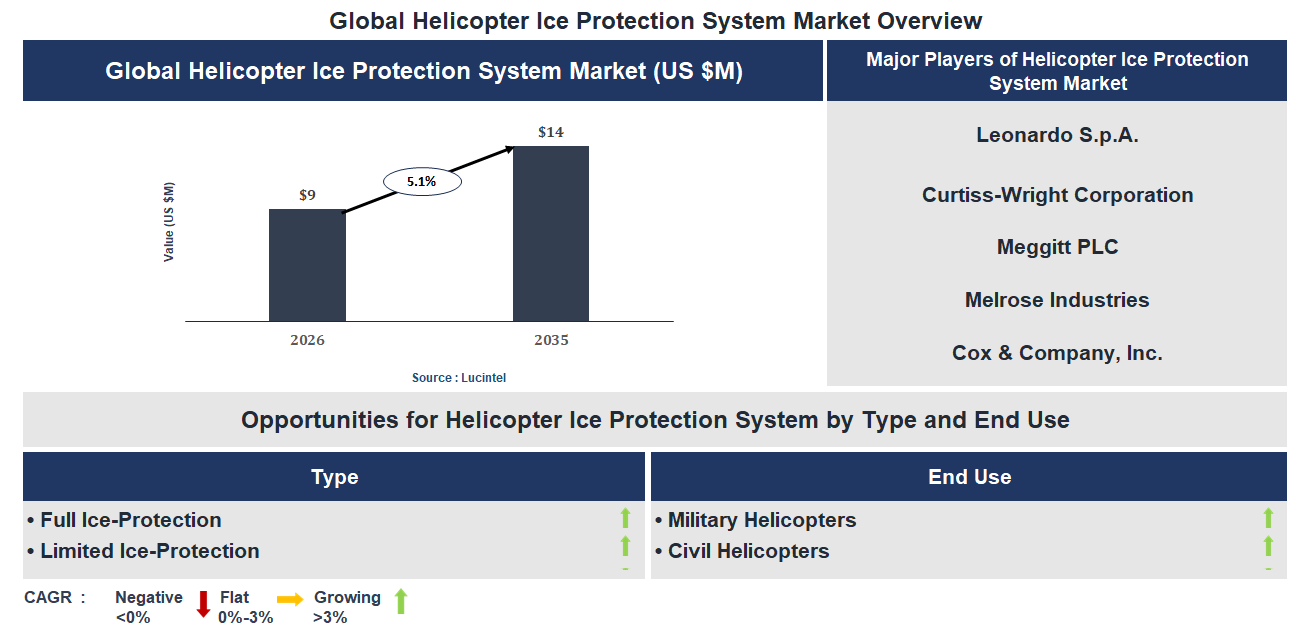
The future of the global helicopter ice protection system market looks promising with opportunities in the military helicopter and civil helicopter markets. The global helicopter ice protection system market is expected to reach an estimated $14 million by 2035 with a CAGR of 5.1% from 2026 to 2035. The major drivers for this market are the increasing demand for safer flying conditions, the rising need for advanced de-icing solutions, and the growing focus on aircraft reliability & performance.• Lucintel forecasts that, within the type category, full ice-protection is expected to witness higher growth over the forecast period.
• Within the end use category, military helicopter is expected to witness higher growth.
• In terms of region, North America is expected to witness the highest growth over the forecast period. Gain valuable insights for your business decisions with our comprehensive 150+ page report. Sample figures with some insights are shown below.
Emerging Trends in the Helicopter Ice Protection System Market
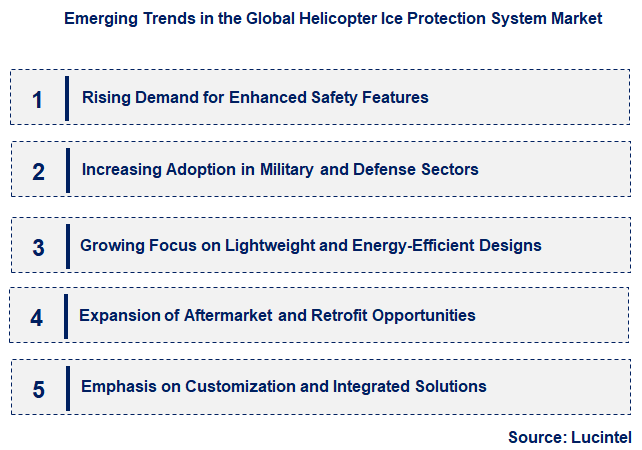
The helicopter ice protection system market is experiencing rapid evolution driven by technological advancements, increasing safety regulations, and the growing demand for reliable helicopter operations in cold regions. As the industry adapts to harsher environments and stricter safety standards, several emerging trends are shaping its future. These developments are not only enhancing system efficiency and safety but also expanding market opportunities across various sectors such as defense, commercial, and rescue operations. Understanding these key trends is essential for stakeholders aiming to capitalize on the markets growth potential and address the challenges posed by extreme weather conditions.• Rising Demand for Enhanced Safety Features: The market is witnessing a significant push toward integrating advanced safety features into ice protection systems. Operators are prioritizing systems that offer real-time monitoring, automatic de-icing, and fail-safe mechanisms to prevent accidents caused by ice accumulation. This trend is driven by stricter safety regulations and the need to minimize operational risks in cold environments. As a result, manufacturers are investing in R&D to develop more reliable, user-friendly, and efficient systems that can adapt to various helicopter models and operational conditions, thereby boosting market growth.
• Increasing Adoption in Military and Defense Sectors: Military applications are increasingly adopting sophisticated ice protection systems to ensure operational readiness in icy terrains. Defense agencies require robust, durable, and high-performance systems capable of functioning under extreme conditions. This trend is expanding the market beyond commercial and rescue operations, opening new revenue streams for manufacturers. The integration of these systems into military helicopters enhances mission safety and effectiveness, especially in Arctic and Antarctic deployments. Consequently, the defense sectors demand is a key driver fueling innovation and market expansion in the helicopter ice protection system industry.
• Growing Focus on Lightweight and Energy-Efficient Designs: As operational efficiency becomes a priority, manufacturers are focusing on developing lightweight and energy-efficient ice protection solutions. These systems aim to reduce the overall weight of helicopters, thereby improving fuel efficiency and payload capacity. Innovations include the use of advanced materials and streamlined designs that do not compromise performance. This trend is particularly relevant for commercial operators seeking cost savings and environmental compliance. The push for sustainability and operational efficiency is thus shaping product development, making lightweight systems a critical market differentiator and growth driver.
• Expansion of Aftermarket and Retrofit Opportunities: The aging fleet of helicopters presents significant retrofit opportunities for ice protection systems. Market players are increasingly offering aftermarket solutions to upgrade existing helicopters with modern, more effective systems. This trend is driven by the high cost of new helicopter procurement and the need to extend the operational life of existing assets. Retrofit projects also allow operators to comply with updated safety standards without significant capital expenditure. As a result, the aftermarket segment is becoming a vital growth area, providing steady revenue streams and fostering innovation in system compatibility and ease of installation.
• Emphasis on Customization and Integrated Solutions: The market is shifting toward tailored ice protection systems that can be integrated seamlessly with other helicopter systems. Customization allows operators to address specific operational needs, environmental conditions, and aircraft configurations. Integrated solutions enhance overall aircraft safety and performance by enabling coordinated de-icing, anti-icing, and monitoring functionalities. This trend is driven by the increasing complexity of helicopter missions and the demand for comprehensive safety solutions. Manufacturers are investing in modular designs and software integration to meet these needs, thereby creating a competitive advantage and expanding market share. These emerging trends are fundamentally reshaping the helicopter ice protection system market by emphasizing safety, efficiency, adaptability, and technological integration. They are enabling operators to perform reliably in extreme conditions while opening new avenues for innovation and market expansion. As these trends continue to evolve, the industry is poised for sustained growth, driven by the increasing importance of safety and operational efficiency in cold-weather helicopter operations.
Recent Developments in the Helicopter Ice Protection System Market
The helicopter ice protection system market is experiencing rapid advancements driven by increasing safety regulations, technological innovations, and rising demand for reliable helicopter operations in cold climates. These developments are transforming the industry by enhancing safety, efficiency, and operational capabilities. As the market evolves, key opportunities are emerging that promise to reshape the landscape, offering significant benefits to manufacturers, operators, and end-users alike.• Growing Demand for Safer Helicopter Operations: The need for reliable ice protection systems is escalating due to harsher winter conditions and stricter safety standards. This demand is prompting manufacturers to develop advanced, more effective systems that prevent ice accumulation, ensuring safer flights. The market is witnessing increased investments in research and development to create innovative solutions that meet evolving safety requirements, thereby expanding market opportunities and boosting confidence among operators.
• Technological Innovations in Ice Detection and Prevention: Recent developments include the integration of sophisticated sensors and automated de-icing mechanisms. These innovations improve real-time ice detection and enable prompt response, reducing operational risks. Enhanced materials and design improvements are also contributing to more durable and efficient systems. These technological advancements are significantly reducing maintenance costs and downtime, leading to increased adoption across various helicopter models and expanding the market’s reach.
• Rising Adoption of Lightweight and Energy-Efficient Systems: Manufacturers are focusing on developing lightweight ice protection systems that do not compromise helicopter performance. Energy-efficient designs are gaining popularity, reducing power consumption and operational costs. These innovations are particularly beneficial for smaller helicopters and those operating in remote areas where fuel efficiency is critical. The trend is driving market growth by enabling broader application and improving overall operational sustainability.
• Increasing Regulatory Support and Standards: Governments and aviation authorities are implementing stricter regulations requiring effective ice protection systems for helicopter safety. This regulatory push is encouraging operators to upgrade existing systems and adopt new technologies. Compliance with these standards is becoming a key market driver, fostering innovation and ensuring safety compliance. The regulatory environment is thus playing a crucial role in accelerating market growth and technological development.
• Expansion into Emerging Markets: Developing regions with growing aviation infrastructure are increasingly adopting helicopter services, creating new opportunities for ice protection systems. Local manufacturers are entering the market, and international players are expanding their presence. This growth is driven by increased demand for safety and operational reliability in cold-weather regions. The expansion into emerging markets is expected to significantly boost overall market size and diversify the customer base, fostering global industry growth. These developments are collectively transforming the helicopter ice protection system market by enhancing safety, efficiency, and regulatory compliance. Technological innovations and expanding market applications are driving growth, creating new opportunities for manufacturers and operators. As the market continues to evolve, these advancements will likely lead to increased adoption, improved safety standards, and broader global reach, shaping the future landscape of helicopter operations in cold environments.
Strategic Growth Opportunities in the Helicopter Ice Protection System Market
The helicopter ice protection system market is experiencing significant growth driven by increasing demand for safety and operational efficiency in cold climates. Advancements in technology, regulatory standards, and the expanding global helicopter fleet are creating new opportunities for innovative ice protection solutions. Market players are focusing on product development, strategic partnerships, and geographic expansion to capitalize on these trends. This evolving landscape offers substantial potential for companies to enhance safety measures and meet the rising needs of helicopter operators worldwide.• Increasing Adoption of Advanced Ice Protection Technologies: The demand for more reliable and efficient ice protection systems is rising as helicopter operators seek to improve safety in icy conditions. Innovations such as electro-thermal and pneumatic systems are gaining popularity due to their enhanced performance and energy efficiency. Regulatory agencies are also mandating stricter safety standards, encouraging manufacturers to develop advanced solutions. This trend presents opportunities for R&D investments and product differentiation, driving market growth.
• Growing Helicopter Fleet in Remote and Cold Regions: The expansion of helicopter operations in Arctic, Antarctic, and other cold regions is fueling the need for specialized ice protection systems. These areas require robust, durable, and easy-to-maintain solutions to ensure safety and operational continuity. As exploration, research, and transportation activities increase in these regions, the market for tailored ice protection systems is expected to expand significantly, prompting manufacturers to innovate and localize products for harsh environments.
• Strategic Collaborations and Partnerships for Innovation: Companies are forming alliances with technology providers, research institutions, and regional players to accelerate product development and market penetration. Collaborations facilitate access to new technologies, funding, and distribution channels, enabling faster deployment of advanced ice protection systems. These strategic partnerships are crucial for overcoming technical challenges and meeting diverse customer needs, thereby fostering market expansion and competitive advantage.
• Rising Focus on Regulatory Compliance and Safety Standards: Governments and aviation authorities are implementing stricter safety regulations related to ice protection in helicopters. Compliance with these standards is essential for market players to operate legally and maintain safety credibility. This regulatory environment encourages innovation and quality improvements, creating opportunities for companies to develop certified, high-performance systems. Adapting to evolving standards will be key for market participants aiming to capture and sustain growth.
• Increasing Investment in R&D for Lightweight and Energy-efficient Systems: The push for reducing helicopter weight and improving fuel efficiency is driving R&D efforts toward lightweight, energy-efficient ice protection solutions. These innovations aim to minimize operational costs and environmental impact while maintaining safety. Investment in new materials, design optimization, and smart control systems is expected to yield next-generation products, opening avenues for market differentiation and expansion into new segments, including smaller and more versatile helicopter models. The overall market outlook is positively influenced by these growth opportunities, promising enhanced safety, technological innovation, and expanded geographic reach. Companies that strategically leverage these trends will be well-positioned to capitalize on the increasing demand for helicopter ice protection systems, ensuring sustained growth and competitive advantage in this evolving industry.
Helicopter Ice Protection System Market Driver and Challenges
The helicopter ice protection system market is influenced by a variety of technological, economic, and regulatory factors. Advances in aviation safety technology, increasing demand for helicopter operations in cold regions, and stringent safety regulations are key drivers. Conversely, high system costs, technological complexity, and regulatory hurdles pose significant challenges. The markets growth is shaped by the need for reliable ice protection solutions to ensure operational safety and compliance. As helicopter operations expand into harsher environments, the importance of effective ice protection systems becomes critical. Understanding these drivers and challenges is essential for stakeholders aiming to capitalize on market opportunities and address potential barriers. The factors responsible for driving the helicopter ice protection system market include:• Technological Advancements: The development of innovative ice protection technologies, such as advanced de-icing fluids and anti-icing systems, enhances safety and operational efficiency. These innovations reduce the risk of ice accumulation, enabling helicopters to operate safely in extreme weather conditions. Continuous R&D efforts are leading to more reliable, lightweight, and cost-effective solutions, which are increasingly adopted by operators. This technological progress not only improves safety standards but also broadens the application scope, encouraging market growth.
• Increasing Cold Climate Operations: The rising demand for helicopter services in polar regions, high-altitude terrains, and cold-weather environments drives the need for effective ice protection systems. Industries such as oil and gas, search and rescue, and scientific research require reliable operations in icy conditions. As these sectors expand their activities in remote and harsh environments, the necessity for advanced ice protection solutions becomes more pronounced, fueling market expansion.
• Regulatory and Safety Standards: Stringent safety regulations imposed by aviation authorities worldwide mandate the use of ice protection systems to ensure flight safety. Compliance with these standards compels helicopter operators to install certified ice protection solutions, thereby boosting market demand. Regulatory frameworks also promote technological upgrades and innovations, fostering a safer flying environment and encouraging market players to develop compliant systems.
• Growing Helicopter Fleet: The increasing global helicopter fleet, driven by urban mobility, emergency services, and industrial applications, amplifies the demand for ice protection systems. As fleet size expands, especially in regions prone to icy conditions, the need for reliable ice protection becomes critical. This growth directly correlates with higher market revenues and encourages manufacturers to innovate and diversify their product offerings.
• Rising Investment in R&D: Significant investments by aerospace companies and research institutions in developing advanced ice protection technologies contribute to market growth. These investments lead to the creation of more efficient, durable, and cost-effective systems. Enhanced R&D efforts also facilitate the integration of new materials and automation, improving system performance and reliability, which in turn attracts more customers and expands market opportunities. The challenges facing the helicopter ice protection system market include:
• High System Costs: The advanced technology required for effective ice protection systems often involves substantial investment, making these solutions expensive for operators. High costs can limit adoption, especially among smaller operators or in regions with budget constraints. Cost barriers may slow market growth and restrict widespread implementation, necessitating innovations to reduce expenses without compromising safety.
• Technological Complexity: Developing and integrating sophisticated ice protection systems involves complex engineering and design challenges. Ensuring compatibility with various helicopter models and maintaining system reliability under extreme conditions require extensive testing and validation. This complexity can lead to longer development cycles, increased costs, and potential delays in product deployment, hindering market expansion.
• Regulatory Hurdles: Navigating the diverse and evolving regulatory landscape across different countries presents significant challenges. Obtaining certifications and approvals for new ice protection technologies can be time-consuming and costly. Regulatory delays may impede the introduction of innovative solutions into the market, affecting manufacturers ability to meet customer demands promptly and limiting overall market growth. The helicopter ice protection system market is shaped by technological innovations, increasing demand from cold climate operations, strict safety regulations, expanding helicopter fleets, and ongoing R&D investments. However, high costs, technological complexities, and regulatory challenges pose obstacles that could hinder growth. Overall, the markets future depends on balancing these drivers and challenges through technological advancements, cost reductions, and regulatory harmonization, which will determine the pace and scope of market expansion.
List of Helicopter Ice Protection System Companies
Companies in the market compete on the basis of product quality offered. Major players in this market focus on expanding their manufacturing facilities, R&D investments, infrastructural development, and leverage integration opportunities across the value chain. With these strategies helicopter ice protection system companies cater increasing demand, ensure competitive effectiveness, develop innovative products & technologies, reduce production costs, and expand their customer base. Some of the helicopter ice protection system companies profiled in this report include-• Leonardo S.p.A.
• Curtiss-Wright Corporation
• Meggitt PLC
• Melrose Industries
• Cox & Company, Inc.
• Ultra Electronics
• ITT Inc
Helicopter Ice Protection System Market by Segment
The study includes a forecast for the global helicopter ice protection system market by type, end use, and region.Helicopter Ice Protection System Market by Type [Value from 2019 to 2035]:
• Full Ice-Protection
• Limited Ice-Protection
Helicopter Ice Protection System Market by End Use [Value from 2019 to 2035]:
• Military Helicopters
• Civil Helicopters
Helicopter Ice Protection System Market by Region [Value from 2019 to 2035]:
• North America
• Europe
• Asia Pacific
• The Rest of the World
Country Wise Outlook for the Helicopter Ice Protection System Market
The helicopter ice protection system market has experienced significant advancements driven by increasing safety regulations, technological innovations, and rising demand for reliable de-icing solutions across the globe. Countries are investing in research and development to enhance system efficiency, reduce weight, and improve operational performance in harsh weather conditions. The markets growth is also fueled by expanding helicopter fleets in various sectors such as defense, emergency services, and commercial transportation. As climate conditions become more unpredictable, the need for advanced ice protection systems is more critical than ever, prompting countries to adopt innovative solutions tailored to their specific operational needs.• United States: The US market has seen substantial growth due to increased defense spending and the expansion of commercial helicopter operations. Leading companies are developing lightweight, automated ice protection systems that integrate with existing helicopter avionics. Regulatory agencies are also pushing for higher safety standards, encouraging adoption of advanced de-icing technologies. The US military is investing heavily in next-generation ice protection systems to enhance operational safety in extreme weather conditions. Additionally, the commercial sector is adopting innovative solutions to improve safety and efficiency during winter operations.
• China: China is rapidly expanding its helicopter fleet, especially in defense and emergency response sectors, driving demand for ice protection systems. The country is focusing on indigenous development of advanced de-icing technologies to reduce reliance on imports. Recent government initiatives aim to modernize aviation infrastructure and enhance safety standards, which include upgrading ice protection capabilities. Chinese companies are investing in research to develop more efficient, cost-effective systems suitable for diverse climatic conditions. The market is also witnessing increased collaborations with international firms to incorporate cutting-edge technologies.
• Germany: Germanys helicopter market is characterized by a focus on high-quality, reliable ice protection systems, driven by stringent European safety regulations. The country is a hub for innovation in lightweight and energy-efficient de-icing solutions, often integrating them with other aircraft systems. German manufacturers are emphasizing automation and real-time monitoring features to improve safety and operational efficiency. The defense and civil sectors are both investing in advanced systems to meet evolving regulatory standards. Germanys emphasis on sustainability is also influencing the development of eco-friendly ice protection technologies.
• India: India is witnessing a growing demand for helicopter ice protection systems due to increased infrastructure development and disaster management activities. The country is focusing on affordable, robust de-icing solutions suitable for its diverse climatic zones. Government initiatives to modernize the aviation sector and expand helicopter fleets are fueling market growth. Indian companies are collaborating with international firms to adopt advanced technologies and improve system performance. The emphasis is on developing cost-effective, easy-to-maintain systems to support both military and civilian applications in challenging weather conditions.
• Japan: Japans market is driven by its advanced aerospace industry and the need for reliable ice protection in its challenging winter climates. The country is investing in innovative, compact, and energy-efficient de-icing systems that can be integrated into existing helicopter models. Japans focus on safety and technological excellence is leading to the adoption of smart, automated systems with real-time monitoring capabilities. The defense sector is also upgrading its fleet with cutting-edge ice protection solutions to ensure operational readiness in severe weather. Collaboration with international firms is common to incorporate the latest technological advancements.

Features of the Global Helicopter Ice Protection System Market
Market Size Estimates: Helicopter ice protection system market size estimation in terms of value ($M). Trend and Forecast Analysis: Market trends (2019 to 2025) and forecast (2026 to 2035) by various segments and regions. Segmentation Analysis: Helicopter ice protection system market size by type, end use, and region in terms of value ($M). Regional Analysis: Helicopter ice protection system market breakdown by North America, Europe, Asia Pacific, and Rest of the World. Growth Opportunities: Analysis of growth opportunities in different types, end uses, and regions for the helicopter ice protection system market. Strategic Analysis: This includes M&A, new product development, and competitive landscape of the helicopter ice protection system market. Analysis of competitive intensity of the industry based on Porter’s Five Forces model.
FAQ
Q1. What is the helicopter ice protection system market size? Answer: The global helicopter ice protection system market is expected to reach an estimated $14 million by 2035. Q2. What is the growth forecast for helicopter ice protection system market? Answer: The global helicopter ice protection system market is expected to grow with a CAGR of 5.1% from 2026 to 2035. Q3. What are the major drivers influencing the growth of the helicopter ice protection system market? Answer: The major drivers for this market are the increasing demand for safer flying conditions, the rising need for advanced de-icing solutions, and the growing focus on aircraft reliability & performance. Q4. What are the major segments for helicopter ice protection system market? Answer: The future of the helicopter ice protection system market looks promising with opportunities in the military helicopter and civil helicopter markets. Q5. Who are the key helicopter ice protection system market companies? Answer: Some of the key helicopter ice protection system companies are as follows:• Leonardo S.p.A.
• Curtiss-Wright Corporation
• Meggitt PLC
• Melrose Industries
• Cox & Company, Inc.
• Ultra Electronics
• ITT Inc Q6. Which helicopter ice protection system market segment will be the largest in future? Answer: Lucintel forecasts that, within the type category, full ice-protection is expected to witness higher growth over the forecast period. Q7. In helicopter ice protection system market, which region is expected to be the largest in next 8 years? Answer: In terms of region, North America is expected to witness the highest growth over the forecast period. Q8. Do we receive customization in this report? Answer: Yes, Lucintel provides 10% customization without any additional cost.
Table of Contents
List of Figures
List of Tables
Methodology
- In-depth interviews of the major players in this market
- Detailed secondary research from competitors’ financial statements and published data
- Extensive searches of published works, market, and database information pertaining to industry news, company press releases, and customer intentions
- A compilation of the experiences, judgments, and insights of Lucintel’s professionals, who have analyzed and tracked this market over the years.


Buy Now
Choose a license that fits your team. Instant PDF delivery.
Prices exclude taxes. Instant delivery. Custom licensing available on request.
Key Questions
- • What are some of the most promising, high-growth opportunities for the helicopter ice protection system market by type (full ice-protection and limited ice-protection), end use (military helicopters and civil helicopters), and region (North America, Europe, Asia Pacific, and the Rest of the World)?
- • Which segments will grow at a faster pace and why?
- • Which region will grow at a faster pace and why?
- • What are the key factors affecting market dynamics? What are the key challenges and business risks in this market?
- • What are the business risks and competitive threats in this market?
- • What are the emerging trends in this market and the reasons behind them?
- • What are some of the changing demands of customers in the market?
- • What are the new developments in the market? Which companies are leading these developments?
- • Who are the major players in this market? What strategic initiatives are key players pursuing for business growth?
- • What are some of the competing products in this market and how big of a threat do they pose for loss of market share by material or product substitution?
- • What M&A activity has occurred in the last 5 years and what has its impact been on the industry? For any questions related to Helicopter Ice Protection System Market, Helicopter Ice Protection System Market Size, Helicopter Ice Protection System Market Growth, Helicopter Ice Protection System Market Analysis, Helicopter Ice Protection System Market Report, Helicopter Ice Protection System Market Share, Helicopter Ice Protection System Market Trends, Helicopter Ice Protection System Market Forecast, Helicopter Ice Protection System Companies, write Lucintel analyst at email: helpdesk@lucintel.com. We will be glad to get back to you soon.


