
Report Feature
Exterior Sheathing Market Trends and Forecast
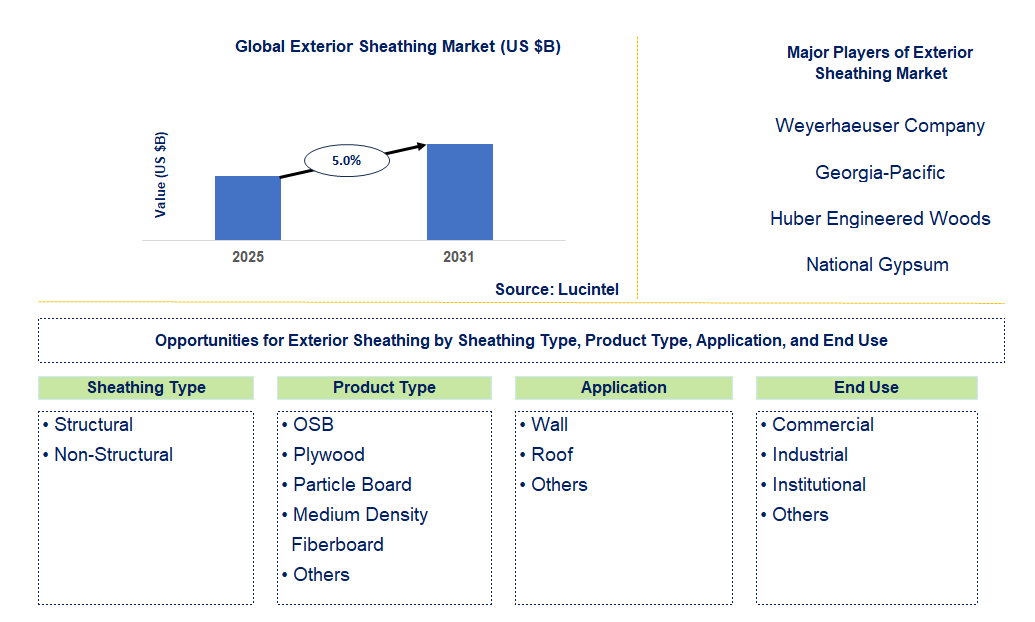
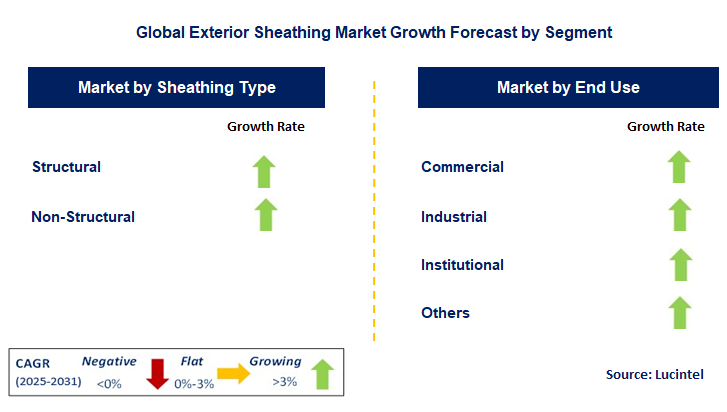
The future of the global exterior sheathing market looks promising with opportunities in the commercial, industrial, and institutional markets. The global exterior sheathing market is expected to grow with a CAGR of 5% from 2025 to 2031. The major drivers for this market are the increasing demand for energy-efficient building materials, the rising construction activities in urban areas, and the growing adoption of weather-resistant sheathing products.• Lucintel forecasts that, within the sheathing type category, structural is expected to witness higher growth over the forecast period.
• Within the end use category, commercial is expected to witness the highest growth.
• In terms of region, North America is expected to witness the highest growth over the forecast period. Gain valuable insights for your business decisions with our comprehensive 150+ page report. Sample figures with some insights are shown below.
Emerging Trends in the Exterior Sheathing Market
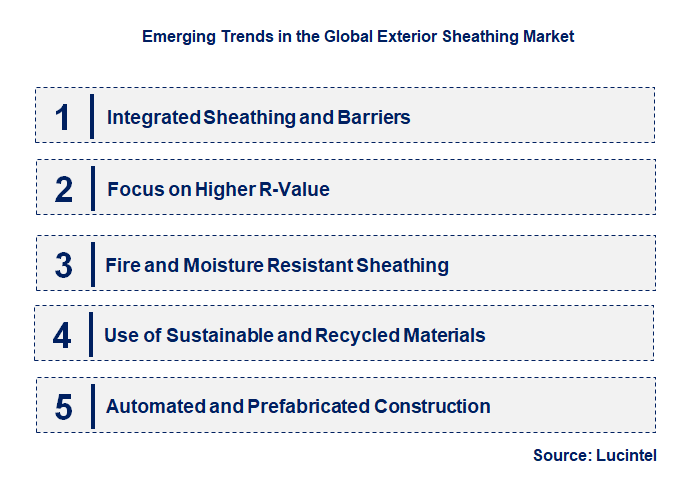
The exterior sheathing market is being reshaped by several key trends that prioritize performance, sustainability, and efficiency. These trends are directly influencing material innovation and construction methods, as builders and developers seek solutions that offer more than just structural support. They are critical for meeting the evolving demands of the modern building industry.• Integrated Sheathing and Barriers: This trend involves manufacturing sheathing panels with a built-in water-resistive barrier (WRB) and air barrier. This eliminates the need for a separate house wrap, streamlining the installation process and reducing labor costs. The impact is a more efficient construction timeline, a more robust building envelope, and improved energy efficiency.
• Focus on Higher R-Value: With increasing demand for energy-efficient buildings, there's a growing trend towards sheathing products that provide high thermal resistance (R-value). This includes foam board sheathing and structural insulated panels (SIPs). The impact is a significant reduction in a building's energy consumption, leading to lower utility bills and a smaller carbon footprint.
• Fire and Moisture Resistant Sheathing: Due to stricter building codes and concerns over extreme weather, a key trend is the development of sheathing materials with superior fire and moisture resistance. Products are now being treated with fire retardants and water-repelling coatings. The impact is enhanced safety and durability, protecting buildings from fire and water damage and extending their lifespan.
• Use of Sustainable and Recycled Materials: This trend involves incorporating recycled content, such as plastic and wood waste, into sheathing panels. Manufacturers are also exploring the use of bio-based materials and sustainable forestry practices. The impact is a reduced environmental footprint, aligning the construction industry with circular economy principles and appealing to eco-conscious consumers and builders.
• Automated and Prefabricated Construction: The exterior sheathing market is adapting to the rise of off-site and prefabricated construction. Sheathing panels are now being designed to be easily integrated into modular building systems. The impact is a more efficient and precise building process, reducing on-site waste, improving quality control, and accelerating project completion times. These emerging trends are collectively reshaping the exterior sheathing market by transforming it from a commodity product into a high-performance building system. The focus on integrated solutions, enhanced durability, and sustainable practices is making sheathing a key component of modern, energy-efficient, and resilient buildings. This shift is crucial for future market growth.
Recent Development in the Exterior Sheathing Market
The exterior sheathing market is experiencing rapid developments driven by a focus on improving product performance and efficiency. These advancements are responding to the demand for building materials that are more durable, easier to install, and better equipped to handle a variety of environmental challenges. These developments are critical for future market growth.• "All-in-One" Sheathing Systems: The most significant development is the introduction of sheathing panels with integrated water-resistive and air barriers. This single-panel solution simplifies the building envelope, reducing material handling and installation steps. The impact is a more streamlined construction process, leading to substantial savings in labor time and cost.
• Smart Sheathing and IoT Integration: A new development involves embedding sensors into sheathing to monitor temperature, moisture, and structural integrity in real-time. This technology is being tested in high-performance and large commercial buildings. The impact is a new level of building performance monitoring, allowing for proactive maintenance and ensuring long-term structural health.
• Advanced Gypsum and Fiberglass Sheathing: Innovations in gypsum-based sheathing have led to the creation of moisture- and mold-resistant products that are also fire-resistant. The development of fiberglass-faced gypsum sheathing further improves its durability and water resistance. The impact is a higher-performing sheathing material that can be used in more challenging climates and applications.
• Enhanced Fire and Wildfire Resistance: In response to increasing wildfire risks, sheathing manufacturers are developing products with enhanced fire-retardant properties. These panels are treated to resist fire spread and maintain structural integrity during an event. The impact is a safer building envelope and a key selling point in regions prone to wildfires, driven by consumer demand and updated building codes.
• Sustainable Product Formulations: There's a growing development in creating sheathing products using a higher percentage of recycled content and sustainably sourced materials. This includes using recycled paper, wood scraps, and even plastic waste in the core of the sheathing. The impact is a more eco-friendly product that appeals to green building initiatives and a market focused on environmental responsibility. These recent developments are collectively impacting the exterior sheathing market by elevating the product from a basic component to a sophisticated building system. The focus on efficiency, durability, and sustainability is driving innovation and creating new, high-value product categories that are better suited for the challenges of modern construction.
Strategic Growth Opportunities in the Exterior Sheathing Market
The exterior sheathing market is poised for significant growth by capitalizing on strategic opportunities across key applications. These opportunities are driven by a need for efficiency, resilience, and sustainability in modern construction. Focusing on high-growth segments will allow manufacturers to expand their market share and create long-term value.• High-Performance Residential Construction: The demand for energy-efficient homes is a major growth opportunity. Marketing sheathing products with high R-values and superior air sealing properties to the residential sector is key. The impact is a growing market in a sector where homeowners are willing to pay a premium for reduced energy bills and a more comfortable, durable home.
• Commercial and Institutional Building: The commercial sector, including offices, schools, and hospitals, has a strong demand for sheathing that meets stringent fire and sound regulations. The opportunity lies in providing high-performance gypsum and cement board sheathing. The impact is a high-volume, high-value market where performance and compliance are critical decision factors.
• Renovation and Repair Projects: The vast market of existing homes and buildings presents a significant opportunity. Sheathing is a crucial component in deep energy retrofits and renovations. The impact is a stable, long-term revenue stream, as sheathing is replaced or upgraded to improve a building’s energy efficiency, comfort, and storm resilience.
• Off-Site and Modular Construction: The shift towards off-site and modular construction is a massive growth opportunity for exterior sheathing. Sheathing panels designed for quick, factory-controlled installation on modular components are highly valued. The impact is a strong partnership with modular builders, who prioritize speed, precision, and quality, making sheathing a vital part of this growing industry.
• Climate-Resilient Building Envelopes: As extreme weather events become more frequent, there is a clear opportunity to market sheathing that offers superior protection against wind, moisture, and fire. The impact is a premium market for specialized products that offer peace of mind and enhanced safety, attracting builders and homeowners in at-risk regions. These strategic growth opportunities are collectively impacting the exterior sheathing market by diversifying its application base and increasing its value proposition. By moving beyond traditional uses and targeting high-growth sectors, the industry is positioning itself as a vital partner in creating more efficient, resilient, and sustainable buildings.
Exterior Sheathing Market Driver and Challenges
The exterior sheathing market's trajectory is influenced by a combination of major drivers and challenges. The key drivers are a strong focus on energy efficiency, advancements in material technology, and favorable building regulations. However, the market faces hurdles related to raw material costs, competition, and installer education. The factors responsible for driving the exterior sheathing market include: 1. Growing Demand for Energy Efficiency: Building energy codes and consumer awareness are driving the demand for high-performance sheathing that improves a building's thermal envelope. This is a primary driver, as sheathing is a critical component for reducing a building's heating and cooling costs. 2. Advancements in Material Technology: Continuous innovation has led to sheathing materials with superior properties like enhanced moisture resistance, fire protection, and durability. These technological improvements address key building challenges and provide a compelling reason for market growth and product adoption. 3. Stricter Building Codes and Regulations: Governments are implementing more stringent building codes that mandate higher performance standards for fire safety, storm resistance, and energy efficiency. These regulations are a powerful driver, creating a direct demand for high-performance sheathing that meets or exceeds these new requirements. 4. Increasing Prefabricated Construction: The rise of off-site and prefabricated construction is boosting the sheathing market. This method requires standardized, high-quality, and easy-to-install sheathing, creating a dedicated market for specialized products designed for factory assembly. 5. Consumer Focus on Durability and Resilience: Homeowners and builders are increasingly prioritizing materials that can withstand extreme weather and natural disasters. This demand for more resilient buildings is a key driver for sheathing products that offer superior protection against wind, fire, and water damage. Challenges in the exterior sheathing market are: 1. Volatile Raw Material Costs: The exterior sheathing market is heavily reliant on materials like wood and gypsum. Fluctuations in the cost of these raw materials can directly impact product pricing and profit margins, creating instability for manufacturers and a barrier for project budgeting. 2. Competition from Alternative Materials: The market faces significant competition from other exterior cladding and insulation products. Products like spray foam insulation and insulated metal panels can sometimes serve a similar function, posing a challenge to sheathing manufacturers and requiring constant innovation to stay competitive. 3. Installer Education and Training: The new, high-tech sheathing systems require specialized knowledge for proper installation to ensure their effectiveness. A lack of trained and certified installers can lead to improper application, which could compromise the product's performance and create a barrier to adoption. The overall impact of these drivers and challenges is a market in transition. While the drivers are pushing the industry toward a future of high-performance, sustainable, and resilient products, the challenges must be addressed through strategic supply chain management, competitive innovation, and a strong focus on installer education to ensure widespread market growth and success.List of Exterior Sheathing Companies
Companies in the market compete on the basis of product quality offered. Major players in this market focus on expanding their manufacturing facilities, R&D investments, infrastructural development, and leverage integration opportunities across the value chain. With these strategies exterior sheathing companies cater increasing demand, ensure competitive effectiveness, develop innovative products & technologies, reduce production costs, and expand their customer base. Some of the exterior sheathing companies profiled in this report include-• Weyerhaeuser Company
• Georgia-Pacific
• Huber Engineered Woods
• National Gypsum
Exterior Sheathing Market by Segment
The study includes a forecast for the global exterior sheathing market by sheathing type, product type, application, end use, and region.Exterior Sheathing Market by Sheathing Type [Value from 2019 to 2031]:
• Structural
• Non-Structural
Exterior Sheathing Market by Product Type [Value from 2019 to 2031]:
• OSB
• Plywood
• Particle Board
• Medium Density Fiberboard
• Others
Exterior Sheathing Market by Application [Value from 2019 to 2031]:
• Wall
• Roof
• Others
Exterior Sheathing Market by End Use [Value from 2019 to 2031]:
• Commercial
• Industrial
• Institutional
• Others
Exterior Sheathing Market by Region [Value from 2019 to 2031]:
• North America
• Europe
• Asia Pacific
• The Rest of the World
Country Wise Outlook for the Exterior Sheathing Market
The exterior sheathing market is undergoing significant transformation, driven by a global focus on building energy efficiency, material sustainability, and structural resilience. Recent developments highlight a shift towards advanced materials and integrated systems that offer superior performance. These innovations are critical for meeting modern building codes and the demands of eco-conscious construction.• United States: The U.S. market is prioritizing integrated sheathing products that combine structural panels with water and air barriers. This "all-in-one" approach simplifies installation and improves building envelope performance. There is a strong demand for high-performance Oriented Strand Board (OSB) and gypsum sheathing that offer enhanced moisture and fire resistance to meet stringent building codes.
• China: China’s rapid urbanization and ambitious green building policies are driving the market. The country is focusing on mass production of high-performance composite sheathing materials. Developments include the use of fiber cement and magnesium oxide boards, which offer superior fire resistance and durability for a variety of residential and commercial applications.
• Germany: Germany, with its strong emphasis on energy efficiency, is a leader in developing insulated sheathing systems. Recent advancements include high-R-value foam board sheathing and sheathing integrated with phase change materials. The market is also heavily influenced by circular economy principles, with a focus on sheathing products made from recycled and bio-based materials.
• India: The Indian market is seeing a surge in demand for cost-effective and climate-resilient sheathing. Developments are focused on moisture-resistant sheathing suitable for the country's diverse climate zones. There is a growing trend towards using gypsum-based boards and insulated sheathing to improve energy performance and protect buildings from extreme weather conditions.
• Japan: Japan's exterior sheathing market is influenced by the need for seismic resistance and durability. Recent developments include sheathing panels with enhanced shear strength and materials that can withstand typhoons and earthquakes. The market is also seeing an increased use of advanced wood-based sheathing products in pre-fabricated construction, a popular method in the country.

Features of the Global Exterior Sheathing Market
Market Size Estimates: Exterior sheathing market size estimation in terms of value ($B). Trend and Forecast Analysis: Market trends (2019 to 2024) and forecast (2025 to 2031) by various segments and regions. Segmentation Analysis: Exterior sheathing market size by various segments, such as by sheathing type, product type, application, end use, and region in terms of value ($B). Regional Analysis: Exterior sheathing market breakdown by North America, Europe, Asia Pacific, and Rest of the World. Growth Opportunities: Analysis of growth opportunities in different sheathing types, product types, applications, end uses, and regions for the exterior sheathing market. Strategic Analysis: This includes M&A, new product development, and competitive landscape of the exterior sheathing market. Analysis of competitive intensity of the industry based on Porter’s Five Forces model.
FAQ
Q1. What is the growth forecast for exterior sheathing market? Answer: The global exterior sheathing market is expected to grow with a CAGR of 5% from 2025 to 2031. Q2. What are the major drivers influencing the growth of the exterior sheathing market? Answer: The major drivers for this market are the increasing demand for energy-efficient building materials, the rising construction activities in urban areas, and the growing adoption of weather-resistant sheathing products. Q3. What are the major segments for exterior sheathing market? Answer: The future of the exterior sheathing market looks promising with opportunities in the commercial, industrial, and institutional markets. Q4. Who are the key exterior sheathing market companies? Answer: Some of the key exterior sheathing companies are as follows:• Weyerhaeuser Company
• Georgia-Pacific
• Huber Engineered Woods
• National Gypsum Q5. Which exterior sheathing market segment will be the largest in future? Answer: Lucintel forecasts that, within the sheathing type category, structural is expected to witness higher growth over the forecast period. Q6. In exterior sheathing market, which region is expected to be the largest in next 5 years? Answer: In terms of region, North America is expected to witness the highest growth over the forecast period. Q7. Do we receive customization in this report? Answer: Yes, Lucintel provides 10% customization without any additional cost.
Table of Contents
List of Figures
List of Tables
Methodology
- In-depth interviews of the major players in this market
- Detailed secondary research from competitors’ financial statements and published data
- Extensive searches of published works, market, and database information pertaining to industry news, company press releases, and customer intentions
- A compilation of the experiences, judgments, and insights of Lucintel’s professionals, who have analyzed and tracked this market over the years.


Buy Now
Choose a license that fits your team. Instant PDF delivery.
Prices exclude taxes. Instant delivery. Custom licensing available on request.
Key Questions
- • What are some of the most promising, high-growth opportunities for the exterior sheathing market by sheathing type (structural and non-structural), product type (OSB, plywood, particle board, medium density fiberboard, and others), application (wall, roof, and others), end use (commercial, industrial, institutional, and others), and region (North America, Europe, Asia Pacific, and the Rest of the World)?
- • Which segments will grow at a faster pace and why?
- • Which region will grow at a faster pace and why?
- • What are the key factors affecting market dynamics? What are the key challenges and business risks in this market?
- • What are the business risks and competitive threats in this market?
- • What are the emerging trends in this market and the reasons behind them?
- • What are some of the changing demands of customers in the market?
- • What are the new developments in the market? Which companies are leading these developments?
- • Who are the major players in this market? What strategic initiatives are key players pursuing for business growth?
- • What are some of the competing products in this market and how big of a threat do they pose for loss of market share by material or product substitution?
- • What M&A activity has occurred in the last 5 years and what has its impact been on the industry? For any questions related to Exterior Sheathing Market, Exterior Sheathing Market Size, Exterior Sheathing Market Growth, Exterior Sheathing Market Analysis, Exterior Sheathing Market Report, Exterior Sheathing Market Share, Exterior Sheathing Market Trends, Exterior Sheathing Market Forecast, Exterior Sheathing Companies, write Lucintel analyst at email: helpdesk@lucintel.com. We will be glad to get back to you soon.


