
Report Feature
Emobility Charging Infrastructure Market Trends and Forecast
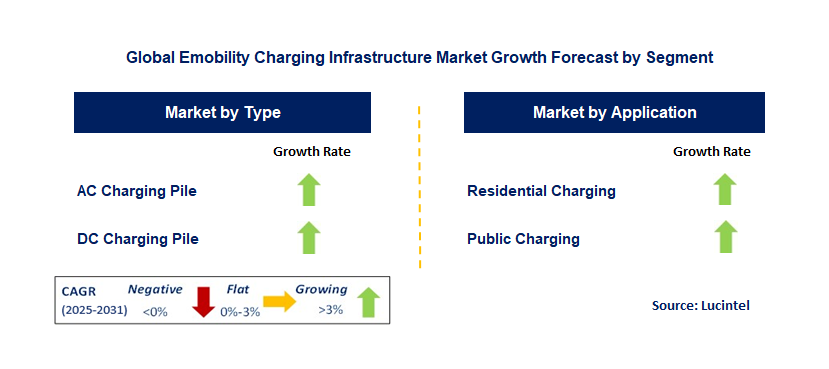
The future of the global emobility charging infrastructure market looks promising with opportunities in the residential charging and public charging markets. The global emobility charging infrastructure market is expected to grow with a CAGR of 16.5% from 2025 to 2031. The major drivers for this market are the increase in electric vehicle adoption and the growing investments in renewable energy. Lucintel forecasts that, within the type category, ac charging pile is expected to witness higher growth over the forecast period due to increasing demand for cost-effective home and workplace charging solutions. Within the application category, public charging is expected to witness the higher growth due to growing demand for urban charging stations to serve high-density population areas. In terms of region, APAC is expected to witness the highest growth over the forecast period. Gain valuable insights for your business decisions with our comprehensive 150+ page report. Sample figures with some insights are shown below.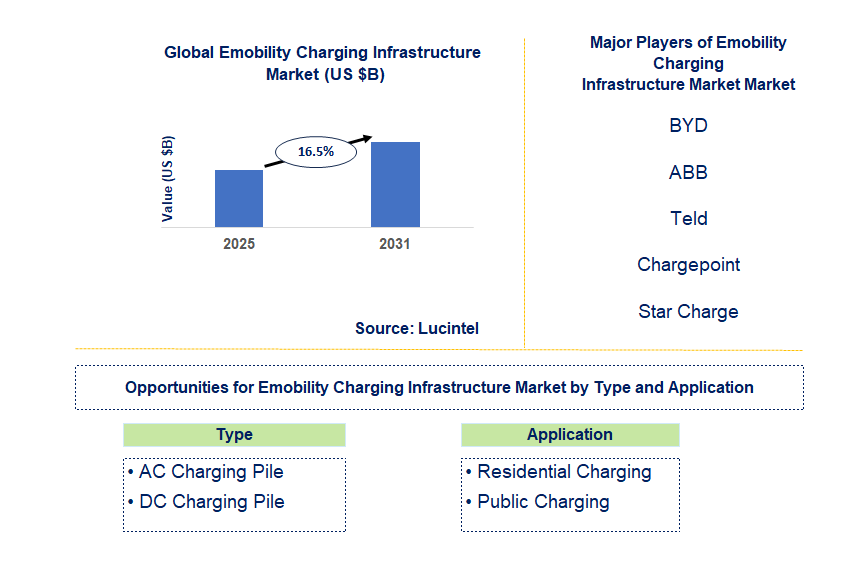
Emerging Trends in the Emobility Charging Infrastructure Market
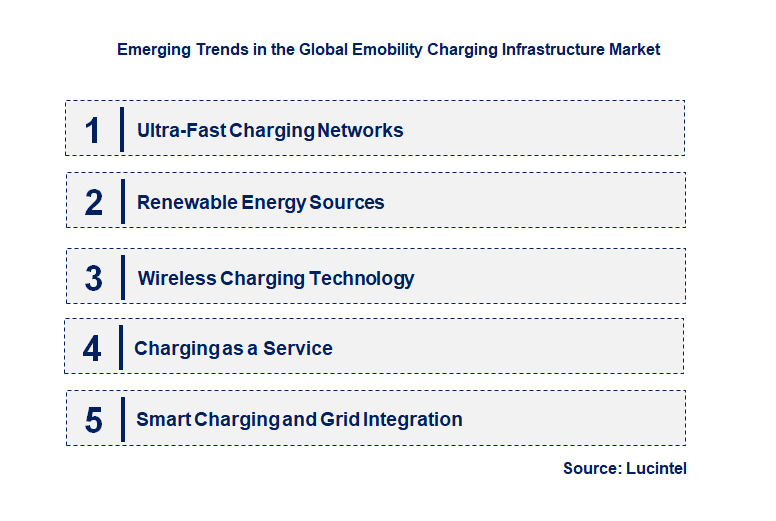
Several emerging trends that are transforming the emobility charging infrastructure market are focused on technological advancements, policy-driven incentives, and improved consumer access. These trends underscore the evolving needs and priorities of the industry, and these developments stand as below:• Ultra-Fast Charging Networks: Because electric vehicles are gaining popularity, the need for ultra-fast charging stations is increasing. These ultra-fast charging stations with capabilities to charge an EV in less than 30 minutes have emerged as major supporting structures for the reduction of charging time, enhancing convenience for the consumer. Companies like Tesla and Iconify are literally investing hugely in ultra-fast charging technology so that EV users can travel distances without considerable delay. The ultra-fast charging infrastructure expansion is expected to enhance the overall attractiveness of electric vehicles and meet the increasing demand for emobility.
• Renewable Energy Sources: Integrating renewable energy sources, such as solar and wind power, with emobility charging stations is one of the key trends in the industry. This reduces the carbon footprint of EVs and makes the charging infrastructure more sustainable. Countries like Germany and Japan are focusing on the integration of green energy into their charging networks. For instance, solar-powered charging stations can charge EVs independent of the conventional power grid. This makes the entire ecosystem of EVs environmentally friendly. Integration of renewable energy will be very important for the long-term sustainability of the emobility sector.
• Wireless Charging Technology: Wireless or inductive charging technology is gaining momentum as an innovative way to improve the EV charging experience. Unlike traditional plug-in charging, wireless charging uses magnetic fields to transfer energy to the EV’s battery, providing greater convenience for users. Research and development in this area are advancing, with companies like Qualcomm and Bosch leading the way. Wireless charging is already at its infant stages but can be seen to become an essential feature of the future EV infrastructure as it seamlessly charges the device with less physical connector reliance.
• Charging as a Service: Charging as a Service or CaaS, a new business model is quickly becoming popular within the emobility charging infrastructure market. This model allows customers to access charging stations on demand, without owning a personal charging point. CaaS companies provide subscription-based services that allow users to charge their EVs at various locations, similar to how customers subscribe to streaming services. This trend is expected to improve accessibility and convenience for EV owners, especially in urban areas where charging infrastructure may be limited or unavailable.
• Smart Charging and Grid Integration: Smart charging technology allows the EV to talk to the power grid to determine when to charge in order to match energy supply and demand. This ensures efficient use of charging stations, decreases strain on the electrical grid, and saves money for consumers. Smart charging also enables EVs to participate in V2G technology, wherein the stored energy is fed back into the grid during peak hours. The trend toward integration of smart charging systems and grid infrastructure is one of the factors that will increase the number of electric vehicles on the road and yet ensure grid stability. These emerging trends transform the emobility charging infrastructure market to make EV charging convenient, accessible, and sustainable. The focus on ultra-fast charging, renewable energy integration, and wireless technology will accelerate EV adoption and support a seamless transition to electric mobility. Meanwhile, the rise of smart charging systems and CaaS will create new business opportunities and enhance the user experience. Overall, these trends are reshaping the landscape of emobility, contributing to the growth of electric vehicle infrastructure and making sustainable transport more accessible to consumers worldwide.
Recent Development in the Emobility Charging Infrastructure Market
Growth in the emobility charging infrastructure market is highly driven by technological innovation, governmental policy support, and increasing demand for electric vehicles. The following are some of the major developments in this market up to now:• Government Investments and Policy Support: Government policies or financial incentives are a huge factor in building up the charging infrastructure. In the United States, the Biden administration has allocated $7.5 billion to expand charging networks under its EV infrastructure plan. Similarly, the Chinese government has set ambitious targets to install millions of charging stations by 2025. Policy frameworks like the EU's Green Deal and India's FAME scheme are also accelerating infrastructure growth. These government initiatives are very important for breaking the initial investment barrier to widely spread their charging stations throughout the various regions.
• Private Sector Participation: Private enterprises play a much more fundamental role in developing charging infrastructure for emobility. Large networks of public charging stations are being built and operated by companies such as Tesla, ChargePoint, and BP. The collaboration between automakers and charging infrastructure providers, such as Nissan’s partnership with charging companies in Japan, is helping to ensure that EV owners have access to convenient charging stations. These private sector investments are improving the accessibility and reliability of charging stations, which is essential for the broader adoption of electric vehicles.
• Advancements in Fast Charging Technology: A very critical factor for growth in the emobility infrastructure market is the development of fast and ultra-fast charging stations. Tesla, for instance, is building an ever-increasing Supercharger network to allow many more vehicles on the network, with the target of being faster than its previous charging times. Companies such as Iconify are building high-power charging stations to charge an electric vehicle to 80% in under 20 minutes in Europe. The evolution of charging technology is currently reducing the concern that people have for range issues and making long-distance travel easier to realize with electric vehicles.
• Urban Deployment of Charging Networks: Cities are deploying charging stations at a very rapid pace to meet the demand for electric vehicle charging. Cities like Los Angeles, Berlin, and Tokyo are building up their charging infrastructure for EV in urban environments. Local governments also give incentives to the business people in installing charging points so that people can charge their cars at the most convenient points. These innovations are crucial to urban areas since they do not have space for home charging solutions.
• Interoperability and Standardization: Interoperability among different charging networks is becoming increasingly important to ensure that EV owners can charge their vehicles at various locations without compatibility issues. Efforts to standardize charging protocols, such as the development of the CCS (Combined Charging System) standard in Europe and the US, are helping to create a seamless charging experience. The collaboration between different charging networks and standardization efforts are helping to make charging stations more accessible and user-friendly for consumers. These are contributing greatly to the growth and expansion of emobility charging infrastructure. Government investment and policy support along with private sector involvement is driving the pace of deployment of charging stations. Advancements in fast-charging technology and a focus on urban infrastructure are making electric vehicle ownership increasingly convenient and feasible. Standardization and interoperability efforts make charging more accessible and ensure consumers have a positive, seamless experience with EV charging infrastructure.
Strategic Growth Opportunities in the Emobility Charging Infrastructure Market
The emobility charging infrastructure market is full of various strategic growth opportunities, led by technological advances, growing demand for electric vehicles, and positive government policies. Some of the major growth opportunities in the application space are discussed below:• Commercial and Retail Charging Stations: Charging stations have the potential for increasing growth in commercial and retail spaces, including shopping centers, office buildings, and hotels. With growing EV adoption, businesses can benefit from this demand by installing charging points in high-traffic areas, creating a new source of revenue and supporting the shift to electric mobility. This segment is likely to grow with the convenience factor of charging while shopping or working.
• Home Charging Solutions: The more electric vehicles in use, the more home charging solutions become part of the emobility ecosystem. For this purpose, manufacturers offer fast-charging wall boxes for homes, which can be used overnight to charge EVs. Incentives and subsidies offered by governments are the drivers for the growth of this segment, which is encouraged through installation of charging stations at home. Convenience for home charging will be the prime driver for this market segment going forward, especially in suburban and rural areas.
• Fleet Charging Infrastructure: As electric fleets are on the rise, which comprise taxis and delivery trucks to public transportation vehicles, dedicated fleet charging infrastructure is the need of the hour. Businesses in electric fleets are looking for efficient and cost-effective solutions that charge multiple vehicles at the same time. The development of fast and ultra-fast charging stations for fleet operations will represent a significant opportunity for growth. This application holds importance for the scalability of EV adoption across commercial and public transport sectors.
• Charging infrastructure for highways: The growth opportunity is in the high way charging infrastructures. Along highways, this will enable a long-distance movement of electric cars, thereby tackling the problem of range anxiety through fast-charging stations. Such a highway wide charging network for the entire nation will be quite crucial for electric vehicles, and this is essential for countries such as the United States and China, which cover vast geographical territories. There is coordination between the government and private firms in building a grid of super-fast recharge centers along highways.
• Mobile Charging Solutions: Mobile charging solutions include portable EV chargers and charging vans, emerging as an innovative application in the market. It can be used in areas without fixed infrastructure for on-demand charging to users. Mobile charging solutions are particularly useful for remote locations, events, and emergency situations, providing flexibility and convenience to EV owners. This segment is expected to grow as the demand for flexible, on-the-go charging options increases. The emobility charging infrastructure market is being shaped by the future as the varied needs of consumers and businesses are addressed through these strategic growth opportunities. With an increase in the establishment of more charging stations in commercial spaces, homes, and along highways, along with mobile charging solutions emerging, it becomes clear that charging will be easily and conveniently available to the owner of an electric vehicle. As these opportunities progress, they are going to propel the world's transition to electric mobility and, in turn, be a huge part of shaping sustainable transport systems.
Emobility Charging Infrastructure Market Driver and Challenges
The technological advancement in emobility charging, economic factors and regulatory policies become the main issues shaping the markets of emobility. The more significant electric vehicles appear on roads; therefore, requirements for charging structure become stronger, which calls more and more energy for development to ensure that business will be better with proper measures. The factors responsible for driving the emobility charging infrastructure market include: 1. Governments Incentives and Policy: Governments across the world are putting policies in place to encourage electric vehicle adoption and increase charging infrastructure. The growth in the market is also fueled by incentives like tax rebates, grants for the installation of charging stations, and subsidies to consumers buying electric vehicles. Furthermore, national and regional targets to reduce carbon emissions have increased the development of charging infrastructure. Such policy-driven initiatives form the bedrock of shaping the market, making the shift to emobility more appealing. 2. Increasing Electric Vehicle Adoption: The rise of electric vehicles has driven the emobility charging infrastructure market exponentially. As consumers opt for electric cars in great numbers, the demand for charging stations has risen. Growth in demand is also spurred by environmental awareness, the appetite of the government to incentivize electric vehicles, and a decrease in the price of EVs. Consequently, expansion of charging infrastructure is considered vital to support the growing EV market, ensuring consumers have convenient and reliable charging options. 3. Technological Advancements in Charging Infrastructure: Advancements in charging technologies, such as ultra-fast chargers and wireless charging, are driving the growth of the emobility charging infrastructure market. These innovations make charging more efficient and convenient, thus reducing the range anxiety and long charging times. The smart charging solutions that allow the vehicles to communicate with the grid and optimize the charging times and energy costs also play a significant role in the spread of charging infrastructure. High-power charging systems continue to advance the overall user experience. 4. Sustainability and Environmental Goals: The push for sustainability as the world fights to combat climate change has led to efforts toward the adoption of electric vehicles, and this has consequently encouraged the establishment of infrastructures to charge them. Governments and businesses are focused on reducing carbon emissions and transitioning into cleaner energy sources. One key way through which this can be achieved is the increased adoption of electric vehicles on various roads, supported by effective charging networks. Such efforts at sustainability boost the emobility charging infrastructure market as renewable energy integration becomes an essential part of the charging networks. 5. Public-Private Partnerships: Public and private sector collaboration is hastening the development of charging infrastructure. Governments offer incentives and funding, while private companies invest in developing and operating charging networks. Also, partnerships between the automobile firms and the charging providers have paved the way to quick expansion of charging stations due to initiatives such as Tesla's Supercharger network. Such collaborations are necessary in meeting the increasing demand for electric mobility's infrastructure and assuring the success of worldwide conversions. Challenges in the emobility charging infrastructure market are: 1. High Initial Investment Costs: One of the key issues in implementing widespread emobility charging infrastructure is that it is highly expensive to deploy charging stations in distant locations. Even though there are long-term advantages, initial capital expenditure is high for setting up charging points, which discourages small companies and municipalities, though government schemes and private funding for large projects are increasing day by day. 2. Interoperability Problems: A major challenge for the emobility market is the lack of interoperability among different charging networks. Consumers may encounter difficulties in charging at stations from others charging providers if there is a problem with compatibility between either different charging standards or payment systems. Standardization efforts like the Combined Charging System (CCS) protocol have, so far, made little headway in solving this problem. The most important aspect of improving the user experience is to ensure that EVs can use charging stations across different networks without any problems. 3. Inadequate Charging Infrastructure in Rural Areas: Urban centers are witnessing rapid expansion of charging stations, but rural areas often lack the necessary infrastructure to support electric vehicle adoption. Installation of charging stations in less densely populated areas is more challenging due to lower demand and high installation costs. This will, therefore, play a significant role in ensuring level playing fields are available for EVs in different parts of the country. In addition, addressing this challenge, mobile charging units, and even partnerships with communities in rural settings can help resolve this issue. Rapid growth has been seen with the help of government incentives, technological advancements, and sustainability goals that drive key drivers in the emobility charging infrastructure market. There are, however, high initial investment costs, interoperability issues, and the lack of proper rural infrastructure which needs to be overcome for successful transition into electric mobility. Therefore, the achievement of these points will lead towards an accessible, efficient, and sustainable charging network for electric vehicles and pave a greener way ahead.List of Emobility Charging Infrastructure Market Companies
Companies in the market compete on the basis of product quality offered. Major players in this market focus on expanding their manufacturing facilities, R&D investments, infrastructural development, and leverage integration opportunities across the value chain. With these strategies emobility charging infrastructure market companies cater increasing demand, ensure competitive effectiveness, develop innovative products & technologies, reduce production costs, and expand their customer base. Some of the emobility charging infrastructure market companies profiled in this report include-• BYD
• ABB
• Teld
• Chargepoint
• Star Charge
• Wallbox
• EVBox
• Webasto
• Xuji Group
• SK Signet
Emobility Charging Infrastructure Market by Segment
The study includes a forecast for the global emobility charging infrastructure market by type, application, and region.Emobility Charging Infrastructure Market by Type [Value from 2019 to 2031]:
• Ac Charging Pile
• Dc Charging Pile
Emobility Charging Infrastructure Market by Application [Value from 2019 to 2031]:
• Residential Charging
• Public Charging
Emobility Charging Infrastructure Market by Region [Value from 2019 to 2031]:
• North America
• Europe
• Asia Pacific
• The Rest of the World
Country Wise Outlook for the Emobility Charging Infrastructure Market
Global demand for electric vehicles is the biggest driver of the emobility charging infrastructure market. Governments, businesses, and consumers are increasingly focused on expanding the network of EV charging stations to support the transition to electric mobility. As nations work to meet environmental goals and reduce carbon emissions, the development of efficient, accessible, and fast-charging infrastructure has become a critical priority. The United States, China, Germany, India, and Japan are all leading the way in this sector with significant contributions to the global growth of electric vehicle adoption and the infrastructure that supports it.• United States: The United States has been a major player in the development of emobility charging infrastructure, with significant investments made to expand and improve charging networks. The Biden administration's green energy policies, including infrastructure for electric vehicles, have encouraged the rapid development of charging stations across the United States. In fact, the federal government has invested heavily in the EV Charging Action Plan and allocated billions of dollars to build new charging networks, especially in underserved communities. Private companies like Tesla, ChargePoint, and Electrify America are looking for market expansion, resulting in fast, ultra-fast charging solutions to meet ever-increasing electric cars taking over the roads.
• China: China tops the world for the highest number of electric vehicles in use, and it also pioneered the country's emobility charging infrastructure development. The Chinese government has invested significantly in the expansion of its national charging network and incentivized local businesses to install charging points. By 2025, China aims to have more than 4.8 million charging points. Ultra-fast charging technology and integration with renewable energy sources are also on the rise. The ambitious goals also included further advancements in the development of wireless charging and battery swapping stations to make charging more convenient and efficient for consumers.
• Germany: Germany is one of the forerunners in emobility in Europe and continues to make strides in increasing its charging infrastructure. The government has already unveiled its master plan of making available 1 million charging points by 2030, all which are accessible and usable for the millions of consumers. Volkswagen and BMW, two of Germany's biggest automotive groups, are investing huge sums in building their own networks and technologies to expand on the charging infrastructures in that country. The high-speed charging stations and investments in green energy-powered charging hubs show the current trends; the country aims to make electric vehicles a mainstream means of transport.
• India: Gradually, India is focusing on the development of emobility charging infrastructures for the adoption of the electric vehicle, and government support plays a significant role in this process. In order to encourage the development of charging infrastructure, the Indian government brought in the Faster Adoption and Manufacturing of Hybrid and Electric Vehicles scheme. New charging points are coming up in the major cities such as Delhi, Mumbai, and Bengaluru, but there is still a problem because of widespread infrastructure in the rural areas and the initial cost of EV charging stations. Still, the market will expand dramatically due to more manufacturers entering the electric car market and the government continues to invest in EV-friendly policies.
• Japan: Japan is upgrading emobility charging infrastructure pursuant to its commitment to emission reductions and encouraging electric mobility. The Japanese government has been urging nationwide construction of EVs with charges throughout the urban centers and highway station charging infrastructures. The number of charging stations in the country is set to reach 150,000 by 2030. Other innovations in the form of ultra-fast charging and partnership between manufacturers, such as Toyota and Nissan, and the charging infrastructure companies enhance the provision and efficiency of the charging points. Japan will integrate renewable sources with charging stations in order to aid its green energy programs.

Features of the Global Emobility Charging Infrastructure Market
Market Size Estimates: Emobility charging infrastructure market size estimation in terms of value ($B). Trend and Forecast Analysis: Market trends (2019 to 2024) and forecast (2025 to 2031) by various segments and regions. Segmentation Analysis: Emobility charging infrastructure market size by type, application, and region in terms of value ($B). Regional Analysis: Emobility charging infrastructure market breakdown by North America, Europe, Asia Pacific, and Rest of the World. Growth Opportunities: Analysis of growth opportunities in different types, applications, and regions for the emobility charging infrastructure market. Strategic Analysis: This includes M&A, new product development, and competitive landscape of the emobility charging infrastructure market. Analysis of competitive intensity of the industry based on Porter’s Five Forces model.
FAQ
Q1. What is the growth forecast for emobility charging infrastructure market? Answer: The global emobility charging infrastructure market is expected to grow with a CAGR of 16.5% from 2025 to 2031. Q2. What are the major drivers influencing the growth of the emobility charging infrastructure market? Answer: The major drivers for this market are the increase in electric vehicle adoption and the growing investments in renewable energy. Q3. What are the major segments for emobility charging infrastructure market? Answer: The future of the emobility charging infrastructure market looks promising with opportunities in the residential charging and public charging markets. Q4. Who are the key emobility charging infrastructure market companies? Answer: Some of the key emobility charging infrastructure market companies are as follows:• BYD
• ABB
• Teld
• Chargepoint
• Star Charge
• Wallbox
• EVBox
• Webasto
• Xuji Group
• SK Signet Q5. Which emobility charging infrastructure market segment will be the largest in future? Answer: Lucintel forecasts that ac charging pile is expected to witness higher growth over the forecast period due to increasing demand for cost-effective home and workplace charging solutions. Q6. In emobility charging infrastructure market, which region is expected to be the largest in next 5 years? Answer: APAC is expected to witness the highest growth over the forecast period. Q7. Do we receive customization in this report? Answer: Yes, Lucintel provides 10% customization without any additional cost.
Table of Contents
Methodology
- In-depth interviews of the major players in this market
- Detailed secondary research from competitors’ financial statements and published data
- Extensive searches of published works, market, and database information pertaining to industry news, company press releases, and customer intentions
- A compilation of the experiences, judgments, and insights of Lucintel’s professionals, who have analyzed and tracked this market over the years.


Buy Now
Choose a license that fits your team. Instant PDF delivery.
Prices exclude taxes. Instant delivery. Custom licensing available on request.
Key Questions
- • What are some of the most promising, high-growth opportunities for the emobility charging infrastructure market by type (ac charging pile and dc charging pile), application (residential charging and public charging), and region (North America, Europe, Asia Pacific, and the Rest of the World)?
- • Which segments will grow at a faster pace and why?
- • Which region will grow at a faster pace and why?
- • What are the key factors affecting market dynamics? What are the key challenges and business risks in this market?
- • What are the business risks and competitive threats in this market?
- • What are the emerging trends in this market and the reasons behind them?
- • What are some of the changing demands of customers in the market?
- • What are the new developments in the market? Which companies are leading these developments?
- • Who are the major players in this market? What strategic initiatives are key players pursuing for business growth?
- • What are some of the competing products in this market and how big of a threat do they pose for loss of market share by material or product substitution?
- • What M&A activity has occurred in the last 5 years and what has its impact been on the industry? For any questions related to Emobility Charging Infrastructure Market, Emobility Charging Infrastructure Market Size, Emobility Charging Infrastructure Market Growth, Emobility Charging Infrastructure Market Analysis, Emobility Charging Infrastructure Market Report, Emobility Charging Infrastructure Market Share, Emobility Charging Infrastructure Market Trends, Emobility Charging Infrastructure Market Forecast, Emobility Charging Infrastructure Companies, write Lucintel analyst at email: helpdesk@lucintel.com. We will be glad to get back to you soon.


