
Report Feature
Dual SIM Smartphone Market Trends and Forecast
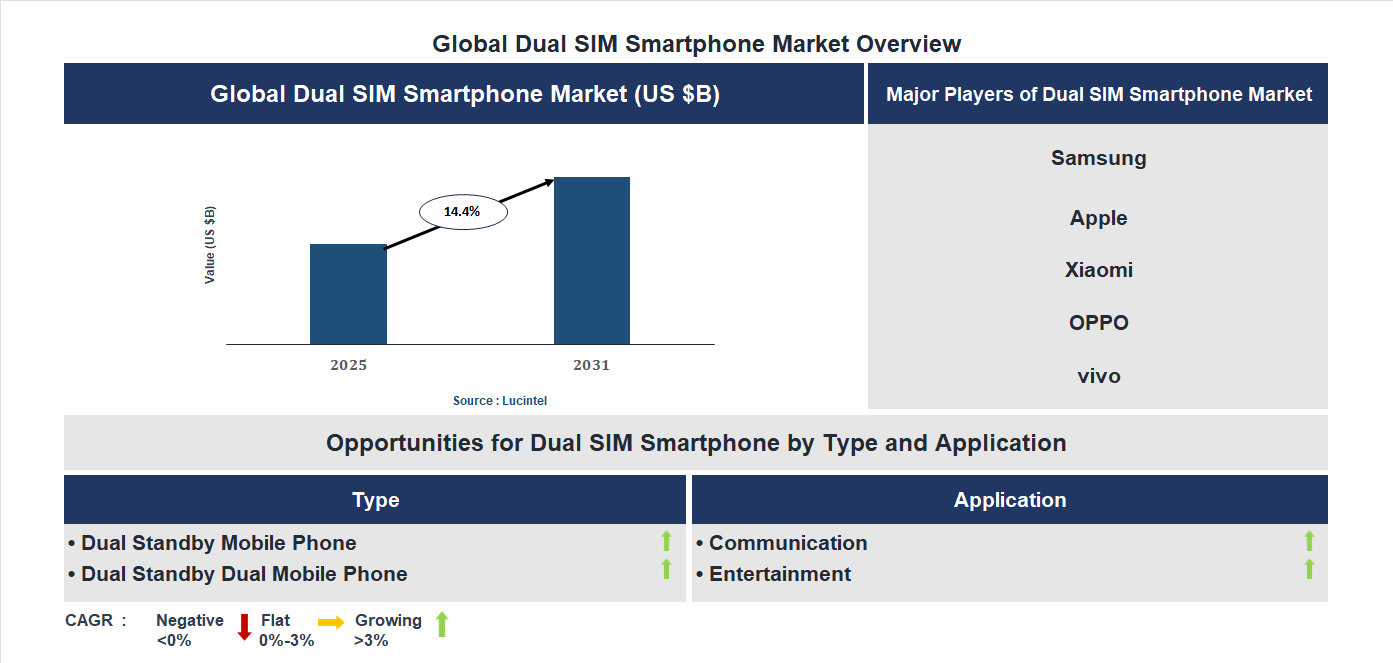
The future of the global dual SIM smartphone market looks promising with opportunities in the communication and entertainment markets. The global dual SIM smartphone market is expected to grow with a CAGR of 14.4% from 2025 to 2031. The major drivers for this market are the increasing demand for cost-effective mobile usage, the rising preference for flexible network switching, and the growing adoption of affordable smartphone models.• Lucintel forecasts that, within the type category, dual standby mobile phone is expected to witness higher growth over the forecast period.
• Within the application category, entertainment is expected to witness higher growth.
• In terms of region, APAC is expected to witness the highest growth over the forecast period. Gain valuable insights for your business decisions with our comprehensive 150+ page report. Sample figures with some insights are shown below.
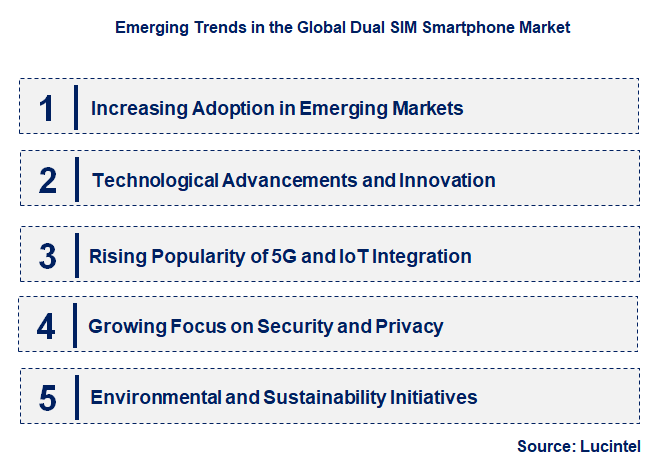
Emerging Trends in the Dual SIM Smartphone Market
The dual SIM smartphone market is experiencing rapid growth driven by increasing consumer demand for flexibility, affordability, and connectivity. As mobile technology advances and global markets evolve, consumers seek devices that offer multiple network options to optimize coverage, reduce costs, and enhance user experience. This trend is also influenced by the rise of emerging markets, where dual SIM phones are particularly popular due to their affordability and convenience. Manufacturers are innovating to meet these demands, leading to new features and competitive pricing. The market's evolution reflects broader shifts in consumer behavior, technological innovation, and regional economic factors, shaping the future landscape of mobile communication.• Increasing Adoption in Emerging Markets: Growing demand for dual SIM smartphones in regions like Asia, Africa, and Latin America is driven by affordability and the need for better network coverage. Consumers in these markets often use multiple SIM cards to access different carriers for cost savings and improved connectivity. This trend is supported by the proliferation of affordable devices and expanding telecom infrastructure, making dual SIM phones a practical choice for a broad demographic. As these markets continue to grow, manufacturers are prioritizing dual SIM features to capture a larger customer base, further fueling market expansion.
• Technological Advancements and Innovation: Manufacturers are integrating advanced features into dual SIM smartphones, such as improved battery life, faster processors, and enhanced camera capabilities. Innovations like eSIM technology are also emerging, allowing users to switch carriers without physically changing SIM cards. These technological improvements enhance user experience, making dual SIM phones more attractive. Additionally, software enhancements enable better management of multiple networks, improving connectivity and reducing interference. As technology evolves, dual SIM smartphones are becoming more sophisticated, offering consumers a seamless and versatile mobile experience.
• Rising Popularity of 5G and IoT Integration: The rollout of 5G networks is influencing the dual SIM smartphone market by enabling faster data speeds and more reliable connections. Consumers increasingly seek devices that support multiple network standards, including 5G, to maximize connectivity options. Integration with Internet of Things (IoT) devices is also boosting demand, as users want seamless connectivity across various gadgets. Dual SIM phones equipped with 5G capabilities allow users to manage multiple networks efficiently, ensuring optimal performance. This trend is expected to accelerate as 5G adoption becomes more widespread globally, further transforming the market landscape.
• Growing Focus on Security and Privacy: As dual SIM smartphones handle sensitive data across multiple networks, security features are becoming a key focus. Manufacturers are incorporating advanced security protocols, biometric authentication, and encryption to protect user information. Privacy concerns related to data sharing and network vulnerabilities are prompting innovations in secure communication. Enhanced security measures are crucial for enterprise users and consumers alike, fostering trust in dual SIM devices. This emphasis on security is shaping product development and influencing consumer preferences, making secure dual SIM smartphones a significant market segment.
• Environmental and Sustainability Initiatives: The market is witnessing a shift towards eco-friendly manufacturing practices and sustainable materials. Companies are designing energy-efficient dual SIM smartphones with longer lifespans and recyclable components. Consumer awareness about environmental impact is driving demand for greener products, prompting manufacturers to adopt sustainable supply chains and reduce electronic waste. These initiatives not only appeal to environmentally conscious consumers but also align with global sustainability goals. As the market matures, sustainability considerations are becoming integral to product development, influencing brand reputation and consumer choice. In summary, these emerging trends are reshaping the dual SIM smartphone market by expanding its reach, enhancing technological capabilities, and emphasizing security and sustainability. The market is becoming more versatile, innovative, and aligned with consumer needs, ensuring continued growth and evolution in the coming years.
Recent Development in the Dual SIM Smartphone Market
The dual SIM smartphone market has experienced significant growth driven by increasing consumer demand for flexibility, affordability, and connectivity. As mobile technology advances, manufacturers are innovating to meet diverse user needs across different regions. The market's evolution is also influenced by changing regulatory landscapes and the proliferation of affordable devices. Recent developments reflect a shift towards more versatile and user-centric solutions, impacting global adoption rates and competitive dynamics. These trends are shaping the future of mobile communication, making dual SIM smartphones more accessible and feature-rich for consumers worldwide.• Technological Advancements: Integration of eSIM technology has revolutionized dual SIM functionality, allowing users to switch carriers without physical SIM cards, enhancing convenience and device design. This innovation reduces device size and improves user experience, encouraging wider adoption across various markets.
• Market Expansion in Emerging Economies: Increased affordability and availability of dual SIM smartphones in regions like Africa, India, and Southeast Asia have driven market growth. These markets prioritize cost-effective connectivity solutions, leading to higher penetration rates and expanding consumer bases.
• Regulatory Changes: Governments in several countries have relaxed regulations around dual SIM usage, facilitating easier import and sale of dual SIM devices. Such policies have boosted market growth by removing barriers and encouraging manufacturers to introduce more dual SIM options.
• Strategic Partnerships and Mergers: Major smartphone brands are forming alliances with telecom providers to bundle dual SIM devices with attractive plans. These collaborations enhance market reach, improve device offerings, and stimulate consumer interest through targeted marketing strategies.
• Innovation in Design and Features: Manufacturers are focusing on sleek designs, longer battery life, and enhanced security features for dual SIM smartphones. These improvements increase device appeal, meet consumer expectations, and differentiate products in a competitive landscape. In summary, recent developments in the dual SIM smartphone market—ranging from technological innovations and market expansion to regulatory reforms, strategic partnerships, and product enhancements—are collectively driving growth and diversification. These trends are making dual SIM smartphones more accessible, functional, and appealing, thereby expanding their global footprint and shaping the future of mobile connectivity.
Strategic Growth Opportunities in the Dual SIM Smartphone Market
The dual SIM smartphone market is experiencing rapid expansion driven by increasing consumer demand for flexible connectivity options, affordability, and regional market variations. As mobile technology evolves, manufacturers are focusing on innovative features to meet diverse user needs across different regions. This growth is further fueled by the rising adoption of smartphones in emerging markets, where consumers seek cost-effective solutions for multiple network providers. Key applications such as urban connectivity, rural outreach, enterprise solutions, gaming, and multimedia are shaping the market landscape. These developments present significant opportunities for manufacturers, service providers, and technology developers to capitalize on emerging trends and consumer preferences.• Urban Connectivity: Enhanced network coverage and seamless switching between networks improve user experience in metropolitan areas, driving higher adoption rates and customer loyalty.
• Rural Outreach: Affordable dual SIM devices enable rural populations to access multiple networks, improving communication and internet access, which expands market penetration.
• Enterprise Solutions: Businesses leverage dual SIM smartphones for better connectivity management, cost savings, and operational efficiency, boosting enterprise adoption.
• Gaming and Multimedia: Dual SIM smartphones support multiple data plans, ensuring uninterrupted gaming and multimedia streaming, attracting tech-savvy consumers.
• Regional Market Expansion: Tailored dual SIM offerings for specific regions cater to local preferences, increasing market share and fostering competitive advantage. In summary, these growth opportunities are significantly impacting the dual SIM smartphone market by expanding consumer base, enhancing user experience, and enabling manufacturers to innovate and differentiate their products. The market is poised for sustained growth as these applications continue to evolve and meet diverse consumer needs worldwide.
Dual SIM Smartphone Market Driver and Challenges
The dual SIM smartphone market is influenced by a variety of technological, economic, and regulatory factors that shape its growth and development. Rapid advancements in mobile technology, increasing smartphone penetration, and evolving consumer preferences are key drivers. Additionally, economic conditions such as rising disposable incomes and affordability play significant roles. Regulatory policies regarding telecommunications and device standards also impact market dynamics. As consumers seek more flexible and cost-effective communication options, manufacturers are innovating to meet these demands. However, the market faces challenges including technological complexities, regulatory hurdles, and intense competition, which can hinder growth. Understanding these drivers and challenges is essential for stakeholders to navigate this evolving landscape effectively. The factors responsible for driving the dual SIM smartphone market include:• Technological Innovation: Rapid advancements in mobile hardware and software enable manufacturers to produce more efficient, feature-rich dual SIM devices. Innovations such as improved network compatibility, longer battery life, and enhanced user interfaces make dual SIM smartphones more appealing. These technological improvements meet consumer demands for seamless connectivity and multi-network usage, fostering market expansion. As technology continues to evolve, manufacturers can introduce more sophisticated features, further boosting adoption rates and market growth.
• Increasing Smartphone Penetration: The global rise in smartphone adoption, especially in emerging markets, significantly fuels the dual SIM market. Consumers in these regions often require affordable, versatile devices capable of managing multiple networks to optimize connectivity and costs. The proliferation of affordable smartphones has made dual SIM devices accessible to a broader demographic, including rural and underserved areas. This widespread adoption drives demand, as users seek devices that offer flexibility and cost savings, thereby expanding the market.
• Economic Factors and Affordability: Rising disposable incomes and decreasing smartphone prices contribute to increased consumer purchasing power. Dual SIM smartphones are often more cost-effective, allowing users to manage multiple plans without additional devices. Economic growth in developing regions encourages consumers to upgrade to newer models, further stimulating market demand. Affordability also enables telecom operators to promote dual SIM devices as part of bundled offerings, enhancing market penetration and fostering competitive advantages.
• Consumer Preference for Flexibility: Modern consumers value the ability to switch between networks for better coverage, cost savings, or specific services. Dual SIM smartphones cater to this need by providing flexibility in managing multiple accounts simultaneously. This preference is particularly prominent among frequent travelers, business users, and those seeking to optimize their communication expenses. As consumer awareness grows, the demand for flexible, multi-network devices increases, positively impacting market growth.
• Regulatory Environment and Telecom Policies: Favorable government policies and regulations promoting competition and device interoperability support the dual SIM smartphone market. Regulations that facilitate easier import/export, standardization, and licensing encourage manufacturers to develop compatible devices. Conversely, restrictive policies or import bans can hinder market growth. Regulatory frameworks that promote consumer rights and fair competition further incentivize manufacturers to innovate and expand their product offerings, thereby influencing overall market dynamics. The challenges facing this dual SIM smartphone market include:
• Technological Complexities: Developing dual SIM smartphones that seamlessly manage multiple networks without compromising performance presents technical challenges. Ensuring compatibility across different network standards, maintaining battery efficiency, and integrating advanced features require significant R&D investment. These complexities can increase manufacturing costs and lead to delays in product launches, potentially limiting market growth and consumer adoption.
• Regulatory and Policy Barriers: Variations in telecom regulations across countries can pose hurdles for manufacturers. Restrictions on dual SIM device imports, licensing issues, or stringent standards may limit market access or increase compliance costs. Such regulatory barriers can slow down product rollout, reduce competitiveness, and restrict market expansion, especially in regions with restrictive policies.
• Intense Market Competition: The market is highly competitive, with numerous local and global players vying for market share. Price wars, rapid product launches, and aggressive marketing strategies can erode profit margins. Additionally, the presence of counterfeit or low-quality devices can undermine brand reputation and consumer trust. This competitive landscape necessitates continuous innovation and strategic positioning, which can be resource-intensive and challenging for manufacturers. In summary, the dual SIM smartphone market is driven by technological advancements, increasing smartphone adoption, economic growth, consumer demand for flexibility, and supportive regulatory environments. However, technological challenges, regulatory barriers, and fierce competition pose significant hurdles. These factors collectively influence the market's trajectory, requiring stakeholders to innovate and adapt strategically. Overall, the market's growth prospects remain promising, provided that companies effectively navigate these drivers and challenges to meet evolving consumer needs and regulatory standards.
List of Dual SIM Smartphone Companies
Companies in the market compete on the basis of product quality offered. Major players in this market focus on expanding their manufacturing facilities, R&D investments, infrastructural development, and leverage integration opportunities across the value chain. With these strategies dual SIM smartphone companies cater increasing demand, ensure competitive effectiveness, develop innovative products & technologies, reduce production costs, and expand their customer base. Some of the dual SIM smartphone companies profiled in this report include-• Samsung
• Apple
• Xiaomi
• OPPO
• vivo
• Transsion
• Honor
• Huawei
• Motorola
• Nokia
Dual SIM Smartphone Market by Segment
The study includes a forecast for the global dual SIM smartphone market by type, application, and region.Dual SIM Smartphone Market by Type [Value from 2019 to 2031]:
• Dual Standby Mobile Phone
• Dual Standby Dual Mobile Phone
Dual SIM Smartphone Market by Application [Value from 2019 to 2031]:
• Communication
• Entertainment
Dual SIM Smartphone Market by Region [Value from 2019 to 2031]:
• North America
• Europe
• Asia Pacific
• The Rest of the World
Country Wise Outlook for the Dual SIM Smartphone Market
The dual SIM smartphone market has experienced significant growth globally, driven by increasing mobile connectivity needs, affordability, and technological advancements. As consumers seek flexible communication options and better network coverage, manufacturers are innovating to meet these demands. The market dynamics vary across regions, influenced by local telecom policies, consumer preferences, and economic factors. In the United States, China, Germany, India, and Japan, recent developments reflect a mix of technological innovation, regulatory changes, and shifting consumer behaviors, shaping the future landscape of dual SIM smartphone adoption and usage.• United States: The dual SIM smartphone market remains niche, primarily driven by international travelers and expatriates. Recent advancements include the integration of eSIM technology, reducing the need for physical SIM cards, and increasing support from major carriers. Manufacturers are focusing on 5G-enabled dual SIM devices, offering better connectivity and flexibility. Regulatory changes favoring eSIM adoption are also encouraging market growth, although overall penetration remains limited compared to other regions.
• China: China has seen rapid growth in dual SIM smartphone adoption, fueled by a large, price-sensitive consumer base. Local brands like Xiaomi, Huawei, and Oppo are leading innovation, offering affordable devices with advanced dual SIM features. Recent developments include the integration of 5G dual SIM models and enhanced software support for seamless switching between networks. The government’s supportive policies and expanding 4G/5G infrastructure further boost market expansion.
• Germany: The dual SIM smartphone market in Germany is growing steadily, driven by business users and frequent travelers. Recent advancements include the adoption of eSIM technology, allowing users to switch carriers without changing physical SIM cards. Manufacturers are offering more premium devices with dual SIM capabilities, emphasizing security and data management features. The increasing popularity of remote work and international travel is also contributing to higher dual SIM device adoption.
• India: India remains one of the largest markets for dual SIM smartphones, with widespread adoption due to affordability and network coverage needs. Recent developments include the launch of budget-friendly 4G and 5G dual SIM devices from brands like Xiaomi, Samsung, and Realme. The government’s push for digital connectivity and the expansion of telecom infrastructure have accelerated market growth. Innovations such as integrated AI features and longer battery life are also enhancing user experience.
• Japan: The dual SIM smartphone market in Japan is growing gradually, mainly among tech-savvy consumers and expatriates. Recent advancements include the adoption of eSIM technology and the release of devices supporting multiple network bands for better coverage. Manufacturers are focusing on compact, high-performance models with dual SIM capabilities, catering to urban users who require flexible connectivity options. The trend towards remote work and international travel is further supporting market expansion.

Features of the Global Dual SIM Smartphone Market
Market Size Estimates: Dual SIM smartphone market size estimation in terms of value ($B). Trend and Forecast Analysis: Market trends (2019 to 2024) and forecast (2025 to 2031) by various segments and regions. Segmentation Analysis: Dual SIM smartphone market size by type, application, and region in terms of value ($B). Regional Analysis: Dual SIM smartphone market breakdown by North America, Europe, Asia Pacific, and Rest of the World. Growth Opportunities: Analysis of growth opportunities in different types, applications, and regions for the dual SIM smartphone market. Strategic Analysis: This includes M&A, new product development, and competitive landscape of the dual SIM smartphone market. Analysis of competitive intensity of the industry based on Porter’s Five Forces model.
FAQ
Q1. What is the growth forecast for dual SIM smartphone market? Answer: The global dual SIM smartphone market is expected to grow with a CAGR of 14.4% from 2025 to 2031. Q2. What are the major drivers influencing the growth of the dual SIM smartphone market? Answer: The major drivers for this market are the increasing demand for cost-effective mobile usage, the rising preference for flexible network switching, and the growing adoption of affordable smartphone models. Q3. What are the major segments for dual SIM smartphone market? Answer: The future of the dual SIM smartphone market looks promising with opportunities in the communication and entertainment markets. Q4. Who are the key dual SIM smartphone market companies? Answer: Some of the key dual SIM smartphone companies are as follows:• Samsung
• Apple
• Xiaomi
• OPPO
• vivo
• Transsion
• Honor
• Huawei
• Motorola
• Nokia Q5. Which dual SIM smartphone market segment will be the largest in future? Answer: Lucintel forecasts that, within the type category, dual standby mobile phone is expected to witness higher growth over the forecast period. Q6. In dual SIM smartphone market, which region is expected to be the largest in next 5 years? Answer: In terms of region, APAC is expected to witness the highest growth over the forecast period. Q7. Do we receive customization in this report? Answer: Yes, Lucintel provides 10% customization without any additional cost.
Table of Contents
List of Figures
List of Tables
Methodology
- In-depth interviews of the major players in this market
- Detailed secondary research from competitors’ financial statements and published data
- Extensive searches of published works, market, and database information pertaining to industry news, company press releases, and customer intentions
- A compilation of the experiences, judgments, and insights of Lucintel’s professionals, who have analyzed and tracked this market over the years.


Buy Now
Choose a license that fits your team. Instant PDF delivery.
Prices exclude taxes. Instant delivery. Custom licensing available on request.
Key Questions
- • What are some of the most promising, high-growth opportunities for the dual SIM smartphone market by type (dual standby mobile phone and dual standby dual mobile phone), application (communication and entertainment), , and region (North America, Europe, Asia Pacific, and the Rest of the World)?
- • Which segments will grow at a faster pace and why?
- • Which region will grow at a faster pace and why?
- • What are the key factors affecting market dynamics? What are the key challenges and business risks in this market?
- • What are the business risks and competitive threats in this market?
- • What are the emerging trends in this market and the reasons behind them?
- • What are some of the changing demands of customers in the market?
- • What are the new developments in the market? Which companies are leading these developments?
- • Who are the major players in this market? What strategic initiatives are key players pursuing for business growth?
- • What are some of the competing products in this market and how big of a threat do they pose for loss of market share by material or product substitution?
- • What M&A activity has occurred in the last 5 years and what has its impact been on the industry? For any questions related to Dual SIM Smartphone Market, Dual SIM Smartphone Market Size, Dual SIM Smartphone Market Growth, Dual SIM Smartphone Market Analysis, Dual SIM Smartphone Market Report, Dual SIM Smartphone Market Share, Dual SIM Smartphone Market Trends, Dual SIM Smartphone Market Forecast, Dual SIM Smartphone Companies, write Lucintel analyst at email: helpdesk@lucintel.com. We will be glad to get back to you soon.


