
Report Feature
Dry-type Air Core Reactor Market Trends and Forecast
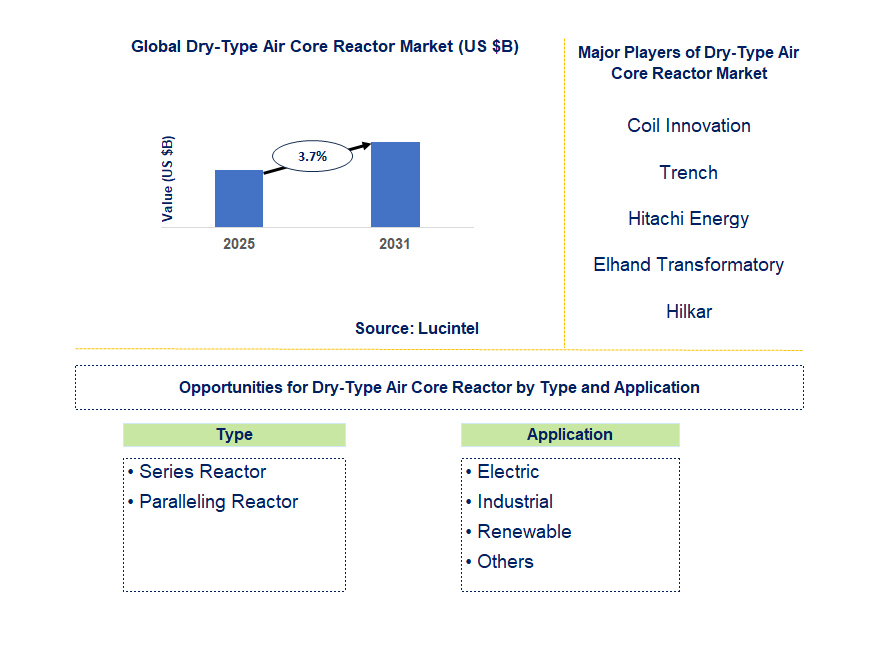
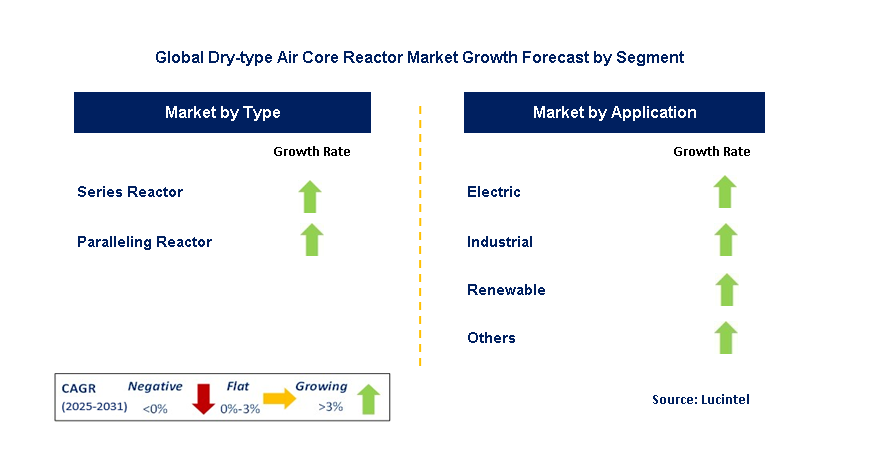
The future of the global dry-type air core reactor market looks promising with opportunities in the electric, industrial, and renewable markets. The global dry-type air core reactor market is expected to grow with a CAGR of 3.7% from 2025 to 2031. The major drivers for this market are rising demand for energy-efficient solutions, growing adoption of renewable energy systems, and increasing focus on grid modernization and reliability.• Lucintel forecasts that, within the type category, series reactor is expected to witness higher growth over the forecast period due to improve stability.
• Within the application category, industrial is expected to witness the highest growth due to t covers a wide range of applications requiring power systems.
• In terms of region, APAC is expected to witness the highest growth over the forecast period due to increasing infrastructure development.
Emerging Trends in the Dry-type Air Core Reactor Market
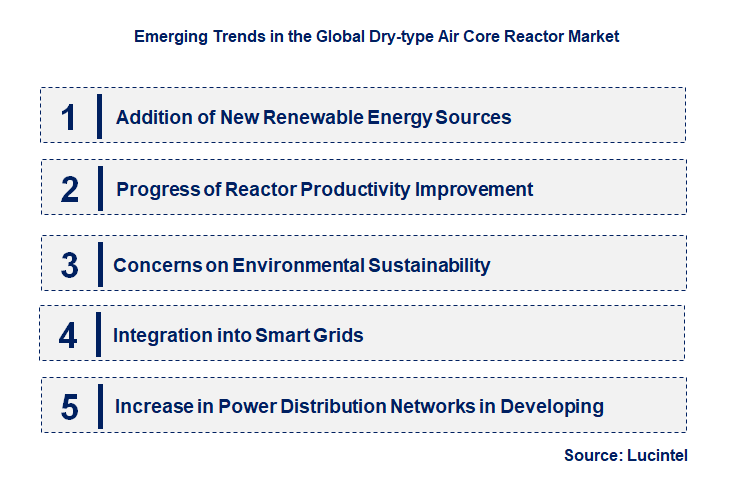
Emerging trends in the dry-type air core reactor sector signifies the rising need for efficient and dependable power regulation and control systems. These trends are being driven by a new set of technological advancements, a focus on sustainability, and the increase in renewable energy sources integration. Below is a summary of the primary trends that indicate the movement of the market and their resultant effects on the industry.• Addition of New Renewable Energy Sources: With the combined efforts of many nations towards work using renewable energy sources, Dry-type Air Core Reactors are used more frequently for the purpose of stabilizing the power grids. The very nature of solar energy and wind energy is volatile, which calls for the incorporation of components that guarantee smooth power flow and grid stability. Reactors are now built to achieve optimal performance together with these sources – power quality is guaranteed. This trend is helping to drive the demand for more reliable and adaptable reactors in the energy transition.
• Progress of Reactor Productivity Improvement: Producers are working to enhance the capabilities of the Dry-type Air Core Reactors which, in turn, will reduce energy losses. Advances in material science and reactor engineering have achieved greater compactness and economy in reactors, as well as higher power flow management. Better efficiency means better performance in high-voltage engineering, meeting the increasing demand for power regulation systems within grid networks where dependable and sustainable power control is needed.
• Concerns on Environmental Sustainability: Focus on sustainability is increasing on the part of manufacturers of Dry-type Air Core Reactors and production processes tend to be more sustainable and greener. The carbon emissions to manufacture these reactors should be mitigated by employing green materials, improving manufacturing methods, and developing long lived reactors which in turn increases operational efficiency. This trend reflects sustainability efforts globally and is expected to further fuel the demand for green power regulation technologies.
• Integration into Smart Grids: Another important factor moving the Dry-type Air Core Reactor industry is the rise of smart grids. A smart grid requires systems with sophisticated components, which offer real time monitoring and control of the power supply to minimize losses. These days, Dry-type Air Core Reactors are being used more and more in smart grid systems for better management of power flows and increased grid stability. This helps to make electricity systems more flexible and efficient, especially in regions with a large share of renewable energy sources.
• Increase in Power Distribution Networks in Developing Regions : Developing countries, particularly in Asia and Africa, are receiving a lot of funding in power infrastructure investment which promotes substantial prospects for Dry-type Air Core Reactors. These regions are improving their grid systems to ensure stability and broader electricity coverage which necessitates more reliable power control components. Global suppliers are getting ready to answer these markets with affordable, easily scalable reactor designs for the rural and urban power distribution systems. The market for the Dry-type Air Core Reactor is changing quickly due to the adoption of renewable energy, improvements in the efficiency of reactors, sustainability, smart grid systems, and increasing activities within developing regions. These trends are transforming the market by creating higher expectations for effective, dependable, and flexible power regulation systems. These trends will continue to foster innovation and further expand the Dry-type Air Core Reactor market.
Recent Development in the Dry-type Air Core Reactor Market
New market news for Dry-type Air Core Reactors indicates that these devices are increasingly being integrated into power distribution systems. These developments are propelled by new technologies, an increasing demand for dependable and effective power regulation, and the shift towards renewable resources. Below are five key developments that are shaping the market today.• Improvement in The Design of Reactors: The latest advancements in the design of reactors have resulted in the creation of more efficient and cheaper Dry-type Air Core Reactors. The current progress in materials and dry type air core reactors manufacturing technology enables the production of reactors optimized for high voltage applications. These achievements make it feasible to design reactors that are smaller and more energy efficient to operate, which decreases operating costs and minimizes the negative environmental effects.
• Increased Adoption in Integration of Renewable Energy Sources: The adoption of Dry-type Air Core Reactors is accelerating to facilitate the addition of wind and solar energy sources into the power grid. As renewable energy resources continue to increase, reactors are essential in providing grid stability and reliable power by controlling the electrical power capacity and addressing fluctuations. The increasing focus on renewable energy dry type air core reactors to improve power grid reliability is making this exports market grow as companies seek to capture opportunities related to increased variability of renewable energy.
• Expansion of Manufacturing Capabilities: Producers are increasing their use of production capabilities to respond to the increase in demand for manufacture Dry-type Air Core Reactors. New plants and newer technology appliances are being invested into, which enable faster cycle times and greater volumes produced. This increase assists manufacturers to meet the growth in demand in both developed and developing economies. In addition, it allows companies to lower expenses while still ensuring optimal quality and reliability for power distribution systems.
• Focus on Sustainable Manufacturing: In the manufacture of Dry-type Air Core Reactors, sustainability is becoming a critical consideration. To become eco-friendlier, producers are incorporating recyclable materials in fabricating the components and reducing waste. The industry is also focusing on making the energy usage of the reactors more efficient in accordance with sustainability targets. The shift toward eco-friendly manufacturing practices helps the industry to deal with new environmental issues and responds to the need for improved green power distribution systems.
• Expansion in Smart Grid Applications : The advancement of smart grid technologies have enabled a Dry-type Air Core Reactor to greatly influence infrastructure today. These reactors are being deployed into smart grids that enable real time control and monitoring of the system. This enhances grid efficiency and stability. Moreover, it is creating new market opportunities as utilities are putting more resources into remodeling their grids for renewable energy and improving the overall system performance. The latest innovations within the scope of Dry-type Air Core Reactors show the dire need for an efficient and sustainable power measurement and regulation system. Growth in the use of smart grid technologies and changes in the design of reactors, along with greater emphasis on sustainability, expanding manufacturing capabilities, and greater use in renewable energy integration are some of the reasons for expansion of the market. Such improvements are ensuring the relevance of Dry-type Air Core Reactors in the modern electric grids and overcoming barriers to renewable energy jumpstart.
Strategic Growth Opportunities in the Dry-type Air Core Reactor Market
Beneath the constant rise in investments directed towards energy infrastructure, the integration of renewable energy and the advancement of the electrical grid, lies the untapped potential for Dry-type Air Core Reactor to expand. Below are five strategies and measures concerning various applications that stand out and develop the future of the market.• Incorporation of New Energies: The growth in renewable sources of energy like wind power and solar power provides dry type air core reactors with an important growth prospect. These sources of energy need proper power control systems to ensure flexibility on the grid. With the increasing use and deployment of renewables around the world, the need for reactors to control the power flow and power distribution will increase, thus allowing manufacturers to increase their scope of products.
• Advanced Grid Systems Progression: Ongoing investment into and development of smart grids is also a key opportunity to harness for dry type air core reactors. Smart grids will put a demand for advanced parts that can automatically control load shedding and peak load power conditioning in real time. The support of renewables should be actively considered for the operations of the reactors. With the advancing investments made by different countries in smart grid architecture, the need for these reactors will keep increasing.
• Electric windmills mounted on massive ships and electric plants in the jungle are offshore and remote energy projects, which do require some trusty and high quality electric components. Once again, Dry-type Air Core Reactors shine through. They are best suited for these places because they work under extreme climates and severe power dispatch, as well as fulfill all stability requirements. The market for these reactors will grow, giving birth to new prospects, as spending on offshore energy and remote grid systems grows.
• Together with Industrial Automation Business, the need for pitch regulators is rising for Air Core Dry Type Power Reactors. Alongside the pinpoint developments of Industrial Air Power System, the complexness of making products is also going up, which means there will be significant gain. More and more industries will be using these Dry-type Air Core Reactors for industrial power networks, since they effortlessly control power flow and take care of the pesky spikes of voltage. Consequently, the new business sector of automated industries will need and create markets for these devices.
• Precision Log Data Retrieval and Analysis Software: Due to the need for energy storage systems that facilitate the usage of renewable sources of energy, Dry-type Air Core Reactors are becoming critical pieces for energy storage systems. These reactors control the energy exchange between the storage systems and the grid, ensuring proper energy transfer. The increase in the adoption of energy storage technologies will consequently raise the need for reactors that are capable of controlling the power flows between storage and distribution systems. Dry-type Air Core Reactor opens up numerous opportunities for growth for such elements as renewal energy integration, smart grid development Offshore and industrial applications, power distribution and energy storage solutions. Continuation of global investments into infrastructure to enhance energy efficiency and sustainability will escalate the demand to these reactors in the evolving power distribution systems.
Dry-type Air Core Reactor Market Driver and Challenges
Like other markets, Dry-type Air Core Reactor market has its drivers and challenges, ranging from technological changes to economic conditions and regulatory policies. These issues impact the market‘s growth in both positive and negative aspects and will dictate the tactics that producers must adopt at the minimum to remain competitive. The market has both, key drivers and challenges and below is how we understand the market. The factors responsible for driving the dry-type air core reactor market include: 1. Technological Advancements : The advancement of new designs and materials in a Dry Air Core Reactor is likely to spur growth in the Dry-type Air Core Reactor market. New materials have better capabilities such as higher heat tolerance and increased toughness. Moreover, new methods of manufacturing make it more economical to produce performance level reactors. All of these factors are making it possible for ranges to be produced to satisfy the growing need for dependable and effective power regulation systems. 2. Increasing Demand for Renewable Energy : The movement towards renewable energy sources is enabling growth in the use of Dry-type Air Core Reactors. Various forms of renewable energy, like wind and solar, will call for advanced power control systems that can ensure proper grid synchronization. With the increasing share of renewable resources in the worldwide energy mix, the necessity for effective power regulation is expected to reach a higher level thus increasing the demand for these reactors in renewable energy schemes. 3. Grid Modernization and Smart Grids: The ongoing efforts to innovate the electrical grids and establish smart grids are giving rise to new prospects for Dry-type Air Core Reactors. Advanced components that can control real-time power distribution and energy monitoring are key to implementing smart grids. Dry-type Air Core Reactors are indispensable in these systems as they bring the needed stability and efficiency required by new age energy networks. As countries shift their focus towards grid modernization, the need for these reactors will escalate with it. 4. Sustainability Goals: Governments and industries are adamantly working towards sustainability and that is begging for eco-friendly means of power regulation. Dry-type Air Core Reactors provide a sustainable solution where there is none due to the traditional oil-filled reactor’s adverse effects. The absence of oil usage also lowers the environmental footprint, more so, goals of sustainability will be easily surpassed by many corporations with these reactors. 5. Emerging Market Growth: The emerging markets in Asia and Africa have started pouring investments into energy infrastructure alongside power generation and distribution systems. Dry-type Air Core Reactors have plenty of opportunities for growth in these markets as these regions are in dire need of dependable power regulation systems as their industrialization and urbanization race forward. Challenges in the dry-type air core reactor market are: 1. Costly Production Processes: The expenses involved in Dry-type Air Core Reactors’ production processes can be high due to the required quality raw materials and sophisticated manufacturing processes utilized. Companies trying to enter markets with lower demands may find the cost associated with producing these reactors to be problematic. Suppliers have to work on cost reduction strategies while ensuring the reactors produced meet the standards needed for power distribution applications. 2. Rivalry with Other Technologies: Oil filled reactors and other power regulation technologies could present competition against Dry-type Air Core Reactors. These substitutes could perform the same function at a much cheaper price which would reduce market expansion. In order to sustain market share, manufacturers would have to market Dry-type Air Core Reactors on aspects of performance and reliability. 3. Compliance with Safety Standards: Increasingly stringent regulations regarding environmental impact and safety standards are challenging manufacturers in the Dry-type Air Core Reactor market. Achieving these regulations may result in higher costs as well as longer lead times. By improving processes and policies faster than competitors, suppliers can gain access to new markets as well as remain competitive within existing ones. The growth of the Dry-type Air Core Reactor market is influenced by technology development, rising demand for renewable energy, modernization of the energy grid, sustainability objectives, and growth of new markets. However, the persistent issues of high production costs, competition from substitute technologies, and regulations have to be tackled for the market to grow. To address these drivers and challenges, manufacturers will have to change policies and strategies to sustain the competition and evolving requirements in the power distribution sector.List of Dry-type Air Core Reactor Companies
Companies in the market compete on the basis of product quality offered. Major players in this market focus on expanding their manufacturing facilities, R&D investments, infrastructural development, and leverage integration opportunities across the value chain. With these strategies dry-type air core reactor companies cater increasing demand, ensure competitive effectiveness, develop innovative products & technologies, reduce production costs, and expand their customer base. Some of the dry-type air core reactor companies profiled in this report include-• Coil Innovation
• Trench
• Hitachi Energy
• Elhand Transformatory
• Hilkar
• HPS
• Shrihans Electricals
• Akanksha Power and Infrastructure
• Phoenix Electric
• Ergun Elektrik
Dry-type Air Core Reactor Market by Segment
The study includes a forecast for the global dry-type air core reactor market by type, application, and region.Dry-type Air Core Reactor Market by type [Value from 2019 to 2031]:
• Series Reactor
• Paralleling Reactor
Dry-type Air Core Reactor Market by Application [Value from 2019 to 2031]:
• Electric
• Industrial
• Renewable
• Others
Dry-type Air Core Reactor Market by Region [Value from 2019 to 2031]:
• North America
• Europe
• Asia Pacific
• The Rest of the World
Country Wise Outlook for the Dry-type Air Core Reactor Market
The market for Dry-type Air Core Reactors is evolving rapidly due to changes in power transmission technology and the increasing need for reliable energy distribution systems. These reactors are integral in high voltage electrical systems as they aid in power regulation and grid stability mitigation. With the advancement of modern economies and industries, the need for Dry-type Air Core Reactors has soared. This analysis focuses on the recent activities that have occurred in the United States, China, Germany, India, and Japan to provide an overview of the key developments in the space.• The United States: The United States is experiencing a sustained expansion in the Dry-type Air Core Reactor market, which has been fueled by the demand of reliable grid infrastructure and the integration of renewable energy sources. The modernization of the country’s power grid with an emphasis on smart grid systems and higher levels of renewables is increasing the supply of reactors that offer voltage control and reactive power provision. Manufacturers in the U.S. are investing in the design of more efficient and economical reactors suitable for high voltage power systems. This market growth is further driven by efforts of the government to enhance the energy grid’s resilience to extreme weather conditions.
• China: These developments and industrial constructions of China have revived the need for Dry type Air Core Reactors. These require heavy investments in renewable energy projects along with the modernization of grids. Moreover, the country’s emission focus in addition to energy efficiency helps minimize the power flow imbalance. Therefore, the growing markets of Dry type Air Core Reactors are met along with Chinese manufactures striving to increase production to cost internationally and domestically.
• Germany: All of these factors are causing new investments for Europe, especially into Germany with the wideness of other renewable sources changing the perspective for Dry type Air Core Reactors for efficient solar energy value. The integration of usage for wind reactors alongside the modernization of the grid are vital for Europe as a whole for sustaining Germany’s economy and the green energy transition known as Energiewende. It is more than obvious that the incorporate boom for clean energy is innovation for the whole European continent.
• India: India is making strides in enhancing its infrastructure, like expanding the power grid to accommodate modern urban and industrial expansion. India’s investment in renewable energy sources has also resulted in a higher reliance on Dry-type Air Core Reactors for better integration of solar and wind power into the national grid. These reactors are also essential in modernizing the country’s electrical systems and improving grid stability. Competition within the Indian market is highly intense due to the need for advanced technology in both local and international exports, thrusting India into the spotlight of the global economy.
• Japan: In Japan, the market for Dry-type Air Core Reactors is receiving considerable attention from players due to the country’s focus on energy self-sufficiency and disaster mitigation. Japan has been making long term investments in its electricity infrastructure after the 2011 earthquakes and tsunamis. Investments are primarily to ensure the inclusion of high capacity renewable energy sources into the grid. The shift towards renewables has increased the need for components that regulate power reliably and efficiently. Japanese firms have begun adding advanced technologies into the designs of the reactors which helps achieve better overall performance while meeting the high safety standards Japan is known for. This ensures the country maintains a strong position in the market for years to come.

Features of the Global Dry-type Air Core Reactor Market
Market Size Estimates: Dry-type air core reactor market size estimation in terms of value ($B). Trend and Forecast Analysis: Market trends (2019 to 2024) and forecast (2025 to 2031) by various segments and regions. Segmentation Analysis: Dry-type air core reactor market size by type, application, and region in terms of value ($B). Regional Analysis: Dry-type air core reactor market breakdown by North America, Europe, Asia Pacific, and Rest of the World. Growth Opportunities: Analysis of growth opportunities in different type, application, and regions for the dry-type air core reactor market. Strategic Analysis: This includes M&A, new product development, and competitive landscape of the dry-type air core reactor market. Analysis of competitive intensity of the industry based on Porter’s Five Forces model.
FAQ
Q1. What is the growth forecast for dry-type air core reactor market? Answer: The global dry-type air core reactor market is expected to grow with a CAGR of 3.7% from 2025 to 2031. Q2. What are the major drivers influencing the growth of the dry-type air core reactor market? Answer: The major drivers for this market are rising demand for energy-efficient solutions, growing adoption of renewable energy systems, and increasing focus on grid modernization and reliability. Q3. What are the major segments for dry-type air core reactor market? Answer: The future of the dry-type air core reactor market looks promising with opportunities in the electric, industrial, and renewable markets. Q4. Who are the key dry-type air core reactor market companies? Answer: Some of the key dry-type air core reactor companies are as follows:• Coil Innovation
• Trench
• Hitachi Energy
• Elhand Transformatory
• Hilkar
• HPS
• Shrihans Electricals
• Akanksha Power and Infrastructure
• Phoenix Electric
• Ergun Elektrik Q5. Which dry-type air core reactor market segment will be the largest in future? Answer: Lucintel forecasts that, within the type category, series reactor is expected to witness higher growth over the forecast period due to improve stability. Q6. In dry-type air core reactor market, which region is expected to be the largest in next 5 years? Answer: In terms of region, APAC is expected to witness the highest growth over the forecast period due to increasing infrastructure development. Q7. Do we receive customization in this report? Answer: Yes, Lucintel provides 10% customization without any additional cost.
Table of Contents
Methodology
- In-depth interviews of the major players in this market
- Detailed secondary research from competitors’ financial statements and published data
- Extensive searches of published works, market, and database information pertaining to industry news, company press releases, and customer intentions
- A compilation of the experiences, judgments, and insights of Lucintel’s professionals, who have analyzed and tracked this market over the years.


Buy Now
Choose a license that fits your team. Instant PDF delivery.
Prices exclude taxes. Instant delivery. Custom licensing available on request.
Key Questions
- • What are some of the most promising, high-growth opportunities for the dry-type air core reactor market by type (series reactor and paralleling reactor), application (electric, industrial, renewable, and others), and region (North America, Europe, Asia Pacific, and the Rest of the World)?
- • Which segments will grow at a faster pace and why?
- • Which region will grow at a faster pace and why?
- • What are the key factors affecting market dynamics? What are the key challenges and business risks in this market?
- • What are the business risks and competitive threats in this market?
- • What are the emerging trends in this market and the reasons behind them?
- • What are some of the changing demands of customers in the market?
- • What are the new developments in the market? Which companies are leading these developments?
- • Who are the major players in this market? What strategic initiatives are key players pursuing for business growth?
- • What are some of the competing products in this market and how big of a threat do they pose for loss of market share by material or product substitution?
- • What M&A activity has occurred in the last 5 years and what has its impact been on the industry? For any questions related to Dry-type Air Core Reactor Market, Dry-type Air Core Reactor Market Size, Dry-type Air Core Reactor Market Growth, Dry-type Air Core Reactor Market Analysis, Dry-type Air Core Reactor Market Report, Dry-type Air Core Reactor Market Share, Dry-type Air Core Reactor Market Trends, Dry-type Air Core Reactor Market Forecast, Dry-type Air Core Reactor Companies, write Lucintel analyst at email: helpdesk@lucintel.com. We will be glad to get back to you soon.


