
Report Feature
Business Software and Service Market Trends and Forecast
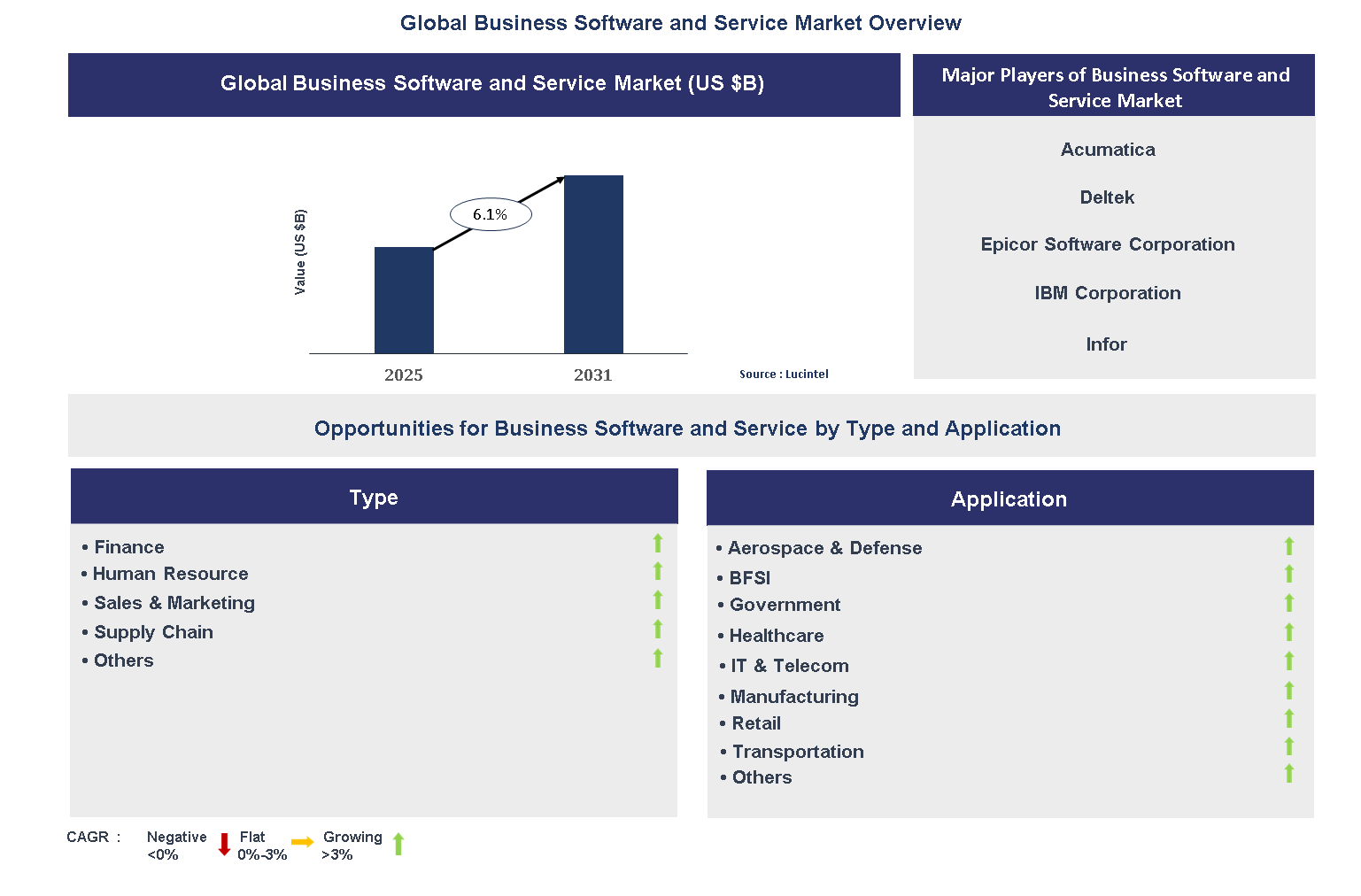
The future of the global business software and service market looks promising with opportunities in the aerospace & defense, BFSI, government, healthcare, IT & telecom, manufacturing, retail, and transportation markets. The global business software and service market is expected to grow with a CAGR of 6.1% from 2025 to 2031. The major drivers for this market are the increasing demand for automation in businesses, the rising adoption of cloud-based software solutions, and the growing need for data-driven decision-making tools.• Lucintel forecasts that, within the type category, human resource is expected to witness the highest growth over the forecast period.
• Within the application category, healthcare is expected to witness the highest growth.
• In terms of region, APAC is expected to witness the highest growth over the forecast period. Gain valuable insights for your business decisions with our comprehensive 150+ page report. Sample figures with some insights are shown below.
Emerging Trends in the Business Software and Service Market
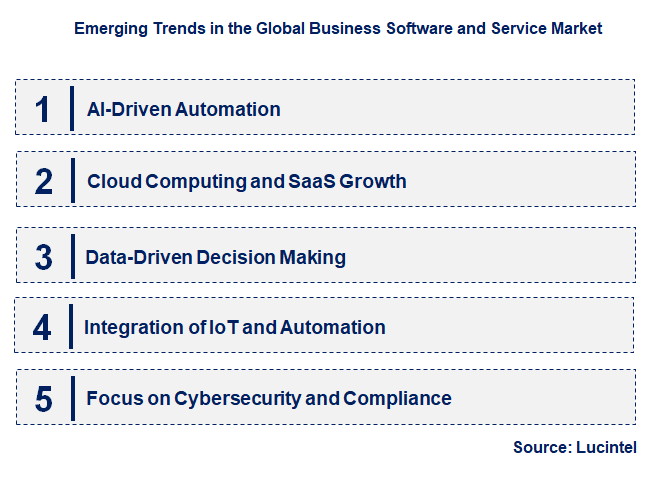
The business software and service market is being transformed by several key trends, as companies adopt new technologies to drive efficiency and growth. From AI and automation to cloud computing and security, these trends are reshaping how businesses operate and interact with their software ecosystems. Below are five emerging trends that are gaining momentum.• AI-Driven Automation: AI is becoming a core component of business software, automating routine tasks and driving smarter decision-making. Machine learning algorithms are used to enhance predictive analytics, supply chain optimization, and customer insights. As businesses look for more efficient ways to operate, AI-driven solutions are reducing manual work and accelerating digital transformation.
• Cloud Computing and SaaS Growth: Cloud computing and SaaS solutions are enabling businesses to scale quickly and reduce infrastructure costs. By adopting cloud-based platforms, organizations can access enterprise software remotely, improving collaboration, flexibility, and data accessibility. The shift to the cloud continues to drive innovation, with companies increasingly relying on SaaS for CRM, HR, and financial management.
• Data-Driven Decision Making: With the rise of big data, companies are using business software to harness the power of analytics and make data-driven decisions. Tools that integrate advanced data analytics and business intelligence (BI) are helping organizations gain real-time insights into customer behavior, market trends, and operational performance, leading to better decision-making.
• Integration of IoT and Automation: The Internet of Things (IoT) is being integrated into business software, particularly in manufacturing, logistics, and supply chain management. IoT devices collect data in real-time, which is then processed and analyzed by business software to optimize operations. Automation powered by IoT is enabling smarter, more efficient systems that reduce downtime and increase productivity.
• Focus on Cybersecurity and Compliance: As businesses digitize their operations, cybersecurity and regulatory compliance are becoming top priorities. Software providers are increasingly embedding security features into their platforms, ensuring that sensitive data is protected. This is particularly important in industries such as healthcare, finance, and retail, where data breaches can have severe consequences. These trends are reshaping the business software and service market by improving efficiency, security, and decision-making. As AI, cloud computing, IoT, and cybersecurity continue to evolve, businesses are adopting solutions that offer greater flexibility, real-time insights, and automation. These changes will have long-term effects on how organizations leverage technology to remain competitive.
Recent Development in the Business Software and Service Market
Recent developments in the business software and service market are reshaping how businesses manage their operations and digital transformation strategies. Advances in cloud computing, AI, and automation are transforming industries, making operations more efficient and data-driven. Below are five key developments that are driving this shift in the global business software space.• Rise of Cloud-Based Software: Cloud-based business software is rapidly replacing traditional on-premises systems due to its scalability, flexibility, and lower cost. Businesses are increasingly adopting SaaS platforms for finance, HR, CRM, and supply chain management. Cloud solutions offer real-time data access, enabling better collaboration and faster decision-making across organizations, regardless of their size.
• AI-Powered Analytics and Insights: AI-driven analytics tools are becoming indispensable for businesses seeking to leverage data more effectively. These tools provide advanced capabilities for predictive analytics, customer segmentation, and demand forecasting. AI-powered software is also streamlining operational processes, enabling businesses to reduce inefficiencies and make more informed decisions based on real-time data.
• Business Process Automation: Business process automation tools are revolutionizing how businesses streamline their workflows and reduce operational costs. By automating repetitive tasks, such as invoicing, inventory management, and HR functions, organizations can improve efficiency and allocate resources to more strategic activities. BPA tools are being integrated with AI for greater decision-making capabilities.
• Collaboration and Remote Work Tools: The shift to remote work has spurred significant development in collaboration tools such as project management platforms, video conferencing software, and team communication apps. Business software companies are enhancing these tools to provide seamless, integrated experiences for distributed teams. These tools are now central to maintaining productivity and collaboration in a hybrid work environment.
• Cybersecurity and Data Privacy Solutions: As cyber threats grow, business software providers are increasingly focusing on embedding robust cybersecurity features into their products. From encryption to multi-factor authentication, security is being integrated at all levels of software. Compliance with data privacy regulations such as GDPR is also becoming a priority, prompting businesses to invest in secure, compliant solutions. Conclusion: These developments are significantly impacting the business software market by enabling organizations to become more agile, secure, and data-driven. As cloud computing, AI, automation, and collaboration tools continue to evolve, businesses will be able to optimize their operations and adapt to the changing digital landscape.
Strategic Growth Opportunities in the Business Software and Service Market
The business software and service market offers numerous strategic growth opportunities, driven by emerging technologies and shifting business needs. Companies are increasingly looking for solutions that improve operational efficiency, enhance data analytics, and strengthen cybersecurity. Below are five key growth opportunities across different applications in the business software market.• AI-Powered Business Intelligence: The demand for AI-driven BI tools is growing rapidly as businesses seek to leverage their data for better decision-making. These tools can automate data analysis, identify trends, and provide actionable insights in real-time. This presents an opportunity for software providers to innovate and offer solutions that turn raw data into valuable business intelligence.
• Automation in Supply Chain Management: With global supply chains becoming more complex, the demand for automation tools to streamline procurement, logistics, and inventory management is increasing. Software providers have an opportunity to develop solutions that integrate AI, IoT, and real-time analytics to optimize supply chain operations, reduce costs, and improve efficiency.
• Cloud-Based Financial Management: The growing adoption of cloud-based ERP and financial management systems offers a major growth opportunity. Businesses are seeking scalable, flexible solutions to manage accounting, budgeting, and financial planning. Cloud-based platforms reduce IT overhead, improve real-time financial reporting, and support compliance with regulations, creating significant demand in this space.
• Human Resource Management Solutions: As organizations focus on improving workforce management, HR software that incorporates AI and data analytics is gaining traction. From recruitment and employee engagement to performance management and payroll, HR solutions are becoming more sophisticated. This offers an opportunity for software providers to create integrated, AI-driven HR platforms that enhance employee experience and optimize HR processes.
• Cybersecurity Software: As cybersecurity threats become more complex, the demand for advanced security solutions is skyrocketing. Software providers that offer cutting-edge encryption, threat detection, and data protection tools have a significant growth opportunity. With the rise of remote work and data privacy concerns, businesses are investing heavily in comprehensive cybersecurity solutions to safeguard their operations. These strategic growth opportunities reflect the increasing demand for advanced, data-driven, and secure business software. By focusing on AI, automation, cloud solutions, HR management, and cybersecurity, software providers can tap into high-growth areas that align with the evolving needs of modern businesses.
Business Software and Service Market Driver and Challenges
The business software and service market is shaped by a variety of drivers and challenges, including technological advancements, economic factors, and regulatory changes. These factors are influencing how companies adopt and utilize software solutions. Below are five key drivers and three challenges affecting the market. The factors responsible for driving the business software and service market include: 1. Technological Advancements in AI: AI continues to drive growth in the business software market by enhancing automation, predictive analytics, and decision-making. AI-powered software can analyze vast amounts of data in real-time, providing actionable insights that improve business operations, customer engagement, and profitability. 2. Cloud Adoption: The shift to cloud-based software is a major driver, offering businesses cost-effective, scalable solutions. Cloud computing allows for improved collaboration, remote access, and reduced infrastructure costs, enabling businesses to implement software solutions quickly and efficiently. 3. Growing Demand for Automation: As businesses look to streamline operations and reduce costs, the demand for automation tools is growing. Software solutions that automate processes like HR, finance, and supply chain management help businesses achieve greater efficiency, allowing them to focus on strategic activities. 4. Data-Driven Decision Making: Companies are increasingly relying on business intelligence (BI) and analytics tools to make informed decisions. The ability to gather, process, and analyze data in real-time is driving the adoption of BI solutions. These tools enable businesses to improve operational performance and customer insights. 5. Globalization and Supply Chain Complexity: As businesses operate in an increasingly globalized market, the complexity of managing supply chains has increased. Software that offers real-time insights and automation in procurement, logistics, and inventory management is becoming essential for global organizations to remain competitive. Challenges in the business software and service market are: 1. Data Privacy and Security Risks: As businesses digitize their operations, the risk of cyber threats and data breaches grows. Ensuring robust security features in business software is essential to protect sensitive information, particularly in industries like healthcare and finance. 2. Integration with Legacy Systems: Many businesses still rely on legacy systems that may not be compatible with modern software solutions. The challenge of integrating new business software with existing infrastructure can slow down adoption and increase costs. 3. Resistance to Change: Traditional business models and resistance from employees can hinder the adoption of new business software. Overcoming this resistance requires effective change management strategies, training, and demonstrating the value of new solutions. The drivers of technological innovation, cloud adoption, and data-driven decision-making are fueling growth in the business software market. However, challenges related to security, system integration, and change management must be addressed for businesses to fully realize the benefits of modern software solutions.List of Business Software and Service Companies
Companies in the market compete on the basis of product quality offered. Major players in this market focus on expanding their manufacturing facilities, R&D investments, infrastructural development, and leverage integration opportunities across the value chain. With these strategies business software and service companies cater increasing demand, ensure competitive effectiveness, develop innovative products & technologies, reduce production costs, and expand their customer base. Some of the business software and service companies profiled in this report include-• Acumatica
• Deltek
• Epicor Software Corporation
• IBM Corporation
• Infor
• NetSuite
• Microsoft Corporation
Business Software and Service Market by Segment
The study includes a forecast for the global business software and service market by type, application, and region.Business Software and Service Market by Type [Value from 2019 to 2031]:
• Finance
• Human Resource
• Sales & Marketing
• Supply Chain
• Others
Business Software and Service Market by Application [Value from 2019 to 2031]:
• Aerospace & Defense
• BFSI
• Government
• Healthcare
• IT & Telecom
• Manufacturing
• Retail
• Transportation
• Others
Business Software and Service Market by Region [Value from 2019 to 2031]:
• North America
• Europe
• Asia Pacific
• The Rest of the World
Country Wise Outlook for the Business Software and Service Market
The business software and service market is experiencing rapid evolution, driven by advancements in technology and the need for more efficient, data-driven solutions. In key global markets, companies are increasingly adopting cloud-based software, AI tools, and automation to streamline operations. Below, we explore recent developments in the market in the United States, China, Germany, India, and Japan.• United States: In the U.S., cloud-based business software solutions continue to dominate, with companies increasingly leveraging AI and machine learning for data analytics and decision-making. Automation tools for business operations have gained traction, particularly in industries like finance, healthcare, and e-commerce. The integration of Software-as-a-Service (SaaS) platforms is making enterprise software more accessible to small and medium-sized businesses (SMBs).
• China: China’s business software and service market is growing rapidly, with a focus on digitization and AI-powered solutions. Local tech giants are leading the charge with innovations in cloud computing and enterprise resource planning (ERP) systems. The government’s push for digital transformation and smart manufacturing has driven adoption, especially in manufacturing and supply chain industries.
• Germany: In Germany, business software adoption is increasingly centered around Industry 4.0 solutions, with a focus on automation, IoT, and cloud computing. German manufacturers are turning to AI and ERP systems to optimize production and supply chain management. Strong regulatory frameworks around data protection also influence the development of business software, particularly in sectors like finance and healthcare.
• India: India’s business software market is rapidly expanding as organizations adopt cloud-based platforms and SaaS tools for operational efficiency. The growing tech ecosystem and focus on digitalization have led to a surge in demand for software solutions, particularly in areas like finance, retail, and IT. AI and automation tools are becoming key drivers of business transformation in India’s service-oriented economy.
• Japan: Japan is witnessing a strong shift toward automation and AI in the business software space, with a particular focus on manufacturing and logistics. The aging population is driving demand for automation tools to mitigate workforce shortages. Cloud computing adoption is also accelerating, as Japanese businesses seek to modernize their legacy systems and improve operational efficiency.

Features of the Global Business Software and Service Market
Market Size Estimates: Business software and service market size estimation in terms of value ($B). Trend and Forecast Analysis: Market trends (2019 to 2024) and forecast (2025 to 2031) by various segments and regions. Segmentation Analysis: Business software and service market size by type, application, and region in terms of value ($B). Regional Analysis: Business software and service market breakdown by North America, Europe, Asia Pacific, and Rest of the World. Growth Opportunities: Analysis of growth opportunities in different types, applications, and regions for the business software and service market. Strategic Analysis: This includes M&A, new product development, and competitive landscape of the business software and service market. Analysis of competitive intensity of the industry based on Porter’s Five Forces model.
FAQ
Q1. What is the growth forecast for business software and service market? Answer: The global business software and service market is expected to grow with a CAGR of 6.1% from 2025 to 2031. Q2. What are the major drivers influencing the growth of the business software and service market? Answer: The major drivers for this market are the increasing demand for automation in businesses, the rising adoption of cloud-based software solutions, and the growing need for data-driven decision-making tools. Q3. What are the major segments for business software and service market? Answer: The future of the business software and service market looks promising with opportunities in the aerospace & defense, BFSI, government, healthcare, IT & telecom, manufacturing, retail, and transportation markets. Q4. Who are the key business software and service market companies? Answer: Some of the key business software and service companies are as follows:• Acumatica
• Deltek
• Epicor Software Corporation
• IBM Corporation
• Infor
• NetSuite
• Microsoft Corporation Q5. Which business software and service market segment will be the largest in future? Answer: Lucintel forecasts that, within the type category, human resource is expected to witness the highest growth over the forecast period. Q6. In business software and service market, which region is expected to be the largest in next 5 years? Answer: In terms of region, APAC is expected to witness the highest growth over the forecast period. Q7. Do we receive customization in this report? Answer: Yes, Lucintel provides 10% customization without any additional cost.
Table of Contents
List of Figures
List of Tables
Methodology
- In-depth interviews of the major players in this market
- Detailed secondary research from competitors’ financial statements and published data
- Extensive searches of published works, market, and database information pertaining to industry news, company press releases, and customer intentions
- A compilation of the experiences, judgments, and insights of Lucintel’s professionals, who have analyzed and tracked this market over the years.


Buy Now
Choose a license that fits your team. Instant PDF delivery.
Prices exclude taxes. Instant delivery. Custom licensing available on request.
Key Questions
- • What are some of the most promising, high-growth opportunities for the business software and service market by type (finance, human resource, sales & marketing, supply chain, and others), application (aerospace & defense, BFSI, government, healthcare, IT & telecom, manufacturing, retail, transportation, and others), and region (North America, Europe, Asia Pacific, and the Rest of the World)?
- • Which segments will grow at a faster pace and why?
- • Which region will grow at a faster pace and why?
- • What are the key factors affecting market dynamics? What are the key challenges and business risks in this market?
- • What are the business risks and competitive threats in this market?
- • What are the emerging trends in this market and the reasons behind them?
- • What are some of the changing demands of customers in the market?
- • What are the new developments in the market? Which companies are leading these developments?
- • Who are the major players in this market? What strategic initiatives are key players pursuing for business growth?
- • What are some of the competing products in this market and how big of a threat do they pose for loss of market share by material or product substitution?
- • What M&A activity has occurred in the last 5 years and what has its impact been on the industry? For any questions related to Business Software and Service Market, Business Software and Service Market Size, Business Software and Service Market Growth, Business Software and Service Market Analysis, Business Software and Service Market Report, Business Software and Service Market Share, Business Software and Service Market Trends, Business Software and Service Market Forecast, Business Software and Service Companies, write Lucintel analyst at email: helpdesk@lucintel.com. We will be glad to get back to you soon.


