
Report Feature
Bioreactor Market Trends and Forecast
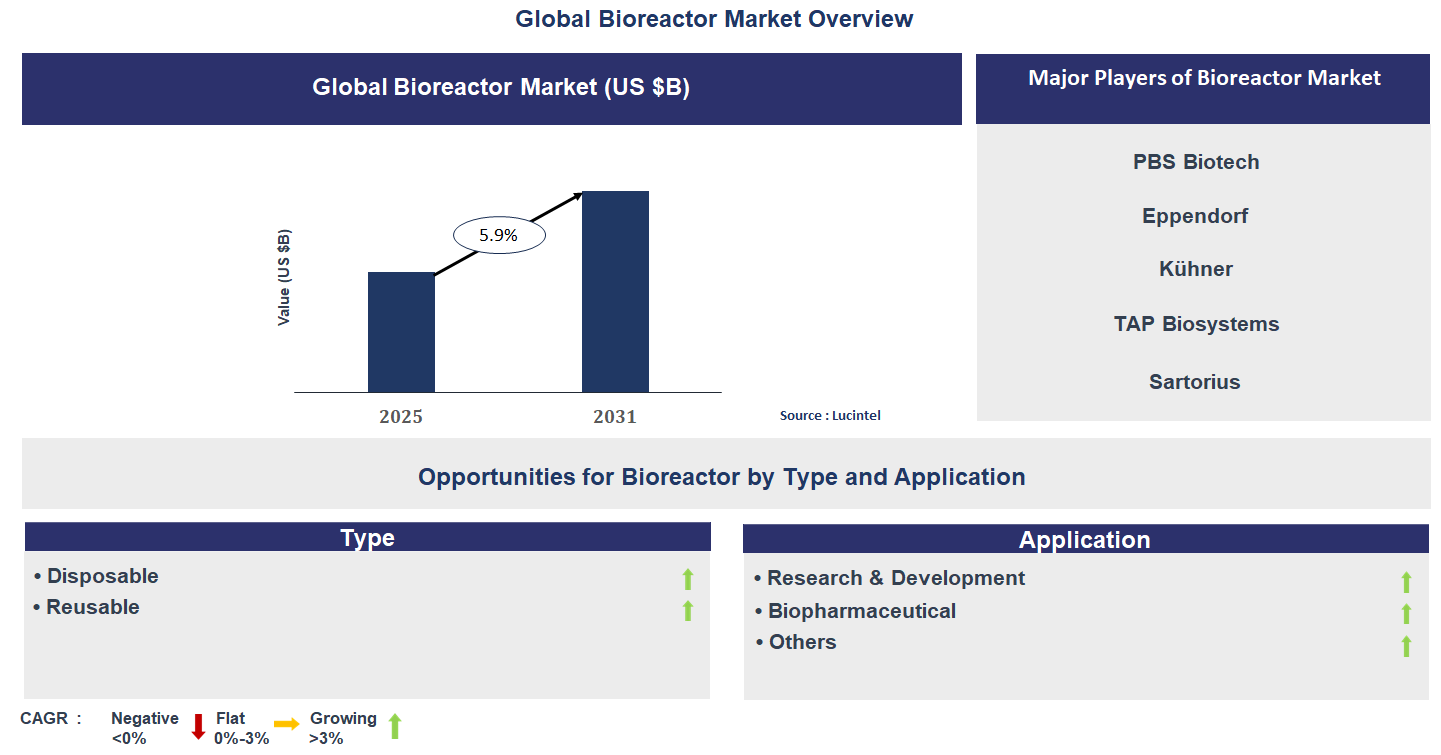
The future of the global bioreactor market looks promising with opportunities in the research & development and biopharmaceutical markets. The global bioreactor market is expected to grow with a CAGR of 5.9% from 2025 to 2031. The major drivers for this market are the increasing demand for cell-based therapies, the rising adoption of single-use bioreactors, and the growing investment in biopharmaceutical production.• Lucintel forecasts that, within the type category, disposable is expected to witness higher growth over the forecast period.
• Within the application category, biopharmaceutical is expected to witness higher growth.
• In terms of region, APAC is expected to witness the highest growth over the forecast period. Gain valuable insights for your business decisions with our comprehensive 150+ page report. Sample figures with some insights are shown below.
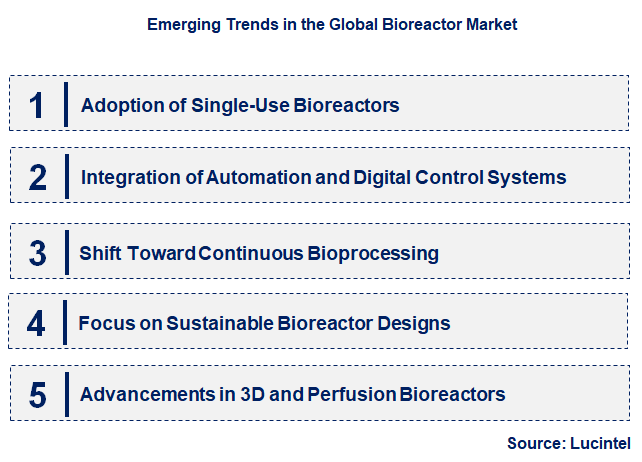
Emerging Trends in the Bioreactor Market
The bioreactor market is evolving rapidly, driven by the increasing need for flexible, efficient, and cost-effective biomanufacturing systems. Trends such as single-use technologies, digital bioprocessing, and continuous manufacturing are transforming the way biologics and cell-based therapies are produced. Automation and advanced control systems are improving yield consistency and reducing human error. The integration of data analytics and artificial intelligence is enabling real-time decision-making. Sustainability and process scalability are becoming key focus areas as companies aim to reduce environmental impact while maintaining high production standards.• Adoption of Single-Use Bioreactors: Single-use systems are gaining traction for their flexibility, reduced cleaning requirements, and lower contamination risk. They enable faster changeovers between batches and minimize downtime. This trend supports small and mid-scale production, particularly in vaccine and cell therapy manufacturing.
• Integration of Automation and Digital Control Systems: Advanced automation technologies, including AI and process analytics, are optimizing bioreactor performance. Digital control enables real-time monitoring of pH, temperature, and dissolved oxygen, leading to improved product consistency and reduced manual intervention.
• Shift Toward Continuous Bioprocessing: Continuous bioprocessing is replacing traditional batch production, offering higher efficiency and yield. This trend improves scalability, lowers costs, and ensures consistent product quality, making it ideal for large-scale biologics production.
• Focus on Sustainable Bioreactor Designs: Manufacturers are developing eco-friendly bioreactors that reduce energy consumption and waste. The adoption of recyclable materials and closed-loop systems supports environmental sustainability without compromising performance or quality.
• Advancements in 3D and Perfusion Bioreactors: 3D and perfusion bioreactors are enhancing cell growth and productivity in tissue engineering and regenerative medicine. They allow continuous nutrient supply and waste removal, ensuring optimal cell culture conditions for complex biological applications. Emerging trends in the bioreactor market reflect the industry’s commitment to efficiency, flexibility, and sustainability. Single-use technologies, automation, and continuous processing are transforming production efficiency and reducing operational costs. The integration of digital control and sustainable designs ensures consistency and environmental responsibility. These innovations are reshaping global biomanufacturing, paving the way for faster, cleaner, and more scalable biologics and cell therapy production.
Recent Development in the Bioreactor Market
Recent developments in the bioreactor market demonstrate a strong focus on technological advancement, product innovation, and strategic collaboration. Companies are expanding production capacity, developing smart bioreactor systems, and integrating digital monitoring technologies. Emphasis on single-use systems and sustainable designs is growing rapidly. Industry players are collaborating to accelerate biopharmaceutical production and enhance efficiency in research and development.• Launch of Smart and Automated Bioreactors: Companies are introducing intelligent bioreactors with sensors and software for real-time process monitoring, enabling predictive control and higher operational accuracy.
• Expansion of Single-Use Bioreactor Facilities: Major biopharmaceutical manufacturers are investing in new facilities equipped with single-use bioreactors to improve scalability and reduce cross-contamination.
• Strategic Collaborations Between Industry and Academia: Partnerships between research institutions and bioreactor manufacturers are fostering innovation in process optimization and advanced cell culture techniques.
• Integration of AI and Predictive Analytics: The adoption of AI-based process modeling is improving bioprocess control, reducing production time, and minimizing deviations during manufacturing.
• Development of Eco-Friendly and Energy-Efficient Systems: Manufacturers are focusing on sustainable designs that reduce energy usage and waste, aligning with environmental goals. The bioreactor market is progressing toward greater efficiency and sustainability through innovation and collaboration. Smart bioreactors, digital monitoring, and eco-friendly designs are improving performance and reducing production costs. These developments are strengthening biopharmaceutical manufacturing and enabling faster responses to global healthcare demands.
Strategic Growth Opportunities in the Bioreactor Market
The bioreactor market offers significant growth opportunities across diverse applications, including biologics, vaccine production, regenerative medicine, and biosimilar manufacturing. The rising adoption of single-use systems, along with automation and modular bioreactors, is opening new avenues for scalability and efficiency. The increasing focus on sustainability and cost optimization further supports innovation.• Expansion in Biopharmaceutical Manufacturing: Growing demand for monoclonal antibodies, vaccines, and biosimilars is driving investments in advanced bioreactor systems that enhance production efficiency.
• Advancements in Cell and Gene Therapy Applications: Bioreactors are critical for scaling up cell and gene therapy manufacturing, offering precise environmental control and improved reproducibility.
• Integration of Modular and Flexible Bioreactor Designs: Modular systems allow rapid capacity adjustments, supporting multi-product facilities and reducing time-to-market for biologics.
• Adoption of Digital Twins and Simulation Technologies: Digital modeling enables process optimization, predictive control, and reduced experimental cycles, improving overall production quality.
• Sustainability and Energy-Efficient Operations: Development of green bioreactor technologies supports reduced energy consumption and waste generation, aligning with global environmental objectives. Strategic growth opportunities in the bioreactor market are defined by technological innovation, process optimization, and sustainability. The expansion of biopharmaceutical and regenerative medicine applications is creating new investment avenues. By adopting digital tools and modular systems, companies are achieving higher flexibility, scalability, and cost efficiency.
Bioreactor Market Driver and Challenges
The bioreactor market is influenced by technological, regulatory, and economic factors. Demand for biologics and cell-based therapies is increasing, while advancements in automation and single-use systems are improving efficiency. However, high setup costs, complex process validation, and skilled labor shortages present significant challenges. The factors responsible for driving the bioreactor market include: 1. Rising Demand for Biopharmaceuticals and Vaccines: Growing global healthcare needs drive investments in advanced bioreactor technologies to scale up production. 2. Adoption of Single-Use Technologies: Single-use bioreactors offer flexibility and reduce contamination risks, making them ideal for small and medium-scale production. 3. Technological Advancements in Automation and Control: Integration of AI and IoT improves monitoring, enhances process efficiency, and reduces manual errors. 4. Expansion of Contract Manufacturing Organizations: Outsourcing bioprocessing to specialized facilities boosts capacity and accelerates time-to-market for biologics. 5. Government Support for Biotechnology Innovation: Policy initiatives and funding programs encourage research and local production, stimulating market growth. Challenges in the bioreactor market are: 1. High Capital and Maintenance Costs: Advanced bioreactors and control systems require significant investment, limiting access for smaller firms. 2. Process Standardization and Validation Issues: Variability in bioprocessing protocols complicates regulatory compliance and quality assurance. 3. Shortage of Skilled Workforce: The need for highly trained professionals in bioprocessing and equipment handling remains a key barrier to scaling production. The bioreactor market continues to expand under the influence of strong technological progress and increasing biopharmaceutical demand. While challenges such as high costs and workforce shortages persist, ongoing innovation and supportive government policies are strengthening market resilience. The combination of digitalization, automation, and sustainability initiatives will shape the next phase of global bioreactor development.List of Bioreactor Companies
Companies in the market compete on the basis of product quality offered. Major players in this market focus on expanding their manufacturing facilities, R&D investments, infrastructural development, and leverage integration opportunities across the value chain. With these strategies bioreactor companies cater increasing demand, ensure competitive effectiveness, develop innovative products & technologies, reduce production costs, and expand their customer base. Some of the bioreactor companies profiled in this report include-• PBS Biotech
• Eppendorf
• Kühner
• TAP Biosystems
• Sartorius
• Celltainer
• Pall
• Merck Millipore
• Eppendorf
• 2mag
Bioreactor Market by Segment
The study includes a forecast for the global bioreactor market by type, application, and region.Bioreactor Market by Type [Value from 2019 to 2031]:
• Disposable
• Reusable
Bioreactor Market by Application [Value from 2019 to 2031]:
• Research & Development
• Biopharmaceutical
• Others
Bioreactor Market by Region [Value from 2019 to 2031]:
• North America
• Europe
• Asia Pacific
• The Rest of the World
Country Wise Outlook for the Bioreactor Market
The global bioreactor market is witnessing rapid growth due to advancements in biopharmaceutical manufacturing, increasing adoption of single-use systems, and growing demand for cell-based therapies. As biotechnology and pharmaceutical industries expand, countries are investing in advanced bioprocessing technologies and automated systems to improve efficiency and scalability. The integration of digital tools, real-time monitoring, and sustainable bioreactor designs is transforming production workflows. Regional initiatives to strengthen local biomanufacturing capabilities and support vaccine development are further driving market expansion. Overall, technological innovation and global collaboration are shaping a highly competitive and efficient bioreactor ecosystem.• United States: In the United States, the Bioreactor market is advancing through automation, single-use technologies, and data-driven manufacturing systems. The growing emphasis on biologics and cell-based therapies has increased demand for flexible and scalable bioprocessing equipment. Major pharmaceutical firms and research institutions are adopting hybrid bioreactor models that combine stainless steel and disposable components to enhance productivity. Regulatory support for continuous manufacturing and process optimization is encouraging further investment in high-performance bioreactors. Additionally, collaborations between biopharma companies and technology providers are accelerating innovation, improving production efficiency, and ensuring consistent quality across large-scale biologic manufacturing.
• China: China is rapidly strengthening its biomanufacturing infrastructure to meet the growing demand for vaccines, biosimilars, and cell therapies. The government is supporting domestic production through investments in advanced bioprocessing equipment and training programs. Local companies are adopting single-use bioreactors to enhance flexibility and reduce contamination risks. Collaborations with international bioreactor manufacturers are improving technological capabilities and standardization. The rise of contract development and manufacturing organizations is expanding production capacity. China’s strategic focus on biopharmaceutical innovation and localization is transforming its Bioreactor market into a hub for both regional and global supply.
• Germany: Germany continues to lead the European Bioreactor market through its strong biopharmaceutical industry and emphasis on precision engineering. Companies are investing in digital bioprocessing technologies and smart sensors that enhance automation and process control. The adoption of single-use and modular bioreactors is increasing operational flexibility while maintaining compliance with European Union standards. Collaborations between academic research centers and biotechnology firms are fostering continuous improvement in biomanufacturing processes. Sustainability initiatives, including energy-efficient bioreactor designs, are gaining prominence. Germany’s focus on innovation, quality, and environmental responsibility positions it as a global leader in bioreactor technology.
• India: India’s Bioreactor market is expanding rapidly due to the country’s growing biopharmaceutical sector and government initiatives supporting biotechnology research. Increasing investment in vaccine production, biosimilars, and contract manufacturing is driving demand for efficient bioreactor systems. Local companies are adopting automated, single-use, and perfusion bioreactors to enhance productivity and reduce contamination risks. Partnerships with global equipment suppliers are improving access to advanced bioprocessing technologies. The focus on Make in India initiatives and rising exports of biopharmaceutical products are strengthening the country’s position in global biotechnology manufacturing.
• Japan: Japan’s Bioreactor market is evolving through advanced automation, compact bioreactor designs, and precision control systems. The country’s strong pharmaceutical base and focus on regenerative medicine are driving innovation in small-scale and modular bioreactors. Manufacturers are investing in smart bioprocessing solutions that allow real-time monitoring and adaptive control. Government support for biomanufacturing and cell therapy research is promoting technological integration. Japan’s bioreactor industry emphasizes reliability, miniaturization, and process optimization to meet growing biopharmaceutical demand. With continued advancements in robotics and AI-driven systems, Japan remains at the forefront of efficient and high-quality biomanufacturing processes.

Features of the Global Bioreactor Market
Market Size Estimates: Bioreactor market size estimation in terms of value ($B). Trend and Forecast Analysis: Market trends (2019 to 2024) and forecast (2025 to 2031) by various segments and regions. Segmentation Analysis: Bioreactor market size by type, application, and region in terms of value ($B). Regional Analysis: Bioreactor market breakdown by North America, Europe, Asia Pacific, and Rest of the World. Growth Opportunities: Analysis of growth opportunities in different types, applications, and regions for the bioreactor market. Strategic Analysis: This includes M&A, new product development, and competitive landscape of the bioreactor market. Analysis of competitive intensity of the industry based on Porter’s Five Forces model.
FAQ
Q1. What is the growth forecast for bioreactor market? Answer: The global bioreactor market is expected to grow with a CAGR of 5.9% from 2025 to 2031. Q2. What are the major drivers influencing the growth of the bioreactor market? Answer: The major drivers for this market are the increasing demand for cell-based therapies, the rising adoption of single-use bioreactors, and the growing investment in biopharmaceutical production. Q3. What are the major segments for bioreactor market? Answer: The future of the bioreactor market looks promising with opportunities in the research & development and biopharmaceutical markets. Q4. Who are the key bioreactor market companies? Answer: Some of the key bioreactor companies are as follows:• PBS Biotech
• Eppendorf
• Kühner
• TAP Biosystems
• Sartorius
• Celltainer
• Pall
• Merck Millipore
• Eppendorf
• 2mag Q5. Which bioreactor market segment will be the largest in future? Answer: Lucintel forecasts that, within the type category, disposable is expected to witness higher growth over the forecast period. Q6. In bioreactor market, which region is expected to be the largest in next 5 years? Answer: In terms of region, APAC is expected to witness the highest growth over the forecast period. Q7. Do we receive customization in this report? Answer: Yes, Lucintel provides 10% customization without any additional cost.
Table of Contents
List of Figures
List of Tables
Methodology
- In-depth interviews of the major players in this market
- Detailed secondary research from competitors’ financial statements and published data
- Extensive searches of published works, market, and database information pertaining to industry news, company press releases, and customer intentions
- A compilation of the experiences, judgments, and insights of Lucintel’s professionals, who have analyzed and tracked this market over the years.


Buy Now
Choose a license that fits your team. Instant PDF delivery.
Prices exclude taxes. Instant delivery. Custom licensing available on request.
Key Questions
- • What are some of the most promising, high-growth opportunities for the bioreactor market by type (disposable and reusable), application (research & development, biopharmaceutical, and others), and region (North America, Europe, Asia Pacific, and the Rest of the World)?
- • Which segments will grow at a faster pace and why?
- • Which region will grow at a faster pace and why?
- • What are the key factors affecting market dynamics? What are the key challenges and business risks in this market?
- • What are the business risks and competitive threats in this market?
- • What are the emerging trends in this market and the reasons behind them?
- • What are some of the changing demands of customers in the market?
- • What are the new developments in the market? Which companies are leading these developments?
- • Who are the major players in this market? What strategic initiatives are key players pursuing for business growth?
- • What are some of the competing products in this market and how big of a threat do they pose for loss of market share by material or product substitution?
- • What M&A activity has occurred in the last 5 years and what has its impact been on the industry? For any questions related to Bioreactor Market, Bioreactor Market Size, Bioreactor Market Growth, Bioreactor Market Analysis, Bioreactor Market Report, Bioreactor Market Share, Bioreactor Market Trends, Bioreactor Market Forecast, Bioreactor Companies, write Lucintel analyst at email: helpdesk@lucintel.com. We will be glad to get back to you soon.


