
Report Feature
Batter Mixer Machine Market Trends and Forecast
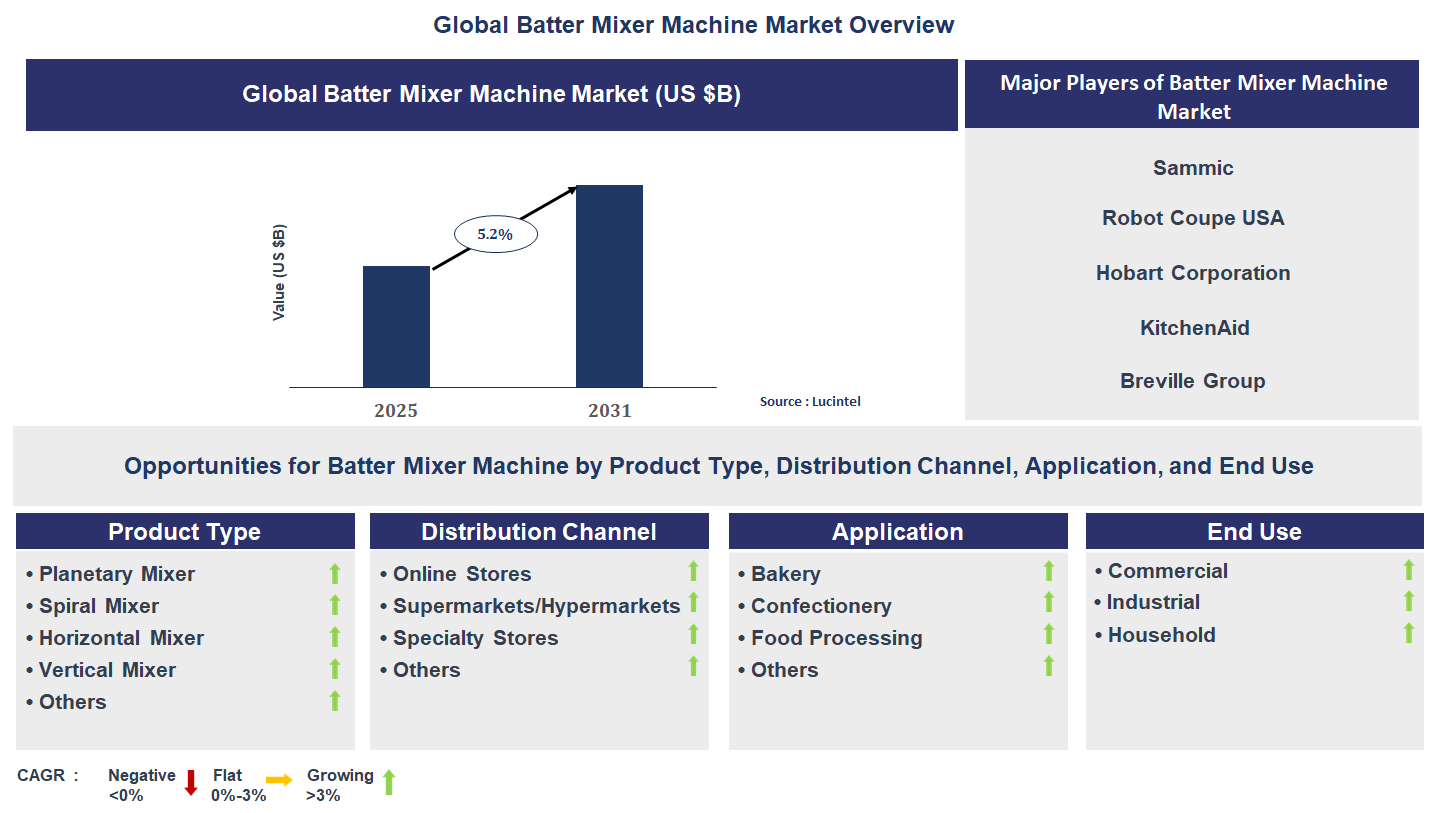
The future of the global batter mixer machine market looks promising with opportunities in the commercial, industrial, and household markets. The global batter mixer machine market is expected to grow with a CAGR of 5.2% from 2025 to 2031. The major drivers for this market are the increasing consumption of baked goods, the rising demand from commercial foodservice sectors, and the growing adoption of smart technology.• Lucintel forecasts that, within the product type category, planetary mixer is expected to witness the highest growth over the forecast period.
• Within the end use category, commercial is expected to witness the highest growth.
• In terms of region, North America is expected to witness the highest growth over the forecast period. Gain valuable insights for your business decisions with our comprehensive 150+ page report. Sample figures with some insights are shown below.
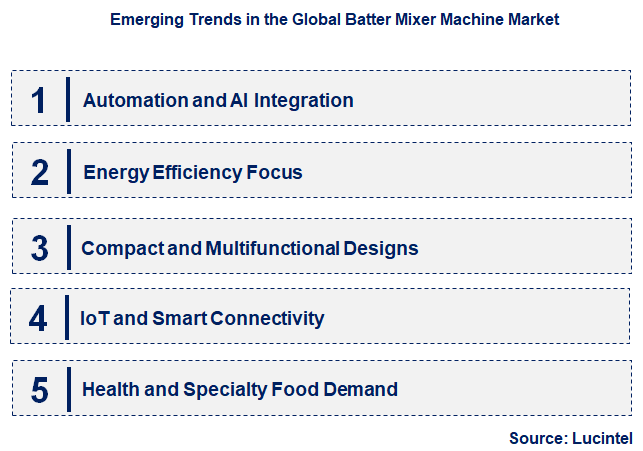
Emerging Trends in the Batter Mixer Machine Market
The market for batter mixer machine is changing fast, influenced by technological advancement, growing consumer demand for healthier and specialty foods, and sustainability needs. Key trends fueling modernization include automation, AI integration, energy efficiency, space-saving designs, and intelligent connectivity. The trends improve productivity, lower costs, and address regulatory requirements, setting the market for long-term growth.• Automation and AI Integration: Higher automation with AI-powered mixers facilitates adaptive speed control and accurate mixing, minimizing labor and enhancing consistency.
• Energy Efficiency Focus: Energy-efficient motor adoption and recyclable materials meet sustainability requirements and compliance standards, lowering costs.
• Compact and Multifunctional Designs: Compact space-conserving mixers are used in artisanal bakeries and small restaurants, reconciling performance with minimal kitchen space.
• IoT and Smart Connectivity: Real-time monitoring and control via IoT facilitate predictive maintenance, operational effectiveness, and improved product quality.
• Health and Specialty Food Demand: Gluten-free, organic, and alternate flour usage mixer solutions provide consistent batter quality to fulfill niche consumer requirements. These trends are transforming the market by propelling innovation towards smarter, eco-friendlier, and more adaptable machines capable of fulfilling varied commercial and household demands.
Recent Development in the Batter Mixer Machine Market
Recent market trends in batter mixer machine concentrate on the adoption of cutting-edge technologies, energy efficiency, broadening product lines, and advancing user protection and hygiene standards. These trends reflect adjusting to changing food industry needs and regulatory drivers for sustainability and operational excellence.• IoT-Based Smart Mixers: Installation of connected mixers enables real-time data capture and control of operations, enhancing efficiency and predictive maintenance.
• AI-Based Mixing Solutions: AI optimizes adaptive speed and consistency control for major industrial applications.
• Regulations Compliance for Energy Efficiency: New designs comply with more stringent energy usage requirements, thereby providing cost benefits and a positive environmental impact.
• Material Advances: Application of premium-grade stainless steel and food-grade, recyclable plastics enhances durability and hygiene but presents supply issues motivating local procurement.
• Segment-Specific Capacity Expansion: Customization of mixers in different capacities (10 kg to 50+ kg) to penetrate niche segments from small bakeries to industrial-scale producers. Such innovations drive competitiveness, innovation, and enable market growth.
Strategic Growth Opportunities in the Batter Mixer Machine Market
Growth opportunities for the batter mixer machine market evolve from increasing uses in bakery, confectionery, restaurants, institutional kitchen, and catering markets. These markets provide entry points to launch new, efficient, and tailored solutions that address particular production requirements.• Bakery Segment Expansion: Increasing demand for specialty baked products, artisan, organic, and gluten-free products fuels the demand for sophisticated mixers that guarantee product consistency.
• Confectionery Industry Expansion: Upsurge in demand for high-quality chocolates and handmade sweets necessitates accurate, delicate mixing to maintain texture and quality.
• Quick Service Restaurants and Cloud Kitchens: Need for fast, consistent batter preparation drives adoption of high-throughput, programmable mixers.
• Institutional and Catering Kitchens: High-volume food preparation demands rugged, high-capacity mixers that lower labor and enhance output consistency.
• Home and Small Business Mixers: Increasing popularity of home baking and small food businesses increases demand for small, low-cost, and multifunctional mixers. These opportunities illustrate market potential via focused product innovation and diversification.
Batter Mixer Machine Market Driver and Challenges
Batter mixer machine market is driven by different technological, economic, and regulatory drivers and challenges. They drive market dynamics by impacting demand, innovation, operating efficiency, and cost structures. The factors responsible for driving the batter mixer machine market include: 1. Expanding Foodservice Sector: Growth in bakeries, restaurants, and catering business drives demand for effective mixing equipment. 2. Advancements in Technology: Use of AI, IoT, automation, and efficient designs improves performance and cost of operations. 3. Increased Health Consciousness Among Consumers: Need for specialty and gluten-free products leads to innovation of precision mixers. 4. Government Regulations: Food safety and energy efficiency regulations drive innovation and eco-friendly product development. 5. Urbanization and Growing Disposable Income: Growing urban population and greater incomes enhance consumption of convenience and baked foods. Challenges in the batter mixer machine market are: 1. Supply Chain Challenges: Increased expenses and scarcity of top-grade materials such as stainless steel and food-safe plastics raise production costs. 2. High Initial Outlay: Sophisticated automated and AI-powered mixers have large capital requirements, precluding access for small enterprises. 3. Regulatory Complexity: Adherence to diverse global laws and certifications can slow product rollout and add expense. These all work together to guide market approaches and innovation paths.List of Batter Mixer Machine Companies
Companies in the market compete on the basis of product quality offered. Major players in this market focus on expanding their manufacturing facilities, R&D investments, infrastructural development, and leverage integration opportunities across the value chain. With these strategies batter mixer machine companies cater increasing demand, ensure competitive effectiveness, develop innovative products & technologies, reduce production costs, and expand their customer base. Some of the batter mixer machine companies profiled in this report include-• Sammic
• Robot Coupe USA
• Hobart Corporation
• KitchenAid
• Breville Group
• Electrolux
• Kenwood Limited
• Waring Commercial
• Hamilton Beach Brands
• Sunbeam Products
Batter Mixer Machine Market by Segment
The study includes a forecast for the global batter mixer machine market by product type, distribution channel, application, end use, and region.Batter Mixer Machine Market by Product Type [Value from 2019 to 2031]:
• Planetary Mixer
• Spiral Mixer
• Horizontal Mixer
• Vertical Mixer
• Others
Batter Mixer Machine Market by Distribution Channel [Value from 2019 to 2031]:
• Online Stores
• Supermarkets/Hypermarkets
• Specialty Stores
• Others
Batter Mixer Machine Market by Application [Value from 2019 to 2031]:
• Bakery
• Confectionery
• Food Processing
• Others
Batter Mixer Machine Market by End Use [Value from 2019 to 2031]:
• Commercial
• Industrial
• Household
Batter Mixer Machine Market by Region [Value from 2019 to 2031]:
• North America
• Europe
• Asia Pacific
• The Rest of the World
Country Wise Outlook for the Batter Mixer Machine Market
The batter mixer machine industry is witnessing consistent growth across the world with increasing demand from commercial food service industries such as bakeries, quick-service restaurants, and confectionery. The industry keeps pace with technology such as automation, IoT connectivity, and AI-based mixing solutions that improve efficiency, consistency, and energy conservation. Regional trends differ with the US and Europe prioritizing premium high-capacity machines and the Asia-Pacific region prioritizing economical and compact models. Sustainability and hygiene requirements also influence product innovation, in addition to increasing urbanization and evolving nutrition trends.• United States: The US market is estimated at USD 89.75 million, with a major North American presence based on large bakeries, restaurants, and cake shops. Smart kitchen appliances and automation technologies such as IoT mixers are major trends focused on maximizing efficiency and product uniformity. The US market prioritizes energy-efficient appliances promoted by environmental laws and consumer sustainability choices. Manufacturers focus on R&D for programmable, safe, and convenient features targeted at commercial and luxury residential users.
• China: The Chinese market is driven by home-grown innovation programs like Made in China 2025, implementing manufacturing safety and quality standards. It has strong demand for low-cost and compact mixer models serving small enterprises and domestic households. Market growth is driven by growing food processing industries and increasing urbanization. Local sourcing and material innovation tactics aim to reverse supply chain issues. Energy-efficient solutions are promoted through government policy for increased sustainability in food production.
• Germany: Germanys batter mixer machine market is supported by strict EU laws such as the Eco-design Directive of reduced energy use and CE marking for safety. The market prefers high-end, high-capacity variants ideal for commercial food production. Demand comes from a healthy foodservice economy focusing on precision, cleanliness, and sustainability. Suppliers concentrate on making mixers that meet organic and specialty food trends along with comfort and ease of use.
• India: Indias market is expanding with increasing disposable income, urbanization, and a developing foodservice sector consisting of bakeries and quick-service restaurants. Equipment needs to meet BIS quality standards and FSSAI sanitary requirements. Compactness and affordability are top of the list targeting both small enterprises and consumers. Developments center on energy efficiency and AI-assisted mixers that maximize mixing accuracy and ease of maintenance. Increasing demand for healthier and organic baked products propels the requirement for sophisticated mixing technology.
• Japan: Worth USD 0.2 billion in 2024 and growing at a CAGR of 8.8%, Japans market is led by automation due to labor shortages and rising demand for convenient foods. Technology in terms of touch-screen controls, programmable controls, and energy-efficient motors is advancing. Tight hygiene regulations necessitate the use of stainless steel mixers with clean-in-place facilities. Development of cloud kitchens and high-end food product demand necessitate consistent mixing quality and operational efficiency.

Features of the Global Batter Mixer Machine Market
Market Size Estimates: Batter mixer machine market size estimation in terms of value ($B). Trend and Forecast Analysis: Market trends (2019 to 2024) and forecast (2025 to 2031) by various segments and regions. Segmentation Analysis: Batter mixer machine market size by various segments, such as by product type, distribution channel, application, end use, and region in terms of value ($B). Regional Analysis: Batter mixer machine market breakdown by North America, Europe, Asia Pacific, and Rest of the World. Growth Opportunities: Analysis of growth opportunities in different product types, distribution channels, applications, end uses, and regions for the batter mixer machine market. Strategic Analysis: This includes M&A, new product development, and competitive landscape of the batter mixer machine market. Analysis of competitive intensity of the industry based on Porter’s Five Forces model.
FAQ
Q1. What is the growth forecast for batter mixer machine market? Answer: The global batter mixer machine market is expected to grow with a CAGR of 5.2% from 2025 to 2031. Q2. What are the major drivers influencing the growth of the batter mixer machine market? Answer: The major drivers for this market are the increasing consumption of baked goods, the rising demand from commercial foodservice sectors, and the growing adoption of smart technology. Q3. What are the major segments for batter mixer machine market? Answer: The future of the batter mixer machine market looks promising with opportunities in the commercial, industrial, and household markets. Q4. Who are the key batter mixer machine market companies? Answer: Some of the key batter mixer machine companies are as follows:• Sammic
• Robot Coupe USA
• Hobart Corporation
• KitchenAid
• Breville Group
• Electrolux
• Kenwood Limited
• Waring Commercial
• Hamilton Beach Brands
• Sunbeam Products Q5. Which batter mixer machine market segment will be the largest in future? Answer: Lucintel forecasts that, within the product type category, planetary mixer is expected to witness the highest growth over the forecast period. Q6. In batter mixer machine market, which region is expected to be the largest in next 5 years? Answer: In terms of region, North America is expected to witness the highest growth over the forecast period. Q7. Do we receive customization in this report? Answer: Yes, Lucintel provides 10% customization without any additional cost.
Table of Contents
List of Figures
List of Tables
Methodology
- In-depth interviews of the major players in this market
- Detailed secondary research from competitors’ financial statements and published data
- Extensive searches of published works, market, and database information pertaining to industry news, company press releases, and customer intentions
- A compilation of the experiences, judgments, and insights of Lucintel’s professionals, who have analyzed and tracked this market over the years.


Buy Now
Choose a license that fits your team. Instant PDF delivery.
Prices exclude taxes. Instant delivery. Custom licensing available on request.
Key Questions
- • What are some of the most promising, high-growth opportunities for the batter mixer machine market by product type (planetary mixer, spiral mixer, horizontal mixer, vertical mixer, and others), distribution channel (online stores, supermarkets/hypermarkets, specialty stores, and others), application (bakery, confectionery, food processing, and others), end use (commercial, industrial, and household), and region (North America, Europe, Asia Pacific, and the Rest of the World)?
- • Which segments will grow at a faster pace and why?
- • Which region will grow at a faster pace and why?
- • What are the key factors affecting market dynamics? What are the key challenges and business risks in this market?
- • What are the business risks and competitive threats in this market?
- • What are the emerging trends in this market and the reasons behind them?
- • What are some of the changing demands of customers in the market?
- • What are the new developments in the market? Which companies are leading these developments?
- • Who are the major players in this market? What strategic initiatives are key players pursuing for business growth?
- • What are some of the competing products in this market and how big of a threat do they pose for loss of market share by material or product substitution?
- • What M&A activity has occurred in the last 5 years and what has its impact been on the industry? For any questions related to Batter Mixer Machine Market, Batter Mixer Machine Market Size, Batter Mixer Machine Market Growth, Batter Mixer Machine Market Analysis, Batter Mixer Machine Market Report, Batter Mixer Machine Market Share, Batter Mixer Machine Market Trends, Batter Mixer Machine Market Forecast, Batter Mixer Machine Companies, write Lucintel analyst at email: helpdesk@lucintel.com. We will be glad to get back to you soon.


