
Report Feature
5G Drone Market Trends and Forecast
The technologies in 5G drone technology have undergone a complete transformation in the last few years, shifting from 4G-based connectivity to high-speed 5G integration. This transition allows for lower latency, faster data transmission, and enhanced real-time video streaming. Advanced AI-driven processing, edge computing, and autonomous navigation have further improved operational efficiency. In addition, 5G technology provides more reliable communication over longer distances and through challenging environments, transforming the applications of surveillance, logistics, agriculture, and emergency operations.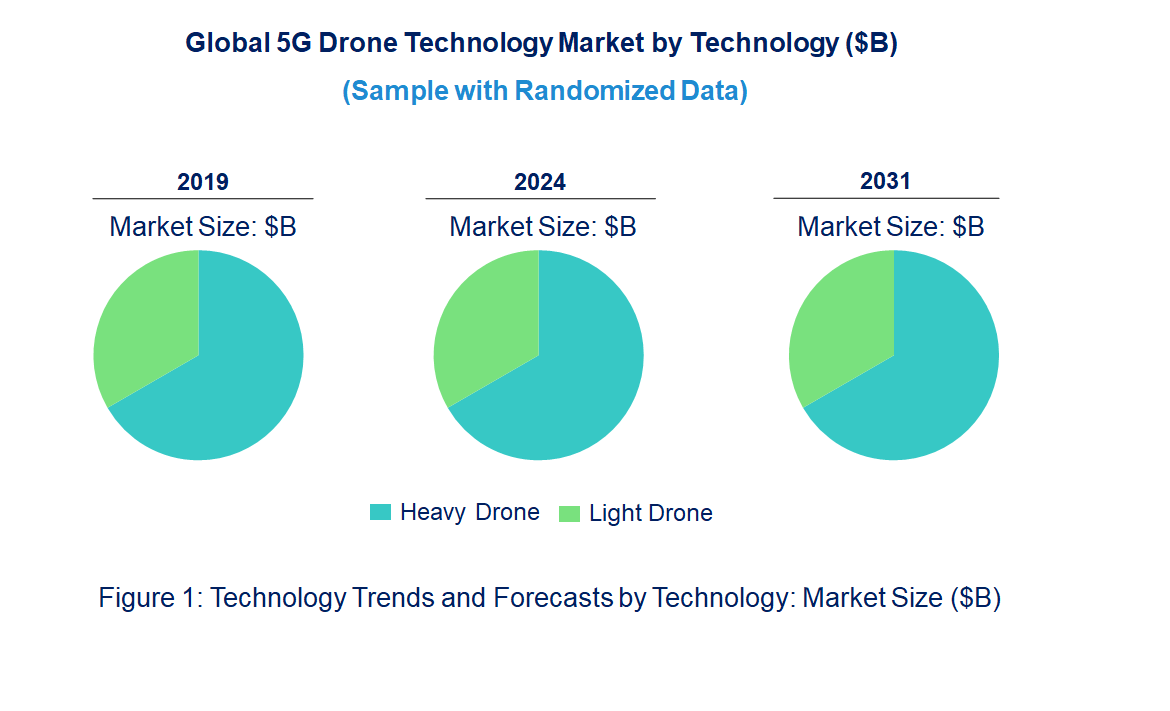
Emerging Trends in the 5G Drone Market
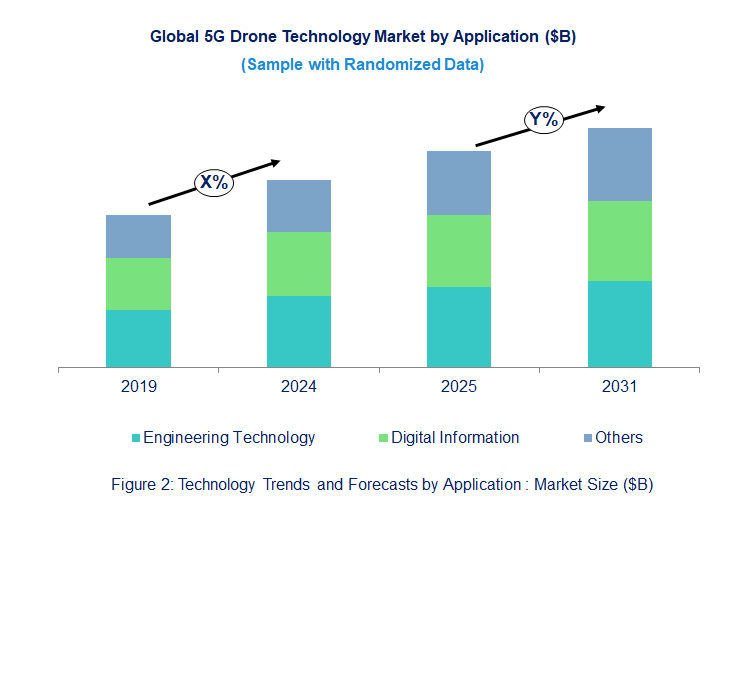
5G integration in drone systems revolutionizes their capabilities across the sectors and applications. Unquestionable advantages offered by 5G drone include lower latency, higher-speed data transmission, and highly reliable connectivity. It provides real-time, complex operation capacities through this technological change to help drones with potential solutions for logistics, surveillance, agriculture, and emergency response. An unrelenting momentum will mold a more autonomous, intelligent, and connected future in 5G drone technology. Key Trends• Better Real-Time Data Transfer: 5G technology offers extremely low latency, enabling drones to transmit and process real-time video and sensor data. This improvement makes applications like live surveillance, mapping, and inspections better in decision-making.
• Advanced Autonomous Abilities: With AI and machine learning, 5G drones become more autonomous. The systems start to make decisions and self-navigate, ensuring efficiency in logistics as well as field operations and saving human intervention.
• Edge Computing Integration: 5G drones are increasingly applying the use of edge computing so that the data can now be processed directly on the drone as opposed to in distant servers; thus, there is an overall fast response time and lesser central cloud infrastructure dependency.
• Improved Communication Reliability for Remote Areas: 5G connectivity provides a more stable connection for communication in remote places where traditional networks cannot work. These innovations are improving applications across defense, emergency response services, and rural infrastructure ventures.
• Collaborative Multi-Drone Networks: 5G enables seamless coordination among multiple drones working together in a network. These collaborative systems improve efficiency in search and rescue missions, large-scale delivery operations, and surveillance. Drones with 5G integration are transforming the market because of faster, more reliable, and intelligent solutions being achieved. Improved real-time transmission with sophisticated AI and cooperative drone networks contributes to operational efficiency and scalability within industries. It is trends such as these that will only ensure innovation until drones turn into unmissable instruments in the fields of logistics, agriculture, defense, surveillance, and emergency response.
5G Drone Market : Industry Potential, Technological Development, and Compliance Considerations
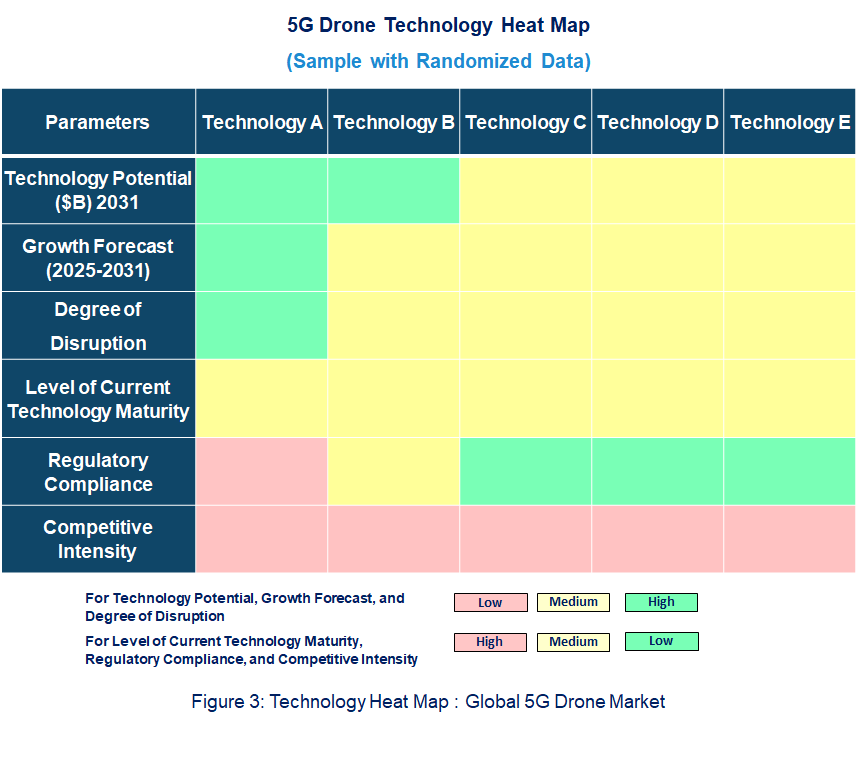
The integration of 5G technology into drone systems is unlocking significant opportunities across multiple sectors, including logistics, agriculture, surveillance, and defense. With 5G's promise of higher speeds, ultra-low latency, and reliable connectivity, drones are becoming more efficient, scalable, and capable of executing complex operations in real time. This technology shift is driving innovation and transforming traditional drone applications into more integrated, AI-driven, and collaborative systems.• Technology Potential: 5G drones are highly connected devices. It provides real-time data transmission, high-definition video streaming, and advanced sensor integration. These things enable operational efficiency and improved decision-making across delivery logistics, environmental monitoring, and surveillance applications.
• Degree of Disruption: The adoption of 5G in drones is highly disruptive as it substitutes slower 4G systems and traditional wireless technologies. It improves the coordination between drones, increases automation, and allows real-time decision-making, hence boosting scalability and efficiency greatly across industries.
• Level of Current Technology Maturity: 5G integration into drone technology is rapidly maturing. Although the commercial and defense sectors are among the first adopters, technological advancement occurs at a very fast rate. More robust 5G infrastructure and drone-specific innovations continue to emerge, thus making real-time operations increasingly reliable and efficient.
• Regulatory Compliance: Compliance with the aviation and communication regulations will remain important. Drone operators must follow guidelines from authorities like the FAA and telecom agencies, ensuring that secure 5G technologies are integrated in conformity with communication spectrum allocation, privacy, and operational safety standards.
Recent Technological development in 5G Drone Market by Key Players
Integration of 5G technology into drone systems is fast emerging, and key players are pushing the bar for better connectivity, greater efficiency, and higher scalability. The use of 5G allows for faster speeds and lower latency, enabling high-speed communication in real time. That makes drones perform complex functions with much more reliability and efficiency. Companies like Qualcomm, Verizon, Amazon, and UPS are heavily investing to take advantage of this technology in applications ranging from logistics and delivery to surveillance and emergency response.• Qualcomm Flight: Qualcomm takes the lead in advancing the integration of 5G technology with drones, thus optimizing their flight control, real-time video streaming, and data transfer. Their 5G solutions are primarily oriented toward higher processing speeds and operational efficiency to ensure better performance in logistics and commercial applications from the drones.
• Verizon: Verizon is pushing 5G connectivity to make drone communication networks stronger. Verizon supports real-time delivery operations and inspection services by offering low-latency 5G solutions for reliability and quick decision-making in logistics, construction, and infrastructure maintenance.
• AT&T: AT&T is strengthening 5G networks that support long-range drone operations. Their technology supports the existence of stable communication links across vast areas, which helps for remote inspections, agricultural monitoring, and delivery operations, and is scalable and efficient.
• T-Mobile: T-Mobile is enhancing drone connectivity with widespread 5G infrastructure. Their solutions focus on facilitating a collaborative drone network, integrating seamlessly for delivery services, search and rescue operations, and agricultural surveillance, ensuring quicker deployment and operational scalability.
• Uber Eats: Uber Eats is leveraging 5G drone technology for faster food delivery services. By using 5G’s low latency and high-speed connectivity, Uber optimizes delivery routes, reduces wait times, and improves customer satisfaction, ensuring quick and efficient order fulfillment.
• Amazon: Amazon further perfects its Prime Air drone delivery service through integration with 5G technology. With lower latency and real-time communication, the deliveries become faster and more reliable, ensuring scalability and operational efficiency across both urban and rural regions.
• UPS: UPS is investing in 5G drones to optimize delivery logistics and improve last-mile delivery services. Its 5G solutions ensure real-time tracking, precise navigation, and quick communication, thus allowing cost-effective and scalable logistics operations in urban and rural landscapes. The adoption of 5G technology in the mainstream drones of market players is revolutionizing logistics, delivery, surveillance, and infrastructure monitoring. New developments by Qualcomm, Verizon, AT&T, T-Mobile, Uber Eats, Amazon, and UPS present new opportunities in 5G drones that promise scalable operations, real-time communication, and efficiency at the operational level. Thus, the integration of this new technology promises to redefine businesses with faster, smarter, and cheaper solutions.
5G Drone Market Driver and Challenges
The 5G drone technology market is rapidly transforming, driven by advancements in connectivity, automation, and real-time communication. However, challenges such as high infrastructure costs, regulatory constraints, and security concerns pose hurdles. Understanding the key drivers and challenges highlights opportunities for growth and innovation in this dynamic market. Drivers• Advancement in 5G Connectivity: High-speed, low-latency 5G availability is a key enabler for drones to send real-time data and have better performance in logistics, surveillance, and emergency services.
• Commercial Applications Grow: The use of commercial applications in drones, such as 5 G-enabled delivery, agriculture, construction, and health care, is increasing because of more efficient and scalable solutions.
• Growth in Investment by Key Players: Major players, including Amazon, UPS, and AT&T, are spending large amounts of money on 5G drone technology to speed up development and adoption. The factors responsible for the Challenges in the 5G drone market include:
• High Infrastructure Costs: The cost of implementing 5G networks and compatible drone systems remains a significant challenge for widespread adoption.
• Regulatory Constraints: Government regulations on drone usage, especially in urban areas, create barriers to operational scalability and innovation. A mix of opportunity and challenge is observed in this market of 5G drone technology. While developments in connectivity and increased business use have the potential for expansion, regulatory and cost problems need to be resolved to continue further expansion.
List of 5G Drone Companies
Companies in the market compete based on product quality offered. Major players in this market focus on expanding their manufacturing facilities, R&D investments, infrastructural development, and leverage integration opportunities across the value chain. With these strategies 5G drone companies cater to increasing demand, ensure competitive effectiveness, develop innovative products & technologies, reduce production costs, and expand their customer base. Some of the 5G drone companies profiled in this report include.• Qualcomm Flight
• Verizon
• AT&T
• T-Mobile
• Uber Eats
• Amazon
5G Drone Market by Technology
• Technology Readiness and Key Applications for Heavy and Light Drones: Heavy drones have reached critical readiness for cargo transportations and industrial inspections, along with the availability of stable 5G networks. Light drones, matured in design, are deployed in large numbers for photography, agriculture, and real-time monitoring. With further innovations in battery life and the integration of AI, this unlocks new opportunities in virtually every industry.
• Heavy and light drones, with competitive intensity and regulatory compliance. The 5G drone competitive environment of heavy drones is high and more innovative in terms of payload capacity and durability. For light drones, it's competition in affordability as well as advanced features like obstacle detection. Regulatory compliance poses a challenge, particularly to heavy drones that have restricted airspace, while the challenges to light drones are minimal, but they must still abide by privacy and safety standards. It will be what defines market leadership: the ability to evolve with changing regulations.
• Disruption Potential of Heavy Drone and Light Drone Technologies: Heavy drones, built for industrial and cargo applications, hold great promise for disrupting logistics and making supply chains more efficient. They can carry heavy payloads; light drones, built with surveillance, photography, and inspection in mind, bring agility and affordability to personal and commercial tasks. The scalability of 5G connectivity further amplifies their operational range, enabling seamless real-time communication. Together, these technologies will disrupt traditional industries, redefine the delivery systems, disaster management systems, and security services.
5G Drone Market Trend and Forecast by Technology [Value from 2019 to 2031]:
• Heavy Drone
• Light Drone
5G Drone Market Trend and Forecast by Application [Value from 2019 to 2031]:
• Engineering Technology
• Digital Information
• Others
5G Drone Market by Region [Value from 2019 to 2031]:
• North America
• Europe
• Asia Pacific
• The Rest of the World
• Latest Developments and Innovations in the 5G Drone Technologies
• Companies / Ecosystems
• Strategic Opportunities by Technology Type
Features of the Global 5G Drone Market
Market Size Estimates: 5G drone market size estimation in terms of ($B). Trend and Forecast Analysis: Market trends (2019 to 2024) and forecast (2025 to 2031) by various segments and regions. Segmentation Analysis: Technology trends in the global 5G drone market size by various segments, such as application and technology in terms of value and volume shipments. Regional Analysis: Technology trends in the global 5G drone market breakdown by North America, Europe, Asia Pacific, and the Rest of the World. Growth Opportunities: Analysis of growth opportunities in different application, technologies, and regions for technology trends in the global 5G drone market. Strategic Analysis: This includes M&A, new product development, and competitive landscape for technology trends in the global 5G drone market. Analysis of competitive intensity of the industry based on Porter’s Five Forces model.Table of Contents
Methodology
- In-depth interviews of the major players in this market
- Detailed secondary research from competitors’ financial statements and published data
- Extensive searches of published works, market, and database information pertaining to industry news, company press releases, and customer intentions
- A compilation of the experiences, judgments, and insights of Lucintel’s professionals, who have analyzed and tracked this market over the years.


Buy Now
Choose a license that fits your team. Instant PDF delivery.
Prices exclude taxes. Instant delivery. Custom licensing available on request.
Key Questions
- • What are some of the most promising potential, high-growth opportunities for the technology trends in the global 5G drone market by technology (heavy drone and light drone), application (engineering technology, digital information, and others), and region (North America, Europe, Asia Pacific, and the Rest of the World)?
- • Which technology segments will grow at a faster pace and why?
- • Which regions will grow at a faster pace and why?
- • What are the key factors affecting dynamics of different technology? What are the drivers and challenges of these technologies in the global 5G drone market?
- • What are the business risks and threats to the technology trends in the global 5G drone market?
- • What are the emerging trends in these technologies in the global 5G drone market and the reasons behind them?
- • Which technologies have potential of disruption in this market?
- • What are the new developments in the technology trends in the global 5G drone market? Which companies are leading these developments?
- • Who are the major players in technology trends in the global 5G drone market? What strategic initiatives are being implemented by key players for business growth?
- • What are strategic growth opportunities in this 5G drone technology space?
- • What M & A activities did take place in the last five years in technology trends in the global 5G drone market?


