
Market Report · July 31, 2026

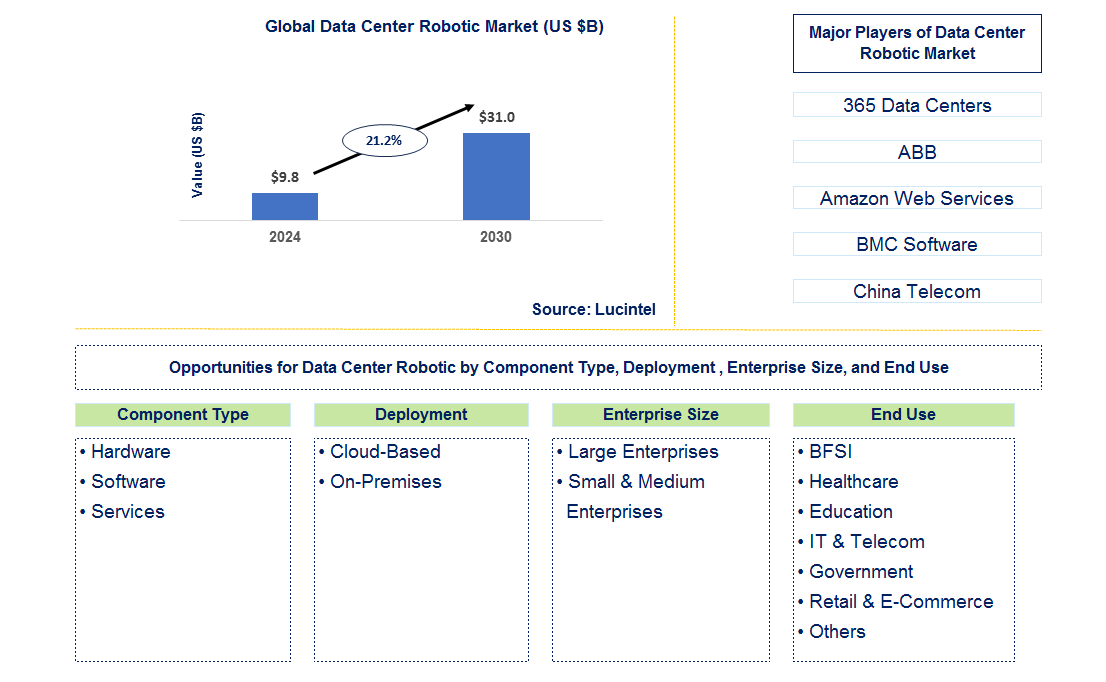
Key data points: The market size in 2030 = $31 billion, growth forecast = 21.2% annually for the next 6 years. Scroll below to get more insights. This market report covers trends, opportunities, and forecasts in the global data center robotic market to 2030 by component type (hardware, software, and services), deployment (cloud-based and on-premises), enterprise size (large enterprises and small & medium enterprises), end use (BFSI, healthcare, education, IT & telecom, government, retail & e-commerce, and others), and region (North America, Europe, Asia Pacific, and the Rest of the World)
We'll send your sample report shortly.
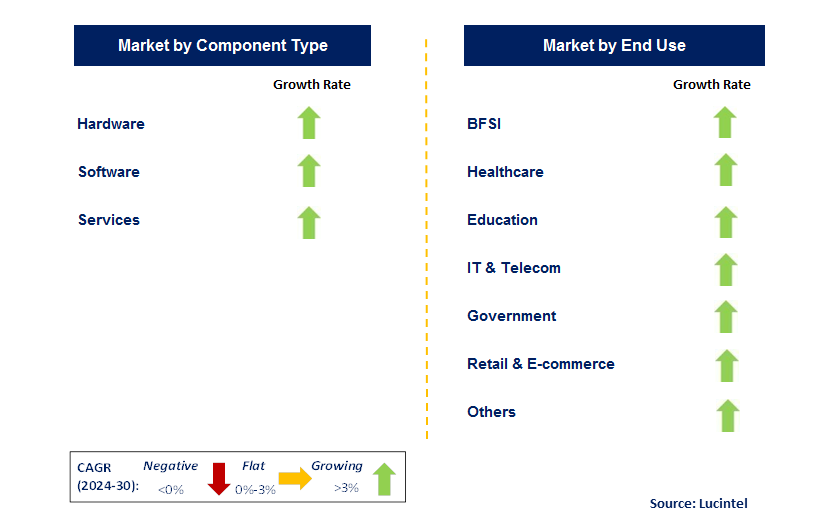
• Lucintel forecasts that, within the component type category, hardware will remain the largest segment over the forecast period due to advantages like effective automation and enhancing overall performance.
• Within the development category, IT & telecom will remain the largest segment due to high acceptance of enhanced technologies like IOT, cloud computing, and AI.
• In terms of regions, North America will remain the largest region over the forecast period due to huge IT infrastructure, rising number of data centers, and technological advancements in the region. Gain valuable insights for your business decisions with our comprehensive 150+ page report.
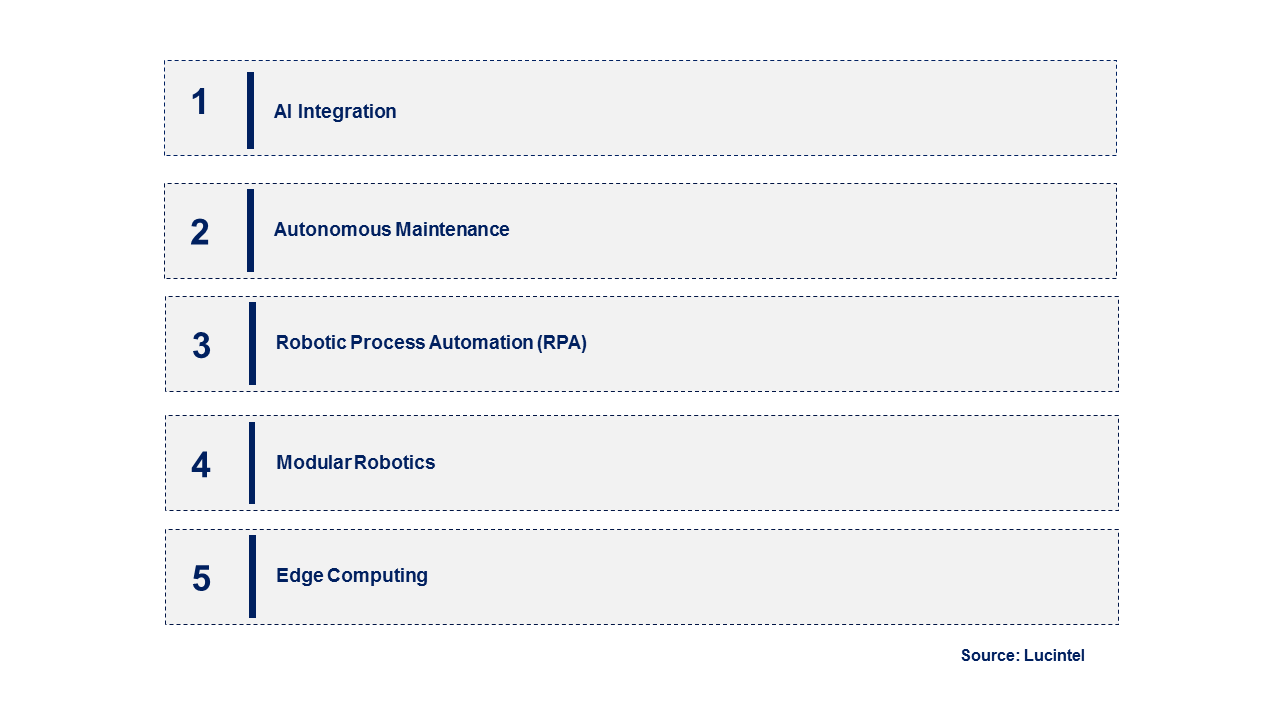
• AI Integration: As AI continues to be incorporated into data center robotics, they become more intelligent and capable of making independent decisions. Such robots driven by artificial intelligence can predict when regular maintenance should be done and help manage other aspects of a system for greater efficacy.
• Edge Computing: Robotics are being deployed in edge data centers to manage localized data processing. This trend supports faster data processing and reduces latency, addressing the growing demand for real-time data analysis and applications.
• Autonomous Maintenance: Autonomous robots have started taking over simple maintenance tasks, such as cleaning, which were previously done manually. These robots work at high speeds and allow for minimal human intervention, thereby preventing accidental mistakes or downtime associated with such interventions, resulting in increased operational efficiencies.
• Robotic Process Automation (RPA): There is an increasing use of RPA for automating repetitive activities within a facility, such as data entry or monitoring systems in a computer room. It helps people become more efficient by eliminating tedious tasks from their daily routines while operations continue running smoothly without interruptions.
• Energy Efficiency: Data centers are using robots to save energy. Less power is used when cooling and the distribution of power and the environment are managed by automated systems. These trends are reshaping the data center robotic market by furthering automation, streamlining operational efficiency, and managing new challenges. AI integration, energy-efficient solutions, and edge computing have catalyzed innovations in this sector, leading to a revolution in how data centers function.
• Introduction of AI-Based Robots: Over time, AI-based robots have found their place in many data centers to optimize operations as well as the decision-making process. They employ machine learning algorithms that can predict when maintenance is required or even automate certain tasks, subsequently improving overall effectiveness.
• Adopting Autonomous Systems: These robotic systems, such as those used for managing servers or environmental controls in a data center, are autonomous. Such systems eliminate human intervention, thereby guaranteeing reliability during operations.
• Advancement in Cooling Management: There is increased use of robots to enable better management of cooling systems. They also facilitate automatic temperature control functions, using less energy while providing better equipment performance by ensuring airflow optimization.
• Adoption of Modular Robotics: Modular robotics offer flexible and scalable automation options; they can easily change their configurations to suit the changing needs of data centers. They are highly adaptive and efficient in their operation as they can be easily reconfigured.
• Edge Data Center Automation: Robotic solutions are being employed in edge data centers to handle localized data processing and management. This allows for real-time analysis of data, reducing latency, which is a trend that is on the rise. These changes herald an era of more efficient automation and improved efficiencies within the data center robotic market, addressing emerging challenges. The future direction of data center operations is shaped by the increasing focus on AI, modular solutions, and energy efficiency.
• AI & Machine Learning Integration: There lies an opportunity for better automation and intelligent decision-making through integrating AI with machine learning in data center robotics. For example, AI-driven robots may optimize operations since they use algorithms that can predict maintenance needs or automate certain tasks, thus enhancing system performance.
• Edge Computing Expansion: The emergence of edge computing creates avenues for deploying robotic technology within edge data centers. In this case, robotics can facilitate local processing, minimizing latency that supports real-time analysis of information and application development.
• Modular Robotics Adoption: Modifiable robotics represent a flexible and scalable form of automation for data centers. The opportunity exists to offer modular systems that can be easily reconfigured to meet changing operational needs and improve efficiency.
• Development of Energy-Efficient Solutions: There is an increased need for energy-efficient robots in data centers. Opportunities encompass designing automated systems that optimize cooling, power distribution, and environmental controls, which reduce energy consumption and operational costs.
• Enhanced Security and Surveillance: The challenge of ensuring better security in data centers opens up opportunities for robotic solutions in surveillance services as well as access control. Advanced robotic systems can provide real-time monitoring and threat detection, enhancing overall security. These growth opportunities are shaping the data center robotic market by driving innovation and expanding automation capabilities. Data center operations are being transformed by focusing on AI, edge computing, modular solutions, and energy efficiency, resulting in new market prospects.
• Technological Advances: Market growth is driven by innovations in robotics and AI. Automation technologies continue to be developed to improve efficiencies while reducing human intervention, thus supporting complex data center operations.
• Increasing Demand for Efficiency: Robotic solutions are adopted due to the increasing need for operational efficiency within data centers. Automation can streamline routine tasks such as optimizing cooling or managing power distribution, leading to improved performance.
• Expansion of Data Centers: The global expansion of data centers creates possibilities for robotic automation. Increasing demands for high-volume information along with infrastructure call for advanced robots that will help manage operations effectively.
• Focus on Energy Efficiency: Reducing energy consumption alongside operational costs forms a basis for adopting energy-efficient robotic systems. For instance, automation can optimize cooling and power management, resulting in significant cost savings.
• Enhanced Security Requirements: Robotic solutions are in demand due to increasing security concerns in data centers. Surveillance and access control are the basis for this demand, where robotics offers real-time monitoring and threat detection for enhanced security. Challenges in the data center robotic market include:
• High Implementation Costs: Initial costs associated with implementing robotic systems can be high, posing a hindrance to some organizations. This requires significant capital investment in advanced robotics and automation technologies.
• Complex Integration: Integrating robotics with legacy data center infrastructures may be difficult. Ensuring compatibility and seamless operation with existing systems is necessary for successful implementation.
• Regulatory and Compliance Issues: Navigating regulatory and compliance issues surrounding robotics and automation can be challenging. Successful deployment necessitates adherence to industry standards and regulations. These drivers and challenges are shaping the data center robotic market by influencing technology adoption, operational efficiency, and security. For market growth and development, addressing implementation costs, integration complexities, and regulatory requirements is crucial.
• 365 Data Centers
• Abb
• Amazon Web Services
• BMC Software
• China Telecom
• Hardware
• Software
• Services
• Cloud-Based
• On-Premises
• Large Enterprises
• Small & Medium Enterprises
• BFSI
• Healthcare
• Education
• IT & Telecom
• Government
• Retail & E-Commerce
• Others
• North America
• Europe
• Asia Pacific
• The Rest of the World
• United States: With AI integration into data center robotics to optimize operations, there have been significant advancements in data center robotics in the US. To improve operational efficiency and reduce human error, leading technology firms invest in autonomous systems for management and maintenance tasks.
• China: China is concentrating its efforts on robotic automation to handle huge volumes of processed data instead of manual processing. The country aims to enhance data center efficiency by investing in advanced robotics and artificial intelligence technologies, supporting digital infrastructure growth.
• Germany: In Germany, robotics helps provide precision and efficiency in data center operations. Driven by the need for high-performance sustainable computer rooms, improvements include utilizing automated systems for server maintenance, cooling management, and handling information.
• India: India’s IT infrastructure expansion and increasing demand for more data have resulted in increased adoption of data center robotics. Innovations in robotic systems therefore concentrate on increased operational efficiencies, aiming to reduce downtime and attract interest from both local and international companies seeking to automate their investments.
• Japan: Japan’s focus on IoT and AI integration with data center robotics is designed to improve the operational efficiency of these centers. This approach will help optimize data management, enhance operational efficiency, and meet challenges related to scaling and maintaining data centers.


• 365 Data Centers
• Abb
• Amazon Web Services
• BMC Software
• China Telecom Q6. Which data center robotic market segment will be the largest in future? Answer: Lucintel forecasts that hardware will remain the largest segment over the forecast period due to advantages like effective automation and enhancing overall performance. Q7. In data center robotic market, which region is expected to be the largest in next 5 years? Answer: North America will remain the largest region over the forecast period due to huge IT infrastructure, rising number of data centers, and technological advancements in the region. Q8. Do we receive customization in this report? Answer: Yes, Lucintel provides 10% customization without any additional cost.


Choose a license that fits your team. Instant PDF delivery.
Prices exclude taxes. Instant delivery. Custom licensing available on request.
Market Report · July 31, 2026
Market Report · July 31, 2026
Market Report · July 31, 2026
Trusted partner for strategic intelligence and business growth


Receive a complimentary market analysis tailored to your industry. Our analysts will identify key growth opportunities and competitive dynamics specific to your business.

Market size, growth rate, and key trend analysis for your specific sector.

Top competitor positioning and market share analysis.

Strategic recommendations backed by data-driven insights.
Get curated market intelligence and competitive moves straight to your inbox.
By subscribing, you agree to receive our monthly insights. Unsubscribe anytime.
Receive a complimentary market analysis tailored to your industry. Our analysts will identify key growth opportunities and competitive dynamics specific to your business.
Market size, growth rate, and key trend analysis for your specific sector.
Top competitor positioning and market share analysis.
Strategic recommendations backed by data-driven insights.
Get curated market intelligence, emerging trends, and competitive moves straight to your inbox each month.
By subscribing, you agree to receive our monthly insights. Unsubscribe anytime.
We'll send your sample report shortly.