
Report Feature
Data Center Managed Service Market Trends and Forecast
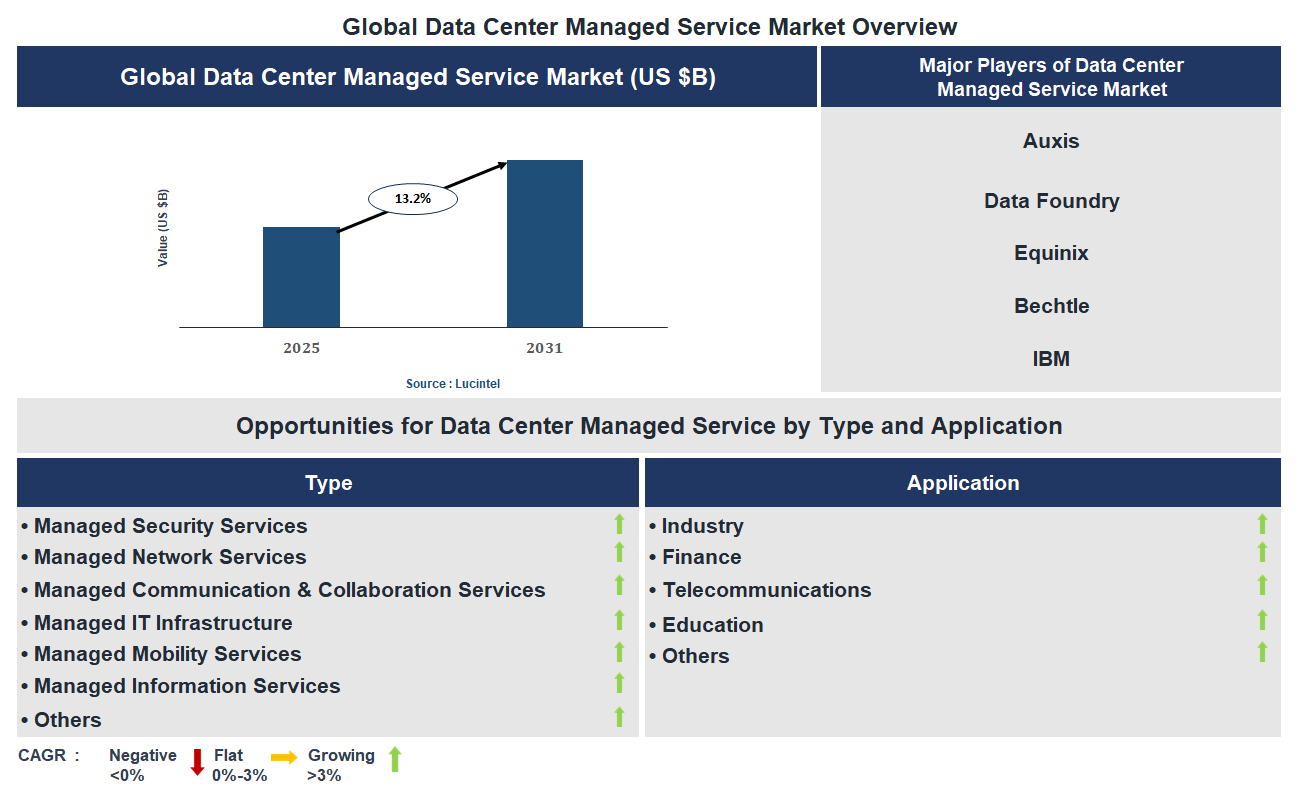
The future of the global data center managed service market looks promising with opportunities in the industry, finance, telecommunication, and education markets. The global data center managed service market is expected to grow with a CAGR of 13.2% from 2025 to 2031. The major drivers for this market are the increasing demand for outsourced it management, the rising adoption of hybrid cloud environments, and the growing need for cost-efficient operations.• Lucintel forecasts that, within the type category, managed security service is expected to witness the highest growth over the forecast period.
• Within the application category, telecommunication is expected to witness the highest growth.
• In terms of region, APAC is expected to witness the highest growth over the forecast period. Gain valuable insights for your business decisions with our comprehensive 150+ page report. Sample figures with some insights are shown below.
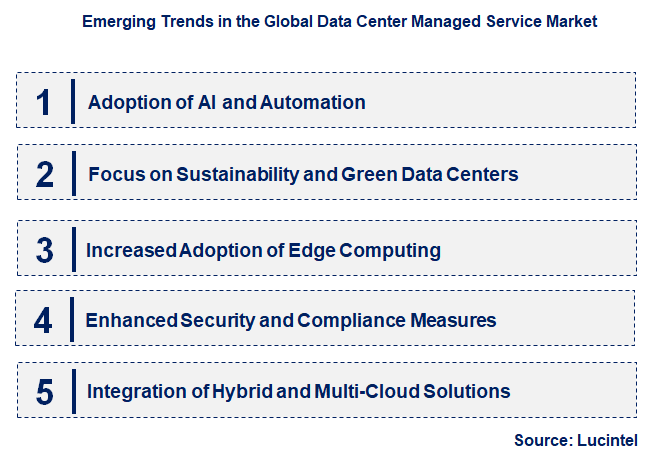
Emerging Trends in the Data Center Managed Service Market
The data center managed service market is experiencing rapid evolution driven by technological advancements, increasing data demands, and the need for enhanced security and efficiency. Organizations are shifting towards outsourcing data center management to leverage specialized expertise, reduce costs, and improve scalability. As digital transformation accelerates across industries, the market is witnessing innovative solutions that address complex operational challenges. These emerging trends are fundamentally reshaping how businesses manage their data infrastructure, emphasizing automation, sustainability, and integrated security. Staying ahead in this competitive landscape requires understanding these key developments and adapting strategies accordingly.• Adoption of AI and Automation: The integration of artificial intelligence and automation tools is transforming data center management by enabling predictive maintenance, real-time monitoring, and automated troubleshooting. This reduces human error, enhances operational efficiency, and minimizes downtime. AI-driven analytics help optimize resource allocation and energy consumption, leading to cost savings and improved performance. As AI technology matures, its role in managing complex data environments will expand, making data centers more intelligent, responsive, and cost-effective.
• Focus on Sustainability and Green Data Centers: Environmental concerns and regulatory pressures are pushing data centers toward sustainable practices. This includes utilizing renewable energy sources, improving energy efficiency, and implementing eco-friendly cooling solutions. Green data centers reduce carbon footprints and operational costs, aligning with corporate social responsibility goals. Innovations such as liquid cooling and energy-efficient hardware are gaining traction, making sustainability a core component of data center management strategies. This trend not only benefits the environment but also enhances brand reputation and compliance.
• Increased Adoption of Edge Computing: The rise of IoT devices and the need for low-latency data processing are driving the growth of edge computing. Managed services are expanding to support decentralized data centers closer to end-users, reducing latency and bandwidth costs. This trend enables real-time analytics and enhances user experiences across industries like healthcare, manufacturing, and retail. Edge computing requires specialized management solutions to handle distributed infrastructure, security, and data synchronization, creating new opportunities and challenges for service providers.
• Enhanced Security and Compliance Measures: As cyber threats grow more sophisticated, data center managed services are prioritizing advanced security protocols. This includes implementing zero-trust architectures, AI-powered threat detection, and comprehensive compliance frameworks. Ensuring data privacy and regulatory adherence is critical, especially with increasing data sovereignty laws. Managed service providers are offering integrated security solutions that proactively identify vulnerabilities, respond to incidents, and maintain audit trails. This focus on security is vital for building client trust and safeguarding sensitive information in a complex threat landscape.
• Integration of Hybrid and Multi-Cloud Solutions: The demand for flexible, scalable, and cost-effective infrastructure is fueling the adoption of hybrid and multi-cloud environments. Managed services are evolving to support seamless integration across various cloud platforms, enabling organizations to optimize workloads and avoid vendor lock-in. This approach offers agility, disaster recovery capabilities, and tailored solutions for diverse business needs. Service providers are developing sophisticated management tools to oversee multi-cloud architectures, ensuring security, compliance, and performance. This trend is reshaping the market by promoting a more versatile and resilient data management ecosystem. In summary, these trends are fundamentally transforming the data center managed service market by fostering smarter, greener, more secure, and flexible data management solutions. They enable organizations to adapt swiftly to technological changes, regulatory demands, and evolving customer expectations, ensuring sustained growth and innovation in the digital age.
Recent Development in the Data Center Managed Service Market
The data center managed service market has experienced rapid growth driven by increasing digital transformation, rising data volumes, and the need for cost-effective, scalable IT solutions. Organizations are outsourcing their data center operations to specialized providers to enhance efficiency, security, and compliance. Technological advancements, such as automation and AI, are further transforming service offerings. Additionally, the shift towards cloud integration and hybrid solutions is reshaping market dynamics. As businesses seek to optimize their IT infrastructure, the market is witnessing significant innovation and competition. These developments are shaping a more agile, secure, and efficient data management landscape, influencing global digital strategies and investments.• Adaptability of AI and automation: The integration of AI and automation tools in data center management enhances operational efficiency, reduces human error, and lowers costs. This development allows for predictive maintenance, real-time monitoring, and improved security protocols, leading to faster response times and minimized downtime. As a result, service providers can offer more reliable and scalable solutions, boosting customer satisfaction and market competitiveness.
• Growth of hybrid cloud solutions: The increasing adoption of hybrid cloud models combines on-premises data centers with public and private cloud services. This flexibility enables organizations to optimize workloads, improve scalability, and enhance data security. The trend is driving demand for managed services that can seamlessly integrate diverse environments, fostering innovation and reducing infrastructure costs.
• Emphasis on security and compliance: With rising cyber threats and stringent data regulations, data center managed service providers are prioritizing security measures and compliance standards. Implementing advanced cybersecurity protocols, data encryption, and regular audits helps protect sensitive information. This focus builds customer trust and ensures adherence to global regulations, which is critical for market growth.
• Expansion of edge computing: The proliferation of IoT devices and the need for real-time data processing are fueling the growth of edge computing. Managed service providers are offering solutions that extend data center capabilities closer to data sources, reducing latency and bandwidth costs. This development supports emerging applications like autonomous vehicles and smart cities, broadening market opportunities.
• Increasing adoption of green data centers: Sustainability initiatives are prompting providers to adopt energy-efficient technologies and renewable energy sources. Green data centers reduce carbon footprints and operational costs, aligning with corporate social responsibility goals. This trend appeals to environmentally conscious clients and regulatory bodies, fostering market expansion and innovation. In summary, these developments are significantly transforming the data center managed service market by enhancing operational efficiency, security, and sustainability. The integration of advanced technologies and evolving customer needs are driving market growth, fostering innovation, and creating new opportunities for service providers worldwide.
Strategic Growth Opportunities in the Data Center Managed Service Market
The data center managed service market is experiencing rapid expansion driven by increasing digital transformation, rising data volumes, and the need for enhanced security and operational efficiency. As organizations seek to optimize their IT infrastructure, managed services are becoming essential for reducing costs, improving scalability, and ensuring compliance. Key applications such as cloud computing, cybersecurity, data storage, network management, and disaster recovery are fueling growth opportunities. These developments are reshaping the market landscape, offering innovative solutions that meet evolving business demands. Companies investing in these areas are gaining competitive advantages, making the market highly dynamic and promising for future expansion.• Cloud Computing: Enhanced scalability and flexibility drive adoption. Managed services enable seamless migration to cloud platforms, supporting remote work and digital innovation, which boosts overall market growth and helps organizations reduce infrastructure costs.
• Cybersecurity: Increasing cyber threats create demand for advanced security solutions. Managed security services provide real-time monitoring, threat detection, and compliance management, significantly reducing risk and ensuring data integrity across data centers.
• Data Storage: Growing data volumes necessitate efficient storage solutions. Managed data storage services optimize capacity, improve data retrieval speeds, and ensure data protection, enabling businesses to handle large-scale data effectively.
• Network Management: Reliable network infrastructure is critical for operational continuity. Managed network services offer proactive monitoring, troubleshooting, and optimization, minimizing downtime and enhancing overall network performance.
• Disaster Recovery: Business continuity depends on robust disaster recovery plans. Managed disaster recovery services ensure rapid data restoration and minimal downtime during disruptions, safeguarding organizational assets and reputation. In summary, these growth opportunities are transforming the data center managed service market by enabling organizations to operate more efficiently, securely, and flexibly. The integration of advanced cloud, security, storage, network, and recovery solutions is driving market expansion, fostering innovation, and supporting the digital transformation journey of enterprises worldwide.
Data Center Managed Service Market Driver and Challenges
The data center managed service market is influenced by a variety of technological, economic, and regulatory factors that shape its growth and development. Rapid advancements in cloud computing, increasing data generation, and the need for cost-effective IT solutions are key drivers. Simultaneously, evolving regulatory standards and cybersecurity concerns pose significant challenges. Market players must navigate these complex dynamics to capitalize on opportunities while mitigating risks. The interplay of these drivers and challenges determines the overall trajectory of the market, impacting investment decisions, service offerings, and strategic planning. Understanding these factors is essential for stakeholders aiming to stay competitive in this rapidly evolving landscape. The factors responsible for driving the Data Center Managed Service Market include:• Technological Innovation: The continuous evolution of cloud computing, virtualization, and automation technologies has revolutionized data center management. These innovations enable service providers to offer scalable, efficient, and flexible solutions that meet the growing demands of businesses. As organizations increasingly migrate to cloud-based infrastructures, the need for managed services that optimize performance and reduce operational costs has surged. This technological progression also facilitates real-time monitoring, predictive maintenance, and enhanced security, making managed services more attractive. Consequently, providers investing in cutting-edge technology can differentiate themselves and capture larger market shares, fueling overall market growth.
• Rising Data Volumes and Digital Transformation: The exponential increase in data generated by enterprises across sectors such as healthcare, finance, and retail is a primary driver. Organizations are adopting digital transformation strategies to improve operational efficiency, customer engagement, and decision-making. Managing this vast amount of data requires sophisticated infrastructure and expertise, which many companies lack internally. Managed service providers offer specialized solutions to handle data storage, processing, and analytics, enabling businesses to focus on core activities. This demand for data management solutions is expected to continue rising, further propelling the growth of the data center managed services market.
• Cost Optimization and Operational Efficiency: Companies are seeking to reduce capital expenditures and operational costs associated with maintaining in-house data centers. Managed services provide a cost-effective alternative by offering shared resources, economies of scale, and predictable pricing models. Outsourcing data center management allows organizations to avoid hefty investments in hardware, software, and skilled personnel. Additionally, managed service providers often deliver enhanced reliability, security, and compliance, which are critical for business continuity. As cost pressures intensify, more enterprises are turning to managed services to optimize their IT operations, thereby driving market expansion.
• Increasing Adoption of Cloud and Hybrid Cloud Solutions: The shift towards cloud computing and hybrid cloud environments is a significant growth driver. Organizations prefer flexible, scalable, and on-demand IT resources, which managed service providers facilitate through comprehensive cloud management solutions. These services enable seamless integration of on-premises infrastructure with public and private clouds, offering agility and resilience. The rising adoption of SaaS, IaaS, and PaaS models further amplifies the need for expert management of complex cloud environments. This trend is expected to continue, with managed service providers playing a crucial role in supporting digital transformation initiatives.
• Growing Focus on Security and Compliance: As cyber threats become more sophisticated, organizations are prioritizing security and regulatory compliance. Managed service providers offer specialized security solutions, including threat detection, intrusion prevention, and data encryption, to safeguard critical infrastructure. They also assist in meeting compliance standards such as GDPR, HIPAA, and PCI DSS, which are vital for operating in regulated industries. The increasing frequency of cyberattacks and stringent regulatory requirements compel businesses to seek expert management of their data center security. This focus on security and compliance is a key driver for the growth of managed services in the data center market. The challenges facing this Market include:
• Rapid Technological Changes and Obsolescence: The fast-paced evolution of technology presents a significant challenge for managed service providers. Keeping up with the latest innovations, such as edge computing, AI, and 5G, requires substantial investment in infrastructure and skills. Providers risk obsolescence if they fail to adapt quickly, which can lead to loss of competitive edge and customer trust. Additionally, integrating new technologies with existing systems can be complex and costly, potentially disrupting service delivery. Staying ahead in this dynamic environment demands continuous innovation and agility, which can strain resources and impact profitability.
• Data Security and Privacy Concerns: Despite the emphasis on security, managing vast amounts of sensitive data remains a challenge. Managed service providers are prime targets for cyberattacks, and any breach can lead to severe financial and reputational damage. Ensuring data privacy and compliance across different jurisdictions adds complexity, especially with evolving regulations. The risk of insider threats, vulnerabilities in third-party components, and the need for constant security updates require robust measures. Failure to adequately address these concerns can result in legal penalties, loss of customer confidence, and market setbacks.
• Regulatory and Compliance Complexities: Navigating the diverse and evolving regulatory landscape is a significant challenge for managed service providers. Different regions have varying standards for data protection, privacy, and security, requiring tailored compliance strategies. Non-compliance can lead to hefty fines, legal actions, and damage to brand reputation. Keeping abreast of changing regulations and implementing necessary controls demands ongoing investment and expertise. This complexity can hinder market entry in certain regions and increase operational costs, impacting overall profitability and growth prospects. In summary, the data center managed service market is driven by technological advancements, increasing data volumes, cost efficiency needs, cloud adoption, and security concerns. However, rapid technological changes, security risks, and regulatory complexities pose substantial challenges. These factors collectively influence market dynamics, requiring providers to innovate continuously, enhance security measures, and navigate regulatory landscapes effectively. Overall, the markets growth hinges on balancing these drivers and challenges, with success dependent on strategic agility and technological adaptation.
List of Data Center Managed Service Companies
Companies in the market compete on the basis of product quality offered. Major players in this market focus on expanding their manufacturing facilities, R&D investments, infrastructural development, and leverage integration opportunities across the value chain. With these strategies data center managed service companies cater increasing demand, ensure competitive effectiveness, develop innovative products & technologies, reduce production costs, and expand their customer base. Some of the data center managed service companies profiled in this report include-• Auxis
• Data Foundry
• Equinix
• Bechtle
• IBM
• Accenture
• Atos
• Infosys
• Fujitsu
• Cognizant
Data Center Managed Service Market by Segment
The study includes a forecast for the global data center managed service market by type, application, and region.Data Center Managed Service Market by Type [Value from 2019 to 2031]:
• Managed Security Services
• Managed Network Services
• Managed Communication & Collaboration Services
• Managed IT Infrastructure
• Managed Mobility Services
• Managed Information Services
• Others
Data Center Managed Service Market by Application [Value from 2019 to 2031]:
• Industry
• Finance
• Telecommunications
• Education
• Others
Data Center Managed Service Market by Region [Value from 2019 to 2031]:
• North America
• Europe
• Asia Pacific
• The Rest of the World
Country Wise Outlook for the Data Center Managed Service Market
The data center managed service market has experienced rapid growth driven by increasing digital transformation, cloud adoption, and the need for efficient data management. As organizations seek to optimize their IT infrastructure, managed services are becoming essential for ensuring security, scalability, and cost-effectiveness. Technological advancements, such as AI and automation, are further shaping this market, enabling providers to deliver more sophisticated solutions. The market dynamics vary across regions, influenced by local technological maturity, regulatory frameworks, and economic factors. Understanding these regional developments is crucial for stakeholders aiming to capitalize on emerging opportunities in this evolving landscape.• United States: The US market is leading in innovation, with significant investments in AI-driven data management and automation tools. Major providers are expanding their cloud and hybrid solutions to meet enterprise demands. The adoption of edge computing and increased focus on cybersecurity are key trends. Regulatory compliance, especially around data privacy, continues to influence service offerings. The US also sees a rise in managed services for AI and machine learning applications, reflecting a shift towards more intelligent data center management.
• China: Chinas data center managed service market is rapidly expanding, driven by government initiatives and the booming digital economy. Local providers are focusing on cost-effective, scalable solutions to support the countrys large-scale cloud infrastructure. The government’s push for data sovereignty and cybersecurity regulations are shaping service offerings. Investments in green data centers and energy-efficient technologies are also prominent. The market is characterized by aggressive growth, with domestic companies gaining ground against international players.
• Germany: Germanys market emphasizes data security, compliance, and energy efficiency, aligning with strict EU regulations like GDPR. Managed service providers are increasingly offering integrated solutions that focus on sustainability and regulatory adherence. The adoption of hybrid cloud models is growing, supported by a strong industrial sector seeking reliable data management. Innovations in data center cooling and renewable energy use are prominent trends. The market is mature, with a focus on high-quality, secure, and compliant managed services.
• India: The Indian data center managed service market is experiencing rapid growth due to digital transformation, government initiatives like Digital India, and increasing cloud adoption. Providers are expanding their infrastructure to support a burgeoning e-commerce and IT sector. Cost-effective, scalable solutions are prioritized to cater to small and medium enterprises. The market is witnessing increased investments in green data centers and energy-efficient technologies. Local providers are gaining prominence, and international players are entering to capitalize on the expanding demand.
• Japan: Japans market is characterized by a focus on disaster resilience, energy efficiency, and advanced technology integration. Managed services are increasingly incorporating AI, IoT, and automation to optimize data center operations. The country’s aging infrastructure is being upgraded with smart, energy-efficient solutions. Regulatory compliance and data security are critical, especially in finance and healthcare sectors. The market is mature, with a strong emphasis on sustainable practices and innovative data management solutions to meet the needs of a technologically advanced society.

Features of the Global Data Center Managed Service Market
Market Size Estimates: Data center managed service market size estimation in terms of value ($B). Trend and Forecast Analysis: Market trends (2019 to 2024) and forecast (2025 to 2031) by various segments and regions. Segmentation Analysis: Data center managed service market size by type, application, and region in terms of value ($B). Regional Analysis: Data center managed service market breakdown by North America, Europe, Asia Pacific, and Rest of the World. Growth Opportunities: Analysis of growth opportunities in different types, applications, and regions for the data center managed service market. Strategic Analysis: This includes M&A, new product development, and competitive landscape of the data center managed service market. Analysis of competitive intensity of the industry based on Porter’s Five Forces model.
FAQ
Q1. What is the growth forecast for data center managed service market? Answer: The global data center managed service market is expected to grow with a CAGR of 13.2% from 2025 to 2031. Q2. What are the major drivers influencing the growth of the data center managed service market? Answer: The major drivers for this market are the increasing demand for outsourced it management, the rising adoption of hybrid cloud environments, and the growing need for cost-efficient operations. Q3. What are the major segments for data center managed service market? Answer: The future of the data center managed service market looks promising with opportunities in the industry, finance, telecommunication, and education markets. Q4. Who are the key data center managed service market companies? Answer: Some of the key data center managed service companies are as follows:• Auxis
• Data Foundry
• Equinix
• Bechtle
• IBM
• Accenture
• Atos
• Infosys
• Fujitsu
• Cognizant Q5. Which data center managed service market segment will be the largest in future? Answer: Lucintel forecasts that, within the type category, managed security service is expected to witness the highest growth over the forecast period. Q6. In data center managed service market, which region is expected to be the largest in next 5 years? Answer: In terms of region, APAC is expected to witness the highest growth over the forecast period. Q7. Do we receive customization in this report? Answer: Yes, Lucintel provides 10% customization without any additional cost.
Table of Contents
List of Figures
List of Tables
Methodology
- In-depth interviews of the major players in this market
- Detailed secondary research from competitors’ financial statements and published data
- Extensive searches of published works, market, and database information pertaining to industry news, company press releases, and customer intentions
- A compilation of the experiences, judgments, and insights of Lucintel’s professionals, who have analyzed and tracked this market over the years.


Buy Now
Choose a license that fits your team. Instant PDF delivery.
Prices exclude taxes. Instant delivery. Custom licensing available on request.
Key Questions
- • What are some of the most promising, high-growth opportunities for the data center managed service market by type (managed security services, managed network services, managed communication & collaboration services, managed IT infrastructure, managed mobility services, managed information services, and others), application (industry, finance, telecommunications, education, and others), and region (North America, Europe, Asia Pacific, and the Rest of the World)?
- • Which segments will grow at a faster pace and why?
- • Which region will grow at a faster pace and why?
- • What are the key factors affecting market dynamics? What are the key challenges and business risks in this market?
- • What are the business risks and competitive threats in this market?
- • What are the emerging trends in this market and the reasons behind them?
- • What are some of the changing demands of customers in the market?
- • What are the new developments in the market? Which companies are leading these developments?
- • Who are the major players in this market? What strategic initiatives are key players pursuing for business growth?
- • What are some of the competing products in this market and how big of a threat do they pose for loss of market share by material or product substitution?
- • What M&A activity has occurred in the last 5 years and what has its impact been on the industry? For any questions related to Data Center Managed Service Market, Data Center Managed Service Market Size, Data Center Managed Service Market Growth, Data Center Managed Service Market Analysis, Data Center Managed Service Market Report, Data Center Managed Service Market Share, Data Center Managed Service Market Trends, Data Center Managed Service Market Forecast, Data Center Managed Service Companies, write Lucintel analyst at email: helpdesk@lucintel.com. We will be glad to get back to you soon.


