
Report Feature
Data Center Immersion Cooling Market Trends and Forecast
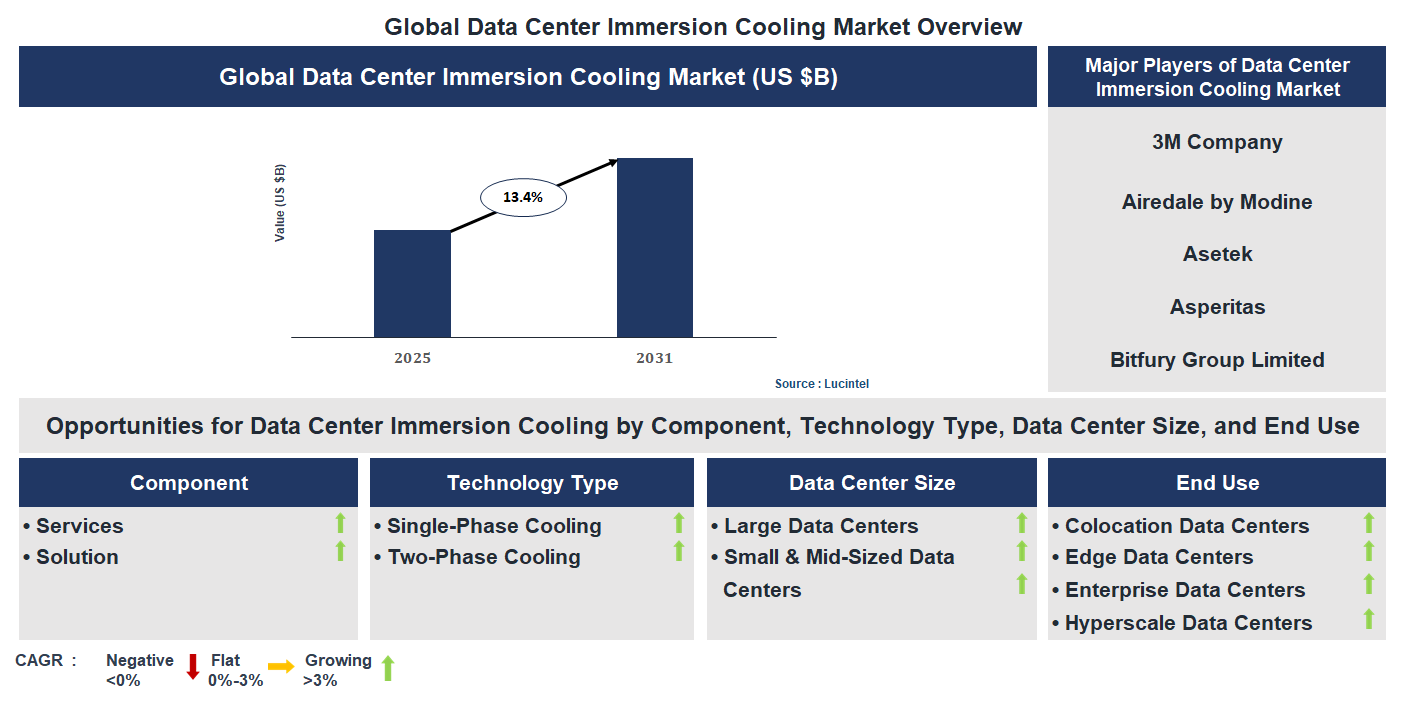
The future of the global data center immersion cooling market looks promising with opportunities in the colocation data center, edge data center, enterprise data center, and hyperscale data center markets. The global data center immersion cooling market is expected to grow with a CAGR of 13.4% from 2025 to 2031. The major drivers for this market are the increasing demand for high-density computing, the rising focus on energy-efficient infrastructure, and the growing need for advanced cooling technologies.• Lucintel forecasts that, within the component category, solution is expected to witness higher growth over the forecast period.
• Within the end use category, hyperscale data center is expected to witness the highest growth.
• In terms of region, North America is expected to witness the highest growth over the forecast period. Gain valuable insights for your business decisions with our comprehensive 150+ page report. Sample figures with some insights are shown below.
Emerging Trends in the Data Center Immersion Cooling Market
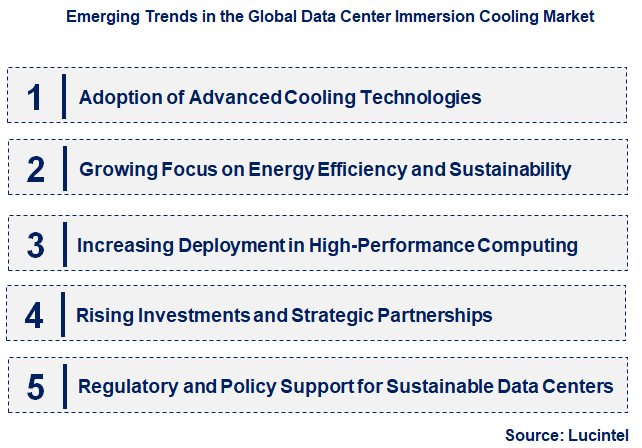
The data center immersion cooling market is experiencing rapid growth driven by the increasing demand for energy-efficient and high-performance cooling solutions in data centers worldwide. As data centers expand to support cloud computing, AI, and big data, traditional cooling methods are becoming less sustainable and more costly. Immersion cooling offers a promising alternative by providing superior thermal management, reducing energy consumption, and enabling higher server densities. This market is also influenced by technological advancements, environmental regulations, and the need for cost-effective infrastructure. These factors are collectively shaping a dynamic landscape that demands innovative cooling solutions to meet future data center needs.• Adoption of Advanced Cooling Technologies: The market is witnessing a shift towards innovative immersion cooling techniques such as single-phase and two-phase systems. These methods offer enhanced heat dissipation, lower energy consumption, and reduced physical space requirements. As data centers seek more efficient cooling options, immersion cooling is becoming increasingly attractive due to its ability to support high-density server configurations. This trend is driven by the need to optimize operational efficiency and reduce carbon footprints, making immersion cooling a vital component of sustainable data center infrastructure.
• Growing Focus on Energy Efficiency and Sustainability: With rising energy costs and stricter environmental regulations, data centers are prioritizing energy-efficient cooling solutions. Immersion cooling significantly reduces power usage effectiveness (PUE) by eliminating the need for traditional air conditioning systems. This trend is also supported by the push towards greener operations, with companies aiming to lower greenhouse gas emissions. As a result, immersion cooling is gaining traction as a sustainable alternative that aligns with corporate social responsibility goals and helps data centers achieve energy efficiency benchmarks.
• Increasing Deployment in High-Performance Computing: The demand for immersion cooling is surging in high-performance computing environments, including AI, machine learning, and scientific research. These applications generate substantial heat, requiring robust cooling solutions to maintain optimal performance. Immersion cooling provides direct contact with the hardware, enabling efficient heat removal and supporting higher processing speeds. This trend is transforming HPC data centers by allowing them to operate at higher densities and with improved reliability, thus accelerating innovation in fields that depend on intensive computational power.
• Rising Investments and Strategic Partnerships: Major technology firms, data center operators, and investment firms are increasing their investments in immersion cooling technologies. Strategic partnerships are forming to develop and deploy scalable, cost-effective solutions. These investments are fueling research and development, leading to more advanced and commercially viable immersion cooling products. The trend indicates a growing confidence in immersion cooling as a mainstream solution, which is expected to accelerate market adoption and drive industry standards, ultimately shaping the future landscape of data center infrastructure.
• Regulatory and Policy Support for Sustainable Data Centers: Governments and regulatory bodies are implementing policies that promote energy-efficient and environmentally friendly data center operations. Incentives, subsidies, and stricter standards are encouraging data center operators to adopt immersion cooling solutions. This regulatory push is fostering innovation and adoption of sustainable cooling technologies, aligning industry practices with global climate goals. As policies evolve, immersion cooling is positioned to become a key component in achieving compliance and sustainability targets, further propelling market growth and technological advancement. In summary, these emerging trends are collectively transforming the data center immersion cooling market by promoting sustainable, high-performance, and cost-effective cooling solutions. They are enabling data centers to meet increasing computational demands while reducing environmental impact, thus reshaping the future of data center infrastructure globally.
Recent Development in the Data Center Immersion Cooling Market
The data center immersion cooling market has experienced significant growth driven by the increasing demand for energy-efficient and sustainable cooling solutions. As data centers expand globally to support cloud computing, AI, and big data, traditional cooling methods face limitations in efficiency and environmental impact. Immersion cooling offers a promising alternative by directly immersing hardware in dielectric liquids, reducing energy consumption and enhancing performance. Recent developments reflect technological innovations, regulatory shifts, and market expansion, shaping the future landscape of data center cooling solutions. These advancements are crucial for meeting the rising data processing needs while minimizing environmental footprints.• Technological Innovations: New dielectric liquids and cooling systems have been developed, improving efficiency and safety. These innovations enable higher server densities and reduce energy consumption, making immersion cooling more viable for large-scale data centers. The enhanced thermal management also extends hardware lifespan, reducing maintenance costs and downtime.
• Regulatory and Environmental Policies: Governments and industry bodies are implementing stricter regulations on energy use and carbon emissions. These policies incentivize data centers to adopt sustainable cooling solutions like immersion cooling. Companies investing in eco-friendly practices gain competitive advantages and meet compliance standards, accelerating market adoption.
• Market Expansion and Investment: Major cloud providers and data center operators are investing heavily in immersion cooling technology. New facilities are being designed with immersion systems, and existing centers are retrofitted. This increased investment boosts market growth, encourages innovation, and broadens the application scope across various sectors.
• Cost Reduction and ROI Improvements: Advances in manufacturing and system design have lowered the costs of immersion cooling systems. As a result, the return on investment (ROI) improves for data center operators, making immersion cooling a financially attractive option. Cost efficiencies are driving wider adoption across different scales of operations.
• Strategic Partnerships and Collaborations: Industry players are forming alliances to develop standardized solutions and share expertise. These collaborations facilitate technology transfer, reduce development risks, and accelerate deployment. Strategic partnerships are vital for scaling immersion cooling solutions globally and ensuring interoperability. In summary, these recent developments are significantly impacting the data center immersion cooling market by enhancing technological capabilities, aligning with regulatory standards, expanding market reach, reducing costs, and fostering industry collaboration. Collectively, they are driving the adoption of immersion cooling as a sustainable, efficient, and scalable solution for future data center needs.
Strategic Growth Opportunities in the Data Center Immersion Cooling Market
The data center immersion cooling market is experiencing rapid growth driven by the increasing demand for energy-efficient and high-performance cooling solutions. As data centers expand globally to support cloud computing, AI, and big data, traditional cooling methods face limitations in efficiency and scalability. Immersion cooling offers a promising alternative by directly immersing hardware in dielectric liquids, reducing energy consumption and enhancing performance. This technological shift opens new avenues across various applications, fostering innovation and sustainability. Companies and data center operators are exploring these opportunities to stay competitive, reduce operational costs, and meet environmental regulations, thereby transforming the landscape of data center cooling solutions.• High-Performance Computing: Immersion cooling significantly enhances HPC performance by enabling higher density configurations and better thermal management. This leads to faster processing speeds, reduced downtime, and increased reliability, which are critical for scientific research, simulations, and AI workloads. The ability to efficiently cool dense hardware supports the development of more powerful supercomputers, driving innovation in research and enterprise sectors.
• Cloud Data Centers: As cloud service providers expand their infrastructure, immersion cooling offers scalable, energy-efficient solutions that reduce operational costs and carbon footprints. This technology allows for higher server densities and improved energy utilization, enabling cloud providers to meet growing demand while adhering to sustainability goals. The adoption of immersion cooling in cloud data centers is expected to accelerate, supporting the digital transformation across industries.
• Edge Computing: The proliferation of edge data centers requires compact, efficient cooling solutions to manage limited space and energy resources. Immersion cooling provides a reliable method to maintain optimal operating temperatures in these constrained environments. Its ability to support high-density deployments makes it ideal for edge applications in IoT, autonomous vehicles, and smart cities, ensuring consistent performance and reduced maintenance.
• Cryptocurrency Mining: Cryptocurrency mining operations demand substantial cooling to sustain high-performance hardware over extended periods. Immersion cooling offers an effective way to manage heat, improve energy efficiency, and reduce noise levels. This technology enables miners to increase operational capacity while lowering energy costs and environmental impact, making mining more sustainable and profitable.
• Telecom Infrastructure: Telecom data centers and network equipment require robust cooling solutions to ensure uninterrupted service. Immersion cooling provides enhanced thermal management, reducing equipment failure and maintenance needs. Its deployment in telecom infrastructure supports the growing demand for 5G and IoT connectivity, ensuring reliable, high-speed data transmission and network resilience. In summary, these growth opportunities are transforming the data center immersion cooling market by enabling higher efficiency, sustainability, and performance across key applications. The adoption of immersion cooling solutions is driving innovation, reducing operational costs, and supporting the expansion of digital infrastructure worldwide. As these opportunities mature, they will play a crucial role in shaping the future of data center technology and environmental sustainability.
Data Center Immersion Cooling Market Driver and Challenges
The data center immersion cooling market is influenced by a variety of technological, economic, and regulatory factors. As data centers expand to meet increasing digital demands, the need for efficient cooling solutions becomes critical. Innovations in immersion cooling technology aim to reduce energy consumption and improve sustainability, while economic pressures drive the adoption of cost-effective methods. Regulatory frameworks focusing on environmental impact and energy efficiency further shape market dynamics. These drivers and challenges collectively determine the pace of adoption, technological advancements, and market growth, making it essential for stakeholders to understand these factors to strategize effectively in this evolving landscape. The factors responsible for driving the Data Center Immersion Cooling Market include:-• Technological Advancements: The continuous development of innovative immersion cooling solutions enhances efficiency and reduces operational costs. These advancements enable data centers to handle higher densities and improve thermal management, making immersion cooling a more viable option. As technology evolves, the integration of smart monitoring and automation further optimizes performance, attracting more data center operators to adopt these solutions. The push for greener, energy-efficient cooling methods aligns with industry goals to reduce carbon footprints, thus accelerating market growth.
• Rising Data Center Deployment: The exponential growth of cloud computing, IoT, and AI applications has led to an increase in data center deployments worldwide. These facilities require effective cooling solutions to manage high-density equipment, which traditional air cooling struggles to support efficiently. Immersion cooling offers a scalable, space-saving, and energy-efficient alternative, making it attractive for new and existing data centers aiming to meet rising demand while maintaining operational efficiency.
• Energy Efficiency and Sustainability Goals: Governments and organizations are increasingly emphasizing sustainability and energy conservation. Immersion cooling significantly reduces energy consumption compared to conventional air cooling by minimizing the need for large HVAC systems. This aligns with global efforts to reduce greenhouse gas emissions and meet environmental regulations. As sustainability becomes a core business objective, the adoption of immersion cooling solutions is expected to accelerate, driven by the desire to achieve greener operations.
• Cost Reduction and Operational Efficiency: Immersion cooling can lower total cost of ownership by reducing energy bills, minimizing equipment failure, and decreasing maintenance costs. The ability to operate at higher densities without additional cooling infrastructure translates into space savings and capital expenditure reduction. Data center operators are increasingly recognizing these economic benefits, which serve as a strong incentive to adopt immersion cooling technology, especially in competitive markets.
• Growing Adoption of Edge Data Centers: The proliferation of edge computing requires smaller, efficient, and reliable data centers located closer to end-users. Immersion cooling is well-suited for these compact facilities due to its high efficiency and minimal footprint. As edge data centers become more prevalent, the demand for innovative cooling solutions like immersion cooling is expected to rise, supporting the market’s expansion into new segments and geographies. The challenges facing this Market include:-
• High Initial Investment: Implementing immersion cooling systems involves significant upfront costs for equipment, infrastructure modifications, and specialized maintenance. Many data center operators are hesitant to adopt due to budget constraints and uncertainty about return on investment. This financial barrier can slow down market penetration, especially among small and medium-sized enterprises that may lack the capital for such upgrades.
• Technological Complexity and Integration: Immersion cooling systems require specialized knowledge for installation, operation, and maintenance. Integrating these solutions into existing data center infrastructure can be complex and may involve compatibility issues. The need for skilled personnel and potential disruptions during implementation pose challenges, potentially hindering widespread adoption and increasing operational risks.
• Regulatory and Safety Concerns: The use of certain dielectric fluids in immersion cooling raises safety and environmental concerns. Regulatory standards regarding fluid handling, disposal, and fire safety can complicate deployment. Additionally, lack of standardized guidelines and certification processes may create uncertainty for operators, slowing market growth and limiting adoption in regions with strict safety regulations. In summary, the data center immersion cooling market is driven by technological innovations, increasing data center deployments, sustainability goals, economic benefits, and the rise of edge computing. However, high initial costs, technological complexities, and regulatory hurdles present significant challenges. These factors collectively influence the pace and scope of market growth, requiring stakeholders to navigate a complex landscape of opportunities and obstacles. Strategic investments, technological advancements, and regulatory clarity will be crucial for unlocking the full potential of immersion cooling solutions in the evolving data center industry.
List of Data Center Immersion Cooling Companies
Companies in the market compete on the basis of product quality offered. Major players in this market focus on expanding their manufacturing facilities, R&D investments, infrastructural development, and leverage integration opportunities across the value chain. With these strategies data center immersion cooling companies cater increasing demand, ensure competitive effectiveness, develop innovative products & technologies, reduce production costs, and expand their customer base. Some of the data center immersion cooling companies profiled in this report include-• 3M Company
• Airedale by Modine
• Asetek
• Asperitas
• Bitfury Group Limited
• Boyd Corporation
• Chilldyne
• CoolIT Systems
• DCX Polska
• Dell Technologies
Data Center Immersion Cooling Market by Segment
The study includes a forecast for the global data center immersion cooling market by component, technology type, data center size, end use, and region.Data Center Immersion Cooling Market by Component [Value from 2019 to 2031]:
• Services
• Solution
Data Center Immersion Cooling Market by Technology Type [Value from 2019 to 2031]:
• Single-Phase Cooling
• Two-Phase Cooling
Data Center Immersion Cooling Market by Data Center Size [Value from 2019 to 2031]:
• Large Data Centers
• Small & Mid-Sized Data Centers
Data Center Immersion Cooling Market by End Use [Value from 2019 to 2031]:
• Colocation Data Centers
• Edge Data Centers
• Enterprise Data Centers
• Hyperscale Data Centers
Data Center Immersion Cooling Market by Region [Value from 2019 to 2031]:
• North America
• Europe
• Asia Pacific
• The Rest of the World
Country Wise Outlook for the Data Center Immersion Cooling Market
The data center immersion cooling market has experienced significant growth driven by increasing data center demands, energy efficiency concerns, and technological advancements. As data centers expand globally, the need for innovative cooling solutions becomes critical to reduce energy consumption and operational costs. Countries are adopting immersion cooling to enhance sustainability and performance, reflecting a shift towards more environmentally friendly infrastructure. This trend is supported by government policies, corporate sustainability goals, and technological innovations. The markets evolution varies across regions, influenced by local regulations, technological adoption rates, and industry investments, shaping a dynamic landscape for immersion cooling solutions worldwide.• United States: The US market has seen rapid adoption of immersion cooling, driven by major cloud service providers and data center operators seeking energy-efficient solutions. Innovations in liquid cooling technology and increased investments in sustainable infrastructure have propelled growth. Regulatory pressures for reducing carbon footprints and operational costs are also encouraging adoption. Several startups and established companies are developing advanced immersion cooling systems, making the US a leader in technological innovation and market expansion.
• China: China is experiencing accelerated growth in immersion cooling adoption, fueled by the rapid expansion of data centers and government initiatives promoting green technology. Major Chinese tech giants are investing heavily in immersion cooling to improve energy efficiency and reduce cooling costs. The government’s focus on sustainable development and energy conservation policies are further supporting market growth. Local manufacturing and technological advancements are making China a significant player in the global immersion cooling market.
• Germany: Germany’s market is characterized by a focus on energy efficiency and sustainability, driven by strict EU regulations and environmental policies. Leading data center operators are integrating immersion cooling to meet carbon reduction targets. Germany’s emphasis on innovation and technological development has resulted in the deployment of advanced cooling solutions. The country also benefits from a strong industrial base and research institutions collaborating on sustainable data center technologies.
• India: India’s rapidly growing digital infrastructure and increasing data center investments are boosting the immersion cooling market. The country’s focus on energy conservation and cost-effective cooling solutions is driving adoption. Local companies are developing affordable immersion cooling systems tailored to India’s climate and energy needs. Government initiatives promoting digital transformation and renewable energy are also supporting market expansion, making India a promising emerging market for immersion cooling solutions.
• Japan: Japan’s market is characterized by a focus on high-performance and energy-efficient cooling solutions, driven by the country’s dense data center infrastructure and energy conservation goals. Leading technology firms are adopting immersion cooling to enhance data center performance and reduce operational costs. Japan’s emphasis on innovation, combined with government policies supporting sustainable technology, is fostering the deployment of advanced immersion cooling systems. The market is also influenced by the need for reliable cooling solutions in the face of natural disasters and energy constraints.

Features of the Global Data Center Immersion Cooling Market
Market Size Estimates: Data center immersion cooling market size estimation in terms of value ($B). Trend and Forecast Analysis: Market trends (2019 to 2024) and forecast (2025 to 2031) by various segments and regions. Segmentation Analysis: Data center immersion cooling market size by various segments, such as by component, technology type, data center size, end use, and region in terms of value ($B). Regional Analysis: Data center immersion cooling market breakdown by North America, Europe, Asia Pacific, and Rest of the World. Growth Opportunities: Analysis of growth opportunities in different components, technology types, data center size, end uses, and regions for the data center immersion cooling market. Strategic Analysis: This includes M&A, new product development, and competitive landscape of the data center immersion cooling market. Analysis of competitive intensity of the industry based on Porter’s Five Forces model.
FAQ
Q1. What is the growth forecast for data center immersion cooling market? Answer: The global data center immersion cooling market is expected to grow with a CAGR of 13.4% from 2025 to 2031. Q2. What are the major drivers influencing the growth of the data center immersion cooling market? Answer: The major drivers for this market are the increasing demand for high-density computing, the rising focus on energy-efficient infrastructure, and the growing need for advanced cooling technologies. Q3. What are the major segments for data center immersion cooling market? Answer: The future of the data center immersion cooling market looks promising with opportunities in the colocation data center, edge data center, enterprise data center, and hyperscale data center markets. Q4. Who are the key data center immersion cooling market companies? Answer: Some of the key data center immersion cooling companies are as follows:• 3M Company
• Airedale by Modine
• Asetek
• Asperitas
• Bitfury Group Limited
• Boyd Corporation
• Chilldyne
• CoolIT Systems
• DCX Polska
• Dell Technologies Q5. Which data center immersion cooling market segment will be the largest in future? Answer: Lucintel forecasts that, within the component category, solution is expected to witness higher growth over the forecast period. Q6. In data center immersion cooling market, which region is expected to be the largest in next 5 years? Answer: In terms of region, North America is expected to witness the highest growth over the forecast period. Q7. Do we receive customization in this report? Answer: Yes, Lucintel provides 10% customization without any additional cost.
Table of Contents
List of Figures
List of Tables
Methodology
- In-depth interviews of the major players in this market
- Detailed secondary research from competitors’ financial statements and published data
- Extensive searches of published works, market, and database information pertaining to industry news, company press releases, and customer intentions
- A compilation of the experiences, judgments, and insights of Lucintel’s professionals, who have analyzed and tracked this market over the years.


Key Questions
- • What are some of the most promising, high-growth opportunities for the data center immersion cooling market by component (services and solution), technology type (single-phase cooling and two-phase cooling), data center size (large data centers and small & mid-sized data centers), end use (colocation data centers, edge data centers, enterprise data centers, and hyperscale data centers), and region (North America, Europe, Asia Pacific, and the Rest of the World)?
- • Which segments will grow at a faster pace and why?
- • Which region will grow at a faster pace and why?
- • What are the key factors affecting market dynamics? What are the key challenges and business risks in this market?
- • What are the business risks and competitive threats in this market?
- • What are the emerging trends in this market and the reasons behind them?
- • What are some of the changing demands of customers in the market?
- • What are the new developments in the market? Which companies are leading these developments?
- • Who are the major players in this market? What strategic initiatives are key players pursuing for business growth?
- • What are some of the competing products in this market and how big of a threat do they pose for loss of market share by material or product substitution?
- • What M&A activity has occurred in the last 5 years and what has its impact been on the industry? For any questions related to Data Center Immersion Cooling Market, Data Center Immersion Cooling Market Size, Data Center Immersion Cooling Market Growth, Data Center Immersion Cooling Market Analysis, Data Center Immersion Cooling Market Report, Data Center Immersion Cooling Market Share, Data Center Immersion Cooling Market Trends, Data Center Immersion Cooling Market Forecast, Data Center Immersion Cooling Companies, write Lucintel analyst at email: helpdesk@lucintel.com. We will be glad to get back to you soon.


