
Report Feature
Data Center Cooling Equipment Market Trends and Forecast
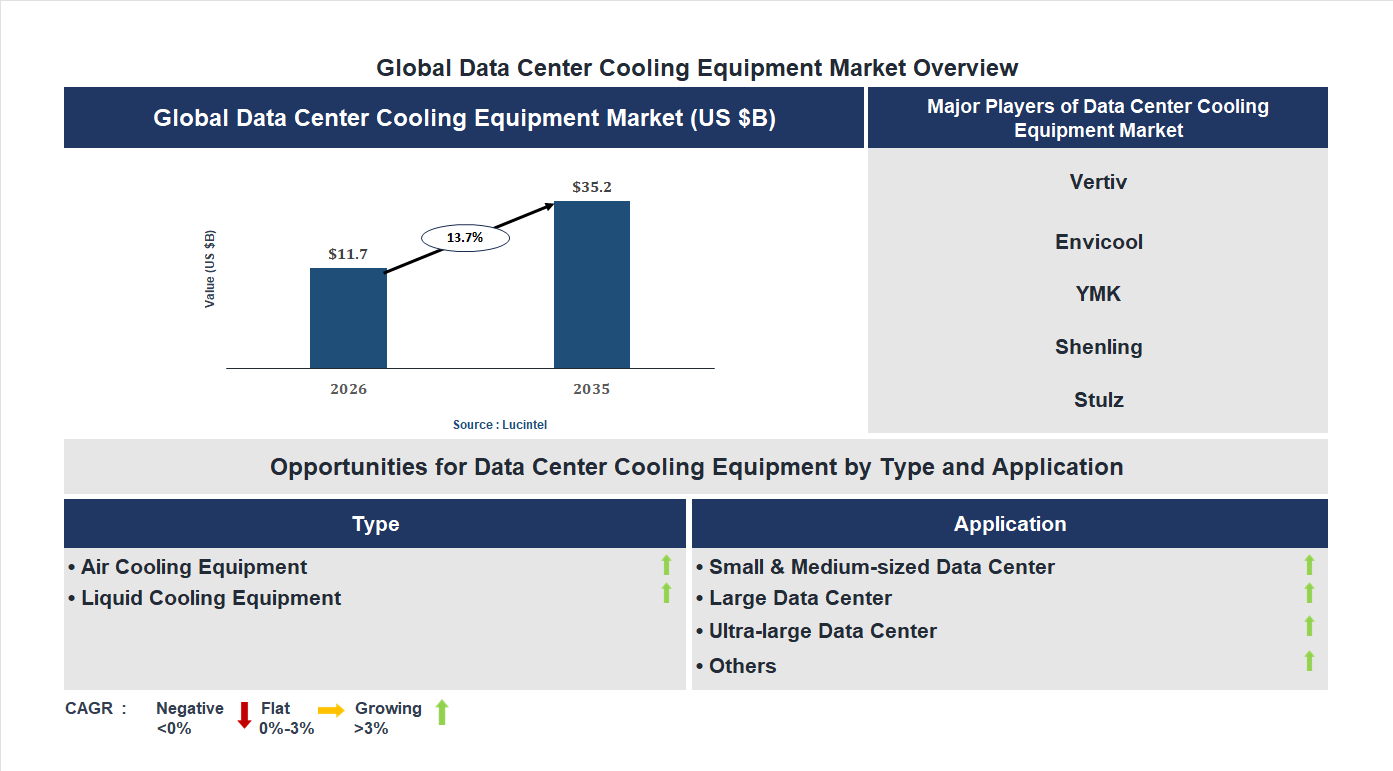
The future of the global data center cooling equipment market looks promising with opportunities in the small & medium-sized data center, large data center, and ultra-large data center markets. The global data center cooling equipment market is expected to reach an estimated $35.2 billion by 2035 with a CAGR of 13.7% from 2026 to 2035. The major drivers for this market are the increasing demand for data processing capabilities, the rising adoption of cloud computing services, and the growing need for efficient cooling systems.• Lucintel forecasts that, within the type category, liquid cooling equipment is expected to witness higher growth over the forecast period.
• Within the application category, ultra-large data center is expected to witness the highest growth.
• In terms of region, APAC is expected to witness the highest growth over the forecast period. Gain valuable insights for your business decisions with our comprehensive 150+ page report. Sample figures with some insights are shown below.
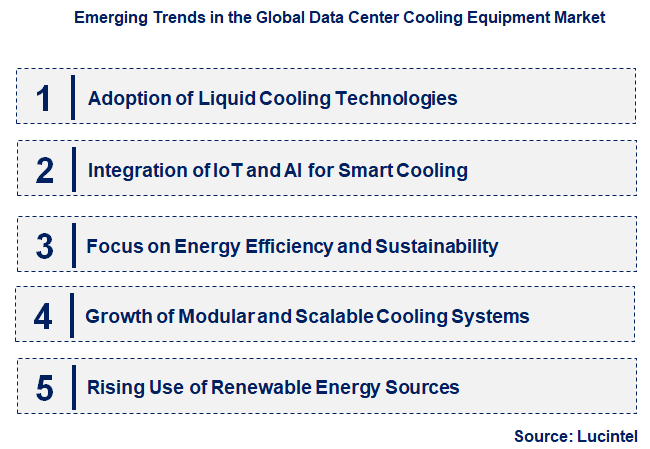
Emerging Trends in the Data Center Cooling Equipment Market
The data center cooling equipment market is experiencing rapid evolution driven by technological advancements, increasing data center deployments, and the need for energy-efficient solutions. As data centers expand globally, the demand for innovative cooling technologies that optimize energy consumption, reduce costs, and ensure reliable operations is rising. Market players are focusing on sustainable and scalable solutions to meet the growing needs of cloud computing, AI, and big data. These developments are transforming the landscape, making cooling systems more intelligent, eco-friendly, and cost-effective. The following key trends highlight the major shifts shaping this dynamic market.• Adoption of Liquid Cooling Technologies: Liquid cooling is gaining prominence due to its superior heat dissipation capabilities. Unlike traditional air cooling, liquid systems efficiently manage high-density server environments, reducing energy consumption and operational costs. This trend is driven by the increasing power density of data centers and the need for more effective cooling solutions. Liquid cooling also enables better space utilization and can be integrated into existing infrastructure, making it a flexible choice for data center operators seeking sustainable and scalable options.
• Integration of IoT and AI for Smart Cooling: The incorporation of Internet of Things (IoT) sensors and Artificial Intelligence (AI) algorithms is revolutionizing data center cooling management. These technologies enable real-time monitoring, predictive maintenance, and automated adjustments to cooling parameters, optimizing energy use and preventing system failures. Smart cooling solutions improve efficiency, reduce downtime, and lower operational costs. As data centers become more complex, IoT and AI-driven systems are essential for maintaining optimal conditions, enhancing overall performance, and supporting sustainability initiatives.
• Focus on Energy Efficiency and Sustainability: With increasing environmental concerns and rising energy costs, energy-efficient cooling solutions are a key market focus. Innovations such as free cooling, evaporative cooling, and advanced heat exchangers are reducing the carbon footprint of data centers. Governments and industry standards are also pushing for greener operations, encouraging investments in sustainable cooling technologies. This trend not only helps data centers comply with regulations but also significantly lowers energy bills, making sustainability a competitive advantage in the market.
• Growth of Modular and Scalable Cooling Systems: Modular cooling solutions are becoming popular due to their flexibility and ease of deployment. These systems allow data centers to expand or upgrade their cooling capacity incrementally, aligning with business growth and changing demands. Modular designs reduce upfront costs and minimize disruption during installation. They are particularly suitable for edge data centers and rapidly growing facilities, providing a cost-effective and adaptable approach to cooling management. This trend supports the dynamic nature of modern data center infrastructure.
• Rising Use of Renewable Energy Sources: To reduce reliance on fossil fuels and lower greenhouse gas emissions, data centers are increasingly integrating renewable energy sources such as solar and wind power into their cooling operations. This approach not only enhances sustainability but also stabilizes energy costs over time. Innovative cooling systems are being designed to work seamlessly with renewable energy, including thermal energy storage solutions. The shift towards renewable energy is a strategic move to meet environmental regulations and corporate social responsibility goals, positioning data centers as leaders in sustainable technology adoption. In summary, these trends are collectively transforming the data center cooling equipment market by promoting smarter, more efficient, and sustainable cooling solutions. They are enabling data centers to operate more reliably and cost-effectively while aligning with global environmental goals. As these innovations continue to evolve, the market is poised for significant growth and increased competitiveness, driven by the imperative for greener and more intelligent data center infrastructure.
Recent Development in the Data Center Cooling Equipment Market
The data center cooling equipment market is experiencing rapid growth driven by increasing data center deployments, rising energy efficiency demands, and technological innovations. As digital transformation accelerates globally, the need for reliable, efficient cooling solutions becomes critical. Market players are investing in advanced technologies to reduce operational costs and environmental impact. This evolving landscape presents significant opportunities for growth, innovation, and competitive advantage, shaping the future of data center infrastructure and sustainability efforts worldwide.• Growing Demand for Energy-efficient Cooling Solutions: The market is expanding as data centers seek sustainable, cost-effective cooling options to reduce energy consumption and carbon footprint, driven by stricter regulations and corporate sustainability goals.
• Adoption of Advanced Cooling Technologies: Innovations like liquid cooling and AI-driven systems are transforming the industry, offering enhanced efficiency, reduced space requirements, and lower operational costs, thus attracting more investments.
• Increasing Data Center Construction Globally: The surge in new data center projects, especially in emerging markets, fuels demand for scalable and reliable cooling equipment, supporting digital expansion and cloud services.
• Integration of IoT and Automation: IoT-enabled cooling systems enable real-time monitoring and predictive maintenance, improving efficiency, reducing downtime, and lowering operational expenses for data center operators.
• Focus on Environmental Sustainability and Regulations: Stricter environmental standards are pushing companies to adopt eco-friendly cooling solutions, fostering innovation and creating new market opportunities for sustainable equipment. These developments are significantly transforming the data center cooling equipment market by enhancing efficiency, sustainability, and scalability. The integration of advanced technologies and increasing global data center investments are driving growth, fostering innovation, and shaping a more sustainable and competitive industry landscape.
Strategic Growth Opportunities in the Data Center Cooling Equipment Market
The data center cooling equipment market is experiencing rapid expansion driven by increasing data center deployments, rising energy efficiency demands, and technological advancements. As digital transformation accelerates globally, the need for reliable, efficient cooling solutions becomes critical to maintain optimal data center operations. Market players are focusing on innovative products, sustainable practices, and strategic partnerships to capitalize on emerging opportunities. This environment presents significant growth potential across various applications, fostering competitive innovation and addressing the evolving needs of data infrastructure management.• Growing Demand for Energy-efficient Cooling Solutions: The increasing energy consumption of data centers necessitates the adoption of energy-efficient cooling equipment. Innovations such as free cooling, liquid cooling, and advanced airflow management are reducing operational costs and environmental impact. Governments and organizations are prioritizing sustainability, driving investments in eco-friendly cooling technologies. This trend creates opportunities for manufacturers to develop and deploy high-performance, low-energy cooling systems tailored to diverse data center sizes and configurations.
• Expansion of Edge Data Centers Requiring Specialized cooling: The proliferation of edge data centers to support IoT, 5G, and real-time analytics demands compact, efficient cooling solutions. These smaller facilities often operate in constrained environments, requiring innovative cooling methods that are space-saving and energy-efficient. The need for localized cooling solutions presents opportunities for specialized equipment designed for edge deployments, including modular and scalable systems that ensure reliable operation with minimal footprint and power consumption.
• Adoption of Smart and Automated Cooling Systems: The integration of IoT, AI, and machine learning into cooling equipment enables real-time monitoring, predictive maintenance, and optimized performance. Smart cooling systems reduce downtime, improve energy efficiency, and lower operational costs. As data centers seek to enhance operational agility, the demand for intelligent cooling solutions grows. This trend opens avenues for vendors to develop connected, automated systems that adapt dynamically to changing thermal loads and environmental conditions.
• Increasing Focus on Sustainable and Eco-friendly Cooling Technologies: Environmental concerns and regulatory pressures are pushing data centers toward sustainable cooling options. Technologies such as immersion cooling, evaporative cooling, and the use of renewable energy sources are gaining traction. Companies investing in green cooling solutions can differentiate themselves and meet corporate social responsibility goals. The shift toward eco-friendly practices fosters innovation and creates market opportunities for sustainable equipment that reduces carbon footprint and operational costs.
• Rising Investments in Retrofitting and Upgrading Existing Data Centers: Many data centers are undergoing modernization to improve efficiency and capacity. Upgrading cooling infrastructure offers significant cost savings and performance enhancements. This presents opportunities for retrofit solutions, including modular cooling units and energy recovery systems. Vendors can capitalize on this trend by offering tailored upgrade packages, ensuring compatibility with existing infrastructure, and providing long-term support to meet evolving technological and regulatory standards. The overall market outlook is positively influenced by these growth opportunities, encouraging innovation, sustainability, and efficiency. As data center demands continue to rise, strategic investments in these areas will drive market expansion, foster competitive differentiation, and support the development of smarter, greener cooling solutions. This evolution will ultimately enhance data center performance, reduce environmental impact, and meet the increasing global digital infrastructure needs.
Data Center Cooling Equipment Market Driver and Challenges
The data center cooling equipment market is influenced by a variety of technological, economic, and regulatory factors. Rapid digital transformation and increasing data generation necessitate advanced cooling solutions to ensure optimal data center performance. Technological innovations such as energy-efficient cooling systems and automation are driving market growth. Economic factors, including rising investments in data infrastructure and the need to reduce operational costs, further propel demand. Regulatory standards aimed at reducing carbon footprints and promoting sustainable practices also shape market dynamics. However, the market faces challenges related to high installation costs, evolving regulatory compliance, and technological complexities. Understanding these drivers and challenges is essential for stakeholders to navigate this evolving landscape effectively. The factors responsible for driving the data center cooling equipment market include:• Increasing Data Center Deployment: The exponential growth of data centers worldwide, driven by cloud computing, IoT, and AI, demands efficient cooling solutions. As data centers expand in size and number, the need for reliable, scalable cooling systems becomes critical to prevent overheating and ensure continuous operation. This surge in deployment directly correlates with increased demand for advanced cooling equipment, fostering innovation and market expansion. The rising adoption of edge data centers further amplifies this trend, requiring localized cooling solutions to support decentralized infrastructure. Consequently, the market benefits from a sustained increase in demand driven by digital transformation initiatives across industries.
• Technological Advancements in Cooling Solutions: Innovations such as liquid cooling, free cooling, and AI-powered automation are revolutionizing the market. These technologies offer enhanced energy efficiency, reduced operational costs, and improved environmental sustainability. For instance, liquid cooling provides superior heat dissipation compared to traditional air cooling, enabling higher server densities. AI-driven systems optimize cooling performance by dynamically adjusting parameters, reducing waste and energy consumption. The development of modular and scalable cooling units allows data centers to adapt to changing needs efficiently. These technological advancements not only improve performance but also align with regulatory pressures for greener operations, thereby expanding market opportunities.
• Growing Emphasis on Energy Efficiency and Sustainability: Environmental concerns and regulatory mandates are pushing data centers to adopt energy-efficient cooling solutions. Governments and industry bodies are setting standards to reduce carbon emissions, encouraging the adoption of eco-friendly equipment. Energy-efficient cooling reduces electricity consumption, which constitutes a significant portion of data center operational costs. Companies are investing in green technologies such as free cooling and heat recovery systems to meet sustainability goals. This shift towards sustainable practices enhances brand reputation and compliance, further driving market growth. The focus on sustainability also opens avenues for innovative products that combine performance with environmental responsibility.
• Rising Investments in Data Infrastructure: Governments and private enterprises are increasing investments in digital infrastructure, fueling demand for data center expansion. These investments are driven by the need for robust cloud services, big data analytics, and digital transformation initiatives. As new data centers are built and existing ones upgraded, the requirement for efficient cooling equipment intensifies. This financial commitment ensures continuous market growth, encouraging manufacturers to develop advanced cooling solutions tailored to diverse operational needs. Additionally, the expansion into emerging markets presents new opportunities for growth, supported by increasing internet penetration and digital adoption.
• Adoption of Edge Computing: The proliferation of edge computing necessitates localized data processing, leading to the development of smaller, decentralized data centers. These facilities require compact, efficient cooling solutions capable of operating in diverse environments. Edge data centers often face space and power constraints, making traditional cooling methods less feasible. The demand for innovative cooling technologies that can operate reliably in remote or harsh conditions is rising. This trend not only diversifies the market but also stimulates innovation in cooling equipment design, catering to the unique needs of edge infrastructure and expanding market reach. The challenges facing this data center cooling equipment market include:
• High Installation and Operational Costs: Implementing advanced cooling systems involves significant capital expenditure, which can be a barrier for small and medium-sized data centers. The costs associated with equipment purchase, installation, and ongoing maintenance are substantial. Additionally, energy consumption during operation adds to operational expenses, impacting profitability. These financial barriers may slow down adoption, especially in regions with limited budgets. To mitigate this, companies are exploring cost-effective solutions, but the initial investment remains a critical challenge that could hinder market growth and technological adoption.
• Rapid Technological Changes and Compatibility Issues: The fast pace of technological innovation leads to compatibility challenges between new cooling solutions and existing data center infrastructure. Upgrading or replacing cooling systems can be complex and disruptive, requiring significant planning and investment. Compatibility issues may also arise with different hardware and software platforms, complicating integration efforts. This rapid evolution demands continuous adaptation from manufacturers and operators, increasing complexity and costs. Ensuring seamless integration while maintaining performance standards remains a key challenge for sustained market growth.
• Regulatory and Environmental Compliance: Evolving regulations aimed at reducing energy consumption and carbon emissions impose stringent standards on cooling equipment. Compliance requires continuous updates to technology and processes, which can be costly and time-consuming. Non-compliance risks penalties and reputational damage, compelling market players to invest heavily in sustainable solutions. Navigating diverse regulatory landscapes across regions adds complexity, especially for global operators. Balancing regulatory requirements with operational efficiency is a persistent challenge that influences product development and market strategies. In summary, the data center cooling equipment market is driven by technological innovations, increasing data infrastructure investments, and sustainability initiatives. However, high costs, rapid technological changes, and regulatory compliance pose significant challenges. These factors collectively shape the markets trajectory, requiring stakeholders to innovate continuously and adapt strategies to sustain growth. The interplay of drivers and challenges will determine the pace and direction of market development, emphasizing the need for balanced approaches that foster innovation while managing costs and compliance.
List of Data Center Cooling Equipment Companies
Companies in the market compete on the basis of product quality offered. Major players in this market focus on expanding their manufacturing facilities, R&D investments, infrastructural development, and leverage integration opportunities across the value chain. With these strategies data center cooling equipment companies cater increasing demand, ensure competitive effectiveness, develop innovative products & technologies, reduce production costs, and expand their customer base. Some of the data center cooling equipment companies profiled in this report include-• Vertiv
• Envicool
• YMK
• Shenling
• Stulz
• Canatal
• Schneider
• iTeaq
• Huawei
• Airsys
Data Center Cooling Equipment Market by Segment
The study includes a forecast for the global data center cooling equipment market by type, application, and region.Data Center Cooling Equipment Market by Type [Value from 2019 to 2035]:
• Air Cooling Equipment
• Liquid Cooling Equipment
Data Center Cooling Equipment Market by Application [Value from 2019 to 2035]:
• Small & Medium-sized Data Center
• Large Data Center
• Ultra-large Data Center
• Others
Data Center Cooling Equipment Market by Region [Value from 2019 to 2035]:
• North America
• Europe
• Asia Pacific
• The Rest of the World
Country Wise Outlook for the Data Center Cooling Equipment Market
The data center cooling equipment market has experienced significant growth driven by increasing data center deployments, rising energy efficiency standards, and technological innovations. As data centers expand globally, countries are adopting advanced cooling solutions to manage heat loads efficiently while reducing operational costs and environmental impact. The United States, China, Germany, India, and Japan are key players in this market, each demonstrating unique trends and advancements. These developments reflect broader technological, economic, and regulatory shifts shaping the future of data center infrastructure worldwide.• United States: The US market is witnessing a surge in energy-efficient cooling systems, including liquid cooling and free cooling technologies. Major data center operators are investing in sustainable solutions to meet stringent environmental regulations and reduce carbon footprints. Innovations in AI-driven cooling management are also gaining traction, optimizing energy use and operational efficiency.
• China: China is experiencing rapid growth in data center capacity, prompting the adoption of advanced cooling solutions such as immersion cooling and modular systems. Government initiatives promoting green data centers are encouraging the deployment of eco-friendly cooling technologies. Local manufacturers are increasingly focusing on cost-effective, scalable cooling options to support expanding infrastructure.
• Germany: Germany emphasizes energy efficiency and sustainability in data center cooling. The market is adopting innovative solutions like indirect evaporative cooling and heat recovery systems to minimize energy consumption. Regulatory frameworks favor environmentally friendly practices, fostering the development of cutting-edge cooling technologies aligned with EU standards.
• India: India’s data center market is expanding swiftly, driven by digital transformation and cloud adoption. The focus is on cost-effective and energy-efficient cooling solutions, including free cooling and modular systems suitable for tropical climates. The government’s push for green data centers is encouraging the adoption of sustainable cooling technologies to reduce operational costs and environmental impact.
• Japan: Japan is advancing in the deployment of high-efficiency cooling systems, including liquid cooling and heat reuse technologies. The country’s focus on disaster resilience and energy conservation influences market trends, leading to innovations in compact and reliable cooling solutions. Regulatory policies support the integration of eco-friendly and energy-saving technologies in data center operations.

Features of the Global Data Center Cooling Equipment Market
Market Size Estimates: Data center cooling equipment market size estimation in terms of value ($B). Trend and Forecast Analysis: Market trends (2019 to 2025) and forecast (2026 to 2035) by various segments and regions. Segmentation Analysis: Data center cooling equipment market size by type, application, and region in terms of value ($B). Regional Analysis: Data center cooling equipment market breakdown by North America, Europe, Asia Pacific, and Rest of the World. Growth Opportunities: Analysis of growth opportunities in different types, applications, and regions for the data center cooling equipment market. Strategic Analysis: This includes M&A, new product development, and competitive landscape of the data center cooling equipment market. Analysis of competitive intensity of the industry based on Porter’s Five Forces model.
FAQ
Q1. What is the market size and growth forecast for data center cooling equipment market? Answer: The global data center cooling equipment market is expected to reach an estimated $35.2 billion by 2035 and grow with a CAGR of 13.7% from 2026 to 2035. Q2. What are the major drivers influencing the growth of the data center cooling equipment market? Answer: The major drivers for this market are the increasing demand for data processing capabilities, the rising adoption of cloud computing services, and the growing need for efficient cooling systems. Q3. What are the major segments for data center cooling equipment market? Answer: The future of the data center cooling equipment market looks promising with opportunities in the small & medium-sized data center, large data center, and ultra-large data center markets. Q4. Who are the key data center cooling equipment market companies? Answer: Some of the key data center cooling equipment companies are as follows:• Vertiv
• Envicool
• YMK
• Shenling
• Stulz
• Canatal
• Schneider
• iTeaq
• Huawei
• Airsys Q5. Which data center cooling equipment market segment will be the largest in future? Answer: Lucintel forecasts that, within the type category, liquid cooling equipment is expected to witness higher growth over the forecast period. Q6. In data center cooling equipment market, which region is expected to be the largest in next 5 years? Answer: In terms of region, APAC is expected to witness the highest growth over the forecast period. Q7. Do we receive customization in this report? Answer: Yes, Lucintel provides 10% customization without any additional cost.
Table of Contents
List of Figures
List of Tables
Methodology
- In-depth interviews of the major players in this market
- Detailed secondary research from competitors’ financial statements and published data
- Extensive searches of published works, market, and database information pertaining to industry news, company press releases, and customer intentions
- A compilation of the experiences, judgments, and insights of Lucintel’s professionals, who have analyzed and tracked this market over the years.


Buy Now
Choose a license that fits your team. Instant PDF delivery.
Prices exclude taxes. Instant delivery. Custom licensing available on request.
Key Questions
- • What are some of the most promising, high-growth opportunities for the data center cooling equipment market by type (air cooling equipment and liquid cooling equipment), application (small & medium-sized data center, large data center, ultra-large data center, and others), and region (North America, Europe, Asia Pacific, and the Rest of the World)?
- • Which segments will grow at a faster pace and why?
- • Which region will grow at a faster pace and why?
- • What are the key factors affecting market dynamics? What are the key challenges and business risks in this market?
- • What are the business risks and competitive threats in this market?
- • What are the emerging trends in this market and the reasons behind them?
- • What are some of the changing demands of customers in the market?
- • What are the new developments in the market? Which companies are leading these developments?
- • Who are the major players in this market? What strategic initiatives are key players pursuing for business growth?
- • What are some of the competing products in this market and how big of a threat do they pose for loss of market share by material or product substitution?
- • What M&A activity has occurred in the last 7 years and what has its impact been on the industry? For any questions related to Data Center Cooling Equipment Market, Data Center Cooling Equipment Market Size, Data Center Cooling Equipment Market Growth, Data Center Cooling Equipment Market Analysis, Data Center Cooling Equipment Market Report, Data Center Cooling Equipment Market Share, Data Center Cooling Equipment Market Trends, Data Center Cooling Equipment Market Forecast, Data Center Cooling Equipment Companies, write Lucintel analyst at email: helpdesk@lucintel.com. We will be glad to get back to you soon.


