
Market Report · July 31, 2026

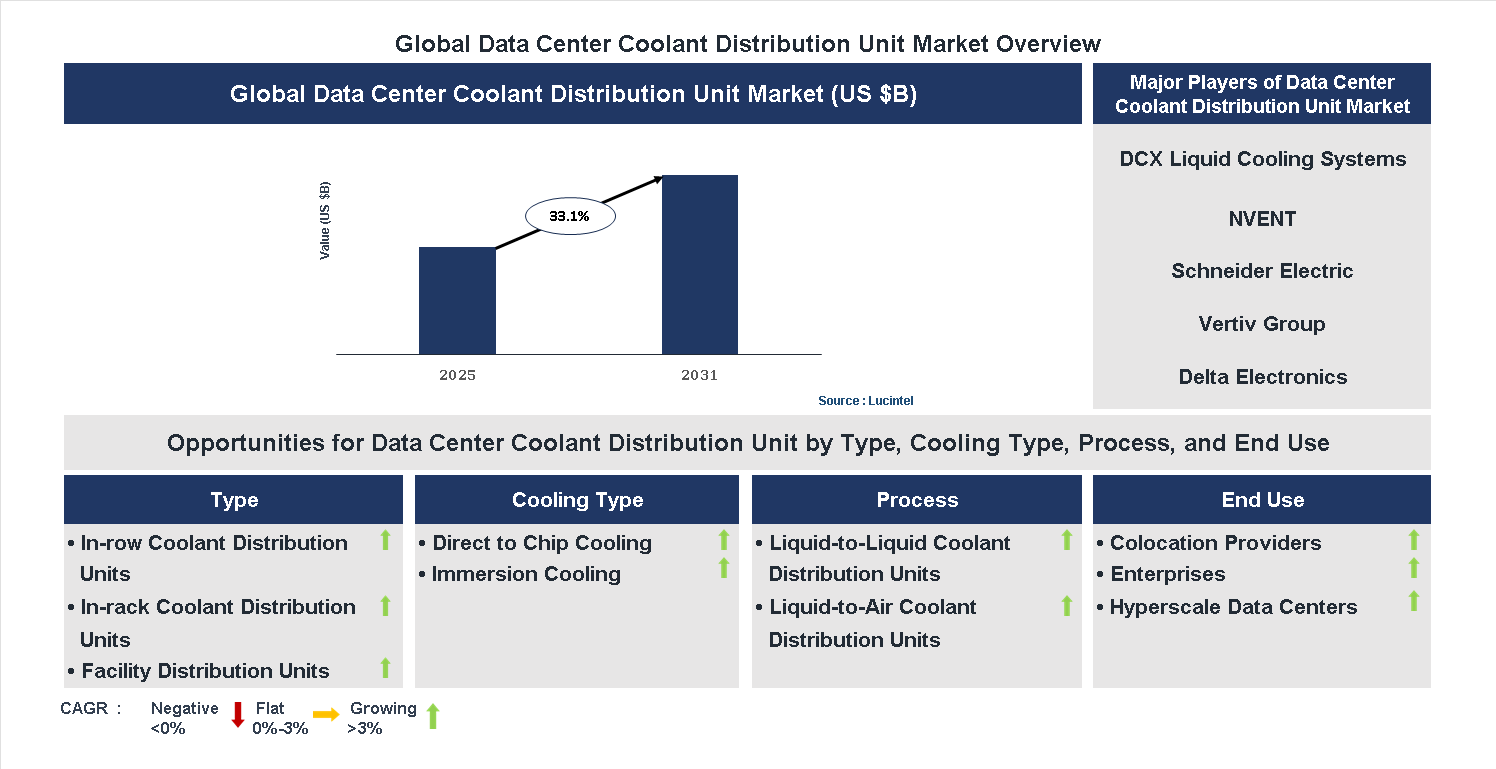
Key data points: The growth forecast = 33.1% annually for the next 7 years. Scroll below to get more insights. This market report covers trends, opportunities and forecasts in data center coolant distribution unit market to 2031 by type (in-row coolant distribution units, in-rack coolant distribution units, and facility distribution units), cooling type (direct to chip cooling and immersion cooling), process (liquid-to-liquid coolant distribution units and liquid-to-air coolant distribution units), end use (colocation providers, enterprises, and hyperscale data centers), and region (North America, Europe, Asia Pacific, and the Rest of the World)
We'll send your sample report shortly.
• Lucintel forecasts that, within the type category, in-row coolant distribution unit is expected to witness the highest growth over the forecast period.
• Within the end use category, hyperscale data center is expected to witness the highest growth.
• In terms of region, North America is expected to witness the highest growth over the forecast period. Gain valuable insights for your business decisions with our comprehensive 150+ page report. Sample figures with some insights are shown below.
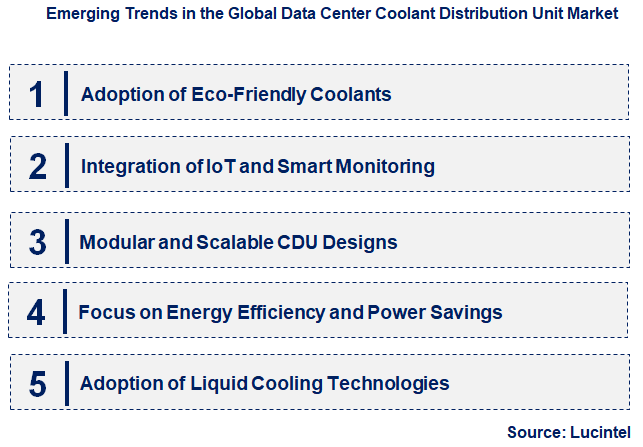
• Adoption of Eco-Friendly Coolants: The market is shifting towards environmentally sustainable coolants such as biodegradable and non-toxic fluids. This trend is driven by increasing environmental regulations and the need for greener data center operations. Eco-friendly coolants reduce the carbon footprint and minimize potential health hazards, making them attractive for data center operators aiming for sustainability certifications. The adoption of such coolants enhances corporate social responsibility and aligns with global efforts to reduce environmental impact, ultimately leading to more sustainable cooling solutions.
• Integration of IoT and Smart Monitoring: The incorporation of Internet of Things (IoT) technology into CDUs is transforming data center cooling management. Smart sensors and real-time monitoring enable predictive maintenance, optimize coolant flow, and improve energy efficiency. IoT integration allows operators to detect anomalies early, reduce downtime, and lower operational costs. This trend enhances system reliability and provides valuable data insights, facilitating better decision-making and proactive management of cooling systems, which is crucial for large-scale, high-density data centers.
• Modular and Scalable CDU Designs: The demand for flexible cooling solutions is driving the development of modular and scalable CDUs. These units can be easily expanded or reconfigured to accommodate changing data center sizes and workloads. Modular designs reduce upfront costs and enable phased investments, making them ideal for evolving infrastructure needs. Scalability ensures that cooling capacity can grow with the data center, improving efficiency and reducing waste. This trend supports the dynamic nature of modern data centers, allowing for more adaptable and cost-effective cooling strategies.
• Focus on Energy Efficiency and Power Savings: Energy efficiency remains a top priority, prompting innovations in CDU design to minimize power consumption. Advanced heat exchange technologies, variable speed pumps, and optimized coolant distribution pathways contribute to significant energy savings. These improvements help data centers meet stringent energy regulations and reduce operational costs. Enhanced efficiency not only lowers carbon emissions but also improves overall system performance, making energy-efficient CDUs a critical component in sustainable data center operations.
• Adoption of Liquid Cooling Technologies: The shift from traditional air cooling to liquid cooling solutions is gaining momentum, especially for high-density data centers. Liquid cooling offers superior heat transfer capabilities, enabling higher server densities and reducing space requirements. This trend supports the increasing power densities of modern hardware and helps in achieving energy savings. Liquid cooling systems are more effective at managing heat, leading to improved reliability and lifespan of equipment. As data centers seek more efficient cooling methods, liquid cooling is becoming a vital trend shaping the future of CDU markets. In summary, these emerging trends—eco-friendly coolants, IoT integration, modular designs, energy efficiency, and liquid cooling—are collectively transforming the data center coolant distribution unit market. They are driving innovations that enhance performance, sustainability, and scalability, enabling data centers to meet the evolving demands of digital infrastructure while reducing environmental impact. These developments are setting new standards for efficiency and reliability, ensuring the market remains dynamic and forward-looking.
• Adoption of Eco-Friendly Coolants: The market is shifting towards environmentally sustainable coolants, such as biodegradable and low-GWP (Global Warming Potential) fluids, reducing ecological footprints and complying with stricter regulations. This transition enhances the market’s sustainability profile and appeals to eco-conscious clients, fostering growth in regions with stringent environmental policies.
• Integration of IoT and Automation: IoT-enabled CDUs are increasingly being adopted for real-time monitoring and predictive maintenance. This integration improves operational efficiency, reduces downtime, and lowers energy consumption. Automated systems enable data centers to optimize cooling performance dynamically, leading to cost savings and enhanced reliability.
• Development of Modular and Scalable Units: Manufacturers are focusing on modular CDU designs that can be easily scaled according to data center size and needs. This flexibility allows data centers to expand or modify cooling systems without significant disruptions or costs, supporting rapid deployment and customization.
• Focus on Energy Efficiency and Power Management: Innovations in energy-efficient components and advanced power management systems are reducing overall energy consumption of CDUs. These developments help data centers meet sustainability goals, lower operational costs, and comply with energy regulations, making the market more attractive to environmentally conscious clients.
• Expansion into Emerging Markets: The market is witnessing increased penetration into emerging regions such as Asia-Pacific and Africa, driven by expanding data center infrastructure and digital transformation initiatives. Local manufacturers are forming strategic partnerships and investing in regional facilities to cater to growing demand, broadening the market’s global footprint. In summary, these recent developments are significantly impacting the data center coolant distribution unit market by enhancing sustainability, operational efficiency, and scalability. The integration of advanced technologies and expansion into new markets are driving growth, making the industry more competitive and aligned with global environmental and digital transformation goals.
• Enterprise Data Centers: Enhanced cooling efficiency is vital for enterprise data centers to reduce energy consumption and operational costs. The adoption of advanced CDU systems improves thermal management, ensuring optimal performance and reliability. This growth opportunity supports the digital transformation initiatives of enterprises, enabling them to handle increasing data loads while maintaining energy efficiency.
• Colocation Facilities: As colocation providers seek scalable and cost-effective cooling solutions, the demand for advanced CDUs rises. These units facilitate flexible cooling configurations, allowing providers to optimize space and energy use. The growth in colocation services, driven by cloud adoption, directly boosts the market for innovative CDU solutions.
• Cloud Service Providers: The rapid expansion of cloud infrastructure necessitates high-capacity, energy-efficient cooling systems. CDUs tailored for cloud data centers help manage thermal loads effectively, ensuring uninterrupted service delivery. This opportunity encourages the development of smart, integrated cooling systems that enhance operational efficiency and reduce carbon footprints.
• Government Data Centers: Governments are investing in secure, resilient data centers, emphasizing sustainable cooling solutions. The deployment of eco-friendly CDUs aligns with green initiatives and regulatory standards. This growth avenue promotes the adoption of environmentally sustainable cooling technologies in public sector infrastructure.
• Hyperscale Data Centers: The surge in hyperscale data centers demands large-scale, reliable cooling solutions. Advanced CDUs designed for high-density environments improve thermal management and energy efficiency. This opportunity drives innovation in modular and scalable cooling systems, supporting the rapid growth of hyperscale infrastructure. In summary, these key growth opportunities across various applications are significantly impacting the data center coolant distribution unit market by fostering innovation, enhancing energy efficiency, and supporting the expansion of digital infrastructure. As demand for sustainable and reliable cooling solutions increases, market players are poised to capitalize on these developments, ensuring continued growth and technological advancement in the sector.
• Technological Innovation: The continuous development of advanced cooling technologies, such as liquid cooling and modular CDU systems, enhances efficiency and reliability. These innovations enable data centers to manage higher thermal loads while reducing energy consumption, aligning with sustainability goals. As technology evolves, the market benefits from improved performance, lower operational costs, and increased scalability, making CDUs more attractive to data center operators seeking cutting-edge solutions.
• Growing Data Center Infrastructure: The exponential increase in data generation and cloud services has led to a surge in data center construction worldwide. This expansion necessitates efficient cooling solutions to maintain optimal operating temperatures. CDUs play a critical role in distributing coolant effectively, supporting the scalability and reliability of data centers. The rising demand for data storage and processing capacity directly fuels the market growth of coolant distribution units.
• Energy Efficiency and Sustainability: Increasing emphasis on reducing energy consumption and carbon footprint is a major driver. Data centers are adopting eco-friendly cooling solutions to comply with environmental regulations and achieve sustainability targets. CDUs that facilitate efficient coolant distribution contribute significantly to lowering energy costs and minimizing environmental impact, making them a preferred choice for environmentally conscious organizations.
• Regulatory and Environmental Policies: Governments and regulatory bodies are implementing strict standards to reduce greenhouse gas emissions and promote sustainable practices. These policies incentivize data centers to adopt energy-efficient cooling systems, including advanced CDUs. Compliance with such regulations not only avoids penalties but also enhances corporate reputation, encouraging market players to innovate and invest in compliant cooling solutions. The challenges facing the data center coolant distribution unit market include:
• High Capital Investment: Implementing advanced CDU systems requires substantial initial investment, which can be a barrier for small and medium-sized data centers. The costs associated with procurement, installation, and maintenance of sophisticated cooling infrastructure can deter adoption, especially in regions with limited financial resources. This financial hurdle may slow down market growth and restrict technological upgrades.
• Regulatory Compliance Complexities: Navigating diverse and evolving environmental regulations across different regions poses a significant challenge. Ensuring that CDU systems meet varying standards for emissions, energy efficiency, and safety can complicate product development and deployment. Non-compliance risks fines and operational disruptions, making regulatory adherence a critical but complex aspect of market expansion.
• Technological Integration and Compatibility: Integrating new CDU systems with existing data center infrastructure can be technically challenging. Compatibility issues, system interoperability, and the need for specialized expertise can hinder seamless adoption. Additionally, rapid technological changes require continuous updates and training, which can increase operational complexity and costs for data center operators. In summary, the data center coolant distribution unit market is driven by technological advancements, increasing data center infrastructure, sustainability initiatives, and regulatory pressures. However, high capital costs, regulatory complexities, and integration challenges pose significant hurdles. These factors collectively influence market dynamics, requiring stakeholders to balance innovation with strategic planning. Overall, the market’s growth prospects remain promising, provided that technological and regulatory challenges are effectively managed to meet the increasing demand for efficient cooling solutions in data centers.
• DCX Liquid Cooling Systems
• NVENT
• Schneider Electric
• Vertiv Group
• Delta Electronics
• Nidec Corporation
• Kaori Heat Treatment
• In-row Coolant Distribution Units
• In-rack Coolant Distribution Units
• Facility Distribution Units
• Direct to Chip Cooling
• Immersion Cooling
• Liquid-to-Liquid Coolant Distribution Units
• Liquid-to-Air Coolant Distribution Units
• Colocation Providers
• Enterprises
• Hyperscale Data Centers
• North America
• Europe
• Asia Pacific
• The Rest of the World
• United States: The US market is witnessing significant innovation with the adoption of eco-friendly coolants and advanced monitoring systems. Major tech companies are investing in energy-efficient cooling solutions to reduce carbon footprints, and there is a growing trend toward modular CDU designs for scalability and flexibility. Regulatory pressures are also encouraging the adoption of sustainable practices in data center cooling.
• China: China is rapidly expanding its data center infrastructure, driven by government initiatives like the Digital China strategy. The focus is on integrating smart cooling systems with IoT technology for real-time monitoring and optimization. Local manufacturers are developing cost-effective, high-performance CDUs to meet the rising demand, and there is a strong emphasis on energy conservation and environmental compliance.
• Germany: Germany’s market emphasizes sustainability and energy efficiency, aligning with the European Union’s environmental directives. Innovations include the use of natural refrigerants and liquid cooling technologies. German companies are also investing in research to develop low-noise, high-efficiency CDUs suitable for urban data centers, with a focus on reducing environmental impact.
• India: India’s data center market is expanding rapidly due to digital transformation and cloud adoption. The focus is on cost-effective cooling solutions that can operate efficiently in hot and humid climates. Local manufacturers are adopting modular and scalable CDU systems, and there is increasing interest in using renewable energy sources to power cooling systems, aligning with government sustainability goals.
• Japan: Japan is advancing in the development of highly reliable and energy-efficient CDU systems, driven by the need for disaster-resilient infrastructure. Innovations include the integration of AI for predictive maintenance and optimization. Japanese firms are also exploring eco-friendly refrigerants and compact designs suitable for space-constrained urban environments, emphasizing sustainability and resilience.


• DCX Liquid Cooling Systems
• NVENT
• Schneider Electric
• Vertiv Group
• Delta Electronics
• Nidec Corporation
• Kaori Heat Treatment Q5. Which data center coolant distribution unit market segment will be the largest in future? Answer: Lucintel forecasts that, within the type category, in-row coolant distribution unit is expected to witness the highest growth over the forecast period. Q6. In data center coolant distribution unit market, which region is expected to be the largest in next 5 years? Answer: In terms of region, North America is expected to witness the highest growth over the forecast period. Q7. Do we receive customization in this report? Answer: Yes, Lucintel provides 10% customization without any additional cost.


Choose a license that fits your team. Instant PDF delivery.
Prices exclude taxes. Instant delivery. Custom licensing available on request.
Market Report · July 31, 2026
Market Report · July 31, 2026
Market Report · July 31, 2026
Trusted partner for strategic intelligence and business growth


Receive a complimentary market analysis tailored to your industry. Our analysts will identify key growth opportunities and competitive dynamics specific to your business.

Market size, growth rate, and key trend analysis for your specific sector.

Top competitor positioning and market share analysis.

Strategic recommendations backed by data-driven insights.
Get curated market intelligence and competitive moves straight to your inbox.
By subscribing, you agree to receive our monthly insights. Unsubscribe anytime.
Receive a complimentary market analysis tailored to your industry. Our analysts will identify key growth opportunities and competitive dynamics specific to your business.
Market size, growth rate, and key trend analysis for your specific sector.
Top competitor positioning and market share analysis.
Strategic recommendations backed by data-driven insights.
Get curated market intelligence, emerging trends, and competitive moves straight to your inbox each month.
By subscribing, you agree to receive our monthly insights. Unsubscribe anytime.
We'll send your sample report shortly.