
Report Feature
Data Center Automation Software Market Trends and Forecast
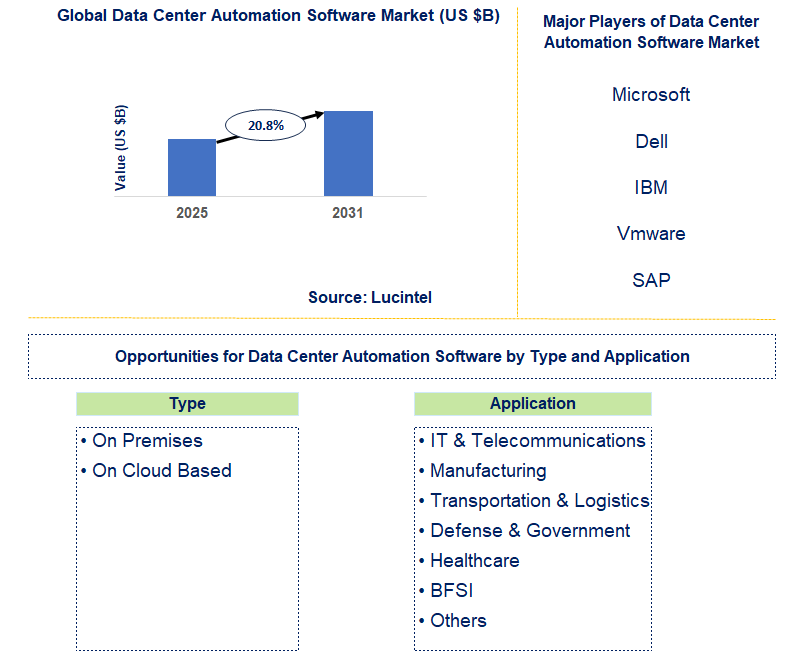
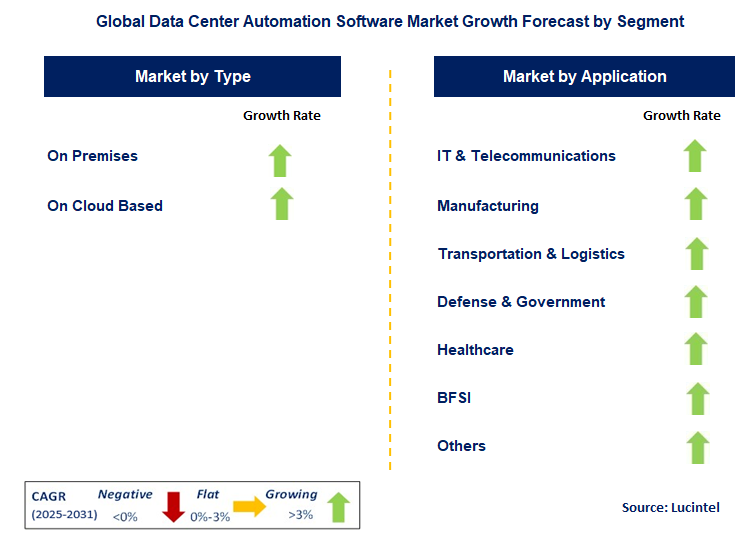
The future of the global data center automation software market looks promising with opportunities in the IT & telecommunication, manufacturing, transportation & logistic, defense & government, healthcare, and BFSI markets. The global data center automation software market is expected to grow with a CAGR of 20.8% from 2025 to 2031. The major drivers for this market are the rising demand for efficiency, the growing adoption of cloud computing, and the increase in data traffic.• Lucintel forecasts that, within the type category, on cloud based is expected to witness higher growth over the forecast period.
• Within the application category, IT & telecommunication is expected to witness the highest growth.
• In terms of region, APAC is expected to witness the highest growth over the forecast period. Gain valuable insights for your business decisions with our comprehensive 150+ page report. Sample figures with some insights are shown below.
Emerging Trends in the Data Center Automation Software Market
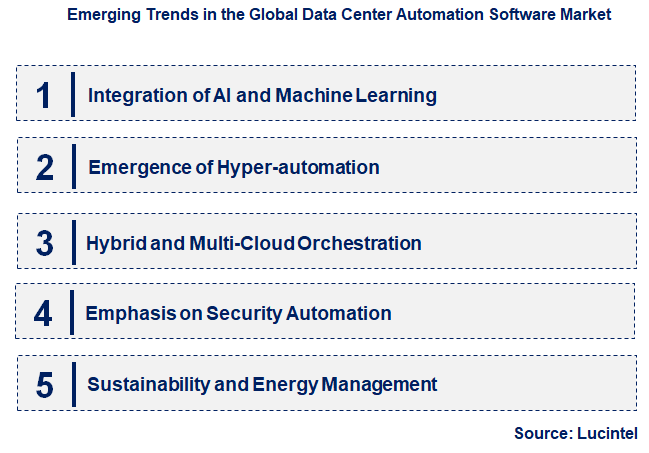
New trends in the data center automation software market are transforming the way that organizations deal with their IT infrastructure, going beyond basic task automation to smart, self-servicing systems. The coming together of artificial intelligence, machine learning, and automation is making data centers more autonomous, predictive, and robust. The transition to hybrid and multi-cloud environments is compelling demands for converged automation platforms that have the ability to manage workloads natively across varied infrastructure seamlessly. Sustainability is also a top priority, with automated software now part of minimizing energy usage.• Integration of AI and Machine Learning: Artificial intelligence and machine learning integration is one of the biggest trends. Automation software is now leveraging AI and ML algorithms to examine huge amounts of operational data, forecast potential failures ahead of time, and take automatic corrective actions. This change from reactive to proactive management reduces downtime, enhances performance, and minimizes manual intervention. AIOps platforms are getting more and more sophisticated, providing deeper insights and automating intricate decision-making, resulting in more efficient and adaptive data center operations.
• Emergence of Hyper-automation: Hyper-automation is a process of automating each and every activity in a data center, from provisioning and configuration management to security and compliance checks. This phenomenon is not limited to single tasks but encompasses the orchestration of entire workflows across multiple systems and domains. It seeks to provide a completely autonomous operational platform, minimizing human error and maximizing speed and efficiency. Hyper-automation is adopted due to the escalating complexity of IT systems and the necessity to manage hugely scaled infrastructure with a minimal workforce.
• Hybrid and Multi-Cloud Orchestration: With organizations moving towards hybrid and multi-cloud models, the need for automation software capable of orchestrating workloads across these heterogeneous environments is increasing. These offerings present a common control plane for managing resources, provisioning applications, and applying policies uniformly across on-premises data centers and multiple public clouds. This trend is helping overcome the complexities of managing distributed, complex infrastructure, portability, and avoiding vendor lock-in, which is a major issue for today's enterprises.
• Emphasis on Security Automation: In the face of increasing cyberattack threats, security automation is a high priority. Software automation is increasingly being employed to regularly scan systems for vulnerabilities, apply security patches automatically, and react to threats in real time. Such proactive measures enable organizations to have a robust security posture and meet regulatory compliances. Security automation is critical in safeguarding sensitive information and guaranteeing the integrity and availability of mission-critical IT services in a rapidly deteriorating cyber environment.
• Sustainability and Energy Management: Sustainability is becoming a more prominent theme. Data center automation software is being utilized to maximize energy consumption and minimize the environmental impact of data centers. These technologies can track power consumption, vary cooling systems, and regulate workloads to optimize energy efficiency. This is a trend that is not just inspired by corporate social responsibility but also by economic advantages of lowering operational expenses. Automation is a critical element in constructing and operating green data centers that are both efficient and sustainable. These new trends are basically transforming the data center automation software market by shifting it toward a smarter, converged, and greener future. The confluence of AI with automation is giving rise to autonomous systems that are capable of operating on their own, and the emphasis on hybrid cloud orchestration and security is meeting the challenge and risk of today's IT infrastructure. The focus on sustainability is turning automation into a critical enabler to reach environmental as well as economic objectives.
Recent Development in the Data Center Automation Software Market
Current trends in the data center automation software industry are focused on improving efficiency, security, and scalability to address the needs of contemporary IT infrastructure. The trend towards self-operation is gaining momentum, with advanced software platforms now responsible for intricate tasks previously executed manually. The industry is witnessing an uptick in partnerships and mergers as organizations look to consolidate their services and offer more holistic solutions. Integration with advanced analytics and predictive functions is a notable development too, which allows data centers to predict and address issues before affecting services.• Emergence of AIOps Platforms: The creation and implementation of AIOps platforms are a significant recent trend. They employ big data and machine learning for automating IT, enabling predictive analytics and intelligent automation. They process data coming from a range of sources, including performance data, log files, and monitoring systems, to identify anomalies, root-cause diagnose, and automate the remedial actions. This evolution is revolutionizing the management of data centers by changing from rule-based, manual automation to more proactive and intelligent means, cutting operations costs substantially and enhancing service reliability.
• Software-Defined Everything (SDX) Integration: The growing convergence of Data Center Automation Software with SDX concepts is a notable evolution. SDX encompasses software-defined storage, networking, and computing, making IT infrastructure manageable and provision able by code instead of manual setup. Automation software now serves as an orchestration layer of the center, automating provisioning and management of all software-defined resources. This evolution simplifies operations, improves agility, and facilitates easier scaling of infrastructure up or down according to varying business demands.
• Greater Security and Compliance Automation: Another important advancement is the integration of security and compliance features within automation software itself. New solutions are engineered to monitor continuously for security weaknesses, impose policies, and create audit trails automatically. This is especially useful for companies with strict regulatory environments. Incorporating security into automation processes guarantees that security controls are properly applied and sustained at all times, minimizing data breaches and guaranteeing compliance with standards such as GDPR and HIPAA.
• Low-Code/No-Code Automation Emergence: There is emergence in the market of low-code and no-code automation platforms. These enable IT professionals, as well as business users, to develop and deploy automation workflows without needing extensive programming expertise. This creates greater expansion of automation use beyond specialized teams and opens up highly effective automation capabilities to wider access. It makes it possible to accelerate development of customized solutions to address specialized needs and enables rapid response to operational issues by organizations.
• Effect of Edge Computing: Edge computing's spread is a new trend that is revolutionizing the market for data center automation. With increasing data processing at or near its point of origin, there is an emerging demand for automation of distributed, edge data centers that are smaller in size. Automation software is increasingly being created to manage the specific issues of edge environments, including restricted connectivity and remote management. This innovation is opening up the possibilities of automation to beyond centralized data centers, bringing new opportunities and demands for providers of software. These innovations are deeply influencing the data center automation software market by making solutions more connected, integrated, and intuitive. The increasing adoption of AIOps and SDX integration is pushing the industry towards programmable and autonomous infrastructure. The emphasis on security and low-code/no-code platforms is increasing adoption and appeal by expanding the reach of automation. The move into edge computing is creating new market opportunities and forcing vendors to develop more flexible and distributed solutions.
Strategic Growth Opportunities in the Data Center Automation Software Market
Strategic opportunities for growth in the data center automation software market are growing as companies aim to harness technology to optimize efficiency, minimize costs, and maximize service delivery. The market is shifting from simple server management to encompassing the automation of networking, storage, and security. The emergence of hybrid and multi-cloud environments, enhanced energy management requirements, and the requirement for smooth integration with contemporary DevOps practices are all developing new growth opportunities. These opportunities are allowing software vendors to provide more focused and high-value solutions to a variety of customers.• Hybrid and Multi-Cloud Automation: A significant growth area is to offer automation products in hybrid and multi-cloud environments. With organizations spreading their workloads across on-premises data centers and multiple public clouds, there is an urgent need for software to offer a single management plane. Products that provide cross-platform orchestration, uniform policy enforcement, and a global view of the entire infrastructure are currently high in demand. This is driven by the necessity for agility, cost savings, and vendor lock-in avoidance.
• DevOps and Continuous Delivery Automation: Bringing data center automation software into DevOps and Continuous Delivery pipelines is a very large growth opportunity. Automation is essential for rapid and frequent application and service deployment. Solutions that enable automation of infrastructure provisioning, configuration, and security tests as part of a continuous integration/continuous delivery pipeline are in great demand. This aligns with the company-wide effort for quicker time-to-market and better collaboration between development and operations.
• Automation of Edge Computing Infrastructure: The explosion of IoT devices and the need for low-latency data processing are fueling the development of edge computing. This presents a new opportunity for data center automation software to control and manage these distributed, frequently unmanned, micro data centers. Solutions will be required to automate functions such as software update, security patching, and remote monitoring within the edge environment. This is a greenfield opportunity for providers to provide lightweight, scalable, and highly resilient automation tooling.
• Energy Management and Sustainability Automation: There is an increasing demand in offering automation software with a focus on energy conservation and sustainability. Data centers consume a large amount of electricity, and companies have been prompted to lower their carbon footprint. Power usage optimization, cooling management, and real-time energy analytics can be offered through automation solutions. This growth field is spurred both by environmental regulations and the need for lowering operational expense, benefiting both the environment and companies in a win-win situation.
• AIOps and Predictive Automation: The transition from reactive to proactive management presents a profitable growth option for AIOps-powered automation. Such platforms scan large volumes of data to anticipate and avoid problems prior to affecting services. Advanced analytics, predictive maintenance, and autonomous issue resolution solutions are on the rise. This opportunity is connected to the need for better service uptime and less manual work, enabling IT organizations to concentrate on strategic projects instead of daily firefighting. These opportunities are changing the data center automation software market by expanding its reach and enhancing its value proposition. The attention is shifting from basic task automation to delivering integrated, intelligent, and application-aware solutions. The transition to hybrid clouds, DevOps, edge computing, and sustainability is increasing the market and opening new revenue streams. These opportunities are stimulating innovation, prompting providers to create more advanced and specialized software that solves the sophisticated issues of today's IT infrastructure.
Data Center Automation Software Market Driver and Challenges
The data center automation software market is influenced by an intricate dynamics of strong drivers and major challenges. The key drivers are driving for aggressive uptake, while the challenges call for innovation and strategic thinking to bridge them. Technology advances, economic pressure, and business agility needs are major drivers. Conversely, complexity in implementation, security requirements, and skill gaps are major challenges. Understanding this dynamic is crucial for businesses and software providers to navigate the market effectively. The factors responsible for driving the data center automation software market include: 1. Growing IT Infrastructure Complexity: The widespread use of virtual servers, cloud infrastructure, and hybrid environments has made the IT landscape extremely complex. Manual management of such infrastructure is no longer possible. Automation software offers the means to orchestrate and manage these heterogeneous systems from a single console, minimizing human error and enhancing operational efficiency. This driver is the underlying cause for the demand for automation solutions. 2. Need for Operational Effectiveness and Cost Savings: Organizations are continually challenged to accomplish more with fewer resources. Data center automation facilitates this by automating simple, mundane, and repetitive tasks, allowing IT personnel to be redirected to more strategic, high-value initiatives. Automation also lowers operational expenses related to labor and potential downtime from human error. This economic driver is a main driver for the business case to implement automation. 3. Cloud Computing Proliferation: The extensive use of public, private, and hybrid clouds has created the need for automation to provision and manage resources natively across these environments. Automation tools play a pivotal role in orchestrating workloads, enforcing consistent policies, and enforcing security within and across cloud boundaries. This driver is closely related to the demand for agile and scalable infrastructure that can support contemporary business applications. 4. Requirement for Quick Time-to-Market: In today's rapid digital economy, companies must roll out new applications and services as quickly as possible. Data center automation, especially when combined with DevOps practices, supports quick and consistent delivery of software. It automates the provisioning of development and testing environments, enabling faster feedback loops and speeding up the entire software development process. This is a key enabler of competitive differentiation. 5. Increased Security and Compliance Needs: With an ever-present danger of cyber threats and more stringent data privacy laws, organizations need to assure their infrastructure is compliant and secure. Automation tools can apply security policies uniformly, patch automatically, and create audit trails. This driver is critical to reducing risk and having confidence with customers and regulators. Challenges in the data center automation software market are: 1. High Upfront Implementation Expenses and Complexity: The cost of initial investment in data center automation software may be high, and the process of implementation can be lengthy and involved. Merging new automation platforms with existing legacy systems, processes, and tools is often a major obstacle. This challenge tends to necessitate a strategic, phased approach and can discourage smaller entities from embracing holistic solutions. 2. Security Issues and Data Privacy Threats: Automation can improve security, but the platforms themselves could be a single point of failure if not secured adequately. A misconfigured automation tool may introduce new vulnerabilities or reveal sensitive information. Moreover, organizations have to make sure that their automation processes meet different data privacy laws, which can be an ever-present and difficult task. 3. Skilled Staff Shortage: There is a huge gap in IT professionals who possess the skills to implement, manage, and optimize contemporary data center automation software. Such a shortage of skills can hinder organizations from realizing the full potential of their automation investment. Reskilling current employees or recruiting new employees with suitable skills is a key challenge that organizations need to overcome to be successful in their automation journey. Overall effect of these drivers and challenges is an evolving dynamic market. The drivers are demanding more automation, more intelligence, and more integration, whereas challenges are compelling providers and customers to be more strategic and more thoughtful in their strategy. Successful market players will be the ones that are able to create solutions that are not only effective and highly capable but also simple to implement and secure. Bridging the skill gap and security issues will prove critical to tapping the markets full potential and fueling the next innovation wave.List of Data Center Automation Software Companies
Companies in the market compete on the basis of product quality offered. Major players in this market focus on expanding their manufacturing facilities, R&D investments, infrastructural development, and leverage integration opportunities across the value chain. With these strategies data center automation software companies cater increasing demand, ensure competitive effectiveness, develop innovative products & technologies, reduce production costs, and expand their customer base. Some of the data center automation software companies profiled in this report include-• Microsoft
• Dell
• IBM
• Vmware
• SAP
• BMC Software
• Hewlett Packard Enterprise
• Red Hat
• Cisco Systems
• Fujitsu Limited
Data Center Automation Software Market by Segment
The study includes a forecast for the global data center automation software market by type, application, and region.Data Center Automation Software Market by Type [Value from 2019 to 2031]:
• On Premises
• On Cloud Based
Data Center Automation Software Market by Application [Value from 2019 to 2031]:
• IT & Telecommunications
• Manufacturing
• Transportation & Logistics
• Defense & Government
• Healthcare
• BFSI
• Others
Data Center Automation Software Market by Region [Value from 2019 to 2031]:
• North America
• Europe
• Asia Pacific
• The Rest of the World
Country Wise Outlook for the Data Center Automation Software Market
Current trends in the data center automation software market are fueled by the growing demand for digital transformation, cloud computing, and the increase of IoT devices. The demand for efficient, scalable, and robust data center operations has pushed automation as a top requirement. This has resulted in the implementation of sophisticated software technologies to address complex, hybrid IT environments. These solutions are increasingly incorporating machine learning and artificial intelligence in order to foresee and avoid problems, streamline resource utilization, and improve security. The industry is seeing tremendous investment and innovation with old tech titans and new start-ups competing for a slice in this fast-growing market.• United States: The American market is dominated by a robust thrust for hyper-automation and AIOps (Artificial Intelligence for IT Operations). Large technology companies and cloud vendors are at the forefront, building in-house solutions and buying up specialized software companies. Hybrid cloud management is gaining attention, with automation software aimed at easily managing workloads across on-premises and various public cloud infrastructures. The emphasis is also placed on beefing up security automation to fight advanced cyberattacks as well as compliance with strict regulations.
• China: Chinas data center automation market is growing explosively, driven by the country's rapid digitalization and government robust support for technology growth. The major trends are the extensive use of automation in hyperscale data centers constructed by hyperscale’s and telecom operators. Chinese companies are creating their own automation platforms, generally with support for local cloud services such as Alibaba Cloud and Tencent Cloud. There is also a heavy emphasis on energy efficiency and green data center strategies, with automation software being the key to maximizing power consumption and cooling.
• Germany: The German market is characterized by a strong emphasis on security, data protection, and compliance, fueled by stringent regulations like GDPR. Adoption of automation software is increasing in industries such as manufacturing and automotive, where organizations are developing smart factories and intelligent car ecosystems. A strong preference for reliable, secure, and highly robust automation solutions is emerging. An increase in partnerships between industrial technology companies and automation software vendors is also observed to provide end-to-end solutions meeting both IT and operational technology requirements.
• India: India's data center automation market is in a phase of fast growth due to the digital India initiative, growing internet penetration, and emergence of local startups. The market is witnessing a strong need for cost-efficient and scalable automation tools. Whereas huge organizations are embracing complete automation suites, small and medium businesses are accepting more modular and flexible tools. The emphasis here is on automating mundane tasks, enhancing operational efficiency, and lessening manual intervention to handle the increasing IT infrastructure complexity.
• Japan: Japan's data center automation market is established but still developing along lines of efficiency and disaster recovery. Because of the vulnerability of the country to natural disasters, there is a high priority given to automation solutions for business continuity and rapid recovery. Japanese firms are also increasingly embracing automation to counteract labor shortages and optimize operations. The market is witnessing growth in AIOps for predictive maintenance and performance enhancement. High reliability and local support from renowned, established vendors is a strong preference.

Features of the Global Data Center Automation Software Market
Market Size Estimates: Data center automation software market size estimation in terms of value ($B). Trend and Forecast Analysis: Market trends (2019 to 2024) and forecast (2025 to 2031) by various segments and regions. Segmentation Analysis: Data center automation software market size by type, application, and region in terms of value ($B). Regional Analysis: Data center automation software market breakdown by North America, Europe, Asia Pacific, and Rest of the World. Growth Opportunities: Analysis of growth opportunities in different types, applications, and regions for the data center automation software market. Strategic Analysis: This includes M&A, new product development, and competitive landscape of the data center automation software market. Analysis of competitive intensity of the industry based on Porter’s Five Forces model.
FAQ
Q1. What is the growth forecast for data center automation software market? Answer: The global data center automation software market is expected to grow with a CAGR of 20.8% from 2025 to 2031. Q2. What are the major drivers influencing the growth of the data center automation software market? Answer: The major drivers for this market are the rising demand for efficiency, the growing adoption of cloud computing, and the increase in data traffic. Q3. What are the major segments for data center automation software market? Answer: The future of the data center automation software market looks promising with opportunities in the IT & telecommunication, manufacturing, transportation & logistic, defense & government, healthcare, and BFSI markets. Q4. Who are the key data center automation software market companies? Answer: Some of the key data center automation software companies are as follows:• Microsoft
• Dell
• IBM
• Vmware
• SAP
• BMC Software
• Hewlett Packard Enterprise
• Red Hat
• Cisco Systems
• Fujitsu Limited Q5. Which data center automation software market segment will be the largest in future? Answer: Lucintel forecasts that, within the type category, on cloud based is expected to witness higher growth over the forecast period. Q6. In data center automation software market, which region is expected to be the largest in next 5 years? Answer: In terms of region, APAC is expected to witness the highest growth over the forecast period. Q7. Do we receive customization in this report? Answer: Yes, Lucintel provides 10% customization without any additional cost.
Table of Contents
List of Figures
List of Tables
Methodology
- In-depth interviews of the major players in this market
- Detailed secondary research from competitors’ financial statements and published data
- Extensive searches of published works, market, and database information pertaining to industry news, company press releases, and customer intentions
- A compilation of the experiences, judgments, and insights of Lucintel’s professionals, who have analyzed and tracked this market over the years.


Buy Now
Choose a license that fits your team. Instant PDF delivery.
Prices exclude taxes. Instant delivery. Custom licensing available on request.
Key Questions
- • What are some of the most promising, high-growth opportunities for the data center automation software market by type (on premises and on cloud based), application (IT & telecommunications, manufacturing, transportation & logistics, defense & government, healthcare, BFSI, and others), and region (North America, Europe, Asia Pacific, and the Rest of the World)?
- • Which segments will grow at a faster pace and why?
- • Which region will grow at a faster pace and why?
- • What are the key factors affecting market dynamics? What are the key challenges and business risks in this market?
- • What are the business risks and competitive threats in this market?
- • What are the emerging trends in this market and the reasons behind them?
- • What are some of the changing demands of customers in the market?
- • What are the new developments in the market? Which companies are leading these developments?
- • Who are the major players in this market? What strategic initiatives are key players pursuing for business growth?
- • What are some of the competing products in this market and how big of a threat do they pose for loss of market share by material or product substitution?
- • What M&A activity has occurred in the last 5 years and what has its impact been on the industry? For any questions related to Data Center Automation Software Market, Data Center Automation Software Market Size, Data Center Automation Software Market Growth, Data Center Automation Software Market Analysis, Data Center Automation Software Market Report, Data Center Automation Software Market Share, Data Center Automation Software Market Trends, Data Center Automation Software Market Forecast, Data Center Automation Software Companies, write Lucintel analyst at email: helpdesk@lucintel.com. We will be glad to get back to you soon.


