
Market Report · July 22, 2026

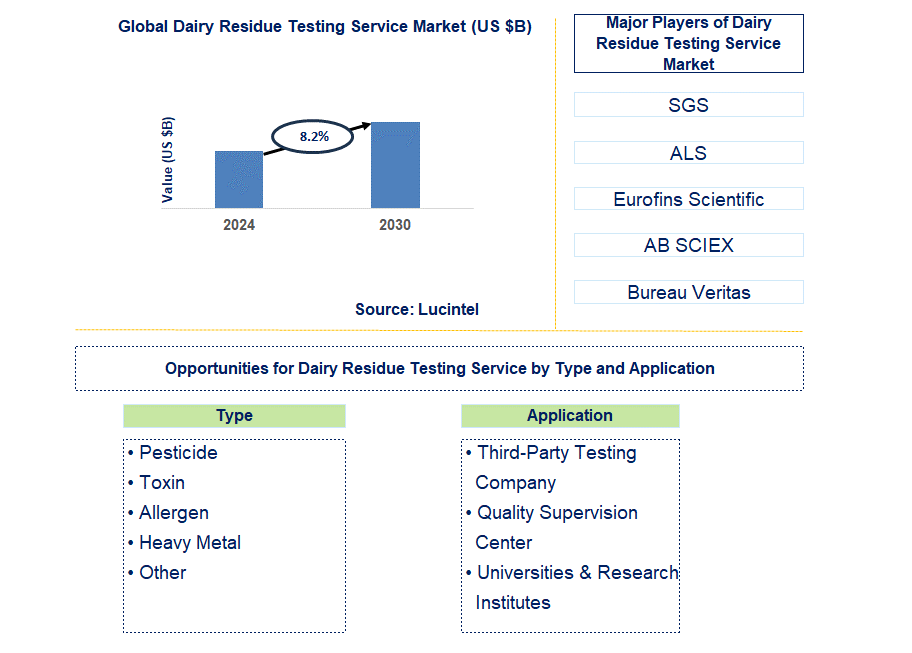
Key data points: The growth forecast = 8.2% annually for the next 6 years. Scroll below to get more insights. This market report covers trends, opportunities, and forecast in the global dairy residue testing service market to 2030 by type (pesticide, toxin, allergen, heavy metal, and other), application (third-party testing company, universities & research institutes, and quality supervision center), and region (North America, Europe, Asia Pacific, and the Rest of the World)
We'll send your sample report shortly.
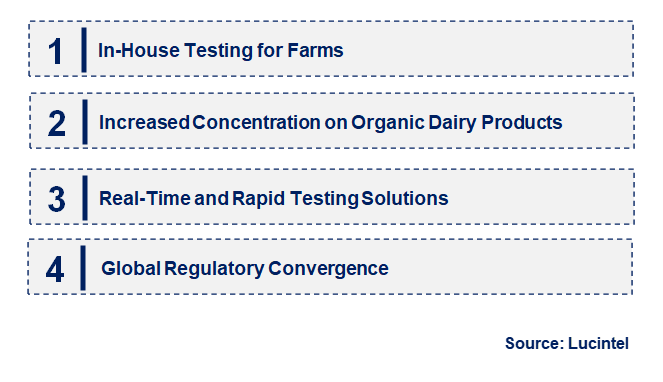
• In-House Testing for Farms: Increasingly, more dairy farms are purchasing in-house testing equipment for regulatory compliance purposes and to avoid fines. This trend is particularly strong in areas such as the U.S. and Europe, which are seeking to achieve stricter residue-free requirements.
• Increased Concentration on Organic Dairy Products: There is a growing market for organic dairy products, which brings about the need for stricter residue assessment. Manufacturers of organic dairy products are assuring consumers that they do not include synthetic hormones and antibiotics, thus creating a demand for testing services.
• Real-Time and Rapid Testing Solutions: In response to this need, manufacturers are advancing toward real-time testing solutions that can provide results in a matter of minutes. The demand is high in countries such as China and India, where speedy testing can avert health hazards and prevent the removal of products from the market.
• Global Regulatory Convergence: There is increasing synchrony in dairy residue testing practices across various regions due to the introduction of stricter regulatory laws and trade agreements. This situation places a burden on dairy producers and testing services to adopt testing methods that conform to both local and international standards, as countries increasingly embrace homogeneous standards for residue testing. These new trends, such as high returns on investment for better testing services, are related to meeting consumer needs for safe dairy products and adhering to international best practices. Previously, this method was relatively costly, and implementing change took time, but growing pressures for real-time testing and advancing technology, along with increasing regulatory demands, have made dairy products safer for consumers.
• Adoption of Advanced Testing Technologies: Technologies such as BD tests and LC-MS allow for faster and more precise residue tests. These technologies enable laboratories to perform deep screenings for various antibiotic and pesticide residues in dairy products.
• Widely Efficient Regulatory Mechanisms: Regulatory authorities in various parts of the world, especially in the U.S. and China, have set lower residue limits for milk and milk products. Such policies compel dairy marketers to enhance their testing services to satisfy regulations and meet consumer needs.
• Expansion of Third-Party Testing: Both consumers and dairy producers are increasingly willing to use third-party testing services to ensure the safety of their products. This trend is particularly strong in Europe and North America, where products are subjected to stringent regulatory measures.
• Increased Investment in In-House Testing: Within dairy farms, practitioners are installing in-house residue testing equipment to quickly address noncompliance regulatory issues. This trend is increasing in the U.S. and European markets due to the high demand for speedy turnaround.
• Geographic Spread of Testing Services to Emerging Markets: The rising demand for dairy products in developing economies, particularly India and China, is contributing to the growth of service providers in these regions. The construction of modern laboratories and the purchase of testing devices are helping these countries achieve global safety benchmarks for dairy products. Establishments such as regulatory and technological improvements have greatly encouraged growth in the dairy residue testing services market over the past few years, especially in developed and developing economies. Companies are committing significant resources to these developments to protect end users and remain relevant in the evolving global market.
• Expansion of In-House Testing Services: The increasing adoption of in-house testing technologies by dairy producers enables rapid adherence to regulations. This creates opportunities for testing service providers to design simple, portable testing equipment suitable for use on farms and in processing facilities.
• Third-Party Testing for Global Compliance: Third-party testing laboratories have opportunities for expansion by providing services that enable dairy producers to meet international quality and safety requirements for their products. This is critical for producers needing to export dairy goods to regions like the EU and U.S.
• Emerging Market Expansion: Due to rising dairy consumption in India and China, testing service providers have a chance to penetrate these markets. Adapting testing facilities to meet local standards presents an opportunity for growth.
• Organic and Specialty Dairy Testing: As consumers demand more organic and specialty dairy products, there is a need to enhance specialized residue testing. Firms can meet this demand by providing specifically designed tests for organic dairy products.
• Technological Solutions for Real-Time Testing: There is significant potential for growth for companies that invest in rapid and real-time testing technologies in the dairy industry. Any company that manufactures quicker and more efficient testing tools will undoubtedly meet the rising demand for rapid and precise results. These strategic growth opportunities exemplify trends in the dairy residue testing service market. We have seen successful approaches that identify new markets, organic testing, and innovative technologies in this dynamic and competitive landscape.
• Stringent Regulatory Standards: Stricter regulations, particularly in the United States, Europe, and China, compel dairy producers to invest in residue testing services to adhere to regulations and avoid penalties, thereby increasing market potential for advanced testing solutions.
• Consumer Demand for Safe Dairy Products: As consumers become more conscious of food safety concerns, the demand for residue-free dairy products has greatly increased. This demand is met through more sophisticated solutions and services provided by testing service providers.
• Technological Advancements: Innovations in LC-MS/MS testing technologies and the introduction of rapid biosensors are increasing the speed of residue detection. This advancement drives market growth by enhancing consumer satisfaction and trust through quick and accurate results.
• Growth in Dairy Consumption in Emerging Markets: Increased dairy consumption in China, India, and other emerging countries stimulates the market for residue testing. Companies are broadening their services in these regions to address local and foreign safety regulations.
• Pressure to Maintain Export Standards: With the growing global market for dairy products, producers are under pressure to comply with international quality standards. Testing services are vital for ensuring adherence to these standards. Challenges in the dairy residue testing service market include:
• High Testing Costs: Advanced testing technologies can be costly, presenting a barrier for small and medium-sized dairy producers. The high costs of specialized equipment and reagents may limit market accessibility for some producers.
• Differences in Regulatory Compliance: Variability in residue tolerance levels across countries presents challenges for many international producers. This inconsistency complicates achieving uniformity in testing services across different jurisdictions.
• Inability to Reach Remote Regions Due to Testing Facility Locations: In some underdeveloped regions, advanced testing laboratories are scarce. This lack of access can hinder efforts to ensure that dairy products are entirely free from residue. Companies need to develop effective logistics strategies to overcome these challenges. The trends of stringent regulations, increased consumer awareness, and the availability of advanced technologies are propelling growth in the dairy residue testing service market. However, challenges such as high testing costs, inconsistent regulations, and lack of service in remote areas must be addressed. Businesses that navigate these challenges while capitalizing on growth opportunities will perform better in the evolving competitive landscape.
• SGS
• ALS
• Eurofins Scientific
• AB SCIEX
• Bureau Veritas
• Intertek
• Arbro Pharmaceuticals
• Fera Science
• AGQ Labs
• Waters Agricultural Laboratories
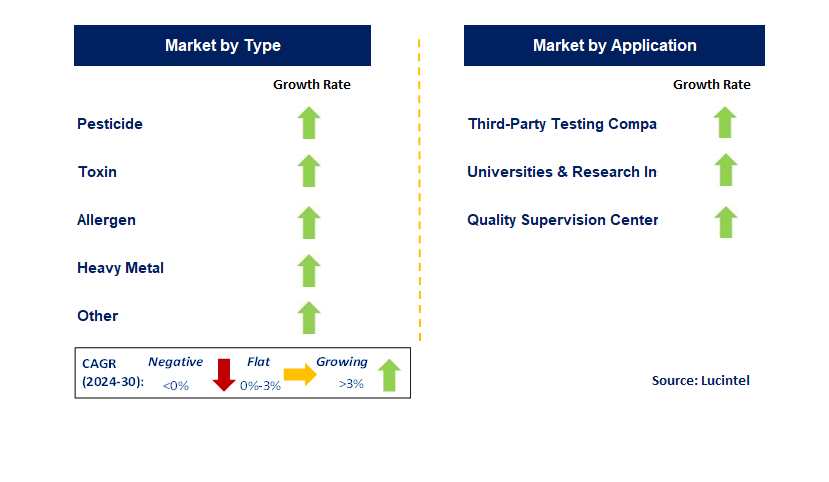
• Pesticide
• Toxin
• Allergen
• Heavy Metal
• Other
• Third-Party Testing Company
• Universities & Research Institutes
• Quality Supervision Center
• North America
• Europe
• Asia Pacific
• The Rest of the World
• United States: In the U.S., factors such as growing awareness of food safety and increasing FDA regulations are driving the growth of the dairy residue testing service market. Additionally, most laboratories are incorporating advanced testing methods like liquid chromatography-mass spectrometry (LC-MS) for detecting these residues. The rise in meat consumption has heightened the demand for thorough laboratory tests in both mainstream and specialty markets. Furthermore, compliance with regulations has led dairy farmers to conduct internal residue analyses.
• China: China’s dairy residue testing service market is expanding rapidly due to food safety concerns and government initiatives to introduce new food safety regulations. Chinese officials are focusing on tracking antibiotics, hormones, and heavy metals in dairy products. The increasing importation of dairy products and growing consumer education are driving dairy farms and companies to seek broader testing services. Additionally, there is a growing adoption of real-time testing technologies within the industry.
• Germany: Germany’s market for testing dairy products for residues is bolstered by the need to comply with stringent European Union regulations and meet consumer demand for high-quality, contaminant-free products. Advanced testing technologies such as ELISA and high-pressure liquid chromatography (HPLC) are commonly used to detect harmful residues. The shift toward more organic and sustainable dairy farming practices is also prompting more frequent testing. Furthermore, partnerships between private laboratories and dairy manufacturing entities are on the rise.
• India: In India, the dairy residue testing service market is on the rise due to increasing demand for food safety, driven by consumer concerns about the presence of residues in food. The Food Safety and Standards Authority of India (FSSAI) has intensified efforts against the use of antibiotics and other harmful substances. More testing laboratories are adopting advanced technologies like polymerase chain reaction (PCR) for rapid detection, with significant investment in upgrading facilities to meet international standards.
• Japan: Japan's dairy residue testing service market is technologically advanced and operates under stringent legal requirements. To meet the growing consumer demand for safe, high-quality dairy products, Japanese manufacturers are investing heavily in complex testing instruments such as mass spectrometers and chromatographs. The focus on consumer health and food safety, along with the desire to achieve international standards, has also contributed to market growth. Additionally, there is an increasing shift among Japanese consumers toward organic and traceable products, creating further demand for testing services.


• SGS
• ALS
• Eurofins Scientific
• AB SCIEX
• Bureau Veritas
• Intertek
• Arbro Pharmaceuticals
• Fera Science
• AGQ Labs
• Waters Agricultural Laboratories Q5. Which dairy residue testing service market segment will be the largest in the future? Answer: Lucintel forecasts that pesticide is expected to witness the highest growth over the forecast period. Q6. In the dairy residue testing service market, which region is expected to be the largest in the next 5 years? Answer: North America is expected to witness the highest growth over the forecast period. Q.7 Do we receive customization in this report? Answer: Yes, Lucintel provides 10% customization without any additional cost.


Choose a license that fits your team. Instant PDF delivery.
Prices exclude taxes. Instant delivery. Custom licensing available on request.
Market Report · July 22, 2026
Market Report · July 16, 2026
Market Report · May 18, 2026
Trusted partner for strategic intelligence and business growth


Receive a complimentary market analysis tailored to your industry. Our analysts will identify key growth opportunities and competitive dynamics specific to your business.

Market size, growth rate, and key trend analysis for your specific sector.

Top competitor positioning and market share analysis.

Strategic recommendations backed by data-driven insights.
Get curated market intelligence and competitive moves straight to your inbox.
By subscribing, you agree to receive our monthly insights. Unsubscribe anytime.
Receive a complimentary market analysis tailored to your industry. Our analysts will identify key growth opportunities and competitive dynamics specific to your business.
Market size, growth rate, and key trend analysis for your specific sector.
Top competitor positioning and market share analysis.
Strategic recommendations backed by data-driven insights.
Get curated market intelligence, emerging trends, and competitive moves straight to your inbox each month.
By subscribing, you agree to receive our monthly insights. Unsubscribe anytime.
We'll send your sample report shortly.