
Market Report · July 16, 2026

Trends, opportunity and forecast in cyber risk service market to 2031 by type (risk assessment & analysis, security testing & validation, and others), application (enterprises, government & institutions, individuals, and others), and region (North America, Europe, Asia Pacific, and the Rest of the World)
We'll send your sample report shortly.
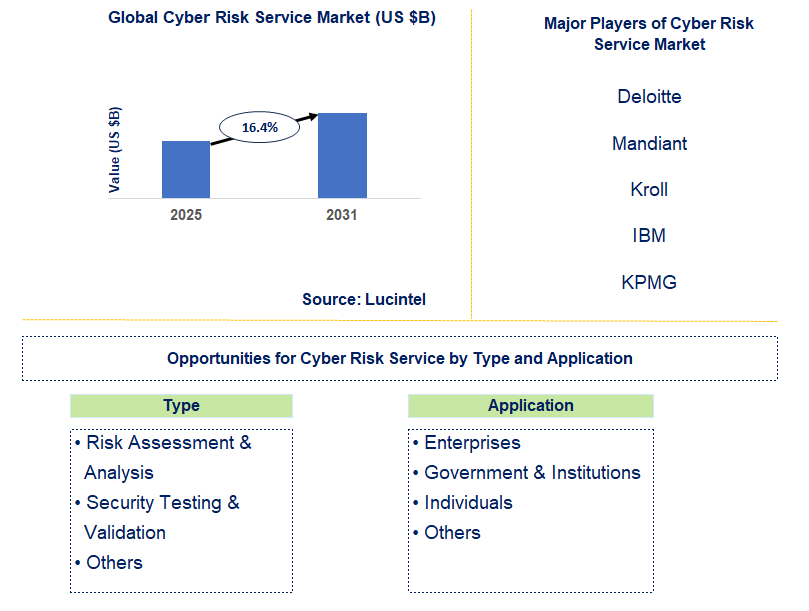
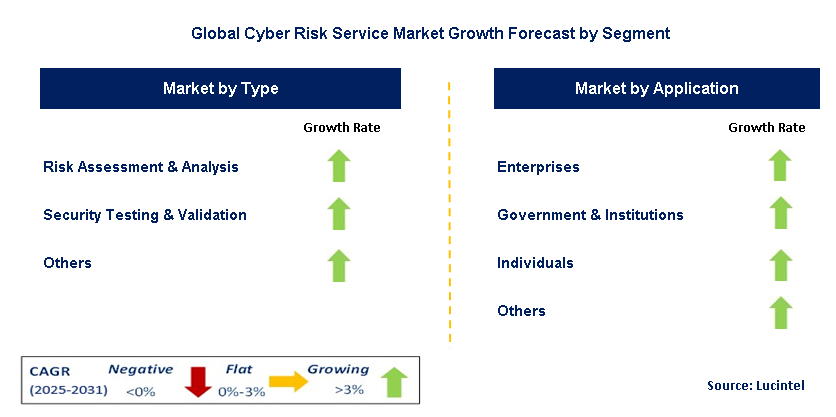
• Lucintel forecasts that risk assessment & analysis is expected to witness higher growth over the forecast period due to its critical role in identifying vulnerabilities, ensuring compliance, and enabling strategic decisions.
• Within this market, enterprise is expected to witness the highest growth due to the complex, high-stakes nature of their cybersecurity needs.
• North America is expected to witness the highest growth over the forecast period due to its high exposure to cyber threats, strong regulatory requirements, and the presence of major technologies.
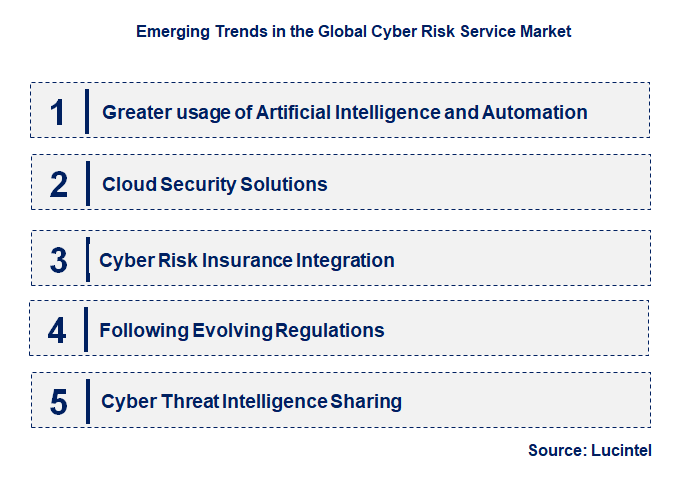
• Greater usage of Artificial Intelligence and Automation: Artificial intelligence is becoming more dominant in the cyber risk service market as well, where AI technologies are used for threat detection, analysis, and response, meaning vulnerabilities can be identified quickly, and possible threats acknowledged. Automation improves management efficiency regarding cyber risks so that organizations respond to incidents faster and even better than they did without such automation, and this integration of AI with cyber risk services helps businesses reduce the number of manual interventions that could lead to security breaches.
• Cloud Security Solutions: With greater numbers of organizations migrating to the cloud, the demand for cloud-based cybersecurity services has increased extensively. Cloud security services that relate to risk assessment, data protection, and threat monitoring have become a must-have for businesses seeking the security of their cloud environments. With the increasing reliance on the cloud infrastructure for storing data and hosting applications, cloud security solutions constitute an integral part of the cybersecurity policy. Providers are focusing on offering services that help businesses mitigate cloud-specific risks such as data breaches and unauthorized access.
• Cyber Risk Insurance Integration: Cyber risk insurance is becoming a growing trend in the market as companies seek ways to mitigate financial losses from cyber incidents. Cyber risk service providers are increasingly offering integrated services that include insurance solutions. This enables businesses to not only manage risks proactively but also protect themselves financially in the event of a cyberattack or data breach. The linking of cyber insurance with cybersecurity services provides a holistic approach toward managing and mitigating cyber risks.
• Following Evolving Regulations: Growing scrutiny over data privacy and security makes businesses more responsive to regulations that are very strict, such as the General Data Protection Regulation (GDPR) in Europe, China's Cybersecurity Law, and India's Personal Data Protection Bill. These companies help clients deal with complicated regulatory environments through compliance assessments, gap analysis, and solutions suited to local and international requirements. As regulatory frameworks continue to evolve, companies are increasingly using these services to ensure they are compliant and avoid costly penalties.
• Cyber Threat Intelligence Sharing: Cyber threats increasingly sophisticated and enterprises are embracing threat intelligence sharing across cyber domains and business strategies; this helps create an open community where the entire industry collaborates with government bodies and other third parties to source emerging threats thus improving defense strategies. Cyber Risk Service Providers share threat intelligence: Cyber risk service providers have led the sharing process of threat intelligence, and from this process of sharing threat information, businesses ensure they remain advanced in front of cyber criminals since they have boosted their detection skills and prevention levels. Emerging trends on the cyber risk service market indicate the introduction of new technologies, strategies, and collaborative efforts. Given that the threats in business concerns are becoming more complex and constantly evolving, there will be an increased need to have enhanced cybersecurity solutions. The above trends point toward a more holistic approach that is proactively integrated and AI-powered in handling cyber risks.
• Move Towards Proactive Risk Management: Many of the firms are shifting from reactive measures in cybersecurity to a more proactive approach. Increasing sophistication in cyber threats is making traditional responses of pure reactiveness far less effective. The services of cyber risk providers are offering solutions through which organizations can identify and mitigate risks before they result in a breach or attack. This includes proactive aspects such as continuous monitoring, vulnerability assessment, and threat intelligence services.
• Increased Focus on Data Privacy and Protection: Data privacy has emerged as a critical concern for companies due to regulatory requirements such as the GDPR and CCPA in California, imposing stringent demands on how companies treat personal data. Cyber risk service providers are more focused on solutions for data protection, including encryption, secure storage of data, and privacy assessments. With businesses looking to secure customer information, the need for such services is increasing especially in industries dealing with sensitive information such as healthcare and finance.
• Increasing Demand for Incident Response and Recovery Services: Cyberattacks, especially ransomware and data breaches, are growing more common and creating a new demand for incident response and recovery services. The capabilities of the cyber risk service providers are enhancing their ability to help organizations recover quickly from a cyber incident. The services comprise incident management, forensic investigations, and recovery strategies that can mitigate the financial and reputational implications of cyberattacks.
• Collaboration Between Public and Private Sectors: There are growing collaborations between governments and private sector companies about cyber risks. Public-private partnerships are becoming very common because often, cyber threats are too huge and complex to be handled alone by any particular entity. These service providers enable such collaboration in the form of services that assist government initiatives, align with a public-sector approach to cybersecurity strategy, and facilitate the creation of a more resilient cybersecurity ecosystem.
• Emerging Threats and New Attack Vectors: For example, new emerging technologies like Internet of Things, artificial intelligence, and 5G networks increase new attack avenues that the providers of cyber risk services need to address. It is through cybercrime that will target such developing technologies, the need for bespoke risk management will be experienced towards the specific weaknesses associated with those technologies. Adaptation in this regard means adjustment of service by providers in regard to challenges which these new technologies pose in securing businesses from newer threats. These are the key trends that indicate how the cyber risk service market is changing. Cyber threats are gradually becoming more sophisticated, and the regulatory demands intensify; companies opt for sophisticated and integrated cybersecurity services to protect their data and infrastructure. Evolving needs of the market are more proactive in terms of risk management, data protection, and incident response.
• Financial Services and Banking: The financial industry always remains a sought-after target as the data and financial assets involved are sensitive. Cyber risk service providers start tailoring solutions for financial institutions, from risk assessments and compliance support to fraud detection. As financial services move toward digital transformation, so will the demand for advanced cybersecurity solutions.
• Healthcare Sector: The healthcare industry has increasingly experienced risks from cybersecurity as more healthcare services shift toward the use of EHRs and connected medical devices. Cyber risk service providers assist healthcare organizations to safeguard their patients' confidential data, be HIPAA compliant, and create effective risk management systems that guard against ransomware attacks and other forms of cyberattacks.
• Critical Infrastructure Protection: Governments and private sector organizations are now focusing on securing critical infrastructure like energy, water, and transportation systems from cyber threats. Cyber risk service providers are offering solutions to help protect these vital systems from attacks that could disrupt public services or cause widespread damage. The demand for these services is expected to increase as global threats to critical infrastructure increase.
• Retail and E-commerce: The growth of online shopping has exposed the retail and e-commerce sectors to cyber threats such as payment fraud and data breaches. Cyber risk service providers offer services like secure payment solutions, customer data protection, and vulnerability assessments that can help retailers secure their online platforms and customer information.
• Government and Public Sector: Governments and public sector organizations are the significant consumers of cyber risk services. This is due to the rise in cyberattacks on government infrastructure. Providers offer cybersecurity solutions that support national security objectives, secure government data, and protect critical public services from cyber threats. The need for these services is growing as governments increase their focus on cybersecurity. This provides strategic growth opportunities, showing a wide range of applications where there is a need for cyber risk services. There are financial institutions, healthcare and government organizations, and other businesses that increasingly need specialized cybersecurity services to protect assets, data, and infrastructure. The market grows as new threats emerge, making it a significant wealth of opportunity for providers looking to meet this growing demand for cyber risk services.
• Deloitte
• Mandiant
• Kroll
• IBM
• KPMG
• Accenture
• Arise Security
• Grant Thornton
• C-Risk
• Marsh
• Risk Assessment and Analysis
• Security Testing and Validation
• Others
• Enterprises
• Government and Institutions
• Individuals
• Others
• North America
• Europe
• Asia Pacific
• The Rest of the World
• United States: The United States has witnessed rapid growth in the cyber risk service market due to high-profile cyberattacks and the increasing complexity of cyber threats. The U.S. government continues to invest significantly in cybersecurity efforts through initiatives like the Cybersecurity and Infrastructure Security Agency (CISA). The private sector remains proactive in taking advanced security services such as threat intelligence, vulnerability assessments, and incident response. Competition in the U.S. market is strong with large firms, as well as specialized service providers, which can offer businesses of all sizes a wide array of solutions.
• China: China's cyber risk service market has grown with the need to safeguard the nation's burgeoning electronic economy and to offer protection against emerging cyber threats. The Chinese government is taking further measures to strengthen its Internet security posture as reflected in its stringent policies, such as the Cybersecurity Law, which requires companies to protect data and their systems. Most Chinese firms are now seeking local service providers to handle cybersecurity, including risk assessments and data protection. Investment in AI and quantum computing for advanced threat detection and prevention is also driven by the government.
• Germany: The German cyber risk service market is growing fast, with its developed industrial base and the rapid digitalization of companies. Germany's government has also been engaged in enhancing its cybersecurity through policy such as the IT Security Act, which demands that critical infrastructure have proper security measures in place. Companies operating in manufacturing, banking, and telecom sectors require risk management and compliance solutions through cybersecurity providers. Advanced cyber threats will force German firms to adopt more proactive measures regarding cybersecurity. They will use assessments of vulnerabilities and penetration testing in this regard.
• India: India's market for cyber risk service is expanding, as businesses begin to shift business operations towards more digital platforms. The Indian government has identified cybersecurity as an imperative national need. Companies have started investing in cyber security services to meet growing regulations, including the Personal Data Protection Bill. Going by increasing cybercrime and growing threats of breaches of sensitive data, Indian companies are increasingly seeking the help of cyber risk service providers to secure their network capabilities, analyze risks, and provide solutions for defense. SMEs are also getting educated about the fact that they need strong cybersecurity services.
• Japan: The cyber risk service market is growing as Japan continues to strengthen its digital security, especially now that it hosted the 2020 Olympic Games, which made the country realize how important robust cyber defenses were. The government of Japan initiated such efforts as the Cybersecurity Strategy to protect critical infrastructure. The growing threat in the private sector is employing cybersecurity services, including threat monitoring and risk assessments, to prepare themselves against data breaches, cyberattacks, and ransomware. Japanese organizations are also considering using advanced technologies, such as AI and blockchain, to strengthen cybersecurity and develop better risk management capabilities.


• Deloitte
• Mandiant
• Kroll
• IBM
• KPMG
• Accenture
• Arise Security
• Grant Thornton
• C-Risk
• Marsh Q5. Which cyber risk service market segment will be the largest in future? Answer: Lucintel forecasts that risk assessment & analysis is expected to witness higher growth over the forecast period due to its critical role in identifying vulnerabilities, ensuring compliance, and enabling strategic decisions. Q6. In cyber risk service market, which region is expected to be the largest in next 5 years? Answer: North America is expected to witness the highest growth over the forecast period due to its high exposure to cyber threats, strong regulatory requirements, and the presence of major technologies. Q7. Do we receive customization in this report? Answer: Yes, Lucintel provides 10% customization without any additional cost.


Choose a license that fits your team. Instant PDF delivery.
Prices exclude taxes. Instant delivery. Custom licensing available on request.
Market Report · July 16, 2026
Market Report · May 18, 2026
Market Report · May 18, 2026
Trusted partner for strategic intelligence and business growth


Receive a complimentary market analysis tailored to your industry. Our analysts will identify key growth opportunities and competitive dynamics specific to your business.

Market size, growth rate, and key trend analysis for your specific sector.

Top competitor positioning and market share analysis.

Strategic recommendations backed by data-driven insights.
Get curated market intelligence and competitive moves straight to your inbox.
By subscribing, you agree to receive our monthly insights. Unsubscribe anytime.
Receive a complimentary market analysis tailored to your industry. Our analysts will identify key growth opportunities and competitive dynamics specific to your business.
Market size, growth rate, and key trend analysis for your specific sector.
Top competitor positioning and market share analysis.
Strategic recommendations backed by data-driven insights.
Get curated market intelligence, emerging trends, and competitive moves straight to your inbox each month.
By subscribing, you agree to receive our monthly insights. Unsubscribe anytime.
We'll send your sample report shortly.