
Market Report · July 20, 2026

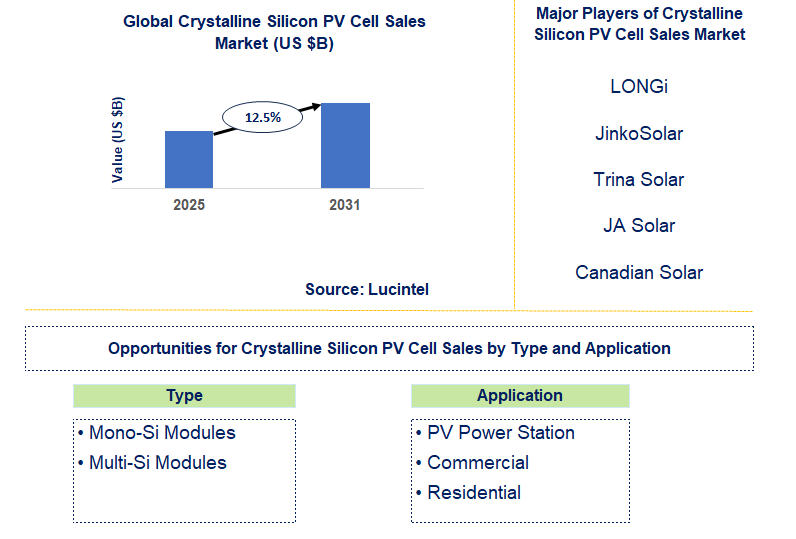
Key data points: The growth forecast = 12.5% annually for the next 7 years. Scroll below to get more insights. This market report covers Trends, opportunities and forecasts in crystalline silicon PV cell sales market to 2031 by type (mono-si modules and multi-si modules), application (PV power station, commercial, and residential), and region (North America, Europe, Asia Pacific, and the Rest of the World)
We'll send your sample report shortly.
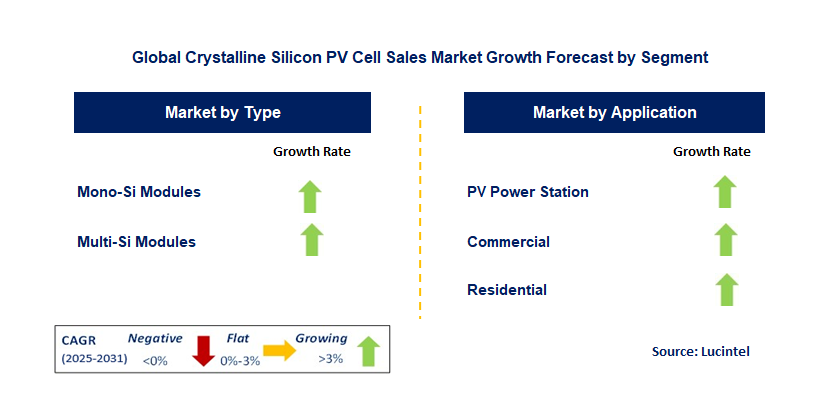
• Lucintel forecasts that, within the type category, mono-si module is expected to witness higher growth over the forecast period.
• Within the application category, residential is expected to witness the highest growth.
• In terms of region, APAC is expected to witness the highest growth over the forecast period.
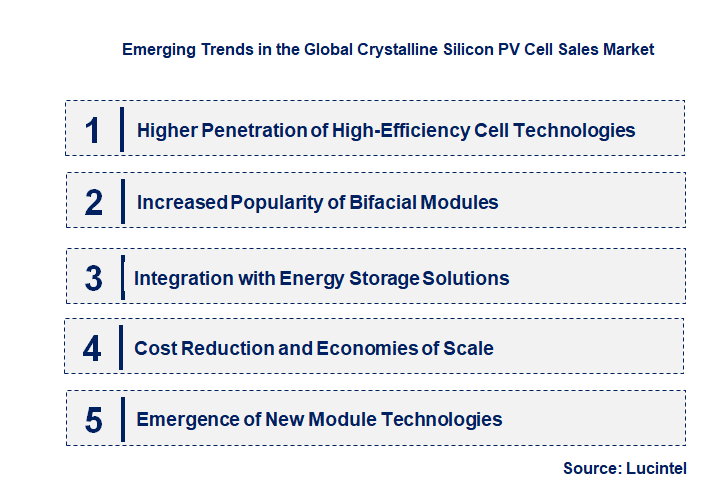
• Higher Penetration of High-Efficiency Cell Technologies: There is widespread adoption in the direction of high-efficiency crystalline silicon cell technologies like PERC (Passivated Emitter Rear Contact), TOPCon (Tunnel Oxide Passivated Contact), and IBC (Interdigitated Back Contact) technology. All these technologies deliver increased conversion efficiency, translating to increased power output per module as well as less expensive system cost. This phenomenon affects the market of sales by propelling the demand for enhanced cell types.
• Increased Popularity of Bifacial Modules: Bifacial solar modules, which have the ability to produce electricity from both the front and back surfaces, are becoming increasingly popular. This development raises the overall energy output of PV systems, particularly for ground-mounted and elevated structures. The sales market is experiencing increased demand for these modules as a result of their increased energy production capacity.
• Integration with Energy Storage Solutions: Increased penetrations of energy storage systems, both utility and residential, are impacting the PV cell sales market. Advanced PV systems in combination with batteries need to be provided with secure and efficient cell for optimized energy harvesting and storage. This integration opens new market opportunities for optimized PV-plus-storage solutions.
• Cost Reduction and Economies of Scale: Ongoing pressure to lower the cost of solar electricity is compelling manufacturers to concentrate on mass production and further process optimization. This trend results in decreasing prices for crystalline silicon PV cell, making solar energy more competitive with conventional energy sources and increasing market penetration.
• Emergence of New Module Technologies: Advances in module technologies, including half-cut cell, multi-busbar technology, and increased wafer sizes, are enhancing module efficiency, reliability, and power. These developments indirectly influence the market for cell sales by creating a demand for cell to fit into these next-generation module configurations. All these new trends are playing an important role in transforming the market for crystalline silicon PV cell sales. Greater emphasis on improved efficiency, bifaciality, storage integration, reduced costs, and next-generation module technologies is pushing innovation and broadening applications for solar power, eventually toward a more competitive and universal crystalline silicon PV.
• Large Wafer Size Adoption Across the Industry: One major trend is the industry-wide adoption of larger silicon wafer sizes (e.g., M10, G12). Larger wafers enable the manufacture of more efficient solar cell and modules, resulting in reduced system costs per watt and higher manufacturing efficiency. This trend is affecting cell sales volumes and equipment investments in manufacturing.
• Mass Production of N-type TOPCon Cell: The shift from P-type PERC cell to N-type TOPCon (Tunnel Oxide Passivated Contact) cell is a crucial advancement. TOPCon technology is more efficient and has lower degradation rates than PERC, leading to high demand for such advanced cell in high-performance segments. This change is impacting market share and roadmaps.
• Increased Automation and Digitalization in Manufacturing: In order to further decrease costs and enhance quality, manufacturers are increasingly using advanced automation and digitalization in their PV cell manufacturing lines. This involves robotics, AI-driven quality control, and process management optimization, affecting production efficiency and cell pricing.
• Emergence of Advanced Interconnection Technologies: Technological advancements in cell interconnection technologies, like shingling and multi-busbar concepts, are enhancing module efficiency and reliability by minimizing electrical losses and maximizing the active area of the module. These developments affect the specifications and performance requirements of the cell that are being traded.
• Increasing Interest in Sustainability and Circular Economy: There is a growing focus on the sustainability dimensions of PV cell manufacturing, such as energy consumption reduction, waste minimization, and end-of-life module recycling processes. This trend is impacting material selection and manufacturing practices in the market for cell sales. These are the most important developments that are substantially affecting the sales market of crystalline silicon PV cell by stimulating technological innovation, enhancing manufacturing productivity, and mitigating sustainability issues. Emphasis on larger wafers, N-type technologies, automation, advanced interconnections, and circular economy initiatives is giving rise to more efficient, affordable, and eco-friendly solar energy solutions.
• Residential Rooftop Solar: The rising use of rooftop solar systems for residential buildings is a substantial growth prospect. Decreasing system prices, government stimulus, and increasing environmental consciousness are fueling demand for high-efficiency and visually appealing crystalline silicon PV modules, which call for high-quality cell.
• Commercial and Industrial (C&I) Solar: Industries and companies are increasingly turning to solar power to minimize operating expenses and achieve sustainability targets. This segment presents opportunities for high-power crystalline silicon PV systems for rooftop, carport, and ground-mounted applications, requiring dependable and affordable cell.
• Utility-Scale Solar Farms: Large solar power plants are a key driver of demand for crystalline silicon PV cell. The construction of huge solar farms around the world to achieve renewable energy goals provides huge opportunities for high-volume sales of efficient and cost-competitive cell.
• Building-Integrated Photovoltaics (BIPV): Incorporating PV cell into building materials themselves (e.g., windows, facades, roofs) is an emerging trend. Specialized crystalline silicon cell are needed for this application that can be integrated into construction components and provide both energy production and architectural purpose.
• Off-Grid and Rural Electrification: Crystalline silicon PV systems play a significant role in supplying electricity to off-grid and remote areas, especially in developing nations. This use presents opportunities for inexpensive and long-lasting solar cell for stand-alone power systems, mini-grids, and solar home systems. These strategic opportunities for growth in key applications are having a strong influence on the crystalline silicon PV cell sales market. Growing demand for solar power in residential, commercial, utility-scale, BIPV, and off-grid applications is fueling innovation and the creation of customized PV solutions, which is causing immense market growth and the mass implementation of crystalline silicon technology.
• LONGi
• JinkoSolar
• Trina Solar
• JA Solar
• Canadian Solar
• Risen Energy
• Hanwha Solutions
• Suntech
• GCL System
• Talesun Solar
• Mono-Si Modules
• Multi-Si Modules
• PV Power Station
• Commercial
• Residential
• North America
• Europe
• Asia Pacific
• The Rest of the World
• United States: Growth is being driven in the US market by federal incentives and state-level renewable energy mandates. The most recent trends have involved growing demand for high-efficiency monocrystalline cell for use in residential and commercial rooftop installations. Domestic manufacturing programs and trade policies are also influencing the market environment, with the goal of boosting local manufacturing and curbing importation.
• China: China holds a commanding position in the global market for crystalline silicon PV cell manufacturing and sales. Recent trends involve a sustained effort to enhance production efficiency and lower manufacturing costs in terms of technological upgradation and economies of scale. The market also witnesses an increasing trend towards higher-efficiency cell technologies such as PERC and TOPCon to meet both domestic and export demand.
• Germany: Germany, a leader in solar adoption, remains a major market for high-quality crystalline silicon PV cell. The recent trend includes a concentration on premium, high-efficiency modules for the residential and commercial segments. There is also a push for integrating PV with energy storage systems and learning to accommodate changing feed-in tariff policies.
• India: India is a fast-growing market for crystalline silicon PV cell, spurred by ambitious renewable energy goals and high-scale solar park projects. The latest trends are growing domestic production capacity and cost-competitive orientation. The market is also seeing an expanding interest in bifacial and high-efficiency cell for utility projects.
• Japan: Japan's market for crystalline silicon PV cell is marked by emphasis on high-quality and high-efficiency modules, especially in residential and commercial segments where available space tends to be restricted. Recent trends include the improvement in cell technology for achieving highest power output per unit area and increased focus on self-consumption models and grid parity.


• LONGi
• JinkoSolar
• Trina Solar
• JA Solar
• Canadian Solar
• Risen Energy
• Hanwha Solutions
• Suntech
• GCL System
• Talesun Solar Q5. Which crystalline silicon PV cell sales market segment will be the largest in future? Answer: Lucintel forecasts that, within the type category, mono-si module is expected to witness higher growth over the forecast period. Q6. In crystalline silicon PV cell sales market, which region is expected to be the largest in next 5 years? Answer: In terms of region, APAC is expected to witness the highest growth over the forecast period. Q7. Do we receive customization in this report? Answer: Yes, Lucintel provides 10% customization without any additional cost.


Choose a license that fits your team. Instant PDF delivery.
Prices exclude taxes. Instant delivery. Custom licensing available on request.
Market Report · July 20, 2026
Market Report · July 20, 2026
Market Report · July 20, 2026
Trusted partner for strategic intelligence and business growth


Receive a complimentary market analysis tailored to your industry. Our analysts will identify key growth opportunities and competitive dynamics specific to your business.

Market size, growth rate, and key trend analysis for your specific sector.

Top competitor positioning and market share analysis.

Strategic recommendations backed by data-driven insights.
Get curated market intelligence and competitive moves straight to your inbox.
By subscribing, you agree to receive our monthly insights. Unsubscribe anytime.
Receive a complimentary market analysis tailored to your industry. Our analysts will identify key growth opportunities and competitive dynamics specific to your business.
Market size, growth rate, and key trend analysis for your specific sector.
Top competitor positioning and market share analysis.
Strategic recommendations backed by data-driven insights.
Get curated market intelligence, emerging trends, and competitive moves straight to your inbox each month.
By subscribing, you agree to receive our monthly insights. Unsubscribe anytime.
We'll send your sample report shortly.