
Report Feature
Cryopreservation Freezer Market Trends and Forecast
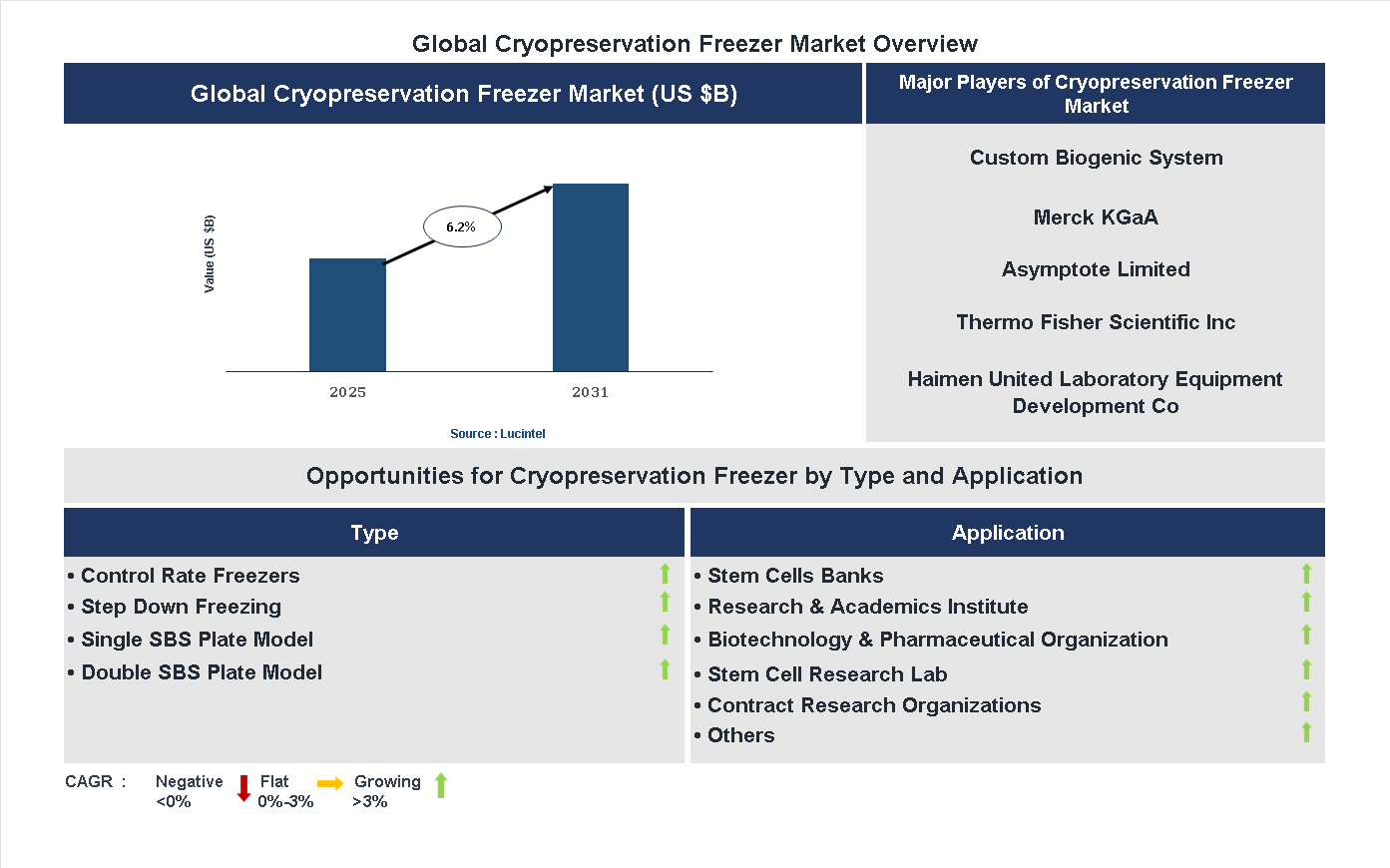
The future of the global cryopreservation freezer market looks promising with opportunities in the stem cell bank, research & academics institute, biotechnology & pharmaceutical organization, stem cell research lab, and contract research organization markets. The global cryopreservation freezer market is expected to grow with a CAGR of 6.2% from 2025 to 2031. The major drivers for this market are the increasing demand for long term biological storage, the rising adoption of cell gene therapies, and the growing investments in biobanking infrastructure.• Lucintel forecasts that, within the type category, control rate freezer is expected to witness the highest growth over the forecast period.
• Within the application category, stem cell bank is expected to witness the highest growth.
• In terms of region, APAC is expected to witness the highest growth over the forecast period. Gain valuable insights for your business decisions with our comprehensive 150+ page report. Sample figures with some insights are shown below.
Emerging Trends in the Cryopreservation Freezer Market
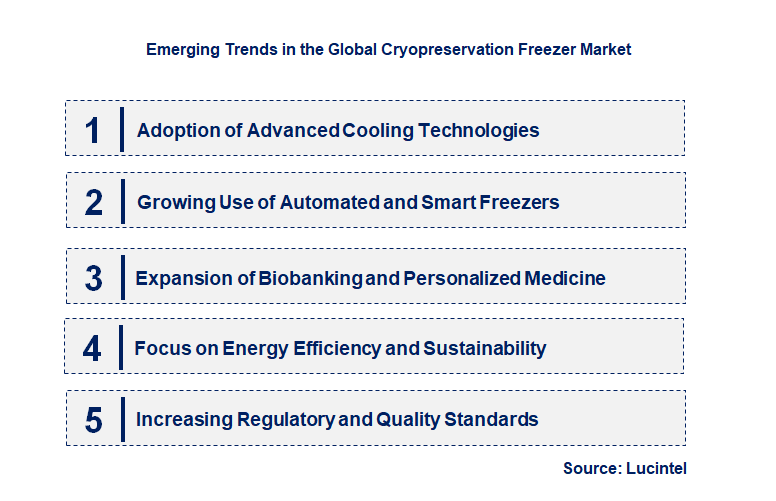
The cryopreservation freezer market is experiencing rapid growth driven by advancements in biotechnology, healthcare, and research sectors. As the demand for preserving biological samples, tissues, and cells increases, the market is evolving with innovative technologies and expanding applications. Key trends are shaping the future landscape, influencing manufacturers, researchers, and healthcare providers to adopt new strategies and solutions. These developments are not only enhancing preservation efficiency but also broadening the scope of cryopreservation applications, ultimately transforming the market into a more dynamic and competitive environment. Understanding these trends is essential for stakeholders aiming to capitalize on emerging opportunities and address future challenges.• Adoption of Advanced Cooling Technologies: The market is witnessing a shift towards ultra-low temperature freezers equipped with advanced cooling systems. These freezers offer improved temperature stability, energy efficiency, and reduced sample degradation. Innovations such as pulse tube cryocoolers and hybrid systems are gaining popularity, providing reliable long-term preservation solutions. This trend enhances sample integrity, reduces operational costs, and supports large-scale biobanking and research activities, making cryopreservation more efficient and sustainable.
• Growing Use of Automated and Smart Freezers: Automation and smart technology integration are transforming cryopreservation freezers. Features like remote monitoring, real-time temperature tracking, and automated defrosting are becoming standard. These advancements minimize human error, improve data accuracy, and enable centralized management of multiple storage units. The adoption of IoT-enabled freezers allows for predictive maintenance and enhanced security, ensuring sample safety and operational efficiency, which is crucial for clinical and research applications.
• Expansion of Biobanking and Personalized Medicine: The rise of biobanking and personalized medicine is significantly impacting the market. Cryopreservation is essential for storing biological samples for future analysis, drug development, and regenerative therapies. The increasing demand for biobanks, especially in genomics and regenerative medicine, is driving the need for scalable, high-capacity freezers. This trend supports the development of tailored treatments and accelerates research, positioning cryopreservation as a cornerstone of precision healthcare.
• Focus on Energy Efficiency and Sustainability: Environmental concerns and rising energy costs are prompting manufacturers to develop energy-efficient cryopreservation freezers. Innovations include improved insulation, eco-friendly refrigerants, and energy management systems. These features reduce carbon footprints and operational costs, aligning with global sustainability goals. The market is increasingly favoring eco-conscious solutions, which not only benefit the environment but also appeal to healthcare and research institutions seeking cost-effective, sustainable options.
• Increasing Regulatory and Quality Standards: Stringent regulatory frameworks and quality standards are shaping the market landscape. Compliance with guidelines from agencies like the FDA and EMA ensures sample safety and data integrity. Manufacturers are investing in validation, documentation, and quality assurance processes to meet these standards. This trend enhances product reliability, fosters trust among users, and facilitates market expansion, especially in clinical and pharmaceutical sectors where regulatory adherence is critical for product approval and market access. In summary, these emerging trends are collectively reshaping the cryopreservation freezer market by driving technological innovation, improving operational efficiency, and expanding application scope. They are fostering a more sustainable, reliable, and user-centric environment, positioning the market for sustained growth and increased competitiveness in the evolving landscape of biological preservation.
Recent Development in the Cryopreservation Freezer Market
The cryopreservation freezer market has experienced significant advancements driven by technological innovations, increasing demand for biological sample preservation, and expanding applications across healthcare, research, and biobanking sectors. As the need for reliable, efficient, and cost-effective freezing solutions grows, market players are focusing on product development, regulatory compliance, and expanding geographic reach. These developments are shaping the future landscape of cryopreservation, making it more accessible and versatile for various industries. The following key developments highlight the recent trends and innovations influencing this dynamic market.• Technological Innovations: Introduction of ultra-low temperature freezers with enhanced energy efficiency and advanced temperature control systems has improved sample preservation quality and reduced operational costs, boosting market growth.
• Expansion in Biobanking: Growing investments in biobanking infrastructure worldwide have increased demand for reliable cryopreservation solutions, supporting large-scale storage of biological samples for research and clinical purposes.
• Regulatory Advancements: Implementation of stricter regulatory standards and quality certifications has driven manufacturers to upgrade products, ensuring safety, compliance, and boosting customer confidence in cryopreservation equipment.
• Customization and Modular Designs: Development of customizable and modular freezers allows tailored solutions for specific research needs, increasing flexibility and adoption across diverse sectors such as pharmaceuticals and academia.
• Geographic Market Expansion: Emerging markets in Asia-Pacific and Latin America are witnessing increased adoption of cryopreservation freezers due to rising healthcare infrastructure and research activities, broadening the market scope. These developments collectively are making the cryopreservation freezer market more innovative, reliable, and accessible, fostering growth across healthcare, research, and industrial sectors. They are also enhancing sample integrity, operational efficiency, and regulatory compliance, which are critical for advancing scientific research and clinical applications.
Strategic Growth Opportunities in the Cryopreservation Freezer Market
The cryopreservation freezer market is experiencing rapid growth driven by advancements in biotechnology, pharmaceuticals, and healthcare sectors. As the demand for preserving biological samples, tissues, and cells increases, key applications are expanding their capabilities and efficiency. Innovations in temperature control, energy efficiency, and automation are creating new opportunities for market players. This evolving landscape offers significant potential for strategic growth, driven by technological advancements and increasing adoption across various sectors. Companies that capitalize on these opportunities can enhance their market share and meet the rising global demand for reliable cryopreservation solutions.• Healthcare and Biobanking: Expansion of biobanks and healthcare facilities is a major growth driver. Cryopreservation freezers are essential for storing blood, tissues, and stem cells, ensuring long-term preservation. The increasing prevalence of chronic diseases and the need for personalized medicine are fueling demand. Technological improvements, such as automated storage systems, enhance sample security and retrieval efficiency. This growth impacts the market by boosting sales and encouraging innovation in freezer design, ultimately supporting medical research and patient care.
• Pharmaceutical and Biotech Research: The pharmaceutical industry relies heavily on cryopreservation for drug development and vaccine storage. The rise of biologics and personalized medicine necessitates advanced freezing solutions. Innovations like ultra-low temperature freezers improve sample integrity and stability. This application offers significant growth opportunities by enabling large-scale storage and reducing contamination risks. The impact includes increased market revenue and the development of specialized freezers tailored to complex pharmaceutical needs, fostering research advancements.
• Fertility Clinics and Reproductive Medicine: The increasing demand for fertility treatments drives the need for reliable cryopreservation solutions. Freezers designed for storing eggs, sperm, and embryos are critical for reproductive success. Technological enhancements, such as rapid cooling and temperature uniformity, improve sample viability. This sectors growth expands the market by creating demand for specialized, high-capacity freezers. The impact is a broader adoption of cryopreservation in reproductive health, supporting patient outcomes and expanding market opportunities for manufacturers.
• Food Industry and Agriculture: Cryopreservation is increasingly used for preserving genetic material, seeds, and food products. The need for long-term storage of valuable biological resources is rising due to climate change and biodiversity conservation efforts. Advanced freezers with energy-efficient features and precise temperature control are vital. This application broadens the market scope, encouraging innovation in freezer technology. The impact includes diversification of market applications and increased revenue streams for freezer manufacturers, supporting sustainability initiatives.
• Academic and Research Institutions: Universities and research centers utilize cryopreservation freezers for storing biological samples and research materials. The demand is driven by ongoing scientific research and the need for reliable long-term storage solutions. Technological advancements such as remote monitoring and data logging improve operational efficiency. This growth opportunity enhances the market by expanding the customer base and fostering innovation. The impact is increased investment in research infrastructure and accelerated scientific discoveries, further propelling market expansion. In summary, these key growth opportunities across various applications are significantly shaping the cryopreservation freezer market. They are driving technological innovation, expanding market reach, and increasing demand for specialized solutions. As these sectors continue to evolve, the market is poised for sustained growth, with companies that adapt to these opportunities gaining competitive advantages and contributing to advancements in healthcare, research, and preservation technologies.
Cryopreservation Freezer Market Driver and Challenges
The cryopreservation freezer market is influenced by a variety of technological, economic, and regulatory factors that shape its growth and development. Advances in cryogenic technology and increasing demand for biobanking and medical research drive market expansion. Economic factors such as healthcare funding and investment in biotech industries also play a significant role. Additionally, regulatory standards for sample preservation and safety influence market dynamics. These drivers and challenges collectively impact the markets trajectory, requiring stakeholders to adapt to evolving technological innovations, economic conditions, and regulatory frameworks to remain competitive and compliant. The factors responsible for driving the cryopreservation freezer market include:-• Technological Advancements: The development of more efficient, reliable, and energy-efficient cryopreservation freezers has significantly propelled market growth. Innovations such as automated temperature control, remote monitoring, and enhanced insulation materials improve sample safety and operational efficiency. These technological improvements reduce sample loss, lower energy consumption, and facilitate large-scale biobanking, making cryopreservation more accessible and cost-effective. As research and healthcare sectors demand higher standards for sample integrity, continuous technological innovation remains a key driver for market expansion.
• Growing Biobanking and Research Activities: The increasing need for biobanking of biological samples, including blood, tissues, and genetic material, is a major growth driver. This trend is driven by advancements in personalized medicine, genomics, and regenerative therapies. Hospitals, research institutions, and pharmaceutical companies are investing heavily in biobanking infrastructure, which relies heavily on cryopreservation freezers. The rising prevalence of chronic diseases and the need for long-term sample storage further fuel this demand, making biobanking a critical factor in market growth.
• Rising Healthcare Expenditure and Investment: Increased healthcare spending worldwide, especially in emerging economies, supports the adoption of advanced cryopreservation solutions. Governments and private investors are funding research and development activities that require reliable sample storage. The expansion of healthcare infrastructure and the growing focus on precision medicine necessitate high-quality cryogenic storage solutions, thereby boosting market demand. Additionally, the commercialization of biotechnological products and therapies encourages investments in cryopreservation technology to ensure sample integrity over long periods.
• Regulatory and Quality Standards: Stringent regulatory frameworks and quality standards for sample storage and handling influence market growth. Compliance with guidelines from agencies such as the FDA, EMA, and ISO ensures sample safety, traceability, and integrity. These standards drive the adoption of advanced cryopreservation freezers equipped with features like temperature monitoring, alarm systems, and data logging. While regulatory compliance can pose challenges for manufacturers, it ultimately enhances market credibility and encourages innovation aligned with safety and quality requirements.
• Increasing Adoption of Automated and Smart Storage Solutions: The integration of automation and smart technology in cryopreservation freezers is a significant driver. Automated systems reduce human error, improve sample tracking, and streamline inventory management. Features like remote monitoring, real-time data access, and predictive maintenance enhance operational efficiency and sample security. As laboratories and biobanks seek to optimize workflows and ensure sample integrity, the adoption of intelligent storage solutions accelerates market growth, offering enhanced reliability and compliance with evolving industry standards. The challenges facing this cryopreservation freezer market include:-
• High Capital and Operational Costs: The initial investment for advanced cryopreservation freezers and ongoing maintenance expenses can be substantial. These costs may limit adoption, especially among smaller research institutions and clinics with constrained budgets. Additionally, energy consumption and the need for specialized personnel to operate and maintain these systems add to operational costs, potentially hindering market expansion in cost-sensitive regions.
• Regulatory Complexity and Compliance: Navigating diverse and evolving regulatory requirements across different countries can be challenging. Ensuring compliance with safety, quality, and data management standards demands significant effort and resources. Non-compliance risks include legal penalties, sample loss, and damage to reputation, which can deter investment and slow market growth, especially for new entrants unfamiliar with complex regulatory landscapes.
• Technological Obsolescence and Data Security Concerns: Rapid technological advancements can render existing equipment obsolete, necessitating frequent upgrades and investments. Additionally, the increasing reliance on digital monitoring and data logging raises concerns about cybersecurity and data breaches. Protecting sensitive biological data from cyber threats is critical, and failure to do so can compromise sample integrity and trust, posing a significant challenge for market players. In summary, the cryopreservation freezer market is driven by technological innovations, expanding biobanking activities, increased healthcare investments, regulatory standards, and smart storage solutions. However, high costs, regulatory complexities, and technological obsolescence pose notable challenges. These factors collectively influence the markets growth trajectory, requiring stakeholders to balance innovation with compliance and cost management to sustain long-term development. The overall impact is a dynamic market poised for continued growth, provided these challenges are effectively addressed through strategic investments and technological advancements.
List of Cryopreservation Freezer Companies
Companies in the market compete on the basis of product quality offered. Major players in this market focus on expanding their manufacturing facilities, R&D investments, infrastructural development, and leverage integration opportunities across the value chain. With these strategies cryopreservation freezer companies cater increasing demand, ensure competitive effectiveness, develop innovative products & technologies, reduce production costs, and expand their customer base. Some of the cryopreservation freezer companies profiled in this report include-• Custom Biogenic System
• Merck KGaA
• Asymptote Limited
• Thermo Fisher Scientific Inc
• Haimen United Laboratory Equipment Development Co
• Linde LLC
• Cryogenic Control
Cryopreservation Freezer Market by Segment
The study includes a forecast for the global cryopreservation freezer market by type, application, and region.Cryopreservation Freezer Market by Type [Value from 2019 to 2031]:
• Control Rate Freezers
• Step Down Freezing
• Single SBS Plate Model
• Double SBS Plate Model
Cryopreservation Freezer Market by Application [Value from 2019 to 2031]:
• Stem Cells Banks
• Research & Academics Institute
• Biotechnology & Pharmaceutical Organization
• Stem Cell Research Lab
• Contract Research Organizations
• Others
Cryopreservation Freezer Market by Region [Value from 2019 to 2031]:
• North America
• Europe
• Asia Pacific
• The Rest of the World
Country Wise Outlook for the Cryopreservation Freezer Market
The cryopreservation freezer market has experienced significant growth driven by advancements in biotechnology, healthcare, and research sectors worldwide. As the demand for preserving biological samples, tissues, and cells increases, countries are investing in innovative freezing technologies and expanding their infrastructure. Regulatory developments, technological innovations, and the growing importance of personalized medicine are shaping the markets evolution. Each country’s unique healthcare priorities and research initiatives shape its market dynamics, leading to diverse growth patterns and strategic investments. Understanding these regional developments provides insight into the global trajectory of cryopreservation freezer technology and its future potential.• United States: The United States leads the market with substantial investments in biotech and healthcare research. Innovations in ultra-low temperature freezers and automation are prominent, driven by the need for reliable sample preservation. The government’s funding for biomedical research and private sector collaborations fosters technological advancements. The increasing adoption of cryopreservation in fertility clinics and biobanking further boosts market growth. Regulatory frameworks are evolving to ensure sample safety and quality, supporting market expansion. Overall, the U.S. market is characterized by high technological adoption and robust R&D activities.
• China: China is rapidly expanding its cryopreservation freezer market, fueled by government initiatives to enhance biotech and healthcare infrastructure. The country’s focus on regenerative medicine and stem cell research drives demand for advanced freezing solutions. Local manufacturers are investing in cost-effective and energy-efficient freezers to cater to domestic needs. The growing number of research institutions and biobanks contributes to market growth. Additionally, increasing healthcare expenditure and rising awareness about sample preservation are key factors. China’s market is marked by a combination of domestic innovation and increasing international collaborations.
• Germany: Germany’s market is characterized by high-quality standards and technological innovation. The country’s strong healthcare system and research institutions prioritize precision and reliability in cryopreservation solutions. Germany is a leader in developing environmentally sustainable freezers with energy-efficient features. The focus on biobanking and personalized medicine supports steady market growth. Regulatory compliance and quality assurance are critical, with strict adherence to EU standards. The presence of major global manufacturers and research collaborations further strengthen Germany’s position in the market. Innovation and sustainability are central themes in its ongoing development.
• India: India’s cryopreservation freezer market is witnessing rapid growth due to increasing healthcare awareness and expanding research activities. The rising demand for fertility preservation and stem cell therapies is a significant driver. Local manufacturers are offering affordable and energy-efficient freezers to meet the needs of a growing healthcare sector. Government initiatives to promote biotechnology and medical research are boosting market prospects. The increasing number of hospitals, clinics, and research labs adopting cryopreservation solutions contributes to growth. Challenges include the need for technological upgrades and regulatory improvements, but overall, India’s market is poised for substantial expansion.
• Japan: Japan’s market is driven by advanced healthcare infrastructure and a focus on regenerative medicine. The country emphasizes high-precision, energy-efficient cryopreservation solutions to support its aging population and medical research. Japan invests heavily in biobanking and stem cell research, fostering demand for reliable freezers. Regulatory standards are stringent, ensuring safety and quality. Domestic manufacturers innovate with eco-friendly and space-saving designs. Collaborations between industry and academia accelerate technological progress. The market’s growth is supported by government funding and a strong emphasis on medical innovation, positioning Japan as a key player in the cryopreservation freezer industry.

Features of the Global Cryopreservation Freezer Market
Market Size Estimates: Cryopreservation freezer market size estimation in terms of value ($B). Trend and Forecast Analysis: Market trends (2019 to 2024) and forecast (2025 to 2031) by various segments and regions. Segmentation Analysis: Cryopreservation freezer market size by type, application, and region in terms of value ($B). Regional Analysis: Cryopreservation freezer market breakdown by North America, Europe, Asia Pacific, and Rest of the World. Growth Opportunities: Analysis of growth opportunities in different types, applications, and regions for the cryopreservation freezer market. Strategic Analysis: This includes M&A, new product development, and competitive landscape of the cryopreservation freezer market. Analysis of competitive intensity of the industry based on Porter’s Five Forces model.
FAQ
Q1. What is the growth forecast for cryopreservation freezer market? Answer: The global cryopreservation freezer market is expected to grow with a CAGR of 6.2% from 2025 to 2031. Q2. What are the major drivers influencing the growth of the cryopreservation freezer market? Answer: The major drivers for this market are the increasing demand for long term biological storage, the rising adoption of cell gene therapies, and the growing investments in biobanking infrastructure. Q3. What are the major segments for cryopreservation freezer market? Answer: The future of the cryopreservation freezer market looks promising with opportunities in the stem cell bank, research & academics institute, biotechnology & pharmaceutical organization, stem cell research lab, and contract research organization markets. Q4. Who are the key cryopreservation freezer market companies? Answer: Some of the key cryopreservation freezer companies are as follows:• Custom Biogenic System
• Merck KGaA
• Asymptote Limited
• Thermo Fisher Scientific Inc
• Haimen United Laboratory Equipment Development Co
• Linde LLC
• Cryogenic Control Q5. Which cryopreservation freezer market segment will be the largest in future? Answer: Lucintel forecasts that, within the type category, control rate freezer is expected to witness the highest growth over the forecast period. Q6. In cryopreservation freezer market, which region is expected to be the largest in next 5 years? Answer: In terms of region, APAC is expected to witness the highest growth over the forecast period. Q7. Do we receive customization in this report? Answer: Yes, Lucintel provides 10% customization without any additional cost.
Table of Contents
List of Figures
List of Tables
Methodology
- In-depth interviews of the major players in this market
- Detailed secondary research from competitors’ financial statements and published data
- Extensive searches of published works, market, and database information pertaining to industry news, company press releases, and customer intentions
- A compilation of the experiences, judgments, and insights of Lucintel’s professionals, who have analyzed and tracked this market over the years.


Buy Now
Choose a license that fits your team. Instant PDF delivery.
Prices exclude taxes. Instant delivery. Custom licensing available on request.
Key Questions
- • What are some of the most promising, high-growth opportunities for the cryopreservation freezer market by type (control rate freezers, step down freezing, single SBS plate model, and double SBS plate model), application (stem cells banks, research & academics institute, biotechnology & pharmaceutical organization, stem cell research lab, contract research organizations, and others), and region (North America, Europe, Asia Pacific, and the Rest of the World)?
- • Which segments will grow at a faster pace and why?
- • Which region will grow at a faster pace and why?
- • What are the key factors affecting market dynamics? What are the key challenges and business risks in this market?
- • What are the business risks and competitive threats in this market?
- • What are the emerging trends in this market and the reasons behind them?
- • What are some of the changing demands of customers in the market?
- • What are the new developments in the market? Which companies are leading these developments?
- • Who are the major players in this market? What strategic initiatives are key players pursuing for business growth?
- • What are some of the competing products in this market and how big of a threat do they pose for loss of market share by material or product substitution?
- • What M&A activity has occurred in the last 5 years and what has its impact been on the industry? For any questions related to Cryopreservation Freezer Market, Cryopreservation Freezer Market Size, Cryopreservation Freezer Market Growth, Cryopreservation Freezer Market Analysis, Cryopreservation Freezer Market Report, Cryopreservation Freezer Market Share, Cryopreservation Freezer Market Trends, Cryopreservation Freezer Market Forecast, Cryopreservation Freezer Companies, write Lucintel analyst at email: helpdesk@lucintel.com. We will be glad to get back to you soon.


