
Report Feature
Crop Spraying Drone Market Trends and Forecast
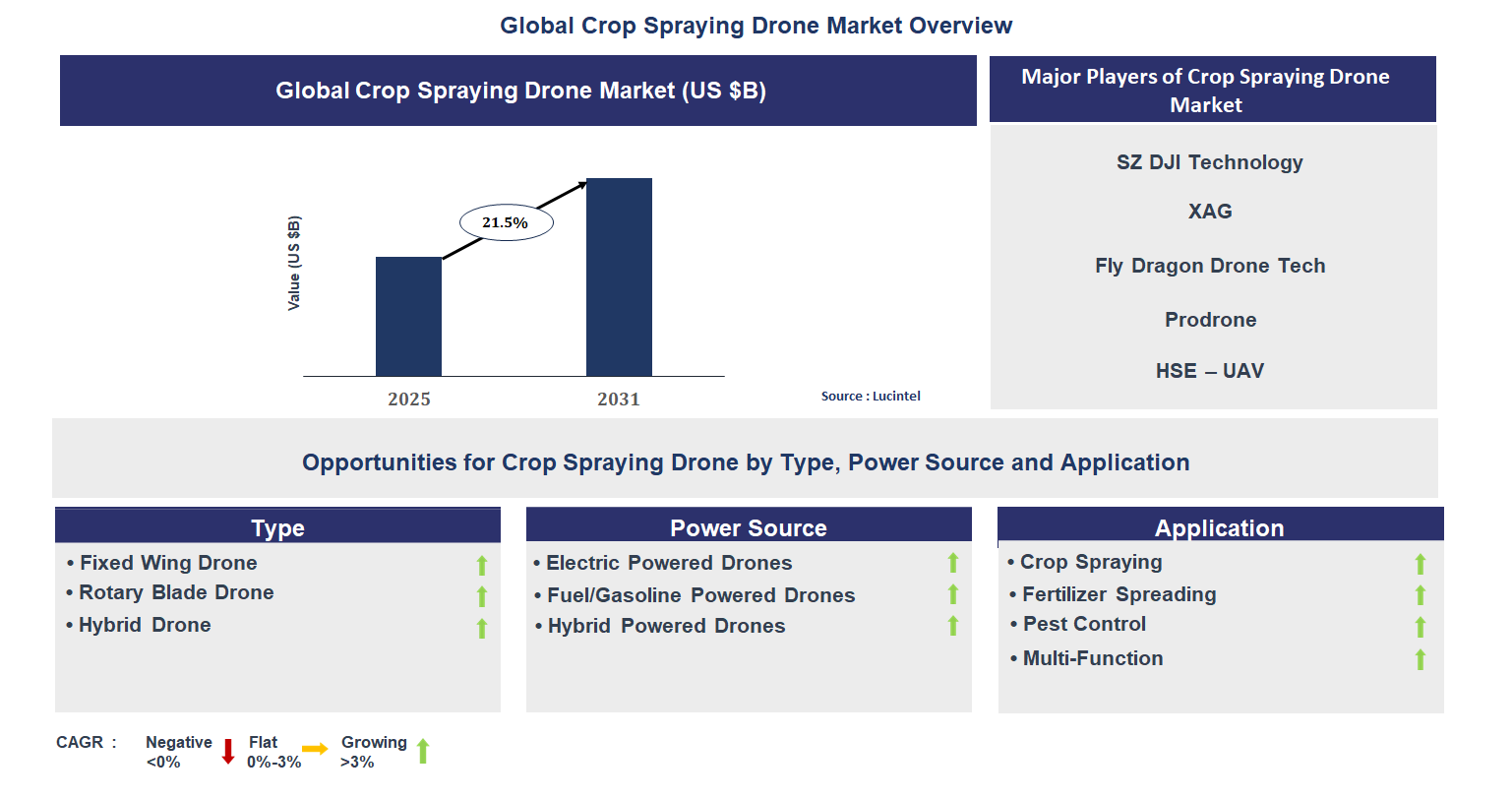
The future of the global crop spraying drone market looks promising with opportunities in the crop spraying, fertilizer spreading, pest control, and multi-function markets. The global crop spraying drone market is expected to grow with a CAGR of 21.5% from 2025 to 2031. The major drivers for this market are the increasing adoption of precision agriculture techniques, the rising demand for efficient crop management, and the growing awareness about reducing pesticide usage.• Lucintel forecasts that, within the type category, hybrid drone is expected to witness the highest growth over the forecast period.
• Within the application category, multi-function is expected to witness the highest growth.
• In terms of region, APAC is expected to witness the highest growth over the forecast period. Gain valuable insights for your business decisions with our comprehensive 150+ page report. Sample figures with some insights are shown below.
Emerging Trends in the Crop Spraying Drone Market
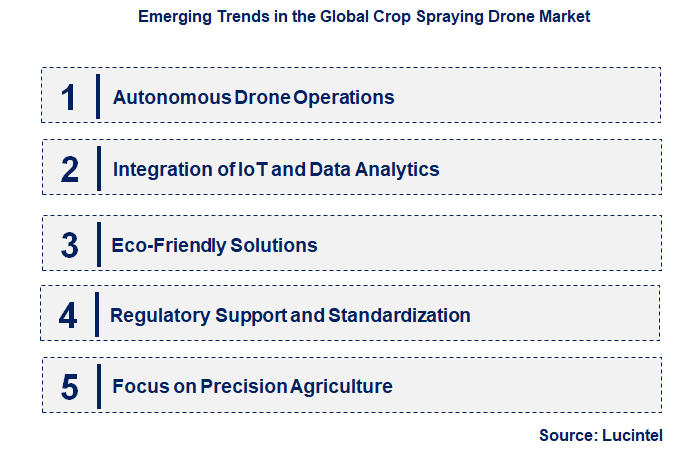
Emerging trends in the crop spraying drone market are shaping the future of agriculture by introducing more efficient, automated, and eco-friendly solutions. These trends reflect a shift toward precision farming, where data-driven insights and advanced technology are enabling smarter, more sustainable agricultural practices.• Autonomous Drone Operations: Increasing use of AI and machine learning to enable fully autonomous crop spraying drones is a significant trend. Autonomous drones can perform spraying tasks without human intervention, improving efficiency, reducing labor costs, and minimizing human error. This trend is driving the market toward greater automation and operational cost reductions.
• Integration of IoT and Data Analytics: The integration of Internet of Things (IoT) sensors and data analytics in crop spraying drones is enhancing precision and efficiency. Drones collect real-time data on soil conditions, crop health, and pest infestations, enabling farmers to make data-driven decisions. This trend helps optimize the use of resources, reducing waste and boosting yields.
• Eco-Friendly Solutions: With growing concerns over pesticide usage and environmental sustainability, there is an increasing demand for eco-friendly crop spraying drones. These drones are designed to minimize chemical waste, reduce environmental impact, and improve the sustainability of farming practices. The push for greener agriculture is driving the development of more environmentally conscious drone technology.
• Regulatory Support and Standardization: As governments around the world recognize the potential of drones in agriculture, regulatory frameworks are evolving to support their use. In many countries, including the U.S. and China, new regulations are being introduced to ensure the safe and effective operation of crop spraying drones, enabling widespread adoption across the agricultural sector.
• Focus on Precision Agriculture: Precision farming techniques are increasingly being applied to crop spraying, ensuring that fertilizers and pesticides are applied only where needed. This reduces over-spraying, cuts costs, and minimizes environmental damage. Drones equipped with advanced sensors and imaging technology are at the forefront of this shift, improving the accuracy of crop management. These trends—autonomous operations, IoT integration, eco-friendly solutions, regulatory support, and precision agriculture—are reshaping the crop spraying drone market. They are driving increased efficiency, sustainability, and cost-effectiveness, which are revolutionizing agricultural practices and improving both crop yields and environmental outcomes.
Recent Development in the Crop Spraying Drone Market
Key developments in the crop spraying drone market highlight the technological, regulatory, and operational advancements driving growth. These developments are improving the overall efficiency and sustainability of agricultural practices, while also paving the way for future innovations in drone-based crop management.• Advancement of AI and Automation: The integration of AI and automation is a game-changer in crop spraying. Drones are now capable of operating autonomously, using AI to detect crop health, identify pests, and adjust spraying intensity in real-time. This development significantly improves spraying accuracy, reduces labor costs, and enhances overall operational efficiency.
• Improved Battery Life and Payload Capacity: Advances in drone battery technology and increased payload capacities are allowing drones to cover larger areas in less time. Longer battery life allows drones to spray more crops in a single flight, while higher payload capacities enable them to carry more pesticides and fertilizers, increasing overall productivity and efficiency.
• Development of Multi-Use Drones: Companies are now designing drones that can perform multiple agricultural tasks, including crop spraying, monitoring crop health, and even planting seeds. This multi-functionality reduces the need for multiple machines and optimizes farm operations, providing a more cost-effective and versatile solution for farmers.
• Regulatory Advancements and Certifications: As drone use becomes more widespread, regulatory bodies are updating frameworks to ensure safety and compliance. In the U.S., the FAA has streamlined regulations for agricultural drone operations, while other countries, like China, are creating standards for drone-based crop management. These advancements facilitate the legal use of drones in agriculture.
• Collaborations Between Drone Companies and Ag-Tech Firms: Partnerships between drone manufacturers and ag-tech companies are accelerating the development of specialized crop spraying drones. These collaborations are leading to the creation of drones tailored to specific crops and farming conditions, improving their effectiveness in different agricultural environments. These developments—AI automation, improved battery life, multi-use drones, regulatory advancements, and industry collaborations—are driving the growth and sophistication of the crop spraying drone market. They enhance operational efficiency, reduce costs, and provide farmers with more precise, sustainable tools for managing their crops.
Strategic Growth Opportunities in the Crop Spraying Drone Market
The crop spraying drone market presents several strategic growth opportunities across various applications, driven by the growing demand for sustainable farming solutions, technological advancements, and regulatory support. These opportunities focus on improving efficiency, sustainability, and accessibility for farmers worldwide.• Expansion in Developing Markets: The growing adoption of precision farming in developing countries, particularly in regions like India and Africa, offers significant growth opportunities. As agricultural productivity needs increase, crop spraying drones can provide small and medium-sized farmers with affordable, efficient tools to optimize crop management and improve yield.
• Advancement of Drone-as-a-Service: The rise of Drone-as-a-Service (DaaS) models provides a growth opportunity for companies to offer drone operations to farmers on a pay-per-use basis. This allows smaller farms with limited capital to access crop spraying technology, boosting market penetration without the need for significant upfront investment in drone equipment.
• Agri-Tech Integration for Data-Driven Farming: The integration of crop spraying drones with broader agri-tech solutions, such as soil sensors and crop management platforms, offers growth potential. These integrated systems allow farmers to make data-driven decisions, enhancing the effectiveness of crop spraying and overall farm management.
• Focus on Sustainable Farming Practices: As global demand for sustainable agricultural practices grows, crop spraying drones designed to minimize pesticide use and environmental impact will see increased adoption. This trend aligns with government initiatives and environmental regulations aimed at reducing the carbon footprint and ecological damage caused by traditional farming practices.
• Development of Advanced Crop-Specific Drones: There is significant growth potential in developing crop-specific drones designed to cater to particular farming environments or crops. For example, drones equipped with tailored spraying systems for vineyards or orchards can provide more efficient crop management and precise spraying, increasing adoption in specialized sectors. These strategic growth opportunities—expansion in developing markets, Drone-as-a-Service, agri-tech integration, sustainable farming focus, and crop-specific drones—are driving innovation and growth in the crop spraying drone market. These opportunities will expand market access, improve farm productivity, and support the global transition to more efficient and sustainable agricultural practices.
Crop Spraying Drone Market Driver and Challenges
The crop spraying drone market is influenced by various drivers and challenges, including technological advancements, economic factors, regulatory environments, and sustainability considerations. Understanding these drivers and challenges is crucial for shaping the future of agricultural drone technology and ensuring its widespread adoption. The factors responsible for driving the crop spraying drone market include: 1. Technological Advancements in Drones: Advances in drone technology, including AI, IoT integration, and autonomous operations, are significant drivers of the market. These innovations improve the efficiency, accuracy, and scalability of crop spraying, making drones an increasingly viable solution for modern farming. 2. Government Support and Regulations: Governments worldwide are supporting the use of drones in agriculture through favorable regulations and incentives. In the U.S., China, and Europe, regulatory bodies are easing drone usage restrictions, making it easier for farmers to adopt these technologies. 3. Rising Demand for Precision Agriculture: As farmers seek ways to optimize crop yields while minimizing input costs and environmental impact, the demand for precision agriculture tools like crop spraying drones is increasing. These drones enable more targeted and efficient application of pesticides, fertilizers, and water. 4. Labor Shortages in Agriculture: The ongoing labor shortage in agriculture, especially in developed countries, is driving farmers to seek automated solutions like drones. Crop spraying drones reduce the reliance on manual labor, making farming more efficient and scalable. 5. Sustainability Trends in Farming: With a growing focus on sustainable farming practices, crop spraying drones are gaining popularity for their ability to reduce pesticide waste, minimize environmental impact, and ensure precise application of chemicals, aligning with global sustainability goals. Challenges in the crop spraying drone market are: 1. High Initial Investment Costs: While the technology is advancing, the high upfront costs of purchasing and maintaining crop spraying drones can be a barrier, particularly for smaller farms in developing countries. This limits access to drone technology in these regions. 2. Regulatory Hurdles: While regulations are evolving, the fragmented regulatory landscape across different countries remains a challenge. Strict approval processes and local regulations may slow the widespread adoption of crop spraying drones, especially in emerging markets. 3. Battery Life and Payload Limitations: Despite advancements, battery life and payload capacity remain limitations for crop spraying drones. Drones with longer operational times and the ability to carry more chemicals can significantly increase efficiency, but overcoming these technical challenges remains a key hurdle. Technological advancements, government support, rising demand for precision agriculture, labor shortages, and sustainability trends are driving the growth of the crop spraying drone market. However, challenges related to high costs, regulatory complexity, and technical limitations need to be addressed to ensure the markets full potential is realized.List of Crop Spraying Drone Companies
Companies in the market compete on the basis of product quality offered. Major players in this market focus on expanding their manufacturing facilities, R&D investments, infrastructural development, and leverage integration opportunities across the value chain. With these strategies crop spraying drone companies cater increasing demand, ensure competitive effectiveness, develop innovative products & technologies, reduce production costs, and expand their customer base. Some of the crop spraying drone companies profiled in this report include-• SZ DJI Technology
• XAG
• Fly Dragon Drone Tech
• Prodrone
• HSE – UAV
• Aero360
• ASTA Technology
Crop Spraying Drone Market by Segment
The study includes a forecast for the global crop spraying drone market by type, power source, application, and region.Crop Spraying Drone Market by Type [Value from 2019 to 2031]:
• Fixed Wing Drone
• Rotary Blade Drone
• Hybrid Drone
Crop Spraying Drone Market by Power Source [Value from 2019 to 2031]:
• Electric Powered Drones
• Fuel/Gasoline Powered Drones
• Hybrid Powered Drones
Crop Spraying Drone Market by Application [Value from 2019 to 2031]:
• Crop Spraying
• Fertilizer Spreading
• Pest Control
• Multi-Function
Crop Spraying Drone Market by Region [Value from 2019 to 2031]:
• North America
• Europe
• Asia Pacific
• The Rest of the World
Country Wise Outlook for the Crop Spraying Drone Market
The crop spraying drone market is experiencing rapid growth as agricultural technology advances and demand for precision farming solutions increases globally. Drones are revolutionizing how crops are sprayed, providing farmers with more efficient, accurate, and eco-friendly solutions. Key markets in the U.S., China, Germany, India, and Japan are leading the way in adopting and advancing this technology.• United States: The U.S. crop spraying drone market has seen significant expansion due to increasing demand for precision agriculture. Technological innovations, such as AI-powered drones capable of autonomous spraying, are helping improve crop yield and reduce chemical waste. Regulatory approvals by the FAA and adoption by large agricultural enterprises are driving growth in this sector.
• China: China’s crop spraying drone market is booming, with drones being increasingly integrated into the countrys large-scale farming operations. The government’s push for agricultural modernization and eco-friendly practices is fueling this demand. Chinese manufacturers are leading the production of cost-effective drones, which is accelerating the technology’s adoption among small and medium-sized farms in rural regions.
• Germany: Germany, with its strong agricultural sector, has embraced crop spraying drones to enhance precision farming. The focus is on sustainability and reducing pesticide use. German farmers are increasingly adopting drones to improve crop management, minimize chemical exposure, and achieve better crop yields. The country’s high-tech ecosystem supports the growth of drone-based solutions in agriculture.
• India: In India, crop spraying drones are emerging as a game-changer for small and medium-scale farmers, offering an affordable and efficient alternative to traditional spraying methods. The Indian government’s initiatives to support drone adoption in agriculture, along with rising interest in sustainable farming practices, are driving market growth in the region, especially in states with large agricultural output.
• Japan: Japan’s agricultural sector is highly advanced, and the adoption of crop spraying drones is part of the country’s broader push toward modernizing farming. Japanese drones are designed to be highly precise and efficient, helping farmers increase productivity while reducing labor costs. The government’s commitment to technological innovation in agriculture further supports the growth of this market.

Features of the Global Crop Spraying Drone Market
Market Size Estimates: Crop spraying drone market size estimation in terms of value ($B). Trend and Forecast Analysis: Market trends (2019 to 2024) and forecast (2025 to 2031) by various segments and regions. Segmentation Analysis: Crop spraying drone market size by type, power source, application, and region in terms of value ($B). Regional Analysis: Crop spraying drone market breakdown by North America, Europe, Asia Pacific, and Rest of the World. Growth Opportunities: Analysis of growth opportunities in different types, power source, applications, and regions for the crop spraying drone market. Strategic Analysis: This includes M&A, new product development, and competitive landscape of the crop spraying drone market. Analysis of competitive intensity of the industry based on Porter’s Five Forces model.
FAQ
Q1. What is the growth forecast for crop spraying drone market? Answer: The global crop spraying drone market is expected to grow with a CAGR of 21.5% from 2025 to 2031. Q2. What are the major drivers influencing the growth of the crop spraying drone market? Answer: The major drivers for this market are the increasing adoption of precision agriculture techniques, the rising demand for efficient crop management, and the growing awareness about reducing pesticide usage. Q3. What are the major segments for crop spraying drone market? Answer: The future of the crop spraying drone market looks promising with opportunities in the crop spraying, fertilizer spreading, pest control, and multi-function markets. Q4. Who are the key crop spraying drone market companies? Answer: Some of the key crop spraying drone companies are as follows:• SZ DJI Technology
• XAG
• Fly Dragon Drone Tech
• Prodrone
• HSE – UAV
• Aero360
• ASTA Technology Q5. Which crop spraying drone market segment will be the largest in future? Answer: Lucintel forecasts that, within the type category, hybrid drone is expected to witness the highest growth over the forecast period. Q6. In crop spraying drone market, which region is expected to be the largest in next 5 years? Answer: In terms of region, APAC is expected to witness the highest growth over the forecast period. Q7. Do we receive customization in this report? Answer: Yes, Lucintel provides 10% customization without any additional cost.
Table of Contents
List of Figures
List of Tables
Methodology
- In-depth interviews of the major players in this market
- Detailed secondary research from competitors’ financial statements and published data
- Extensive searches of published works, market, and database information pertaining to industry news, company press releases, and customer intentions
- A compilation of the experiences, judgments, and insights of Lucintel’s professionals, who have analyzed and tracked this market over the years.


Buy Now
Choose a license that fits your team. Instant PDF delivery.
Prices exclude taxes. Instant delivery. Custom licensing available on request.
Key Questions
- • What are some of the most promising, high-growth opportunities for the crop spraying drone market by type (fixed wing drone, rotary blade drone, and hybrid drone), power source (electric powered drones, fuel/gasoline powered drones, and hybrid powered drones), application (crop spraying, fertilizer spreading, pest control, and multi-function), and region (North America, Europe, Asia Pacific, and the Rest of the World)?
- • Which segments will grow at a faster pace and why?
- • Which region will grow at a faster pace and why?
- • What are the key factors affecting market dynamics? What are the key challenges and business risks in this market?
- • What are the business risks and competitive threats in this market?
- • What are the emerging trends in this market and the reasons behind them?
- • What are some of the changing demands of customers in the market?
- • What are the new developments in the market? Which companies are leading these developments?
- • Who are the major players in this market? What strategic initiatives are key players pursuing for business growth?
- • What are some of the competing products in this market and how big of a threat do they pose for loss of market share by material or product substitution?
- • What M&A activity has occurred in the last 5 years and what has its impact been on the industry? For any questions related to Crop Spraying Drone Market, Crop Spraying Drone Market Size, Crop Spraying Drone Market Growth, Crop Spraying Drone Market Analysis, Crop Spraying Drone Market Report, Crop Spraying Drone Market Share, Crop Spraying Drone Market Trends, Crop Spraying Drone Market Forecast, Crop Spraying Drone Companies, write Lucintel analyst at email: helpdesk@lucintel.com. We will be glad to get back to you soon.


