
Market Report · July 15, 2026

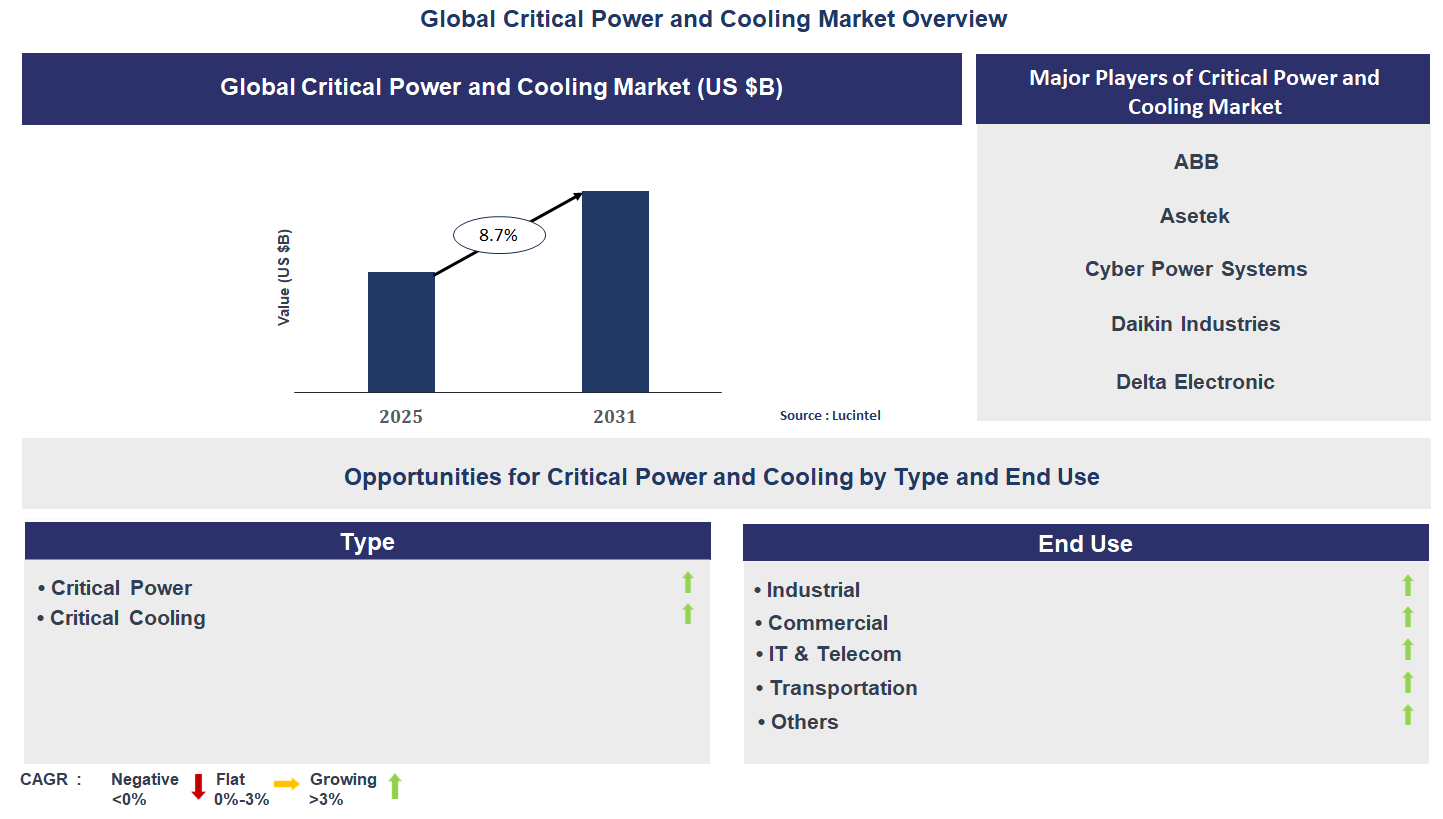
Key data points: The growth forecast = 8.7% annually for the next 7 years. Scroll below to get more insights. This market report covers trends, opportunities and forecasts in critical power and cooling market to 2031 by type (critical power and critical cooling), end use (industrial, commercial, IT & telecom, transportation, and others), and region (North America, Europe, Asia Pacific, and the Rest of the World)
We'll send your sample report shortly.
• Lucintel forecasts that, within the type category, critical power is expected to witness higher growth over the forecast period.
• Within the end use category, IT & telecom is expected to witness the highest growth.
• In terms of region, North America is expected to witness the highest growth over the forecast period. Gain valuable insights for your business decisions with our comprehensive 150+ page report. Sample figures with some insights are shown below.
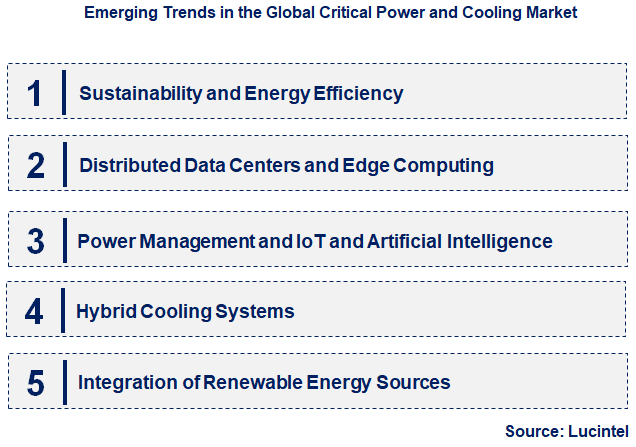
• Sustainability and Energy Efficiency: The increased focus on sustainability is driving the critical power and cooling industry. Data centers and other critical facilities are increasingly embracing power-saving technologies like liquid cooling and renewable energy-driven solutions. This is towards minimizing operating expenses as well as lowering the environmental footprint of cooling systems. Firms are seeking to reduce carbon emissions via creative design and green power sources, reacting to both regulatory and customer pressures for environmentally friendly operations. These transformations will result in a more energy-efficient, greener strategy for essential power and cooling.
• Distributed Data Centers and Edge Computing: Growth in edge computing is creating the demand for distributed data centers that need on-site critical power and cooling solutions. In contrast to the conventional large-scale centralized data centers, edge facilities are situated nearer to end-users and require specific power and cooling systems that are efficient and compact. The smaller and decentralized systems must solve the challenge of reliability and performance while minimizing operational expenses. Firms are investing in scalable and modular power and cooling technologies to facilitate this growing trend, adding flexibility and responsiveness to the marketplace.
• Power Management and IoT and Artificial Intelligence: The convergence of artificial intelligence (AI) and Internet of Things (IoT) is revolutionizing critical power and cooling management. AI-based systems are able to optimize power distribution, identify faults, and control cooling loads in real-time. IoT sensors allow for ongoing environmental condition and equipment performance monitoring, predictive maintenance, and downtime reduction. This trend is optimizing critical power and cooling systems through the use of data-driven insights to automate operations and enhance performance, making them more cost-effective and reliable.
• Hybrid Cooling Systems: Hybrid cooling systems that integrate air and liquid cooling technology are becoming increasingly popular in the market. These types of systems are more energy efficient since they utilize liquid cooling for dense servers and use air cooling for less resource-intensive operations. Hybrid systems are highly effective in hot climates where air cooling alone would not be enough. By leveraging the benefits of both cooling systems, these systems provide flexibility, scalability, and improved efficiency, meeting a broad spectrum of applications in many industries.
• Integration of Renewable Energy Sources: Incorporating renewable energy sources, including solar, wind, and hydro, into critical power and cooling systems is gaining importance. As companies aim to minimize their ecological footprint and comply with regulations, data center and other facility green energy use is on the rise. The installation of solar-powered cooling systems and wind power for backup power is becoming more common to make processes environmentally friendly. Not only does this cost reduction, but it also complements the international move towards cleaner, greener energy sources. The new trends in the critical power and cooling market highlight the need for efficiency, innovation, and sustainability. With increasing demand for data-intensive services comes the demand for flexible and energy-efficient power and cooling infrastructure. Businesses and nations across the globe are investing in hybrid systems, renewable power sources, AI-based management, and edge computing hardware, all of which are greatly changing the dynamics of critical power and cooling. These trends have the added benefit of encouraging more environmentally friendly operations while increasing the overall cost-effectiveness and reliability of critical infrastructure.
• Innovation in Liquid Cooling Solutions: Liquid cooling technologies have been gaining considerable popularity in recent years. These systems utilize liquids over air to transfer and absorb heat from critical equipment and servers. Liquid cooling is especially useful in high-density environments where air cooling may prove inadequate. Liquid cooling, by providing better heat transfer efficiency, enables reduced cooling infrastructure requirements, thus saving energy and operational expenses. This technology is essential for data centers that process vast amounts of data, allowing them to become more sustainable.
• AI-Powered Power Management Systems Development: Artificial intelligence is leaving its footprint in power management systems within the Critical Power and Cooling industry. AI-powered algorithms are employed for optimizing the use of energy by anticipating the demand for power and therefore modulating cooling systems. It prevents overcooling or wastage of power while keeping cooling and power systems running in maximum efficiency. AI solutions are especially beneficial in large data centers, where power and cooling requirements vary based on workloads.
• Growth of Immersion Cooling for High-Performance Computing: Immersion cooling, where computing hardware is submerged in a thermally conductive fluid, is gaining favor for high-performance computing (HPC) use. This technique enables heat to be dissipated more efficiently than the conventional air or liquid-based cooling techniques. Immersion cooling results in very high space and energy savings and has grown very popular for the state-of-the-art data centers and HPC centers. This innovation meets the growing demand for effective cooling technologies for applications where heat generation is a key issue.
• Adoption of Free Air Cooling for Data Centers: Free air cooling, in which outdoor air is exploited to cool data center equipment, is becoming increasingly popular as a viable and cost-saving option. The method employs cold outside air, minimizing the use of conventional air conditioning units, thus saving energy. In cooler climates, free air cooling can achieve a considerable reduction in mechanical cooling requirements, resulting in significant operational costs savings. Increased use of free air cooling is evidence of the industrys efforts in pursuing cleaner and more energy-efficient operation of data centers.
• Emphasis on Modular Power and Cooling Solutions: Modular power and cooling solutions are becoming increasingly popular for their scalability and flexibility. These systems enable companies to increase infrastructure in a phased manner, allowing them to accommodate increased demand without having to make huge initial investments. The modular solution is especially beneficial for edge data centers and remote locations where space and resources might be constrained. Through customization possibilities, the systems offer economical solutions that can be adjusted according to particular requirements, allowing efficient and sustainable development. These advancements in the critical power and cooling industry indicate the industrys emphasis on energy efficiency, sustainability, and performance of operations. New advancements like liquid cooling, AI-driven management, immersion cooling, and modular designs are changing the way power and cooling infrastructure is designed and installed. This helps businesses save money, increase reliability, and build more sustainable data infrastructure.
• Data Centers and Cloud Computing: The data center sector remains a central force behind the Critical Power and Cooling market. With the growing dependence on cloud computing, companies are making significant investments in power and cooling systems that are more efficient and scalable to meet intensifying data demands. Cooling technology advancements, including immersion cooling and liquid cooling, are critical to the sustainability of high-density data centers. The expansion of the cloud and data processing needs will keep generating opportunities for critical power and cooling infrastructure suppliers.
• Telecommunications Infrastructure: Telecommunications infrastructure is a major growth area for the Critical Power and Cooling market. With the expansion of 5G networks and rising connectivity needs, telecommunication operators require power and cooling solutions that are dependable and energy-efficient to power their base stations, data centers, and other mission-critical infrastructure. Players in the industry are putting money into energy-efficient cooling technologies to minimize operational expenses and maintain seamless service in high-demand environments.
• Industrial Automation and Manufacturing: Industrial production plants and automation hubs need constant, trustworthy power and cooling systems to run their devices and equipment. The rising use of robotics and automated processes in plants necessitates more sophisticated cooling systems capable of easily dissipating heat. More technologically advanced manufacturing plants will demand tailored critical power and cooling systems to maintain continuous operation and save energy as facilities grow more technologically advanced.
• Medical and Healthcare Facilities: Medical facilities and healthcare use critical power and cooling infrastructure to meet the reliability and safety needs of medical devices such as life-support equipment, data storage hardware, and diagnosis tools. The need for cooling systems to shield sensitive equipment from heat is increasing due to the digitization of healthcare operations. Energy-efficient and robust power and cooling solutions are essential to provide uninterrupted service and safeguard patient information in these institutions.
• Smart Infrastructure and Cities: Smart city development poses a tremendous opportunity for the Critical Power and Cooling market. Smart cities are based on extensive webs of sensors, data centers, and communication systems, all of which need to be equipped with effective power and cooling systems. With more intelligent systems being installed in cities, energy-efficient solutions will be in greater demand. Critical power and cooling vendors will take an active role in underpinning the infrastructure of smart cities by providing scalable and sustainable solutions for cities. The growing demand in a range of applications including data centers, telecommunications, healthcare, and manufacturing is creating immense opportunities within the critical power and cooling market. As industries only go for energy efficiency, scalability, and resilience, there is a heightened requirement for novel cooling and power solutions. The opportunities for growth are redefining the future of the market, promoting the use of new technology and green practices in a variety of sectors.
• ABB
• Asetek
• Cyber Power Systems
• Daikin Industries
• Delta Electronic
• Eaton Corporation
• General Electric
• Johnson Controls
• Rittal
• Schneider Electric
• Critical Power
• Critical Cooling
• Industrial
• Commercial
• IT & Telecom
• Transportation
• Others
• North America
• Europe
• Asia Pacific
• The Rest of the World
• United State: The critical power and cooling market in the United States is changing as a result of increased data center growth, especially in areas with concentrations of high-tech industry clusters such as Silicon Valley and the Pacific Northwest. The increased dependency on cloud-based services and AI-based applications has created a need for effective power backup and cooling solutions. In addition, the U.S. is working towards sustainability initiatives, encouraging energy-efficient solutions such as hybrid and solar-powered cooling systems. These are complemented by strong government policies for the development of green technologies, making the U.S. a leader in mission-critical power solutions.
• China: China is quickly developing its critical power and cooling infrastructure with the growth of Chinas digital economy. The development of smart cities, e-commerce, and cloud computing has boosted demand for dependable power and cooling systems in industrial and commercial sectors. Chinas emphasis on energy efficiency and clean energy technologies, including liquid cooling technologies, has shaped more eco-friendly systems. Consequently, innovative cooling technologies, such as immersion cooling, are a top priority for Chinese businesses to enhance the energy efficiency of massive data centers.
• Germany: Germany is at the forefront when it comes to energy-efficient critical power and cooling technologies. It has strict environmental norms and an emphasis on sustainability that has led to the use of renewable energy-based power backup solutions for data centers. The German market is increasingly adopting sophisticated cooling technologies, including free air cooling and district cooling systems, to minimize power consumption and operational expenditure. Power and cooling management software advancements also assist in maximizing system optimization in real-time, improving the overall effectiveness of critical power infrastructure in Germany.
• India: Indias power and cooling market is growing significantly because of a growing digital economy and the increase in data centers and cloud computing. In spite of this, there are issues like energy reliability and the requirement for high-efficiency equipment because India has a hot tropical climate. To counteract the impacts of high ambient temperatures, Indian companies are looking into sophisticated cooling technologies such as evaporative cooling and hybrid systems. Apart from this, the Indian governments initiatives towards the development of digital infrastructure and clean energy adoption are opening up the way for growth in energy-efficient power and cooling technologies.
• Japan: Japans critical power and cooling market is driven by leading-edge technology innovations, especially in cooling efficiency and disaster resiliency. As natural disasters are a regular occurrence, Japan has made significant investments in developing redundant backup power systems and disaster-hardened cooling technologies for critical facilities. Japanese firms are also at the forefront when it comes to designing advanced high-density data center cooling systems and investigating advancements such as AI-based monitoring for real-time power and cooling load management. Japans focus on energy-efficient and green solutions matches the countrys interest in minimizing its carbon footprint.


• ABB
• Asetek
• Cyber Power Systems
• Daikin Industries
• Delta Electronic
• Eaton Corporation
• General Electric
• Johnson Controls
• Rittal
• Schneider Electric Q5. Which critical power and cooling market segment will be the largest in future? Answer: Lucintel forecasts that, within the type category, critical power is expected to witness higher growth over the forecast period. Q6. In critical power and cooling market, which region is expected to be the largest in next 5 years? Answer: In terms of region, North America is expected to witness the highest growth over the forecast period. Q7. Do we receive customization in this report? Answer: Yes, Lucintel provides 10% customization without any additional cost.


Choose a license that fits your team. Instant PDF delivery.
Prices exclude taxes. Instant delivery. Custom licensing available on request.
Market Report · July 15, 2026
Market Report · May 18, 2026
Market Report · May 18, 2026
Trusted partner for strategic intelligence and business growth


Receive a complimentary market analysis tailored to your industry. Our analysts will identify key growth opportunities and competitive dynamics specific to your business.

Market size, growth rate, and key trend analysis for your specific sector.

Top competitor positioning and market share analysis.

Strategic recommendations backed by data-driven insights.
Get curated market intelligence and competitive moves straight to your inbox.
By subscribing, you agree to receive our monthly insights. Unsubscribe anytime.
Receive a complimentary market analysis tailored to your industry. Our analysts will identify key growth opportunities and competitive dynamics specific to your business.
Market size, growth rate, and key trend analysis for your specific sector.
Top competitor positioning and market share analysis.
Strategic recommendations backed by data-driven insights.
Get curated market intelligence, emerging trends, and competitive moves straight to your inbox each month.
By subscribing, you agree to receive our monthly insights. Unsubscribe anytime.
We'll send your sample report shortly.