
Market Report · July 22, 2026

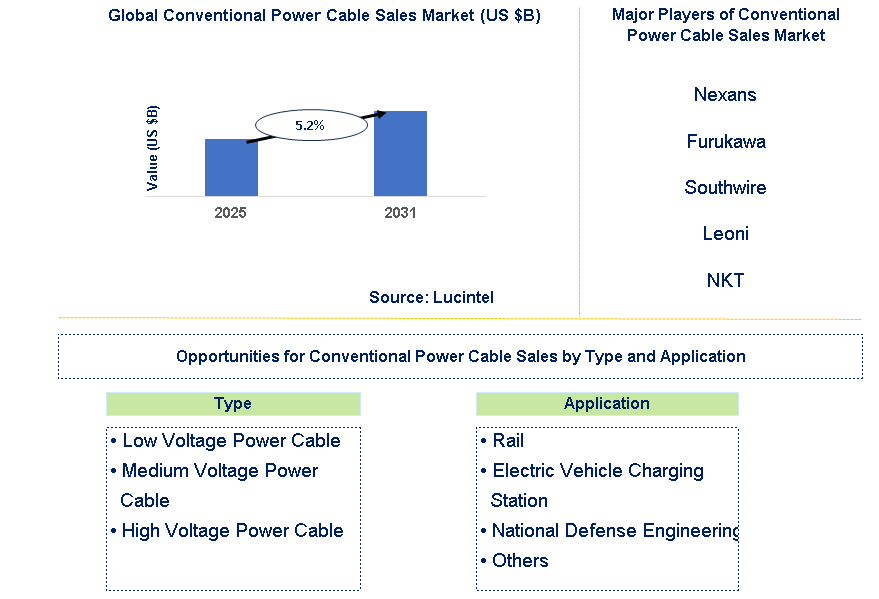
Key data points: The growth forecast = 5.2% annually for the next 7 years. Scroll below to get more insights. This market report covers Trends, opportunities and forecasts in conventional power cable sales market to 2031 by type (low voltage power cable, medium voltage power cable, and high voltage power cable), application (rail, electric vehicle charging station, national defense engineering, and others), and region (North America, Europe, Asia Pacific, and the Rest of the World)
We'll send your sample report shortly.
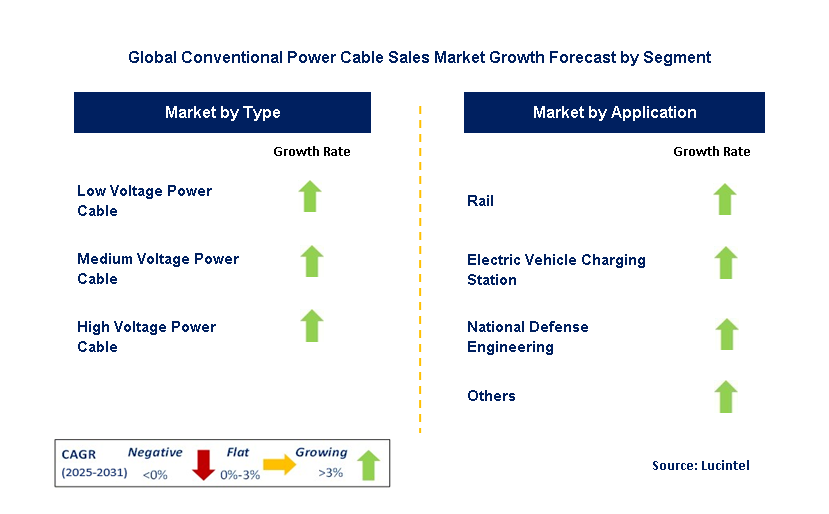
• Lucintel forecasts that, within the type category, low voltage power cable is expected to witness the highest growth over the forecast period due to the increasing need for power distribution system.
• Within the application category, electric vehicle charging station is expected to witness the highest growth due to the growing demand for charging infrastructure.
• In terms of region, APAC is expected to witness the highest growth over the forecast period.
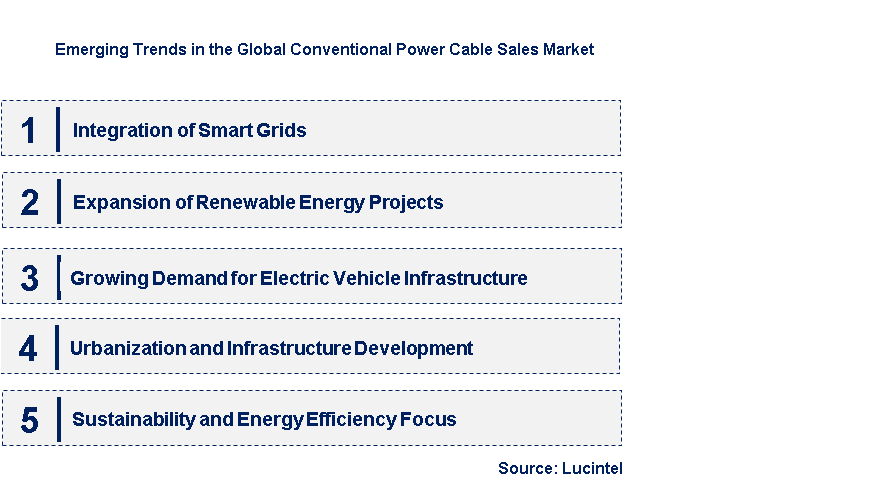
• Integration of Smart Grids: The transition to smart grids is transforming the traditional power cable industry. Smart grids utilize sophisticated communication systems to enhance the distribution of electricity, increase energy efficiency, and provide real-time monitoring. Traditional cables employed in smart grids need to handle greater levels of connectivity, reliability, and safety. Growing demand for infrastructure of smart grids, especially within developed economies, is fueling the expansion of high-end power cables designed to address sophisticated electrical distribution systems.
• Expansion of Renewable Energy Projects: The world drive towards renewable energy is strongly impacting the need for traditional power cables. Renewable energy projects like wind farms, solar power plants, and hydroelectric power plants involve large cabling to feed electricity into the grid. As governments and industries make investments in cleaner power sources, the traditional power cable industry is gaining from the demand for power cables with the capacity to handle huge levels of electricity produced by renewable sources and distribute it in an efficient manner to end-users.
• Growing Demand for Electric Vehicle Infrastructure: With electric vehicles (EVs) gaining increasing popularity, the demand for a strong EV charging infrastructure is expanding at a very fast pace. Traditional power cables are also key to providing efficient and safe charging stations for EVs. Increased demand for EVs is directly paving the way for the growth of the traditional power cable market since traditional power cables are needed to link charging stations with the electrical grid. As more nations are investing in EV infrastructure, this trend is likely to fuel demand for traditional power cables in the foreseeable future.
• Urbanization and Infrastructure Development: The current urbanization and infrastructure growth in developing economies are fueling the demand for traditional power cables. With increasing urbanization and new infrastructure developments, there is a need for dependable and long-lasting power cables for numerous applications, such as residential complexes, industrial facilities, and transportation networks. This is particularly evident in nations such as China and India, where rapid urbanization is taking place. The market for power cables is also likely to grow rapidly in these markets to meet the expanding demand for electricity transmission and infrastructure.
• Sustainability and Energy Efficiency Focus: There is a shift in focus towards energy efficiency and sustainability in the traditional power cable industry. Governments, companies, and consumers are increasingly aware of their environmental footprint, which is driving the creation of energy-efficient cables that minimize power loss when transmitting. This is driving manufacturers to create power cables that are more sustainable, such as the use of recyclable materials and energy-efficient production processes. With sustainability becoming a top priority, the traditional power cable market is being transformed to address these needs. The trends emerging in the traditional power cable sales market mirror the increased demand for effective, green, and dependable energy transmission networks. The application of smart grids, development of renewable energy schemes, and widespread use of electric vehicles are contributing majorly towards transforming the market. Additionally, increased urbanization and infrastructure development, along with the pressure towards sustainability and energy efficiency, are spurring technological advancements in power cables. As such trends keep unfolding, they are revolutionizing the traditional power cable market, promoting innovations in materials, design, and use to respond to the continually increasing need for energy infrastructure.
• Advances in Materials Technology: Improvements in cable materials, like the application of high-performance polymers and superconducting materials, have contributed considerably to increasing the efficiency and lifespan of traditional power cables. The materials facilitate cables to transfer higher voltages, over greater distances, and withstand harsh environmental conditions, thereby being suitable for numerous applications, ranging from renewable energy projects to urban infrastructure.
• Expansion of Renewable Energy Programs: Governments and industries across the globe are now more interested in developing renewable energy schemes, and this has strengthened the demand for traditional power cables. As solar, wind, and hydropower installations expand, the demand for efficient and effective power transmission networks is on the rise. This has resulted in enhanced sales of traditional cables to fund these projects, especially in markets such as China and Europe, where renewable energy projects are picking up pace.
• Growth of Electric Vehicle Infrastructure: The growth of electric vehicle infrastructure, such as the installation of electric vehicle charging stations, is driving the growth of the traditional power cable market. Electric vehicle adoption is increasing, and the resultant infrastructure requirements are fueling demand for power cables to facilitate these charging systems. This trend is likely to continue, especially in countries that are actively promoting the shift to electric mobility, such as Europe and the United States.
• Urbanization and Infrastructure Upgradation: Developing nations' fast-paced urbanization, along with continued infrastructure upgradation in developed nations, is driving demand for traditional power cables. Demand for high-quality power cables is being driven by the need for efficient power transmission systems for new residential, commercial, and industrial buildings. This phenomenon is especially prevalent in nations such as India and China, where mega-scale infrastructure development is taking place.
• Energy Efficiency Regulations by Government: The governments are bringing in more stringent regulations on carbon emissions and energy efficiency, which indirectly affect the traditional power cable market. Mandating the application of energy-efficient materials in the power transmission network is compelling companies to innovate and develop products with greater sustainability and energy-saving standards. The traditional power cable sales industry is being transformed by several technological innovations, growing renewable energy initiatives, and governmental policies favoring sustainability. These trends point towards the changing scenario of the sector and its contribution towards funding crucial infrastructure projects. With ongoing increases in demand for power transmission systems throughout the world, the traditional power cable market will remain in constant adaptation to ensure the provision of energy distribution and consumption needs in contemporary energy systems.
• Growth in Renewable Energy Projects: The rising trend towards cleaner energy sources such as wind, solar, and hydropower presents enormous growth opportunities for traditional power cables. With the development of renewable energy production, demand for effective and efficient power delivery systems increases. Power cables play a key function in linking renewable energy sources with the grid. This is a chance for suppliers to offer niche cables that have the capability of carrying high voltage and reducing loss of power in order to provide efficient transmission of energy over extended distances.
• Expansion of Electric Vehicle Charging Infrastructure: The increasing use of electric vehicles (EVs) brings about an increasing demand for charging infrastructure, which in turn increases the demand for power cables. EV charging stations need high-quality, long-lasting cables to enable fast charging and effective power delivery. As the world's EV market expands, producers of traditional power cables can benefit from this demand by providing cables specifically designed for EV charging stations, particularly those with high voltage and endurance against wear and tear due to environmental conditions.
• Infrastructure development and urbanization: As the world experiences quick urbanization, the demand for sophisticated infrastructure such as power transmission lines and networks is increasing. Urban areas and industrial estates need strong power cables for domestic, commercial, and industrial power distribution. This movement offers a big growth prospect for the power cable industry. Manufacturers can emphasize producing cables that respond to the stringent demands of city life, with higher durability, safety, and sustainability to match the power demand of populated areas.
• Smart Grids and Power System Digitalization: The creation of smart grids and rising digitalization of power networks trigger demand for the application of specific cables that allow for real-time data communication, automation, and optimal energy management. Smart grids depend on complex communication networks and power cables able to manage power as well as data. The opportunity for growth allows traditional manufacturers of power cables to evolve and produce cables with added features in both power as well as information transmission, increasing energy efficiency as well as system reliability.
• Compliance with Regulations and Environmental Standards: As regulations become tighter on the environmental front, the industry is under growing pressure to meet sustainability and green standards. This presents opportunities for the creation of environmentally-friendly and recyclable cable materials or production of cables with lower environmental degradation. Those companies that are able to innovate in terms of meeting these changing regulatory requirements will be poised to capture increasing demand for sustainable and environmentally friendly power cable solutions. The strategic opportunities for growth in the traditional power cable sales market are motivated by several drivers such as growth in renewable energy, growth in electric vehicles, urbanization, smart grid progress, and growth in regulatory demands. Companies that can innovate and transform to address these trends will be in good shape to leverage these growth opportunities. By targeting specialized power cables for these applications, the traditional power cable market will remain dynamic and address the shifting requirements of global infrastructure and energy delivery.
• Nexans
• Furukawa
• Southwire
• Leoni
• NKT
• KEI Industries
• Riyadh Cable
• Qingdao Hanhe Cable
• Jinlongyu Group
• Guangzhou Nanyang Cable Group
• Low Voltage Power Cable
• Medium Voltage Power Cable
• High Voltage Power Cable
• Rail
• Electric Vehicle Charging Station
• National Defense Engineering
• Others
• North America
• Europe
• Asia Pacific
• The Rest of the World
• United States: The United States has witnessed continuous growth in the traditional power cable market as a result of higher investment in infrastructure, such as expansion in renewable energy systems. With the emphasis being on upgrading the power grid and installing electric vehicle charging infrastructure, the demand for strong and secure power cables is on the upsurge. Additionally, governmental regulations favoring energy efficiency and environmentally friendly efforts have fueled growth in traditional cables used in residential and industrial spaces. The trend is also complemented by an increase in replacing aging cables with new ones within existing infrastructure.
• China: There has been fast-paced urbanization, industrialization, and government assistance for clean energy projects in China, and these have all made the demand for traditional power cables high. China is at the forefront of developing renewable energy, and this needs an extensive network of power distribution to be installed, increasing the demand for power cables. Furthermore, with ambitious smart city initiatives and the drive to upgrade infrastructure, China's traditional power cable market has been witnessing steady growth. There is also growing use of electric vehicles, further fueling cable demand across public and private sectors.
• Germany: Germany has been concentrating on upgrading its energy infrastructure as part of its energy transition to a more sustainable energy system. The nation is also moving out of nuclear power and expanding its renewable energy source usage like wind and sun. This process necessitates the laying of new conventional power cables, particularly in rural areas where renewable power generation is strongest. Germany's large manufacturing base is further supporting demand for power cables because factories and plants require efficient electric systems to work in a smooth way.
• India: India is one of the most rapidly growing markets for traditional power cables, with tremendous demand originating from its growing infrastructure and industrial sectors. The emphasis by the government on electrification and strengthening the power grid is propelling demand for power cables. Also, the shift toward renewable sources like solar and wind energy is generating more demand for traditional cables to supply and distribute power. The government's initiative towards rural electrification is also driving the growth of the traditional power cable industry as the nation attempts to provide stable electricity supply to remote regions.
• Japan: Japan's traditional power cable market is mainly spurred by the development of its industrial economy and continued initiatives to enhance energy efficiency. As the nation rebuilds after natural calamities such as the Fukushima nuclear accident, Japan is making significant investments in upgrading energy infrastructure and renewable energy systems. There is an increasingly high demand for traditional cables for power generation and distribution, particularly within cities. The initiative by Japan to adopt electric vehicles and upgrade infrastructure also contributes to demand for specialized power cables within residential and commercial sectors.


• Nexans
• Furukawa
• Southwire
• Leoni
• NKT
• KEI Industries
• Riyadh Cable
• Qingdao Hanhe Cable
• Jinlongyu Group
• Guangzhou Nanyang Cable Group Q5. Which conventional power cable sales market segment will be the largest in future? Answer: Lucintel forecasts that, within the type category, low voltage power cable is expected to witness the highest growth over the forecast period due to the increasing need for power distribution system. Q6. In conventional power cable sales market, which region is expected to be the largest in next 5 years? Answer: In terms of region, APAC is expected to witness the highest growth over the forecast period. Q7. Do we receive customization in this report? Answer: Yes, Lucintel provides 10% customization without any additional cost.


Choose a license that fits your team. Instant PDF delivery.
Prices exclude taxes. Instant delivery. Custom licensing available on request.
Market Report · July 22, 2026
Market Report · July 22, 2026
Market Report · July 17, 2026
Trusted partner for strategic intelligence and business growth


Receive a complimentary market analysis tailored to your industry. Our analysts will identify key growth opportunities and competitive dynamics specific to your business.

Market size, growth rate, and key trend analysis for your specific sector.

Top competitor positioning and market share analysis.

Strategic recommendations backed by data-driven insights.
Get curated market intelligence and competitive moves straight to your inbox.
By subscribing, you agree to receive our monthly insights. Unsubscribe anytime.
Receive a complimentary market analysis tailored to your industry. Our analysts will identify key growth opportunities and competitive dynamics specific to your business.
Market size, growth rate, and key trend analysis for your specific sector.
Top competitor positioning and market share analysis.
Strategic recommendations backed by data-driven insights.
Get curated market intelligence, emerging trends, and competitive moves straight to your inbox each month.
By subscribing, you agree to receive our monthly insights. Unsubscribe anytime.
We'll send your sample report shortly.