
Report Feature
Consumable-free Cell Counter Market Trends and Forecast
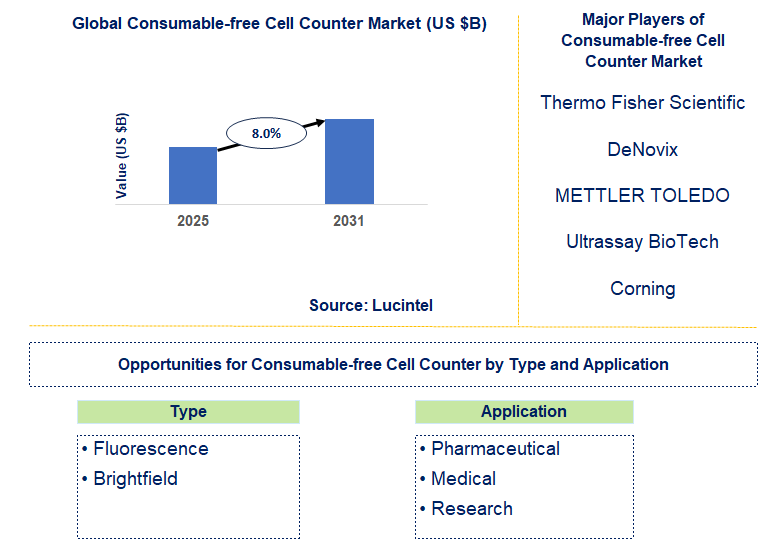
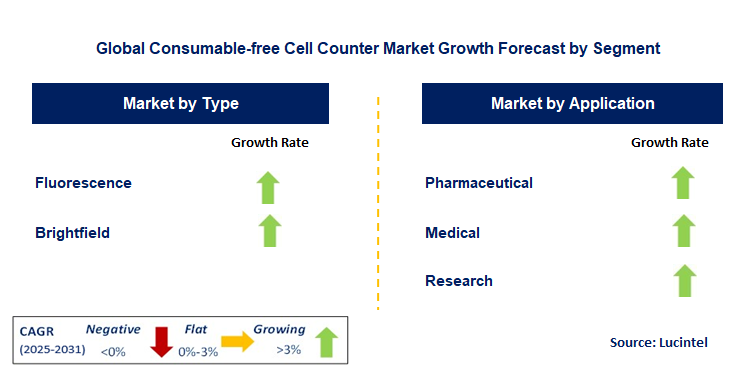
The future of the global consumable-free cell counter market looks promising with opportunities in the pharmaceutical, medical, and research markets. The global consumable-free cell counter market is expected to grow with a CAGR of 8% from 2025 to 2031. The major drivers for this market are the increasing demand for accurate cell counting solutions, the rising adoption of automated lab technologies, and the growing preference for consumable-free devices.• Lucintel forecasts that, within the type category, fluorescence is expected to witness higher growth over the forecast period.
• Within the application category, research is expected to witness the highest growth.
• In terms of region, APAC is expected to witness the highest growth over the forecast period. Gain valuable insights for your business decisions with our comprehensive 150+ page report. Sample figures with some insights are shown below.
Emerging Trends in the Consumable-free Cell Counter Market
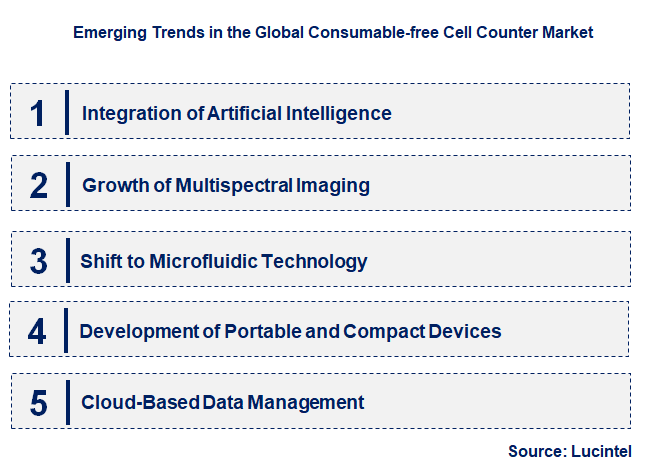
The consumable-free cell counter market is being reshaped by several key trends, reflecting a broader industry shift toward efficiency, intelligence, and accessibility. These trends are influencing instrument design, software capabilities, and market positioning, moving the technology beyond simple cell counting to comprehensive cell analysis and data management.• Integration of Artificial Intelligence: This trend involves incorporating AI and machine learning algorithms into cell counter software. The impact is enhanced accuracy and efficiency, as the system can automatically differentiate between cells and debris, and learn to recognize various cell types. This significantly reduces human error and speeds up analysis time.
• Growth of Multispectral Imaging: A key trend is the use of multispectral imaging in consumable-free cell counters, allowing for the analysis of multiple fluorescent stains simultaneously. The impact is a more comprehensive assessment of cell viability and function. This provides researchers with richer data from a single measurement, a crucial development for complex cell-based assays.
• Shift to Microfluidic Technology: The market is seeing a trend toward microfluidic-based systems, which can handle very small sample volumes with high precision. The impact is a reduction in sample and reagent consumption, making the process more cost-effective. This trend is particularly beneficial for high-value samples, such as those from clinical trials.
• Development of Portable and Compact Devices: There is an emerging trend of creating smaller, portable cell counters for use in a variety of settings. The impact is increased accessibility and flexibility, allowing for on-site cell counting in field research, point-of-care diagnostics, or small labs with limited space. This broadens the market's reach beyond large research institutions.
• Cloud-Based Data Management: This trend involves integrating cell counters with cloud-based software for data storage, analysis, and sharing. The impact is a more streamlined and collaborative research workflow. Researchers can access their data from anywhere, share it with colleagues, and perform advanced analysis, creating a more interconnected and efficient research environment. These emerging trends are fundamentally reshaping the consumable-free cell counter market, transforming it into a more intelligent, efficient, and accessible industry. The focus on AI and advanced imaging is improving data quality, while the move towards portability and cloud integration is making the technology more user-friendly and collaborative.
Recent Development in the Consumable-free Cell Counter Market
The consumable-free cell counter market is experiencing several key developments, driven by the demand for more accurate, efficient, and cost-effective solutions in life science research and diagnostics. These advancements are centered on improving instrument capabilities and expanding their applications to a broader range of users.• Launch of New Fluorescence Models: A significant development is the introduction of new models that incorporate advanced fluorescence-based counting. The impact is a more accurate differentiation between live and dead cells, which is crucial for cell viability analysis. This improves the reliability of data for applications like cell culture and drug discovery.
• Improved Software and User Interface: Manufacturers are focusing on developing more intuitive software and user interfaces. The impact is enhanced ease of use, which reduces the need for extensive training and minimizes human error. This development makes the technology more accessible to a wider range of users, including technicians in smaller laboratories.
• Integration with Automation and Robotics: Recent developments include the integration of consumable-free cell counters with automated liquid handlers and robotic systems. The impact is a shift towards high-throughput, hands-free workflows. This is particularly important for biopharmaceutical companies and contract research organizations that require efficient, scalable processes for quality control.
• Focus on Green Lab Initiatives: A key development is the market's alignment with sustainability and "green lab" initiatives. The impact is a reduced environmental footprint due to the elimination of plastic counting slides and disposable consumables. This appeals to institutions and researchers who are increasingly prioritizing eco-friendly practices in their operations.
• Market Consolidation and Partnerships: The market is seeing a trend of consolidation, with larger life science companies acquiring smaller, innovative manufacturers. The impact is an increase in research and development funding for new technologies. This allows for faster innovation and the development of more advanced products that meet evolving customer needs. These recent developments are collectively transforming the consumable-free cell counter market into a more sophisticated and environmentally conscious industry. The focus on automation, user experience, and sustainability is making the technology more appealing to a broader user base. These advancements are crucial for the market's continued expansion.
Strategic Growth Opportunities in the Consumable-free Cell Counter Market
The consumable-free cell counter market offers strategic growth opportunities across key applications, driven by a growing need for efficiency and precision in various life science fields. These opportunities are focused on expanding into new segments and leveraging the technology's advantages to provide solutions for specific industry needs.• Targeting the Pharmaceutical and Biotech Sector: The most significant growth opportunity is in the pharmaceutical and biotechnology industry, particularly for drug discovery and cell therapy development. The impact is a high-value customer base that requires high-throughput, accurate, and reliable cell counting for quality control and R&D.
• Expansion into Clinical Diagnostics: There is an opportunity to expand into the clinical diagnostics market, providing a cost-effective solution for blood cell counting and other clinical applications. The impact is a new revenue stream and a broader market. This requires meeting stringent regulatory standards but offers a large and stable market.
• Serving the Food and Beverage Industry: The food and beverage industry, which requires microbial cell counting for quality control, presents a new application. The impact is a diversification of the customer base. By providing a rapid and easy-to-use counter, companies can serve this growing industry that needs to ensure product safety and quality.
• Focus on Academic and Research Institutions: The academic and research sector remains a core growth opportunity. The impact is a reliable customer base with a constant need for cell counting for a wide variety of research. By offering affordable and durable instruments with robust features, companies can secure a strong foothold in this segment.
• Developing for Stem Cell Research: The rapidly growing field of stem cell research and regenerative medicine offers a high-potential growth opportunity. The impact is a demand for specialized counters that can accurately assess the viability and purity of stem cell cultures. This is a high-growth, high-value segment. These strategic growth opportunities highlight the market's potential beyond its traditional base. By focusing on high-value applications in the biopharmaceutical sector, expanding into new industries like food and clinical diagnostics, and continuing to serve academic research, the consumable-free cell counter market can achieve significant and sustainable growth.
Consumable-free Cell Counter Market Driver and Challenges
The consumable-free cell counter market is propelled by a combination of powerful drivers and significant challenges. The major drivers, including the growth of the life science industry and the need for cost reduction, are fueling expansion. However, it must also address key challenges related to accuracy and competition to maintain its growth trajectory. The factors responsible for driving the consumable-free cell counter market include: 1. Growing Focus on Cost Reduction: The elimination of expensive, single-use consumables is a major driver. This reduces the long-term operational costs for laboratories, making consumable-free counters a financially attractive alternative to traditional methods. This is particularly appealing to budget-conscious academic and research institutions. 2. Increasing Research and Development Funding: The significant increase in R&D funding for biotechnology, pharmaceuticals, and cell-based therapies is a key driver. As more research is conducted, there is a greater demand for efficient and accurate tools like consumable-free cell counters to support cell culture and analysis. 3. Need for High-Throughput Screening: The shift toward high-throughput screening in drug discovery and bioprocessing is a major driver. Consumable-free counters, especially those with automated features, are essential for rapidly analyzing a large number of samples, which is necessary for a fast and efficient research workflow. 4. Rising Awareness of Environmental Sustainability: A growing number of laboratories and institutions are adopting "green lab" initiatives to reduce their environmental footprint. The elimination of plastic consumables aligns with these goals. This trend is a strong driver, as it resonates with the values of a growing number of end-users. 5. Accuracy and Reliability Improvements: Technological advancements in optics and software have significantly improved the accuracy and reliability of consumable-free cell counters. This overcomes a historical barrier to adoption and makes the technology a viable and trusted alternative to manual or consumable-based methods. Challenges in the consumable-free cell counter market are: 1. Accuracy Issues with Cellular Debris: A significant challenge is the potential for consumable-free counters to misidentify cellular debris as viable cells, which can lead to inaccurate counts. While AI is helping, it remains a challenge, particularly with complex or dirty samples, and can affect the reliability of the data. 2. Competition from Manual Counting: Despite their advantages, consumable-free counters face competition from traditional, manual hemocytometer methods. These methods are inexpensive, widely understood, and are often preferred by smaller labs with low sample throughput or budget constraints, limiting the market for automated instruments. 3. Initial High Cost of Investment: The initial high cost of purchasing a consumable-free cell counter can be a significant barrier to adoption. This can be prohibitive for small startups, individual labs, or institutions with limited capital budgets, despite the promise of long-term cost savings on consumables. The consumable-free cell counter market is driven by compelling factors such as cost savings and technological innovation, which are positioning it for strong growth. However, to fully realize its potential, the market must address challenges related to overcoming accuracy limitations, competing with traditional methods, and reducing the initial high cost of investment for a broader customer base.List of Consumable-free Cell Counter Companies
Companies in the market compete on the basis of product quality offered. Major players in this market focus on expanding their manufacturing facilities, R&D investments, infrastructural development, and leverage integration opportunities across the value chain. With these strategies consumable-free cell counter companies cater increasing demand, ensure competitive effectiveness, develop innovative products & technologies, reduce production costs, and expand their customer base. Some of the consumable-free cell counter companies profiled in this report include-• Thermo Fisher Scientific
• DeNovix
• METTLER TOLEDO
• Ultrassay BioTech
• Corning
• Ningbo Lixian Intelligent Technology
• Gaofen Biotechnology
Consumable-free Cell Counter Market by Segment
The study includes a forecast for the global consumable-free cell counter market by type, application, and region.Consumable-free Cell Counter Market by Type [Value from 2019 to 2031]:
• Fluorescence
• Brightfield
Consumable-free Cell Counter Market by Application [Value from 2019 to 2031]:
• Pharmaceutical
• Medical
• Research
Consumable-free Cell Counter Market by Region [Value from 2019 to 2031]:
• North America
• Europe
• Asia Pacific
• The Rest of the World
Country Wise Outlook for the Consumable-free Cell Counter Market
The consumable-free cell counter market is experiencing significant growth, driven by the increasing need for cost-effective and efficient cell analysis in research and bioproduction. Recent developments are centered on technological advancements, such as improved optics and software, which are enhancing accuracy and ease of use, making these instruments more accessible and reliable for a broader range of applications.• United States: The U.S. market, a global leader in life sciences, is seeing robust adoption of consumable-free cell counters in academic and biopharmaceutical research. Recent developments are focused on advanced models with enhanced imaging and data analysis software. The trend is also toward integration into automated workflows, catering to the demand for high-throughput screening and reducing human error.
• China: China’s market is rapidly expanding, fueled by a surge in biopharma and academic research. Recent developments are focused on a mix of local production and partnerships with international companies. Local manufacturers are offering competitively priced instruments, while global players are adapting their products to meet the needs of the vast and growing Chinese market.
• Germany: Germany’s market is characterized by a strong emphasis on precision engineering and quality. Recent developments are centered on creating highly accurate and reliable instruments for use in stringent quality control processes. The market is also seeing a push for automation and integration with other lab equipment, reflecting a focus on streamlined and efficient lab workflows.
• India: The Indian market is experiencing a significant increase in demand for consumable-free cell counters, driven by the rapid growth of its biopharmaceutical and academic sectors. Recent developments include an increase in imports of advanced instruments and a rise in local distribution networks. The focus is on providing cost-effective and durable solutions for a growing number of research institutions.
• Japan: Japan's market is mature and technology-driven, with recent developments focusing on high-end instruments with advanced features. The market is seeing a strong demand for cell counters that can perform complex analysis, such as distinguishing between different cell types and assessing viability with high accuracy. The focus is on innovation and quality for sophisticated research applications.

Features of the Global Consumable-free Cell Counter Market
Market Size Estimates: Consumable-free cell counter market size estimation in terms of value ($B). Trend and Forecast Analysis: Market trends (2019 to 2024) and forecast (2025 to 2031) by various segments and regions. Segmentation Analysis: Consumable-free cell counter market size by type, application, and region in terms of value ($B). Regional Analysis: Consumable-free cell counter market breakdown by North America, Europe, Asia Pacific, and Rest of the World. Growth Opportunities: Analysis of growth opportunities in different types, applications, and regions for the consumable-free cell counter market. Strategic Analysis: This includes M&A, new product development, and competitive landscape of the consumable-free cell counter market. Analysis of competitive intensity of the industry based on Porter’s Five Forces model.
FAQ
Q1. What is the growth forecast for consumable-free cell counter market? Answer: The global consumable-free cell counter market is expected to grow with a CAGR of 8% from 2025 to 2031. Q2. What are the major drivers influencing the growth of the consumable-free cell counter market? Answer: The major drivers for this market are the increasing demand for accurate cell counting solutions, the rising adoption of automated lab technologies, and the growing preference for consumable-free devices. Q3. What are the major segments for consumable-free cell counter market? Answer: The future of the consumable-free cell counter market looks promising with opportunities in the pharmaceutical, medical, and research markets. Q4. Who are the key consumable-free cell counter market companies? Answer: Some of the key consumable-free cell counter companies are as follows:• Thermo Fisher Scientific
• DeNovix
• METTLER TOLEDO
• Ultrassay BioTech
• Corning
• Ningbo Lixian Intelligent Technology
• Gaofen Biotechnology Q5. Which consumable-free cell counter market segment will be the largest in future? Answer: Lucintel forecasts that, within the type category, fluorescence is expected to witness higher growth over the forecast period. Q6. In consumable-free cell counter market, which region is expected to be the largest in next 5 years? Answer: In terms of region, APAC is expected to witness the highest growth over the forecast period. Q7. Do we receive customization in this report? Answer: Yes, Lucintel provides 10% customization without any additional cost.
Table of Contents
Methodology
- In-depth interviews of the major players in this market
- Detailed secondary research from competitors’ financial statements and published data
- Extensive searches of published works, market, and database information pertaining to industry news, company press releases, and customer intentions
- A compilation of the experiences, judgments, and insights of Lucintel’s professionals, who have analyzed and tracked this market over the years.


Buy Now
Choose a license that fits your team. Instant PDF delivery.
Prices exclude taxes. Instant delivery. Custom licensing available on request.
Key Questions
- • What are some of the most promising, high-growth opportunities for the consumable-free cell counter market by type (fluorescence and brightfield), application (pharmaceutical, medical, and research), and region (North America, Europe, Asia Pacific, and the Rest of the World)?
- • Which segments will grow at a faster pace and why?
- • Which region will grow at a faster pace and why?
- • What are the key factors affecting market dynamics? What are the key challenges and business risks in this market?
- • What are the business risks and competitive threats in this market?
- • What are the emerging trends in this market and the reasons behind them?
- • What are some of the changing demands of customers in the market?
- • What are the new developments in the market? Which companies are leading these developments?
- • Who are the major players in this market? What strategic initiatives are key players pursuing for business growth?
- • What are some of the competing products in this market and how big of a threat do they pose for loss of market share by material or product substitution?
- • What M&A activity has occurred in the last 5 years and what has its impact been on the industry? For any questions related to Consumable-free Cell Counter Market, Consumable-free Cell Counter Market Size, Consumable-free Cell Counter Market Growth, Consumable-free Cell Counter Market Analysis, Consumable-free Cell Counter Market Report, Consumable-free Cell Counter Market Share, Consumable-free Cell Counter Market Trends, Consumable-free Cell Counter Market Forecast, Consumable-free Cell Counter Companies, write Lucintel analyst at email: helpdesk@lucintel.com. We will be glad to get back to you soon.


