
Market Report · July 22, 2026

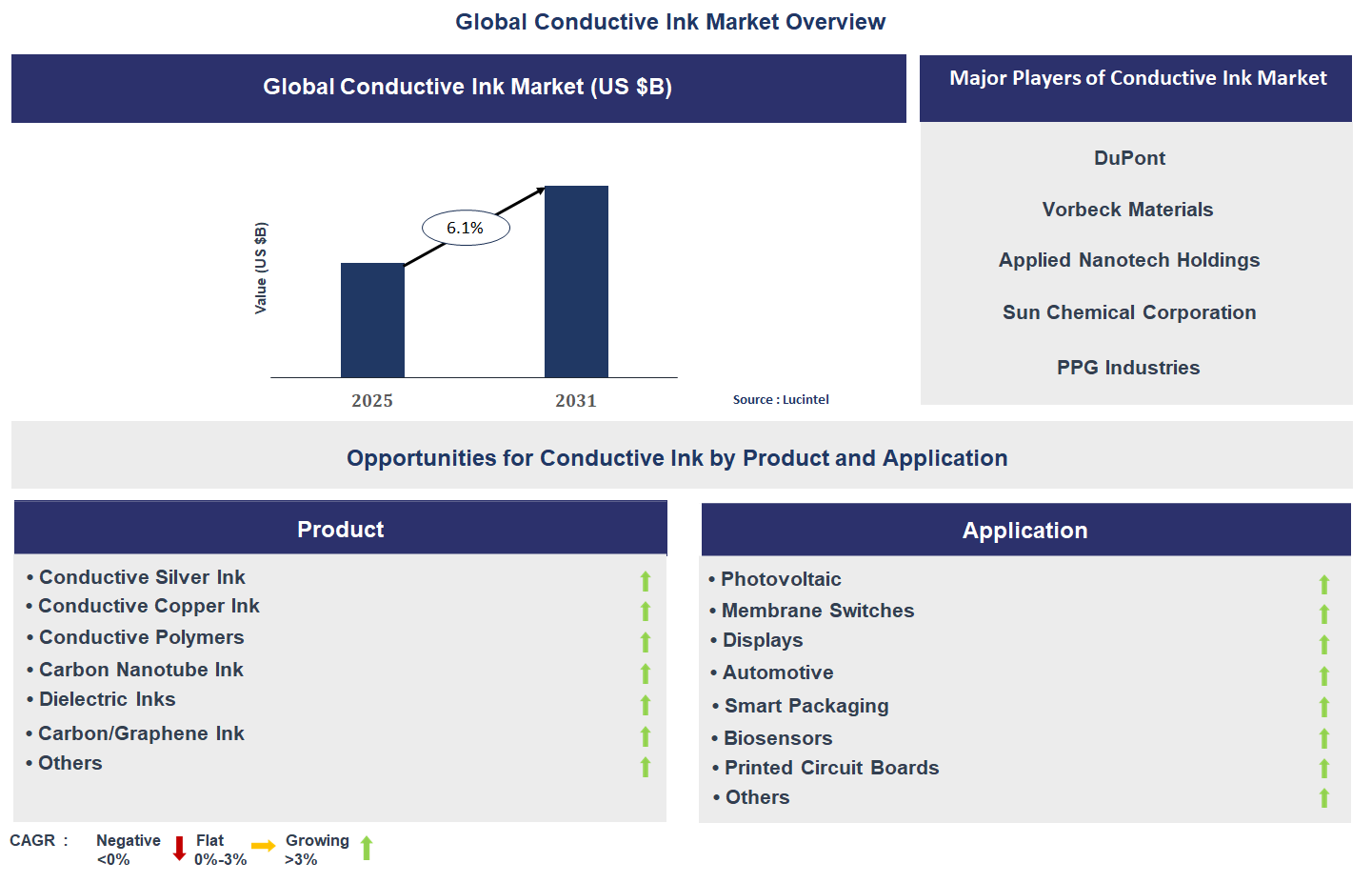
Key data points: The growth forecast = 6.1% annually for the next 7 years. Scroll below to get more insights. This market report covers trends, opportunities and forecasts in conductive ink market to 2031 by product (conductive silver ink, conductive copper ink, conductive polymers, carbon nanotube ink, dielectric inks, carbon/graphene ink, and others), application (photovoltaic, membrane switches, displays, automotive, smart packaging, biosensors, printed circuit boards, and others), and region (North America, Europe, Asia Pacific, and the Rest of the World)
We'll send your sample report shortly.
• Lucintel forecasts that, within the product category, conductive silver ink is expected to witness the highest growth over the forecast period.
• Within the application category, photovoltaic is expected to witness the highest growth.
• In terms of region, APAC is expected to witness the highest growth over the forecast period. Gain valuable insights for your business decisions with our comprehensive 150+ page report. Sample figures with some insights are shown below.
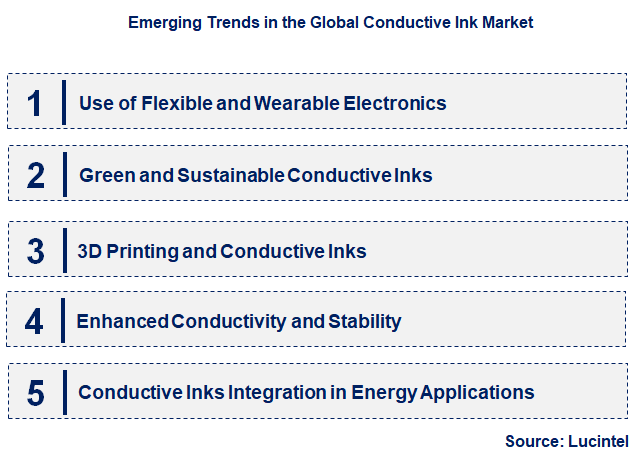
• Use of Flexible and Wearable Electronics: Flexible and wearable electronics are one of the major growth drivers in the conductive ink market. With the increase in IoT devices, wearables, and smart fabrics, the need for conductive inks that are printable on flexible substrates is on the rise. These inks play a vital role in creating lightweight, stretchable circuits that can be used in clothing, health monitoring devices, and other portable electronics. With wearable technology becoming increasingly popular, manufacturers of conductive inks are considering making their products more flexible, more conductive, and more durable.
• Green and Sustainable Conductive Inks: There is an emerging trend toward sustainable conductive inks using sustainable resources and processes. The trend is primarily motivated by the need for green technology and minimizing the environmental footprint of electronics manufacturing. Inks are being formulated from renewable sources, e.g., plant-based polymers, for use in green electronics. These eco-friendly inks not only save the environment from waste but also attract consumers and producers seeking less polluting options in electronics manufacturing.
• 3D Printing and Conductive Inks: 3D printing is a technology that is changing the application of conductive inks in electronics production. Conductive inks are becoming more commonly used in 3D printing to produce custom electronic components. This convergence enables increased prototyping speed, increased design flexibility, and lower manufacturing costs. As the applications of 3D printing grow, the demand for conductive inks will keep expanding, particularly in fields such as healthcare, the automotive sector, and consumer electronics, where tailored solutions are highly sought after.
• Enhanced Conductivity and Stability: To keep up with the increasing call for high-performance electronics, manufacturers are making efforts to enhance the durability and conductivity of conductive inks. With the incorporation of newer materials like silver nanoparticles and carbon-based materials, conductive inks are becoming more consistent and fit for use in applications calling for long-term performance. With greater conductivity, these inks are also suitable for the production of high-speed communication technologies, energy-harvesting devices, and automotive sensors, which opens new frontiers for conductive ink usage.
• Conductive Inks Integration in Energy Applications: Conductive inks are now being utilized in energy-based applications including solar cells and energy-harvesting devices. Conductive inks are being incorporated into thin-film solar cells, where they serve as the conductive layer responsible for energy transfer. As demand for renewable energy continues to grow, conductive inks are becoming critical in making solar cells efficient and cost-effective. In addition, such inks are also applied in energy storage devices and energy management sensors, further broadening the uses of conductive inks in the energy field. These nascent trends are transforming the conductive ink market by influencing innovations around flexibility, sustainability, and functionality. The use of conductive inks in flexible electronics, green formulations, and energy applications is presenting new opportunities and overcoming the challenges of contemporary manufacturing. As these trends mature, the market will continue to grow, with conductive inks playing an integral role in driving next-generation technologies in a variety of industries.
• High-Performance Conductive Inks Development: The market has witnessed the creation of high-performance conductive inks with higher conductivity and stability. New formulations such as inks prepared using silver, carbon nanotubes, and graphene are offering better performance for high-end applications like 5G electronics and automotive sensors. The inks provide good conductivity even in low quantities, making way for more efficient and lasting printed electronics, and thus make them suitable for applications where high performance is needed.
• Advancements in Printing Technologies: There has been considerable progress in printing techniques applied to conductive inks. Inkjet and screen printing are being optimized, with enhanced accuracy and manufacturing scale. These advances are facilitating the easy and affordable production of high volumes of printed electronics. Consequently, the application of conductive inks for mass-produced items like flexible displays, sensors, and wearables is gaining momentum.
• Introduction of Environmentally Friendly Conductive Inks: With the increase in demand for green products, companies are launching environmentally friendly conductive inks that are made using sustainable materials. These conductive inks are free from toxic materials like lead and cadmium and can be manufactured through green process manufacturing. The introduction of these green inks is aiding in compliance with regulation needs and meeting the demand for environmentally friendly products on the part of customers.
• Conductive Inks Integration in Smart Packaging: Conductive inks are being increasingly used in smart packaging applications. Through printing conductive circuits on packaging materials, businesses can develop packaging that provides RFID tags, sensors, and interactive displays. This innovation is broadening the applications of conductive inks to sectors such as retail, logistics, and healthcare, where smart packaging solutions become increasingly vital for product tracking and real-time information delivery to consumers.
• Research and Development Partnerships: Partnerships among research organizations, research institutes, and business firms have led to various new developments in conductive ink technology. Such partnerships are faster-tracking the production of next-generation inks that are not only more effective but also cheaper to manufacture. Joint ventures also assist in ramping up the manufacturing of conductive inks such that producers can address increasing demand from various industries. These new developments are propelling growth in the conductive ink market. With advances in performance, printing technologies, and sustainability, conductive inks are being used in a wider range of industries. These developments are facilitating new applications, lowering the cost of production, and enhancing the functionality of electronic devices, ultimately boosting the potential for future growth in the market.
• Growth into Flexible Electronics: The need for bendable and foldable electronics is opening up new avenues for conductive ink uses. With the increasing use of smartphones, wearables, and flexible displays, conductive inks that support efficient and long-lasting circuits on flexible substrates will become increasingly needed. Specialized companies dealing in printable electronics are positioned to benefit from this expanding market by creating inks that are specifically intended for use in such new devices.
• Expansion in Solar and Energy Harvesting Applications: Conductive inks are also a key factor in the creation of energy-efficient products such as thin-film solar cells and energy-harvesting devices. Direct printing of conductive inks onto flexible substrates ensures that they are suitable for low-cost, high-performance solar panels. With the rise in demand for renewable energy, the application of conductive inks to energy applications is likely to grow in size, providing strong opportunities for growth to manufacturers in the energy industry.
• Use of Conductive Inks in Automotive Electronics: The automotive sector is increasingly using conductive inks for applications in flexible sensors, printed circuits, and intelligent vehicle displays. With cars becoming smarter and more integrated, demand for stable, affordable electronics will continue to grow. Conductive inks are offering a more flexible and lighter solution for auto applications, enabling companies to be innovative in autonomous driving, infotainment systems, and energy management.
• Smart Packaging Solution Development: The growth of intelligent packaging applications across industries such as retail, healthcare, and logistics is opening up new avenues for conductive ink technologies. Conductive inks can be applied to print circuits on packaging materials, allowing features such as RFID tags, sensors, and interactive displays. With companies seeking solutions to increase customer experience and streamline supply chains, applications of conductive inks in intelligent packaging will increase further.
• Advances in Healthcare Applications: In the medical field, conductive inks are utilized for wearable sensor development, diagnosis devices, and even implants. These inks enable the production of lightweight, flexible, and affordable electronic components that are vital for monitoring patient health in real time. With the healthcare industry adopting IoT solutions and wearable devices, manufacturers of conductive ink have a huge chance to supply inks that address the increased demand for medical technology. The conductive ink industry offers many strategic growth opportunities in a wide range of industries. While flexible electronics, renewable energy, automotive technologies, smart packaging, and healthcare applications continue to develop, conductive inks will be central to determining the future direction of these industries. By seizing these opportunities, businesses can increase their share of the market and fuel innovation in the future.
• DuPont
• Vorbeck Materials
• Applied Nanotech Holdings
• Sun Chemical Corporation
• PPG Industries
• Creative Materials
• Poly-Ink
• Henkel
• PChem Associates
• Johnson Matthey Colour Technologies
• Conductive Silver Ink
• Conductive Copper Ink
• Conductive Polymers
• Carbon Nanotube Ink
• Dielectric Inks
• Carbon/Graphene Ink
• Others
• Photovoltaic
• Membrane Switches
• Displays
• Automotive
• Smart Packaging
• Biosensors
• Printed Circuit Boards
• Others
• North America
• Europe
• Asia Pacific
• The Rest of the World
• United States: There has been considerable growth in the conductive ink industry in the United States, fueled by robust research and development activity and the broadening need for flexible electronics. Firms such as DuPont and conductive ink startups are keenly formulating newer formulations that enhance conductivity, longevity, and eco-friendliness. The U.S. is intensively concentrating on innovations in consumer electronics, automotive, and healthcare devices. Apart from this, government grants for research are also funding advancements in the fields of printed electronics and IoT uses. With increased demand for printable electronics, the U.S. is solidifying its position as the leader in conductive ink technologies.
• China: China is quickly becoming a world center for the conductive ink industry. The large production capacity of the country, high R&D investment, and fast development of printed electronics in several industries have boosted growth. Chinese corporations such as TONGDA Group are seeking new ways of manufacturing conductive inks with better electrical properties. Increasing demand for flexible displays, wearables, and solar cells in China is also propelling the demand for next-generation conductive inks. As the Chinese government continues to focus on technology and innovation, the market will continue to grow, boosting greater international competition and cooperation.
• Germany: Germany has had a long reputation for engineering prowess, and the conductive ink industry is no different. German producers are concentrating on high-performance conductive inks for use in automotive, industrial sensors, and medical applications. The top universities and research institutes in the country are pushing the development of new conductive ink products to meet the rigorous requirements of accuracy and dependability needed in industrial use. Germanys focus on green technologies and sustainability has also resulted in the creation of environmentally friendly conductive inks, which are increasingly popular among companies looking to minimize their footprint.
• India: India is emerging as a key player in the market for conductive inks, with increasing focus on electronics manufacturing and innovation. The nations strong IT industry and growing need for consumer electronics have opened up possibilities for conductive ink uses, specifically in printed circuit boards and flexible electronics. Indian companies are just starting to take up conductive inks as a means of use in sensors and solar power systems. Although the market is just in development, Indias emphasis on establishing a more sophisticated electronics manufacturing infrastructure holds great potential for increased future expansion of conductive ink technologies.
• Japan: Japan has dominated electronics and technology for decades, and the conductive ink industry is no different. Japanese manufacturers such as Panasonic and Mitsubishi are at the forefront of producing conductive inks for cutting-edge applications like OLED displays, touch sensors, and wearable devices. Japans strong focus on innovation in the area of smart devices and heavy R&D investments are positioning Japan as a prominent actor in the conductive ink market. Japan also focuses on energy-saving products, which is stimulating the demand for conductive inks in energy-harvesting devices and flexible solar cells.


• DuPont
• Vorbeck Materials
• Applied Nanotech Holdings
• Sun Chemical Corporation
• PPG Industries
• Creative Materials
• Poly-Ink
• Henkel
• PChem Associates
• Johnson Matthey Colour Technologies Q5. Which conductive ink market segment will be the largest in future? Answer: Lucintel forecasts that, within the product category, conductive silver ink is expected to witness the highest growth over the forecast period. Q6. In conductive ink market, which region is expected to be the largest in next 5 years? Answer: In terms of region, APAC is expected to witness the highest growth over the forecast period. Q7. Do we receive customization in this report? Answer: Yes, Lucintel provides 10% customization without any additional cost.


Choose a license that fits your team. Instant PDF delivery.
Prices exclude taxes. Instant delivery. Custom licensing available on request.
Market Report · July 22, 2026
Market Report · July 22, 2026
Market Report · July 22, 2026
Trusted partner for strategic intelligence and business growth


Receive a complimentary market analysis tailored to your industry. Our analysts will identify key growth opportunities and competitive dynamics specific to your business.

Market size, growth rate, and key trend analysis for your specific sector.

Top competitor positioning and market share analysis.

Strategic recommendations backed by data-driven insights.
Get curated market intelligence and competitive moves straight to your inbox.
By subscribing, you agree to receive our monthly insights. Unsubscribe anytime.
Receive a complimentary market analysis tailored to your industry. Our analysts will identify key growth opportunities and competitive dynamics specific to your business.
Market size, growth rate, and key trend analysis for your specific sector.
Top competitor positioning and market share analysis.
Strategic recommendations backed by data-driven insights.
Get curated market intelligence, emerging trends, and competitive moves straight to your inbox each month.
By subscribing, you agree to receive our monthly insights. Unsubscribe anytime.
We'll send your sample report shortly.