
Report Feature
Compound Weave Conveyor Belt Market Trends and Forecast
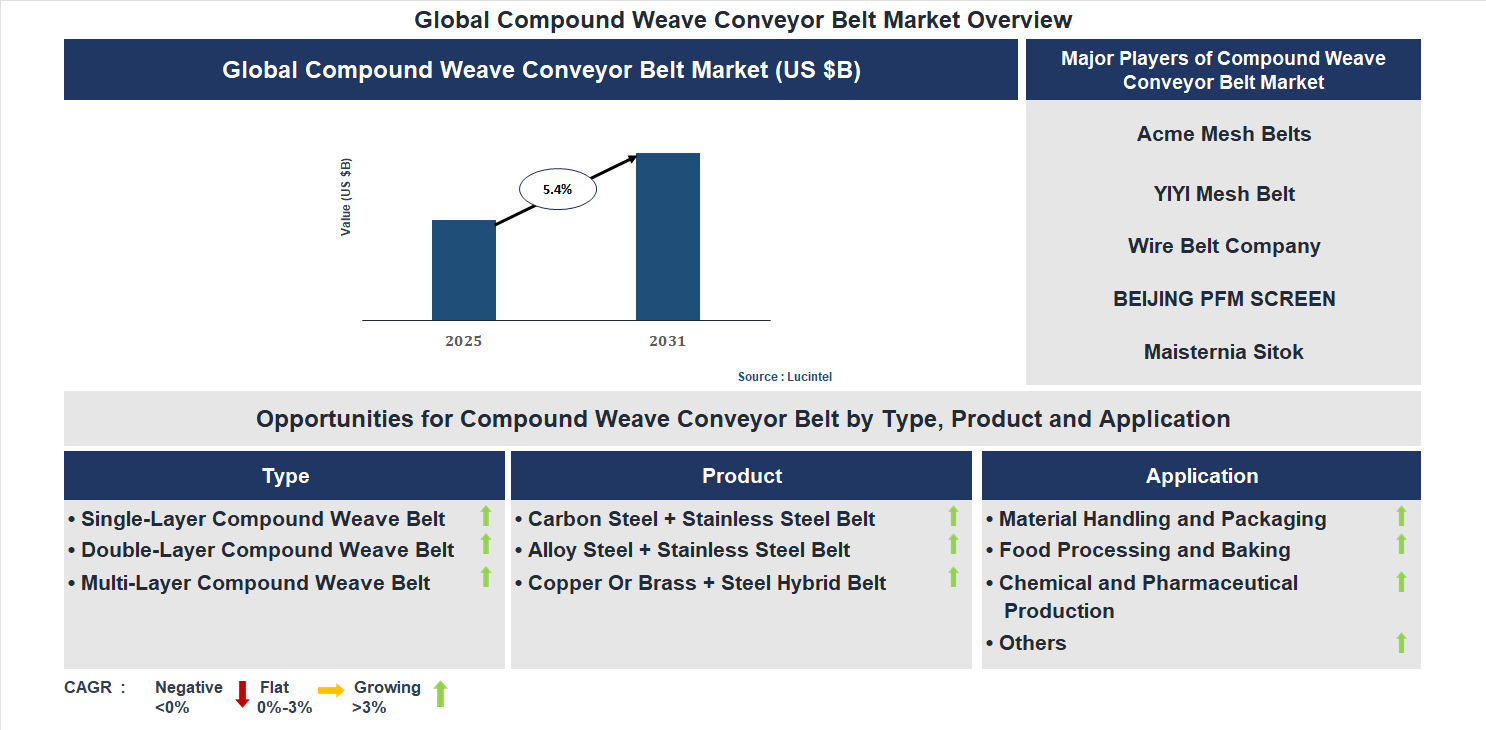
The future of the global compound weave conveyor belt market looks promising with opportunities in the material handling & packaging, food processing & baking, and chemical & pharmaceutical production markets. The global compound weave conveyor belt market is expected to grow with a CAGR of 5.4% from 2025 to 2031. The major drivers for this market are the rising investments in warehousing & logistics infrastructure and the increase in investments in port & bulk material handling facilities.• Lucintel forecasts that, within the type category, multi-layer compound weave belt is expected to witness the highest growth over the forecast period.
• Within the application category, material handling & packaging is expected to witness the highest growth.
• In terms of region, APAC is expected to witness the highest growth over the forecast period. Gain valuable insights for your business decisions with our comprehensive 150+ page report. Sample figures with some insights are shown below.
Emerging Trends in the Compound Weave Conveyor Belt Market
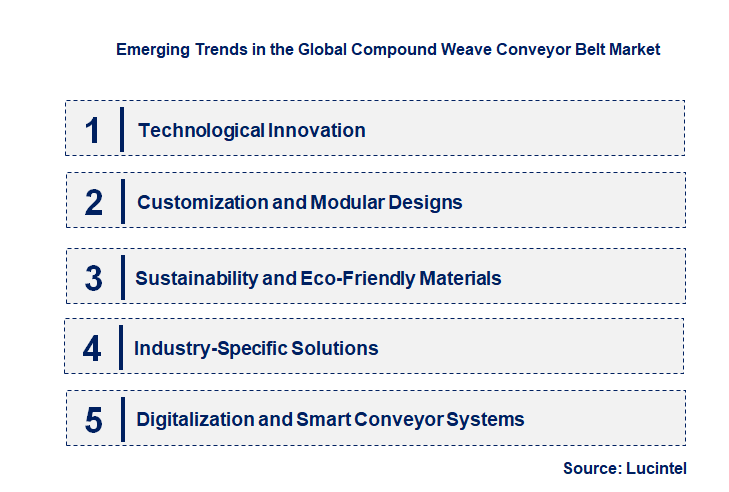
The compound weave conveyor belt market is experiencing rapid evolution driven by technological advancements, increasing industrial automation, and a growing emphasis on efficiency and safety. As industries such as manufacturing, food processing, and logistics seek more durable and adaptable solutions, market players are innovating to meet these demands. Emerging trends are shaping the future landscape, influencing product development, supply chain dynamics, and customer expectations. These developments are not only enhancing operational performance but also fostering sustainability and customization, making the market more competitive and dynamic. Understanding these key trends is essential for stakeholders aiming to capitalize on growth opportunities and stay ahead in this evolving sector.• Technological Innovation: The integration of advanced materials and manufacturing techniques is leading to more durable, flexible, and heat-resistant conveyor belts. Innovations such as silicone coatings, anti-static properties, and improved tensile strength are enhancing product lifespan and performance. This trend allows industries to reduce downtime, maintenance costs, and improve safety standards, ultimately increasing operational efficiency and reliability.
• Customization and Modular Designs: Increasing demand for tailored conveyor solutions is driving the development of customizable and modular belts. These designs enable easy installation, maintenance, and adaptability to specific industry needs. Customization improves process efficiency, reduces waste, and allows for seamless integration into existing systems, providing a competitive edge for manufacturers and end-users.
• Sustainability and Eco-Friendly Materials: Growing environmental concerns are prompting the adoption of eco-friendly materials such as biodegradable polymers and recycled components. These sustainable options reduce the carbon footprint of conveyor systems and align with corporate social responsibility goals. The shift towards greener products is also influencing regulatory standards and consumer preferences, fostering innovation in sustainable belt manufacturing.
• Industry-Specific Solutions: The market is witnessing a rise in industry-specific conveyor belts designed to meet unique operational requirements. For example, food-grade belts with hygienic features, or heavy-duty belts for mining applications. These specialized solutions improve process efficiency, safety, and compliance with industry standards, thereby expanding market reach and customer satisfaction.
• Digitalization and Smart Conveyor Systems: The adoption of IoT, sensors, and automation is transforming conveyor systems into smart, data-driven solutions. Real-time monitoring, predictive maintenance, and remote control capabilities enhance operational efficiency and reduce downtime. Digitalization also enables better inventory management and process optimization, making conveyor systems more intelligent and responsive to industry needs. In summary, these emerging trends are fundamentally reshaping the compound weave conveyor belt market by driving innovation, sustainability, customization, and digital transformation. They are enabling industries to achieve higher efficiency, safety, and environmental compliance, thus fostering a more competitive and resilient market landscape.
Recent Development in the Compound Weave Conveyor Belt Market
The compound weave conveyor belt market is experiencing rapid growth driven by technological advancements and increasing industrial demand. Innovations in materials and manufacturing processes are enhancing belt durability and efficiency. The rise of automation across sectors like manufacturing, logistics, and food processing is fueling market expansion. Additionally, sustainability initiatives are prompting the adoption of eco-friendly belts. Market players are investing heavily in R&D to develop customized solutions, which further accelerates growth. These developments collectively are transforming the landscape, offering new opportunities and challenges for stakeholders.• Technological advancements in belt materials: The development of high-performance, lightweight, and durable materials such as synthetic fibers and composites is significantly improving conveyor belt longevity and performance. These innovations reduce maintenance costs and downtime, making belts more reliable for demanding applications. Enhanced resistance to wear, chemicals, and temperature extremes broadens their usability across industries. As a result, manufacturers can offer tailored solutions, boosting market competitiveness and customer satisfaction. This progress is crucial for meeting evolving industrial needs and sustainability goals.
• Automation and Industry 4.0 integration: The integration of automation technologies and Industry 4.0 principles into conveyor systems is revolutionizing the market. Smart belts equipped with sensors enable real-time monitoring of performance, predictive maintenance, and reduced operational costs. Automated systems improve efficiency, safety, and throughput in manufacturing and logistics. This technological shift attracts industries seeking to optimize supply chains and reduce labor costs. As a result, the market is witnessing increased demand for intelligent conveyor belts, fostering innovation and growth in the sector.
• Rising demand from the food processing industry: The food processing sectors need for hygienic, safe, and efficient conveyor solutions is driving market growth. Compound weave belts with food-grade materials and easy-clean features are increasingly adopted to meet strict safety standards. These belts facilitate smooth handling of delicate products and reduce contamination risks. The expansion of processed food markets globally further amplifies demand. This trend encourages manufacturers to develop specialized belts, enhancing product quality and operational efficiency, and opening new revenue streams within the industry.
• Focus on sustainability and eco-friendly solutions: Environmental concerns are prompting the adoption of sustainable conveyor belt options. Manufacturers are developing belts with recyclable materials and energy-efficient manufacturing processes. These eco-friendly belts help companies reduce carbon footprints and comply with environmental regulations. The shift towards sustainability also appeals to eco-conscious consumers and clients. As a result, the market is witnessing a surge in demand for green solutions, fostering innovation and aligning industry growth with global environmental goals.
• Customization and specialized solutions for diverse industries: The increasing need for tailored conveyor belts to suit specific industry requirements is a key development. Customization options include size, material, surface texture, and load capacity, enabling precise application fit. Industries such as mining, pharmaceuticals, and electronics benefit from specialized belts that improve efficiency and safety. This trend encourages manufacturers to invest in flexible production processes and R&D. The ability to deliver customized solutions enhances market competitiveness and customer loyalty, driving overall growth and diversification of the market. These developments are significantly transforming the compound weave conveyor belt market by enhancing product performance, sustainability, and industry-specific solutions. The integration of advanced materials, automation, and customization is expanding application scopes and improving operational efficiencies. As industries prioritize eco-friendly and smart solutions, market players are innovating rapidly. Overall, these trends are fostering a dynamic, competitive environment that promises sustained growth, increased adoption, and technological progress in the conveyor belt industry.
Strategic Growth Opportunities in the Compound Weave Conveyor Belt Market
The compound weave conveyor belt market is experiencing significant growth driven by increasing industrial automation, demand for durable and versatile conveyor solutions, and advancements in manufacturing technologies. As industries such as mining, food processing, and logistics expand, the need for reliable, high-performance conveyor belts rises. Market players are focusing on innovation, customization, and sustainability to capture new opportunities. This evolving landscape presents numerous avenues for strategic growth, enabling companies to enhance efficiency, reduce costs, and meet diverse application requirements across various sectors.• Growing demand for durable and high-performance conveyor belts: The need for belts that withstand harsh conditions, heavy loads, and chemical exposure is increasing across industries. Innovations in materials like rubber composites and synthetic fabrics improve longevity and performance, opening opportunities for manufacturers to develop specialized products tailored to specific industry needs. This trend drives market expansion as companies seek reliable solutions to minimize downtime and maintenance costs.
• Expansion of automation in manufacturing and logistics sectors: As automation accelerates, the demand for efficient conveyor systems rises. Compound weave conveyor belts, known for their strength and flexibility, are increasingly integrated into automated processes. This growth is fueled by the need for seamless material handling, reduced labor costs, and increased throughput. Companies investing in smart, sensor-enabled belts can capitalize on this trend, offering enhanced monitoring and maintenance capabilities.
• Rising adoption in the food processing industry: The food sector requires hygienic conveyor belts, easy to clean and resistant to food-grade chemicals. Compound weave belts meet these criteria, making them ideal for applications involving high temperatures, moisture, and cleaning protocols. The increasing focus on food safety standards and automation in food production facilities presents substantial growth opportunities for belt manufacturers specializing in food-grade solutions.
• Technological advancements enabling customized solutions: Innovations in belt design, such as modular structures and surface modifications, allow for tailored solutions to complex industrial challenges. Customization enhances performance, reduces waste, and improves safety. The ability to develop application-specific belts provides a competitive edge, encouraging collaborations between manufacturers and end-users to meet unique operational requirements across diverse industries.
• Focus on sustainability and eco-friendly materials: Environmental concerns are prompting the adoption of sustainable materials and manufacturing processes in conveyor belt production. Biodegradable, recyclable, and energy-efficient belts are gaining popularity, aligning with corporate sustainability goals. This shift opens new markets for eco-conscious products and encourages R&D investments in greener alternatives, ultimately expanding the market while reducing environmental impact. The overall market outlook is positively influenced by these growth opportunities, fostering innovation and competitiveness. Companies that strategically leverage these trends can enhance their market share, improve product offerings, and meet evolving customer demands. As industries continue to modernize and prioritize sustainability, the compound weave conveyor belt market is poised for sustained expansion and technological advancement.
Compound Weave Conveyor Belt Market Driver and Challenges
The compound weave conveyor belt market is influenced by a variety of technological, economic, and regulatory factors that shape its growth and development. Advances in manufacturing technology and material science have enabled the production of more durable and efficient belts, while economic factors such as industrial expansion and infrastructure development drive demand. Regulatory standards concerning safety and environmental impact also play a crucial role in shaping market dynamics. Additionally, innovations in automation and logistics are pushing the industry toward more sophisticated solutions. However, the market faces challenges related to high production costs, regulatory compliance complexities, and fluctuating raw material prices, which can hinder growth prospects. The factors responsible for driving the compound weave conveyor belt market include:• Technological Innovation: The continuous development of advanced weaving techniques and durable materials enhances belt performance, longevity, and safety. These innovations meet the increasing demand for high-capacity and high-speed conveyor systems across industries such as mining, manufacturing, and logistics. Improved manufacturing processes reduce costs and enable customization, further expanding market opportunities. As automation becomes more prevalent, the need for reliable, high-quality conveyor belts grows, making technological advancements a key driver of market growth.
• Industrial Expansion: Rapid industrialization in emerging economies and ongoing infrastructure projects globally boost demand for conveyor belts. Sectors such as construction, mining, and food processing require robust conveyor systems to improve efficiency and safety. The expansion of e-commerce and logistics hubs also increases the need for reliable material handling solutions. This economic growth fuels investments in conveyor belt infrastructure, directly impacting the market positively by increasing sales and adoption rates.
• Regulatory Compliance and Safety Standards: Stringent safety and environmental regulations compel industries to adopt high-quality, compliant conveyor belts. Manufacturers are driven to innovate and produce belts that meet these standards, which often include fire resistance, chemical resistance, and eco-friendly materials. Compliance ensures operational safety and reduces liability, making it a significant market driver. Companies investing in compliant products gain competitive advantages and access to new markets, further propelling market growth.
• Sustainability and Eco-Friendly Materials: Growing environmental awareness and regulations promote the use of sustainable materials in conveyor belt manufacturing. Biodegradable, recyclable, and eco-friendly compounds are increasingly preferred, aligning with global sustainability goals. This shift encourages manufacturers to develop innovative products that reduce environmental impact, opening new market segments. The demand for sustainable solutions is expected to continue rising, influencing product development and market expansion.
• Automation and Industry 4.0 Integration: The rise of automation and Industry 4.0 technologies enhances the efficiency and reliability of conveyor systems. Smart belts equipped with sensors and IoT connectivity enable real-time monitoring, predictive maintenance, and improved operational control. This technological integration reduces downtime and operational costs, making conveyor belts more attractive to industries seeking to optimize supply chains. The push toward smart manufacturing significantly drives market growth by fostering innovation and increasing demand for advanced conveyor belt solutions. The challenges facing this Market include:
• High Production Costs: Manufacturing compound weave conveyor belts involves sophisticated processes and high-quality raw materials, leading to elevated production costs. These costs can limit profitability and make it difficult for manufacturers to offer competitive pricing, especially in price-sensitive markets. Additionally, investments in research and development for innovative materials and technologies further increase expenses. Managing these costs while maintaining quality and compliance is a persistent challenge that can hinder market expansion and limit accessibility for smaller players.
• Regulatory and Compliance Complexities: Navigating diverse and evolving safety, environmental, and quality standards across different regions poses significant challenges. Manufacturers must adapt their products to meet various regulations, which can involve costly certifications and testing procedures. Non-compliance risks legal penalties, product recalls, and damage to reputation. The complexity of regulatory landscapes can slow down product development cycles and restrict market entry, especially for companies lacking extensive regulatory expertise or resources.
• Fluctuating Raw Material Prices: The market heavily depends on raw materials such as rubber, PVC, and specialized fabrics, whose prices are subject to volatility due to geopolitical tensions, supply chain disruptions, and commodity market fluctuations. These price swings impact manufacturing costs and profit margins, forcing companies to adjust pricing strategies and inventory management. Unpredictable raw material costs can create financial instability, complicate long-term planning, and hinder consistent market growth. In summary, the compound weave conveyor belt market is driven by technological advancements, industrial growth, regulatory compliance, sustainability initiatives, and automation integration. However, high production costs, regulatory complexities, and raw material price fluctuations pose significant challenges. These factors collectively influence market dynamics, with technological and economic drivers fostering growth while regulatory and cost-related challenges require strategic management. Overall, the markets future hinges on innovation, cost control, and adaptability to evolving standards, shaping a competitive landscape poised for continued development.
List of Compound Weave Conveyor Belt Companies
Companies in the market compete on the basis of product quality offered. Major players in this market focus on expanding their manufacturing facilities, R&D investments, infrastructural development, and leverage integration opportunities across the value chain. With these strategies compound weave conveyor belt companies cater increasing demand, ensure competitive effectiveness, develop innovative products & technologies, reduce production costs, and expand their customer base. Some of the compound weave conveyor belt companies profiled in this report include-• Acme Mesh Belts
• YIYI Mesh Belt
• Wire Belt Company
• BEIJING PFM SCREEN
• Maisternia Sitok
• Bharat Wire Mesh Co.
• IWIMESH PVT. LTD.
• Yangzhou Leneng Machinery Co., Ltd.
• Agnihotri Engineering Screens
• Saryee Belting
Compound Weave Conveyor Belt Market by Segment
The study includes a forecast for the global compound weave conveyor belt market by type, product, application, and region.Compound Weave Conveyor Belt Market by Type [Value from 2019 to 2031]:
• Single-Layer Compound Weave Belt
• Double-Layer Compound Weave Belt
• Multi-Layer Compound Weave Belt
Compound Weave Conveyor Belt Market by Product [Value from 2019 to 2031]:
• Carbon Steel + Stainless Steel Belt
• Alloy Steel + Stainless Steel Belt
• Copper Or Brass + Steel Hybrid Belt
Compound Weave Conveyor Belt Market by Application [Value from 2019 to 2031]:
• Material Handling and Packaging
• Food Processing and Baking
• Chemical and Pharmaceutical Production
• Others
Compound Weave Conveyor Belt Market by Region [Value from 2019 to 2031]:
• North America
• Europe
• Asia Pacific
• The Rest of the World
Country Wise Outlook for the Compound Weave Conveyor Belt Market
The compound weave conveyor belt market has experienced significant growth driven by increasing industrial automation, infrastructure development, and technological innovations worldwide. As industries seek more durable, efficient, and customizable conveyor solutions, key markets are adapting to meet these demands through advancements in materials, manufacturing processes, and design flexibility. The United States, China, Germany, India, and Japan are leading regions contributing to this markets evolution, each with unique developments reflecting their industrial priorities and technological capabilities. These countries are investing in research, expanding manufacturing capacities, and adopting sustainable practices to enhance the performance and environmental footprint of conveyor belt solutions.• United States: The US market has seen substantial innovation in high-performance materials such as reinforced polymers and advanced composites, improving durability and load capacity. Automation integration with smart sensors and IoT technology enhances predictive maintenance and operational efficiency. Major players are investing in R&D to develop eco-friendly belts with reduced environmental impact, aligning with sustainability goals. The US also witnesses increased adoption in sectors like logistics, manufacturing, and food processing, driven by e-commerce growth and infrastructure upgrades.
• China: China remains the largest consumer and producer of conveyor belts, with rapid technological advancements and increased automation in manufacturing sectors. The focus is on developing lightweight, high-strength belts that reduce energy consumption and improve efficiency. The country is also investing heavily in local R&D to innovate in fire-resistant and anti-static belt technologies, catering to electronics and chemical industries. Expansion of manufacturing facilities and strategic partnerships with global firms are further strengthening Chinas market position.
• Germany: Known for engineering excellence, Germany emphasizes precision manufacturing and high-quality materials in the compound weave conveyor belt market. Innovations include belts with enhanced chemical resistance and temperature tolerance, suitable for automotive and chemical industries. Germany is also pioneering sustainable manufacturing practices, such as using recycled materials and energy-efficient production processes. The focus on customization and durability has made German companies leaders in specialized conveyor solutions for industrial applications.
• India: The Indian market is experiencing rapid growth due to expanding manufacturing, infrastructure projects, and the automotive sector. Companies are adopting cost-effective, durable belts with improved wear resistance to suit local conditions. There is a rising trend toward integrating automation and IoT for better monitoring and maintenance. Additionally, Indian manufacturers are focusing on developing belts with eco-friendly materials to meet global sustainability standards, while government initiatives boost infrastructure development, further propelling market growth.
• Japan: Japans market is characterized by technological innovation and high-quality standards. Japanese firms are developing advanced compound weave belts with superior chemical and heat resistance, suitable for electronics, automotive, and food processing industries. The focus on automation and robotics integration enhances operational efficiency. Japan also emphasizes environmentally sustainable manufacturing, including the use of recyclable materials and energy-efficient processes. Continuous R&D efforts aim to produce belts that offer longer service life and better performance in demanding industrial environments.

Features of the Global Compound Weave Conveyor Belt Market
Market Size Estimates: Compound weave conveyor belt market size estimation in terms of value ($B). Trend and Forecast Analysis: Market trends (2019 to 2024) and forecast (2025 to 2031) by various segments and regions. Segmentation Analysis: Compound weave conveyor belt market size by type, product, application, and region in terms of value ($B). Regional Analysis: Compound weave conveyor belt market breakdown by North America, Europe, Asia Pacific, and Rest of the World. Growth Opportunities: Analysis of growth opportunities in different types, products, applications, and regions for the compound weave conveyor belt market. Strategic Analysis: This includes M&A, new product development, and competitive landscape of the compound weave conveyor belt market. Analysis of competitive intensity of the industry based on Porter’s Five Forces model.
FAQ
Q1. What is the growth forecast for compound weave conveyor belt market? Answer: The global compound weave conveyor belt market is expected to grow with a CAGR of 5.4% from 2025 to 2031. Q2. What are the major drivers influencing the growth of the compound weave conveyor belt market? Answer: The major drivers for this market are the rising investments in warehousing & logistics infrastructure and the increase in investments in port & bulk material handling facilities. Q3. What are the major segments for compound weave conveyor belt market? Answer: The future of the compound weave conveyor belt market looks promising with opportunities in the material handling & packaging, food processing & baking, and chemical & pharmaceutical production markets. Q4. Who are the key compound weave conveyor belt market companies? Answer: Some of the key compound weave conveyor belt companies are as follows:• Acme Mesh Belts
• YIYI Mesh Belt
• Wire Belt Company
• BEIJING PFM SCREEN
• Maisternia Sitok
• Bharat Wire Mesh Co.
• IWIMESH PVT. LTD.
• Yangzhou Leneng Machinery Co., Ltd.
• Agnihotri Engineering Screens
• Saryee Belting Q5. Which compound weave conveyor belt market segment will be the largest in future? Answer: Lucintel forecasts that, within the type category, multi-layer compound weave belt is expected to witness the highest growth over the forecast period. Q6. In compound weave conveyor belt market, which region is expected to be the largest in next 5 years? Answer: In terms of region, APAC is expected to witness the highest growth over the forecast period. Q7. Do we receive customization in this report? Answer: Yes, Lucintel provides 10% customization without any additional cost.
Table of Contents
List of Figures
List of Tables
Methodology
- In-depth interviews of the major players in this market
- Detailed secondary research from competitors’ financial statements and published data
- Extensive searches of published works, market, and database information pertaining to industry news, company press releases, and customer intentions
- A compilation of the experiences, judgments, and insights of Lucintel’s professionals, who have analyzed and tracked this market over the years.


Buy Now
Choose a license that fits your team. Instant PDF delivery.
Prices exclude taxes. Instant delivery. Custom licensing available on request.
Key Questions
- • What are some of the most promising, high-growth opportunities for the compound weave conveyor belt market by type (single-layer compound weave belt, double-layer compound weave belt, and multi-layer compound weave belt), product (carbon steel + stainless steel belt, alloy steel + stainless steel belt, and copper or brass + steel hybrid belt), application (material handling and packaging, food processing and baking, chemical and pharmaceutical production, and others), and region (North America, Europe, Asia Pacific, and the Rest of the World)?
- • Which segments will grow at a faster pace and why?
- • Which region will grow at a faster pace and why?
- • What are the key factors affecting market dynamics? What are the key challenges and business risks in this market?
- • What are the business risks and competitive threats in this market?
- • What are the emerging trends in this market and the reasons behind them?
- • What are some of the changing demands of customers in the market?
- • What are the new developments in the market? Which companies are leading these developments?
- • Who are the major players in this market? What strategic initiatives are key players pursuing for business growth?
- • What are some of the competing products in this market and how big of a threat do they pose for loss of market share by material or product substitution?
- • What M&A activity has occurred in the last 6 years and what has its impact been on the industry? For any questions related to Compound Weave Conveyor Belt Market, Compound Weave Conveyor Belt Market Size, Compound Weave Conveyor Belt Market Growth, Compound Weave Conveyor Belt Market Analysis, Compound Weave Conveyor Belt Market Report, Compound Weave Conveyor Belt Market Share, Compound Weave Conveyor Belt Market Trends, Compound Weave Conveyor Belt Market Forecast, Compound Weave Conveyor Belt Companies, write Lucintel analyst at email: helpdesk@lucintel.com. We will be glad to get back to you soon.


