
Market Report · July 29, 2026

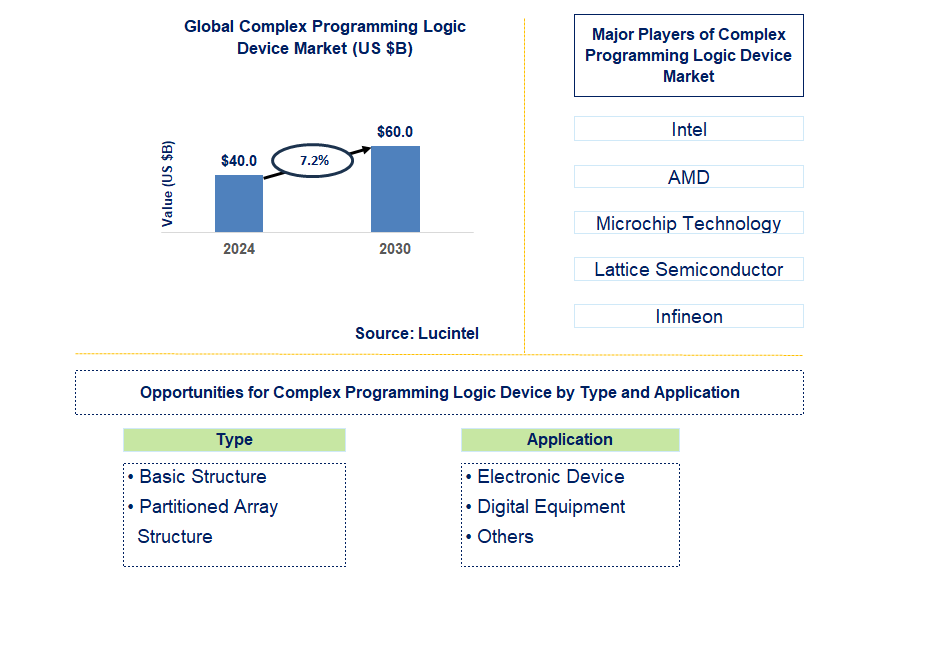
Key data points: The growth forecast = 7.2% annually for the next 6 years. Scroll below to get more insights. This market report covers trends, opportunities, and forecast in the global complex programming logic device market to 2030 by type (basic structure and partitioned array structure), application (electronic device, digital equipment, and others), and region (North America, Europe, Asia Pacific, and the Rest of the World)
We'll send your sample report shortly.
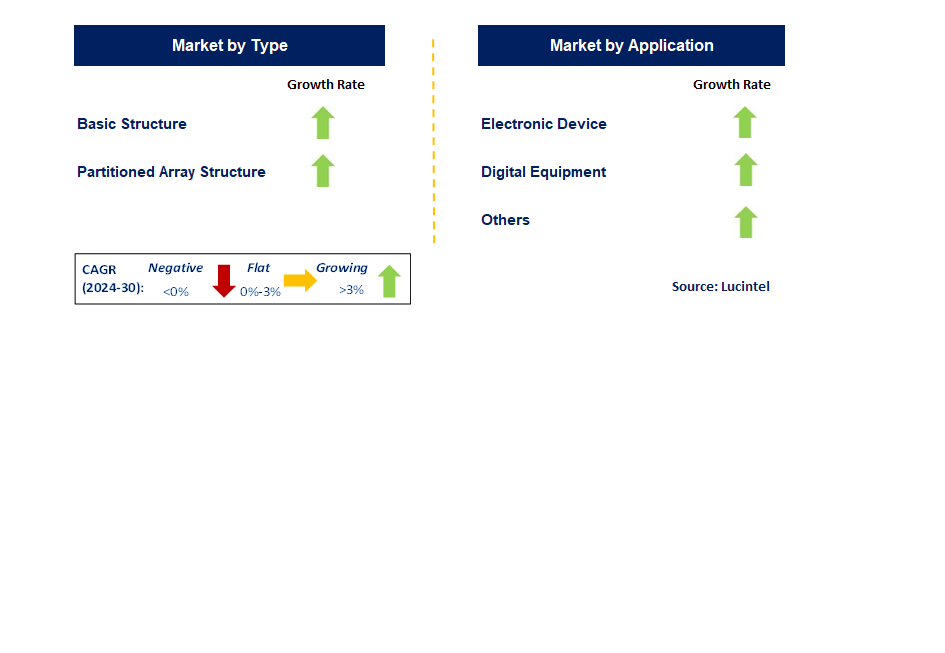
• Lucintel forecasts that, within the type category, basic structure is expected to witness higher growth over the forecast period.
• Within the application category, the electronic device is expected to witness the highest growth.
• In terms of regions, APAC is expected to witness the highest growth over the forecast period. A more than 150-page report is developed to help in your business decisions.
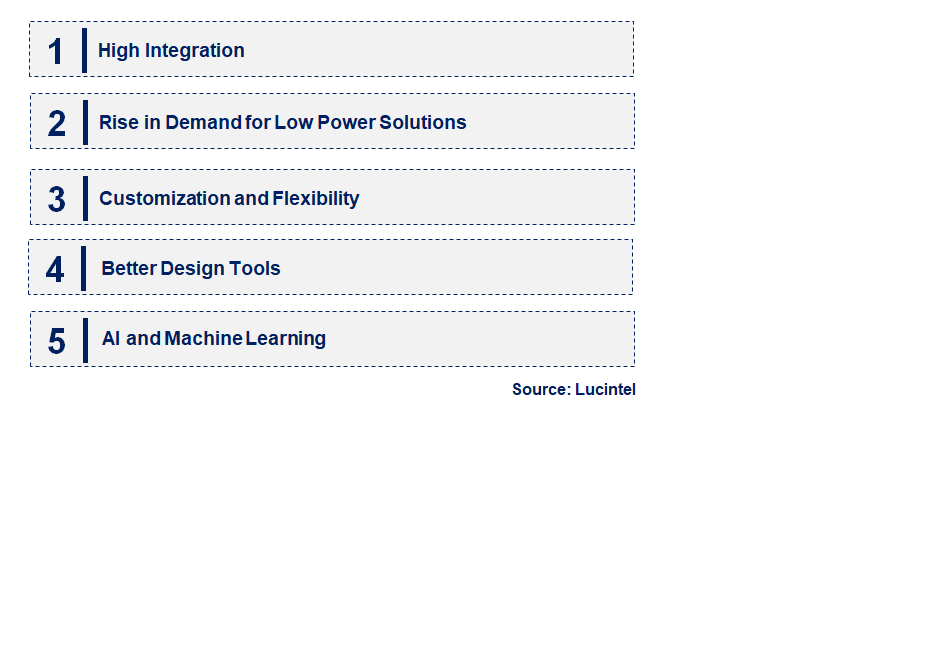
• High Integration: Increased integration in CPLDs means more functions on a single chip. This results in the integration of more designs, which is important for consumer electronics, automotive, and industrial applications, particularly in miniaturizing devices. It leads to better performance, reduced power consumption, and cost savings for manufacturers and end-users alike.
• Rise in Demand for Low Power Solutions: The adoption of energy-efficient CPLDs is driven by the need for sustainable operations, energy cost savings, and industrial applications. Low-power devices are essential, especially for battery-powered devices in the IoT and wearable technology sectors. OEMs are designing CPLDs that offer high performance while consuming minimal power, as required by regulations and consumer specifications.
• Customization and Flexibility: The demand for custom CPLD solutions is growing, especially for specific application needs in automotive, telecommunications, and similar industries. Companies are increasingly offering programmable versions that allow customers to modify the devices according to their requirements. This increases utility and accelerates the introduction of products for particular applications, making CPLDs more attractive to various manufacturing industries.
• Better Design Tools: Advances in design tools for CPLD development are making it easier and faster to bring products to market. These tools provide designers with better ease-of-use interfaces and more powerful capabilities to create complex logic designs efficiently. In a highly competitive environment, where ease of use is crucial, better software solutions are enabling smaller companies and startups to compete, further diversifying the market landscape.
• AI and Machine Learning: The integration of AI and machine learning in CPLDs allows for designing and implementing devices in innovative ways. In smart applications, these capabilities enable better performance in predictive analytics and optimization. As AI becomes more widely implemented, the most critical path to innovation will be CPLDs that support such advanced functionalities. Emerging trends in CPLDs are enhancing product capabilities, driving innovation, and responding to changing consumer preferences. The focus on integration, power efficiency, customization, and advanced design tools is shaping the future of CPLDs across various applications. As these trends continue to emerge, they will increasingly form the core of competitive strategies for all players in the industry.
• Increased R&D Investment: Companies are actively investing in R&D to strengthen CPLD technology. The emphasis on R&D is resulting in more powerful, integrated CPLDs. Improved R&D leads to sustainable competitive advantages and enables companies to respond to rapidly changing industry requirements in sectors like automotive, telecommunications, and consumer electronics.
• Expanding Application Areas: CPLDs are increasingly being used across various application areas, including consumer electronics and industrial automation. The demand is growing not only because of the flexible, customized solutions they offer but also because of their increasing relevance in smart technologies and operational efficiencies across sectors.
• Focus on Energy Efficiency: As sustainability becomes more important, CPLD producers are focusing on energy-efficient designs. Among the latest developments are commitments to low-power device production, which reduces operating costs and ensures compliance with international environmental standards. This is a significant trend, particularly in light of rising regulatory pressures for greener technologies.
• Collaborative Partnerships: New strategic alliances are forming between firms to increase their CPLD capabilities and market access. These partnerships enable knowledge sharing, resource pooling, and faster product development, leading to increased innovation. Industry partners are collaborating to navigate complex market dynamics, complementing each other's strengths in technology and distribution.
• Global Supply Chain Optimization: Companies are optimizing their supply chains by removing obstacles and ensuring efficient distribution of CPLDs. With global demand accelerating, effective supply chain management will be increasingly important. These efforts not only enhance operational efficiency but also allow companies to respond to changing market needs in a timely manner. Innovations, new applications, and sustainability efforts are transforming the CPLDs market. As technology evolves, the competitive horizon for CPLDs will continue to expand, offering opportunities for adaptable and innovative players in the field.
• Automotive Electronics: CPLDs are increasingly used in the automotive industry, particularly in applications like ADAS and electric vehicles. These devices enable complex logic functions and real-time data processing. As the industry moves toward autonomous and electric vehicles, CPLDs will be essential for enabling the advanced technologies required for these vehicles.
• Industrial Automation: CPLDs are finding increasing use in industrial automation due to their efficiency and speed in performing complex logic operations. The success of the smart factory vision and related initiatives is driving demand for programmable logic devices. Their flexibility and adaptability make them well-suited for automation solutions, improving production process efficiency by minimizing idle time.
• Telecommunications Infrastructure: CPLDs are crucial for developing high-performance network infrastructures in telecommunications. With the rise of 5G and IoT, high-performance logic devices are needed to manage complex data flows. CPLDs, offering flexibility and processing power, are essential for the next generation of consumer electronics and telecommunications applications.
• Consumer Electronics: CPLDs play a key role in the growing consumer electronics sector, particularly with the rise of smart home appliances and wearable devices. As manufacturers strive to create novel and distinctive products, CPLDs enable customization and enhanced performance, making them a vital component in the development of next-generation consumer electronics.
• Medical Devices: The medical device industry is increasingly adopting CPLDs for applications that require precise data handling and control. Due to their reliability, low power consumption, and efficient logic operations, CPLDs are in high demand for telehealth and wearable health technologies. They are expected to play a key role in simplifying and automating complex medical applications, becoming an essential component of future healthcare technologies. These growth opportunities are central to the CPLDs market as they expand across various applications and enhance technological capabilities. As industries recognize the potential of CPLDs, these opportunities will drive innovation and market expansion, shaping the future of programmable logic devices. Companies that seize these opportunities will be better positioned to lead the evolving technological landscape.
• Intel
• AMD
• Microchip Technology
• Lattice Semiconductor
• Infineon
• Basic Structure
• Partitioned Array Structure
• Electronic Device
• Digital Equipment
• Others
• North America
• Europe
• Asia Pacific
• The Rest of the World
• United States: The U.S. CPLD market has grown steadily, driven by the need for high-performance, low-power devices in the telecommunications and automotive sectors. CPLD players in the U.S. have been investing heavily in R&D, leading to the evolution of more complex CPLDs with improved scalability and integration capabilities. This aligns with the growing demand for smart technologies and applications in IoT.
• China: In China, the CPLD market is booming rapidly due to the country’s advancements in electronics manufacturing and government support for its semiconductor innovation agenda. CPLD solutions have gained popularity in consumer electronics and industrial automation, particularly among domestic companies. Furthermore, China’s push for technological self-sufficiency has led to the development of CPLD products that challenge established global brands within the country.
• Germany: Germany has a strong engineering foundation that drives CPLD innovation, particularly in the automotive and industrial sectors. The country's commitment to Industry 4.0 has increased demand for specialized logic devices. Additionally, energy-efficient CPLDs align with the EU's sustainability goals, making German companies more competitive in the global market.
• India: The CPLD market in India is expanding as automation and smart solutions gain traction across sectors such as telecommunications and healthcare. Local startups are entering the CPLD space, offering cost-effective and customized solutions. Government initiatives like digitalization and the "Make in India" campaign are boosting market prospects and attracting foreign investment.
• Japan: Japan remains a global leader in CPLD technology, with a strong focus on research and development in consumer electronics and robotics. Large companies in Japan are investing heavily in the development of next-generation CPLDs that consume low power and support high-speed applications. The country’s robust supply chain and advanced research capabilities continue to position Japan ahead of its global competitors.


• Intel
• AMD
• Microchip Technology
• Lattice Semiconductor
• Infineon Q5. Which complex programming logic device market segment will be the largest in the future? Answer: Lucintel forecasts that basic structure is expected to witness higher growth over the forecast period. Q6. In the complex programming logic device market, which region is expected to be the largest in the next 5 years? Answer: APAC is expected to witness the highest growth over the forecast period. Q.7 Do we receive customization in this report? Answer: Yes, Lucintel provides 10% customization without any additional cost.


Choose a license that fits your team. Instant PDF delivery.
Prices exclude taxes. Instant delivery. Custom licensing available on request.
Market Report · July 29, 2026
Market Report · July 20, 2026
Market Report · July 20, 2026
Trusted partner for strategic intelligence and business growth


Receive a complimentary market analysis tailored to your industry. Our analysts will identify key growth opportunities and competitive dynamics specific to your business.

Market size, growth rate, and key trend analysis for your specific sector.

Top competitor positioning and market share analysis.

Strategic recommendations backed by data-driven insights.
Get curated market intelligence and competitive moves straight to your inbox.
By subscribing, you agree to receive our monthly insights. Unsubscribe anytime.
Receive a complimentary market analysis tailored to your industry. Our analysts will identify key growth opportunities and competitive dynamics specific to your business.
Market size, growth rate, and key trend analysis for your specific sector.
Top competitor positioning and market share analysis.
Strategic recommendations backed by data-driven insights.
Get curated market intelligence, emerging trends, and competitive moves straight to your inbox each month.
By subscribing, you agree to receive our monthly insights. Unsubscribe anytime.
We'll send your sample report shortly.