
Compact Construction Equipment Market Trends and Forecast
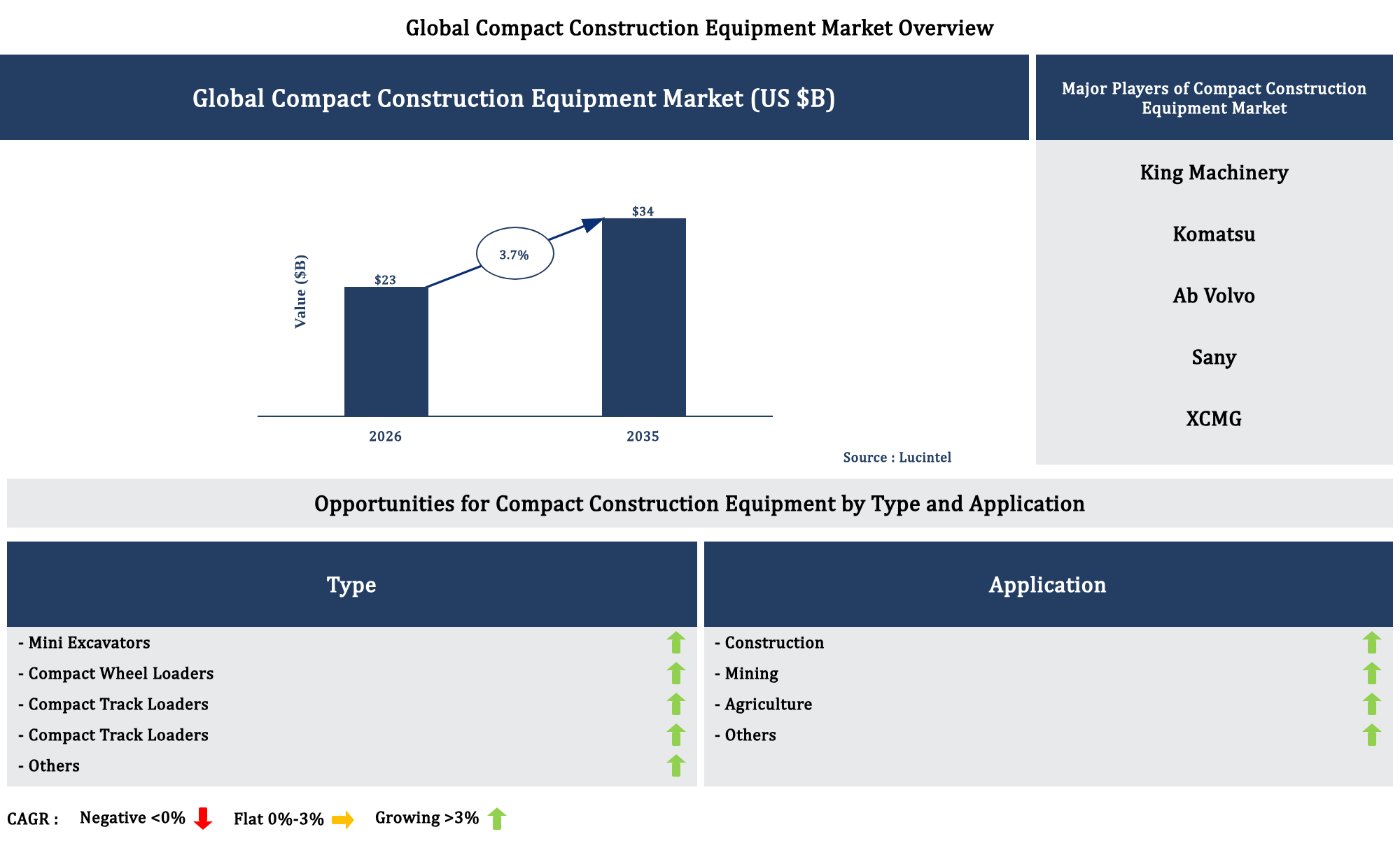
The future of the global compact construction equipment market looks promising with opportunities in the construction, mining, and agriculture markets. The global compact construction equipment market is expected to reach an estimated $34,046 million by 2035 with a CAGR of 3.7% from 2026 to 2035. The major drivers for this market are the growing focus on fuel-efficient & low-emission equipment, the rising demand for rental construction equipment services, and the increasing adoption in tight & urban spaces.
• Lucintel forecasts that, within the type category, mini excavator is expected to witness the highest growth over the forecast period.
• Within the application category, construction is expected to witness the highest growth.
• In terms of region, APAC is expected to witness the highest growth over the forecast period.
Gain valuable insights for your business decisions with our comprehensive 150+ page report. Sample figures with some insights are shown below.
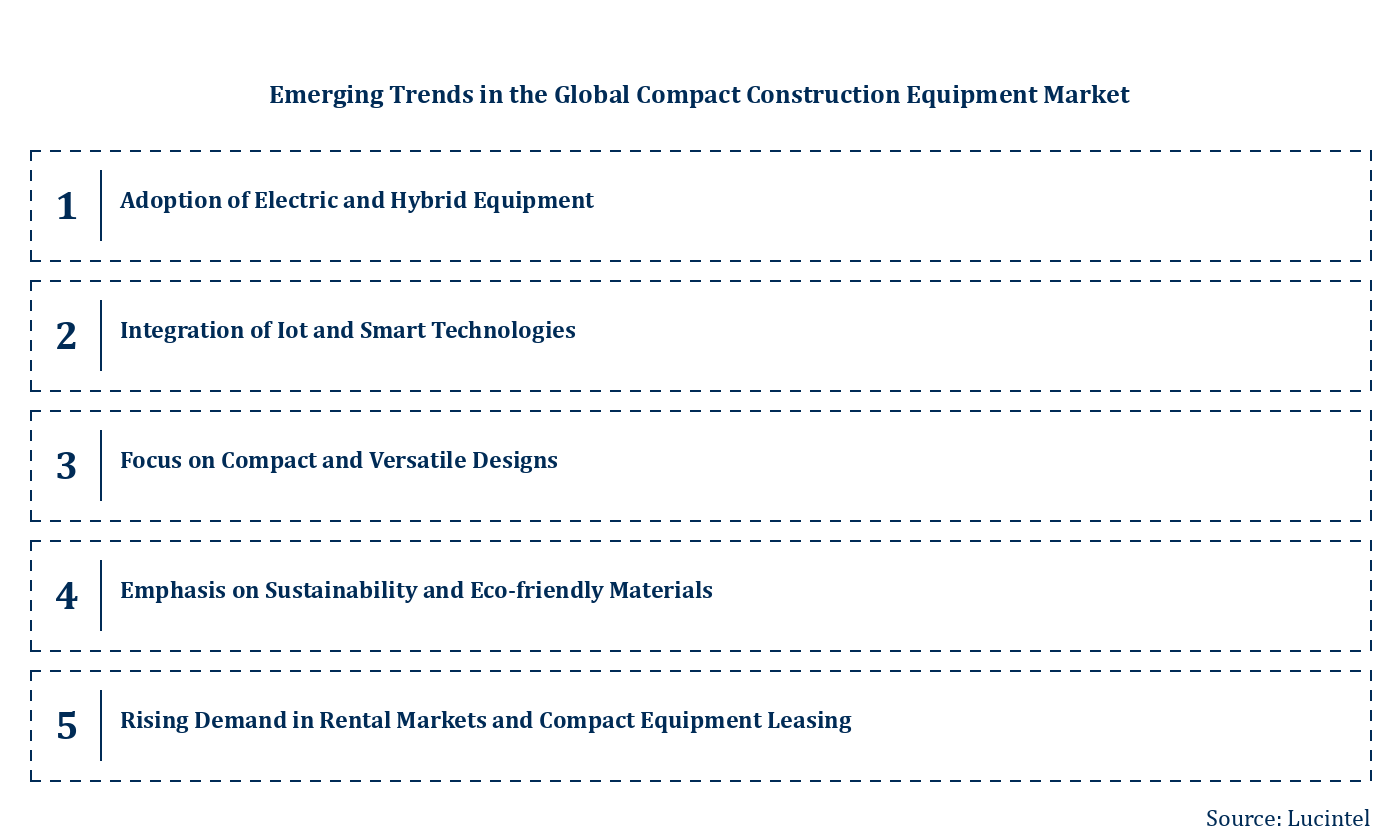
Emerging Trends in the Compact Construction Equipment Market
The compact construction equipment market is experiencing rapid evolution driven by technological advancements, changing industry demands, and environmental considerations. As construction projects become more complex and sustainable practices gain prominence, manufacturers are innovating to meet these needs. The market is also influenced by urbanization, labor shortages, and the push for efficiency and safety. These factors are fostering new trends that are reshaping how compact equipment is designed, used, and integrated into construction workflows. Understanding these emerging trends is crucial for stakeholders aiming to stay competitive and leverage new opportunities in this dynamic market landscape.
• Adoption of Electric and Hybrid Equipment: The shift towards electric and hybrid compact construction equipment is driven by environmental regulations and the need to reduce carbon emissions. These machines offer lower operating costs, quieter operation, and compliance with stricter emission standards. As battery technology improves, the range and power of electric models are increasing, making them viable for a broader range of applications. This trend is expected to accelerate as manufacturers invest in sustainable solutions, ultimately transforming the market by promoting cleaner, more efficient construction practices.
• Integration of IoT and Smart Technologies: The incorporation of Internet of Things (IoT) and smart technologies into compact equipment is enhancing operational efficiency and safety. Connected machines can provide real-time data on performance, maintenance needs, and location, enabling predictive maintenance and reducing downtime. Operators benefit from advanced control systems that improve precision and ease of use. This trend is fostering a more data-driven approach to construction, optimizing resource allocation, and minimizing costs. As connectivity becomes standard, the market is moving towards highly intelligent, automated equipment solutions.
• Focus on Compact and Versatile Designs: The demand for compact, versatile equipment that can operate efficiently in confined spaces is increasing, especially in urban construction projects. Manufacturers are designing multi-functional machines that combine several capabilities into a single unit, reducing the need for multiple pieces of equipment. These innovations improve productivity and reduce logistical challenges on-site. The trend reflects a shift towards more adaptable machinery that can handle diverse tasks, making construction processes more streamlined and cost-effective, particularly in densely populated areas.
• Emphasis on Sustainability and Eco-Friendly Materials: Sustainability is a key driver influencing product development in the market. Manufacturers are adopting eco-friendly materials and sustainable manufacturing practices to reduce environmental impact. Equipment is being designed with energy-efficient engines and recyclable components. This focus aligns with global efforts to promote green construction and meet regulatory standards. The trend encourages companies to innovate in material science and design, ultimately leading to a market that prioritizes environmental responsibility alongside performance.
• Rising Demand in Rental Markets and Compact Equipment Leasing: The growth of rental and leasing services for compact construction equipment is reshaping market dynamics. Contractors prefer renting to reduce capital expenditure and access the latest technology without ownership costs. This trend is expanding the market reach of manufacturers and service providers, fostering flexible usage models. It also encourages the development of equipment tailored for rental purposes, such as easy maintenance and durability. The rental market‘s growth is making compact equipment more accessible, supporting small and medium-sized enterprises and increasing overall market penetration.
These trends are collectively transforming the compact construction equipment market by promoting sustainability, technological integration, versatility, and flexible usage models. They are driving innovation, improving operational efficiency, and enabling construction companies to meet evolving industry demands more effectively. As these developments continue, the market is poised for significant growth and increased competitiveness, aligning with broader trends toward smarter, greener, and more adaptable construction solutions.
Recent Developments in the Compact Construction Equipment Market
The compact construction equipment market is experiencing rapid growth driven by urbanization, infrastructure development, and technological advancements. As construction projects become more complex and space constraints increase, demand for versatile, efficient, and easy-to-maneuver equipment rises. Innovations in automation and eco-friendly solutions are also shaping the industry. These developments are creating new opportunities for manufacturers and investors, transforming how construction projects are executed worldwide. The market‘s evolution reflects a shift towards smarter, more sustainable construction practices that meet modern demands.
• Growing Urbanization and Infrastructure Projects: The surge in urban development worldwide is fueling demand for compact equipment that can operate efficiently in confined spaces, accelerating project timelines and reducing costs.
• Technological Integration and Automation: The adoption of smart features, telematics, and automation enhances productivity, safety, and maintenance, making equipment more attractive to contractors seeking efficiency.
• Eco-Friendly and Energy-Efficient Solutions: Increasing emphasis on sustainability drives innovation in electric and hybrid compact equipment, reducing emissions and operational costs for users.
• Expansion into Emerging Markets: Rising infrastructure investments in developing regions open new avenues for market growth, with localized manufacturing and distribution strategies gaining importance.
• Product Diversification and Innovation: Manufacturers are introducing versatile attachments and modular designs, broadening equipment applications and increasing market competitiveness.
These developments are significantly impacting the compact construction equipment market by boosting efficiency, sustainability, and accessibility. They enable faster project completion, lower operational costs, and expanded market reach, fostering industry growth. As technological and environmental trends continue to evolve, the market is poised for sustained expansion and innovation, meeting the dynamic needs of modern construction projects worldwide.
Strategic Growth Opportunities in the Compact Construction Equipment Market
The compact construction equipment market is experiencing rapid growth driven by urbanization, infrastructure development, and the need for versatile, efficient machinery in confined spaces. Technological advancements and increasing demand for sustainable solutions are further fueling market expansion. Companies are focusing on innovation, product diversification, and strategic partnerships to capture emerging opportunities. This dynamic environment offers significant potential for stakeholders to enhance market share and meet evolving customer needs across various construction and landscaping applications.
• Growing Demand for Versatile Equipment in Urban Construction: The increasing need for compact, maneuverable machinery suited for tight spaces in urban environments is driving market growth. Contractors prefer lightweight, easy-to-transport equipment that can perform multiple functions, reducing project timelines and costs. Innovations in design and functionality are expanding the capabilities of compact equipment, making it essential for infrastructure projects, residential developments, and renovation works. This trend is expected to continue as urbanization accelerates globally.
• Adoption of Advanced Technologies for Improved Efficiency: Integration of IoT, telematics, and automation in compact construction equipment is transforming operational efficiency. These technologies enable real-time monitoring, predictive maintenance, and remote control, reducing downtime and operational costs. Enhanced safety features and user-friendly interfaces are also improving productivity. As technology adoption becomes more widespread, manufacturers are investing heavily in R&D to develop smarter, more connected equipment, creating new growth avenues in the market.
• Rising Focus on Sustainable and Eco-Friendly Solutions: Environmental regulations and increasing awareness of sustainability are prompting manufacturers to develop eco-friendly compact equipment. Innovations include electric and hybrid models, energy-efficient engines, and low-emission systems. These solutions help reduce carbon footprints and operational costs for users. The shift towards green construction practices is expected to accelerate, with governments and clients favoring sustainable equipment, thereby expanding market opportunities for eco-conscious product offerings.
• Expansion of Rental and Leasing Services: The growing preference for renting rather than owning equipment is boosting the rental market segment. Rental companies offer flexible, cost-effective solutions for short-term projects, reducing capital expenditure for contractors. This trend enhances equipment utilization rates and provides access to the latest technology without significant upfront investment. As construction activity increases, the rental model is likely to dominate, encouraging manufacturers to develop equipment tailored for rental fleets and service providers.
• Increasing Demand from Emerging Markets for Infrastructure Development: Rapid urbanization and economic growth in emerging markets are fueling infrastructure projects, creating substantial demand for compact construction equipment. These regions often require cost-effective, easy-to-transport machinery suitable for diverse terrains and limited space. Local governments and private developers are investing heavily in roads, bridges, and housing, providing lucrative opportunities for market players. Expanding distribution networks and localized manufacturing are strategies being adopted to capitalize on these emerging market opportunities.
The overall impact of these growth opportunities is set to significantly enhance the market’s expansion, innovation, and competitiveness. Stakeholders who leverage technological advancements, sustainability initiatives, and regional growth trends will be well-positioned to capture new market segments. As demand for compact construction equipment continues to rise, strategic investments and product development aligned with these opportunities will shape the future landscape of the market, ensuring sustained growth and profitability.
Compact Construction Equipment Market Driver and Challenges
The compact construction equipment market is influenced by a variety of technological, economic, and regulatory factors that shape its growth trajectory. Advances in automation and telematics are enhancing operational efficiency, while economic fluctuations impact investment in construction projects. Regulatory standards concerning emissions and safety are also pivotal, prompting manufacturers to innovate and adapt. Additionally, urbanization trends and infrastructure development drive demand, but challenges such as high initial costs, environmental regulations, and market saturation pose hurdles. Understanding these drivers and challenges is essential for stakeholders to navigate the evolving landscape and capitalize on emerging opportunities.
The factors responsible for driving the compact construction equipment market include:-
• Technological Innovation: The integration of automation, telematics, and IoT in compact equipment enhances productivity, safety, and maintenance efficiency. These advancements reduce operational costs and improve precision, making equipment more attractive to contractors. As technology becomes more affordable and accessible, adoption rates increase, fueling market growth. Companies investing in R&D are leading to smarter, more efficient machines that meet evolving customer needs and regulatory standards, thus expanding market opportunities.
• Urbanization and Infrastructure Development: Rapid urban growth worldwide necessitates extensive infrastructure projects, including roads, bridges, and buildings. Compact construction equipment is ideal for confined spaces and smaller-scale projects, making it highly suitable for urban environments. Governments and private sectors are increasing investments in infrastructure, which directly boosts demand for these versatile machines. This trend is expected to continue, especially in emerging economies, providing a sustained growth driver for the market.
• Environmental Regulations and Emission Standards: Stricter environmental policies worldwide compel manufacturers to develop eco-friendly equipment with lower emissions and higher fuel efficiency. Compliance with standards such as Tier 4 emissions regulations drives innovation in engine technology and alternative power sources like electric and hybrid systems. These regulations also influence purchasing decisions, encouraging clients to opt for cleaner, more sustainable equipment, thereby expanding the market for environmentally compliant compact machinery.
• Economic Growth and Construction Spending: Economic stability and growth directly influence construction activity levels. Increased infrastructure spending, real estate development, and industrial projects lead to higher demand for compact construction equipment. Conversely, economic downturns can cause delays or reductions in project investments, impacting sales. Nonetheless, in regions experiencing economic expansion, the market benefits from increased construction budgets, supporting steady growth in equipment demand.
• Rising Rental Market: The increasing preference for equipment rental over ownership offers a significant growth avenue. Rental companies seek versatile, reliable, and cost-effective compact equipment to meet diverse client needs. This trend reduces barriers to entry for smaller contractors and facilitates equipment turnover, boosting sales for manufacturers. The rental market‘s expansion is driven by project-based work, financial flexibility, and maintenance considerations, making it a key driver for market growth.
The challenges facing the compact construction equipment market include:-
• High Initial Investment Costs: Despite the benefits, the purchase of compact construction equipment involves substantial upfront costs, which can be prohibitive for small and medium-sized contractors. This financial barrier limits market penetration and adoption, especially in developing regions. Although rental options mitigate this issue, the high cost of advanced, technologically equipped machinery remains a challenge for manufacturers aiming to expand their customer base.
• Stringent Environmental Regulations: While regulations promote eco-friendly equipment, they also impose compliance costs on manufacturers. Developing compliant machinery requires significant R&D investment, increasing production costs. Additionally, frequent regulatory updates necessitate continuous innovation, which can delay product launches and increase prices. These factors can hinder market growth, especially for smaller players with limited resources.
• Market Saturation and Competition: The market is becoming increasingly competitive with numerous global and local players. Market saturation in mature regions limits growth opportunities, forcing companies to innovate or reduce prices to maintain market share. Intense competition can lead to margin pressures and reduced profitability. Moreover, rapid technological advancements require continuous investment, posing challenges for smaller firms to stay competitive and adapt swiftly.
The compact construction equipment market is driven by technological advancements, urbanization, environmental compliance, economic growth, and rental trends. However, high costs, regulatory hurdles, and intense competition present significant challenges. These factors collectively influence market dynamics, requiring stakeholders to innovate, adapt, and strategize effectively. Overall, the market‘s growth potential remains promising, provided companies can navigate these complexities and leverage emerging opportunities efficiently.
List of Compact Construction Equipment Companies
Companies in the market compete on the basis of product quality offered. Major players in this market focus on expanding their manufacturing facilities, R&D investments, infrastructural development, and leverage integration opportunities across the value chain. With these strategies compact construction equipment companies cater increasing demand, ensure competitive effectiveness, develop innovative products & technologies, reduce production costs, and expand their customer base. Some of the compact construction equipment companies profiled in this report include-
• King Machinery
• Komatsu
• Ab Volvo
• Sany
• XCMG
Compact Construction Equipment Market by Segment
The study includes a forecast for the global compact construction equipment market by type, application, and region.
Compact Construction Equipment Market by Type [Value from 2019 to 2035]:
• Mini Excavators
• Compact Wheel Loaders
• Compact Track Loaders
• Others
Compact Construction Equipment Market by Application [Value from 2019 to 2035]:
• Construction
• Mining
• Agriculture
• Others
Compact Construction Equipment Market by Region [Value from 2019 to 2035]:
• North America
• Europe
• Asia Pacific
• The Rest of the World
Country Wise Outlook for the Compact Construction Equipment Market
The compact construction equipment market has experienced significant growth driven by urbanization, infrastructure development, and technological advancements worldwide. As construction projects become more complex and environmentally conscious, countries are adopting innovative solutions to enhance efficiency, safety, and sustainability. The market‘s evolution is marked by increased automation, electric-powered machinery, and smart technology integration. These developments reflect the global push towards greener and more cost-effective construction practices, with regional variations influenced by economic growth, regulatory policies, and technological adoption rates. Understanding these regional trends is crucial for stakeholders aiming to capitalize on emerging opportunities in this dynamic industry.
• United States: The U.S. market has seen rapid adoption of electric and hybrid compact equipment, driven by stringent environmental regulations and a focus on sustainability. Technological innovations such as telematics and automation are improving operational efficiency and safety. The demand for versatile, compact machinery for urban construction and renovation projects continues to grow, supported by infrastructure investments and a robust construction sector. Rental companies are increasingly integrating smart equipment to optimize fleet management, reflecting a shift towards more technologically advanced solutions.
• China: China remains the largest market for compact construction equipment, fueled by rapid urbanization and infrastructure expansion. The country is witnessing a surge in electric and battery-powered machinery to meet environmental standards. Local manufacturers are investing heavily in R&D to develop innovative, cost-effective solutions tailored to domestic needs. Government policies promoting green construction and smart city initiatives are further boosting demand. Additionally, digitalization and IoT integration are enhancing equipment performance and maintenance, making Chinese products more competitive globally.
• Germany: Germany‘s market is characterized by a strong emphasis on sustainability, energy efficiency, and advanced technology integration. The adoption of electric and hybrid compact equipment is accelerating, supported by strict EU regulations on emissions. German manufacturers are leading in automation and precision engineering, offering highly efficient machinery for urban and industrial projects. The focus on quality and durability remains paramount, with a growing trend towards smart, connected equipment that improves productivity and reduces downtime. The market is also influenced by government incentives for green construction practices.
• India: The Indian market is experiencing rapid growth due to increasing infrastructure projects, urbanization, and government initiatives like Smart Cities and Make in India. There is a rising demand for affordable, durable, and fuel-efficient compact equipment suitable for diverse terrains. Electric and hybrid machinery are gaining traction, supported by government incentives for clean energy solutions. Local manufacturers are expanding their product portfolios to include technologically advanced options. The market is also witnessing increased adoption of telematics and IoT for better fleet management and maintenance, aligning with the country‘s push towards digitalization.
• Japan: Japan‘s market is driven by technological innovation, aging infrastructure, and a focus on energy efficiency. The adoption of electric and hybrid compact equipment is growing, with Japanese companies leading in robotics and automation integration. The emphasis on safety and precision is reflected in the development of smart machinery equipped with sensors and IoT connectivity. Japan is also investing in eco-friendly solutions to meet stringent environmental standards. The market benefits from a mature construction sector that values high-quality, reliable equipment, with a strong focus on reducing operational costs and environmental impact.
Features of the Global Compact Construction Equipment Market
Market Size Estimates: Compact construction equipment market size estimation in terms of value ($M).
Trend and Forecast Analysis: Market trends (2019 to 2025) and forecast (2026 to 2035) by various segments and regions.
Segmentation Analysis: Compact construction equipment market size by type, application, and region in terms of value ($M).
Regional Analysis: Compact construction equipment market breakdown by North America, Europe, Asia Pacific, and Rest of the World.
Growth Opportunities: Analysis of growth opportunities in different type, application, and regions for the compact construction equipment market.
Strategic Analysis: This includes M&A, new product development, and competitive landscape of the compact construction equipment market.
Analysis of competitive intensity of the industry based on Porter’s Five Forces model.
FAQ
Q1. What is the compact construction equipment market size?
Answer: The global compact construction equipment market is expected to reach an estimated $34,046 million by 2035.
Q2. What is the growth forecast for compact construction equipment market?
Answer: The global compact construction equipment market is expected to grow with a CAGR of 3.7% from 2026 to 2035.
Q3. What are the major drivers influencing the growth of the compact construction equipment market?
Answer: The major drivers for this market are the growing focus on fuel-efficient & low-emission equipment, the rising demand for rental construction equipment services, and the increasing adoption in tight & urban spaces.
Q4. What are the major segments for compact construction equipment market?
Answer: The future of the compact construction equipment market looks promising with opportunities in the construction, mining, and agriculture markets.
Q5. Who are the key compact construction equipment market companies?
Answer: Some of the key compact construction equipment companies are as follows:
• King Machinery
• Komatsu
• Ab Volvo
• Sany
• XCMG
Q6. Which compact construction equipment market segment will be the largest in future?
Answer: Lucintel forecasts that, within the type category, mini excavator is expected to witness the highest growth over the forecast period.
Q7. In compact construction equipment market, which region is expected to be the largest in next 8 years?
Answer: In terms of region, APAC is expected to witness the highest growth over the forecast period.
Q8. Do we receive customization in this report?
Answer: Yes, Lucintel provides 10% customization without any additional cost.
This report answers following 11 key questions:
Q.1. What are some of the most promising, high-growth opportunities for the compact construction equipment market by type (mini excavators, compact wheel loaders, compact track loaders, compact track loaders, and others), application (construction, mining, agriculture, and others), and region (North America, Europe, Asia Pacific, and the Rest of the World)?
Q.2. Which segments will grow at a faster pace and why?
Q.3. Which region will grow at a faster pace and why?
Q.4. What are the key factors affecting market dynamics? What are the key challenges and business risks in this market?
Q.5. What are the business risks and competitive threats in this market?
Q.6. What are the emerging trends in this market and the reasons behind them?
Q.7. What are some of the changing demands of customers in the market?
Q.8. What are the new developments in the market? Which companies are leading these developments?
Q.9. Who are the major players in this market? What strategic initiatives are key players pursuing for business growth?
Q.10. What are some of the competing products in this market and how big of a threat do they pose for loss of market share by material or product substitution?
Q.11. What M&A activity has occurred in the last 5 years and what has its impact been on the industry?
For any questions related to Compact Construction Equipment Market, Compact Construction Equipment Market Size, Compact Construction Equipment Market Growth, Compact Construction Equipment Market Analysis, Compact Construction Equipment Market Report, Compact Construction Equipment Market Share, Compact Construction Equipment Market Trends, Compact Construction Equipment Market Forecast, Compact Construction Equipment Companies, write Lucintel analyst at email: helpdesk@lucintel.com. We will be glad to get back to you soon.
