
Report Feature
Communications Hardware Market Trends and Forecast
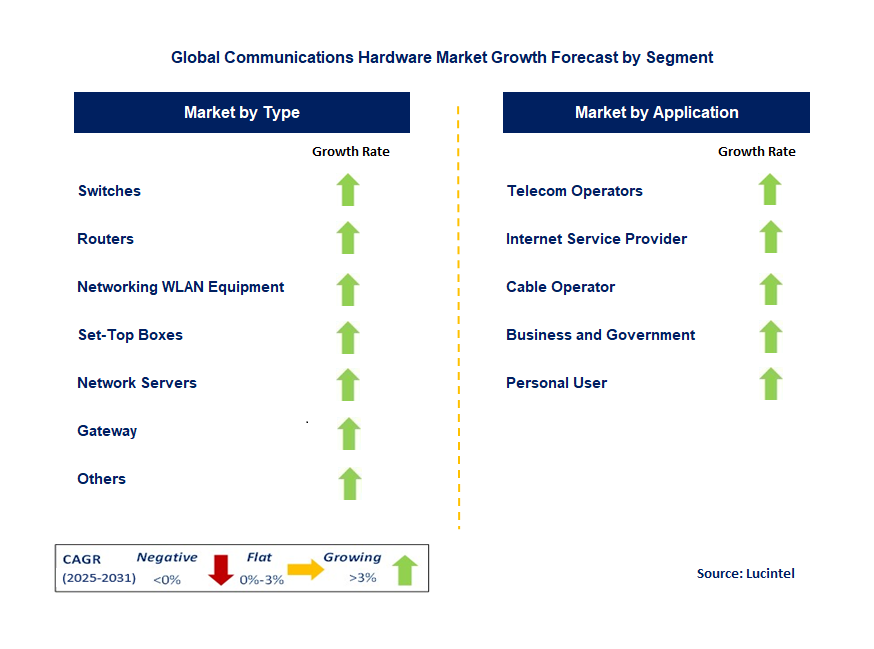
The future of the global communications hardware market looks promising with opportunities in the telecom operator, internet service provider, cable operator, business and government, and personal user markets. The global communications hardware market is expected to grow with a CAGR of 7.8% from 2025 to 2031. The major drivers for this market are continuous innovation in communication technologies drives demand for upgraded hardware solutions, the growing adoption of internet of things (IoT) devices increases the need for reliable communication hardware for connectivity, and advanced communication hardware to support faster data transfer speeds. Lucintel forecasts that, within the type category, router is expected to witness the highest growth over the forecast period due to the growing number of connected devices, the expansion of 5g networks, and the rising need for high-speed data transfer.. Within the application category, internet service provider is expected to witness the highest growth due to significant demand for communication hardware like routers, gateways, and network servers. In terms of region, APAC is expected to witness the highest growth over the forecast period due to the rapid technological advancements and large-scale infrastructure development. Gain valuable insights for your business decisions with our comprehensive 150+ page report. Sample figures with some insights are shown below.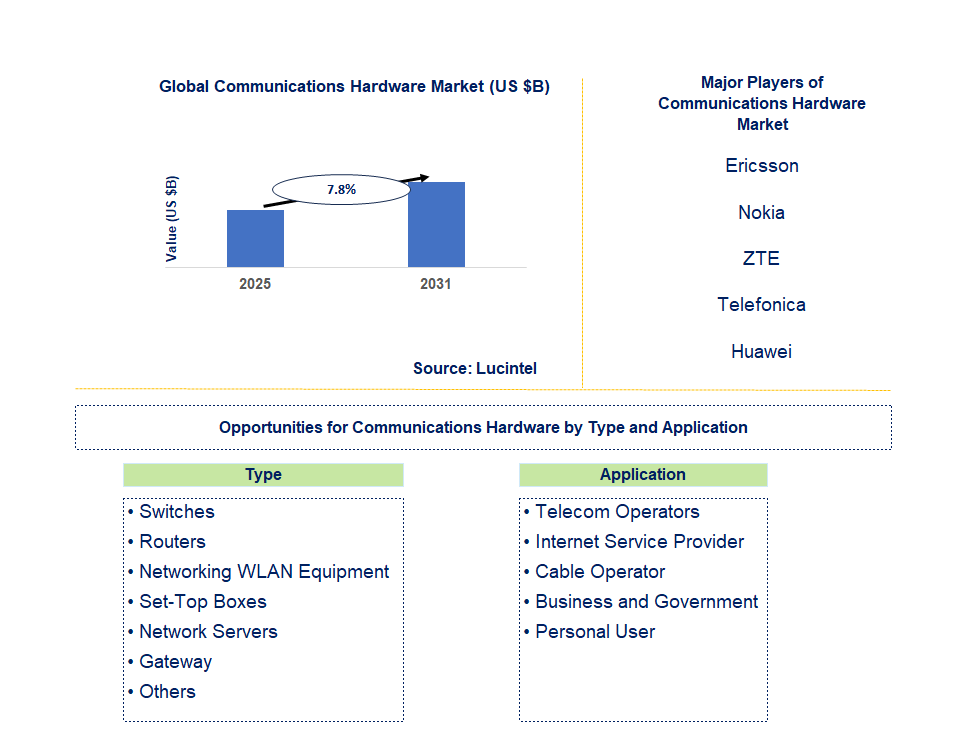
Emerging Trends in the Communications Hardware Market
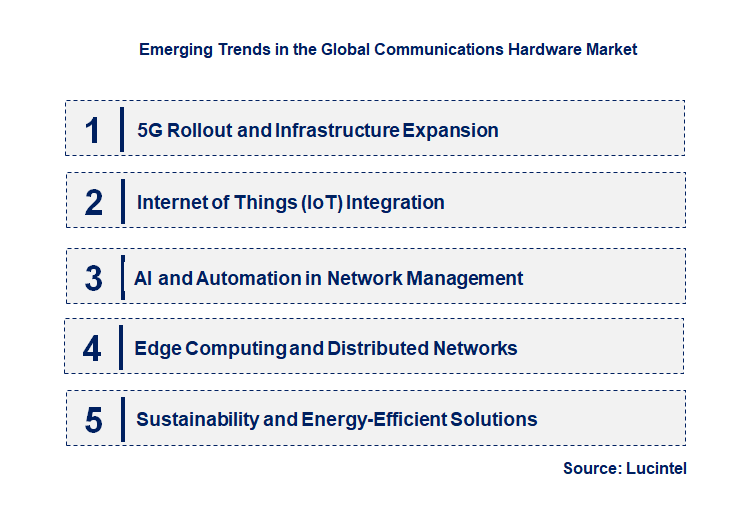
Communications hardware is undergoing massive change, as it is now highly influenced by the changes in 5G technology, IoT, and next-generation networking. The new trends of building and managing communication networks are forcing changes in hardware development in many industries. Therefore, these trends are a must-know for business and resellers to adapt and take advantage of the new opportunities that may arise.• 5G Rollout and Infrastructure Expansion: One of the most prominent trends in the communications hardware market is the global push for 5G connectivity. Governments and telecom companies are investing in 5G infrastructure, and therefore the demand for 5G-compatible devices, base stations, and antennas is increasing dramatically. 5G provides higher speeds, lower latency, and greater connectivity to support innovations in IoT, autonomous vehicles, and smart cities. The rollout of 5G is creating an enormous market for communication hardware supporting these advancements. Resellers and manufacturers are working on upgrading the networks and are offering the needed hardware to meet growing demand for 5G services.
• Internet of Things (IoT) Integration: The growing use of IoT is another significant trend that is remolding the communications hardware market. With the increasing use of IoT devices in healthcare, manufacturing, and smart homes, there is a growing need for communication hardware that can support these devices. IoT integration requires robust, scalable, and low-power communication solutions. Communication hardware companies are responding by developing specialized equipment that can efficiently handle large volumes of connected devices. This trend is driving the demand for sensors, gateways, and networking solutions that will make IoT applications work flawlessly.
• AI and Automation in Network Management: AI and automation are changing the management of communications networks. AI-based network management tools are helping telecom companies optimize their infrastructure, predict and solve problems, and automate routine tasks. This trend reduces the operational costs and enhances the performance of the network. The hardware vendors are developing AI-enabled devices and systems, integrating them with the existing infrastructure and providing smarter network solutions. The applications of AI and automation keep on increasing their importance in the communications hardware market as the complexity level of the network grows due to expansion of 5G and IoT.
• Edge Computing and Distributed Networks: Edge computing, where data is processed closer to where it is generated, decreases latency and bandwidth requirements and promises to gain momentum rapidly. Currently, edge computing is a driving factor behind centralized networks and edge-friendly devices in the communications hardware market. This trend is of particular importance in industries like autonomous vehicles, healthcare, and manufacturing, where real-time data processing is critical. Increasing hardware vendors are developing edge devices with added processing power and security, which are enabling increasingly more efficient and reliable distributed networks.
• Sustainability and Energy-Efficient Solutions: All these days, sustainability has become an important consideration in the design and development of communications hardware. Since energy consumption and environmental impact are concerns about technology, hardware manufacturers are shifting focus toward energy-efficient solutions. The demand for sustainable communication hardware, such as low-energy base stations and eco-friendly devices, is on the rise. Telecom companies are also adopting green practices in network operations, including utilizing renewable energy sources and optimizing hardware for reduced carbon footprints. This trend is influencing the design of future communication technologies, driving both innovation and sustainability in the market. Emerging trends in the communications hardware market continue reshaping the industry, motivated by innovation, increased demand for new technologies, and growth opportunities across sectors. The advancement of 5G, IoT, AI, and sustainability demands on the part of communication hardware companies as communication hardware companies must provide innovative solutions considering changing customer needs. With the increased use of edge computing and AI-driven network management, it further opens the possibilities for what communication hardware can be capable of to enable faster, smarter, and more efficient networks. The next generation of communication technologies and hardware solutions will be laid on this foundation.
Recent Development in the Communications Hardware Market
Recent developments in the communications hardware market are primarily driven by advancements in 5G, IoT, edge computing, and the increasing demand for energy-efficient solutions. As telecommunications infrastructure evolves, hardware vendors are responding by developing cutting-edge products to meet the growing needs of both consumers and businesses. This includes deploying new base stations, antennas, as well as IoT devices and advancements of the network management tools powered by AI. In addition, efforts on sustainability are changing the way communication hardware is designed and produced. These factors are transforming the market to create new grounds for innovation and growth.• Roll-out of 5G Infrastructure: The roll-out of 5G infrastructure globally is one of the most significant trends in the communications hardware market. Telecom companies are making heavy investments in network upgrades that offer faster, more reliable connectivity. This transition is generating immense demand for 5G-enabled devices, network equipment, and base stations. Communication hardware manufacturers are concentrating on products that can deliver the high speed and low latency required by 5G networks, creating enormous opportunities for vendors in this segment. The adoption of 5G is said to revolutionize industries like health care, transport, and entertainment all over the globe.
• Huge Increase in IoT Device Demand: Growing IoT is an area that fuels the demand for communication hardware as it supports several networks of interconnected devices. With more and more industries adopting IoT for smart cities, healthcare, and industrial automation, there is a need for specialized hardware, such as sensors, gateways, and connectivity solutions. The companies are responding with communication hardware that can handle large-scale IoT deployments with reliable and secure connections. It is in those industries requiring real-time data processing where robust IoT infrastructure continues to grow in demand.
• Advancements in AI-Powered Networking: Artificial intelligence is now being leveraged greatly to optimize network management and performance. Communication hardware companies are now integrating into their products AI capabilities for automating and making smarter decisions. AI-powered network management tools help service providers monitor, manage, and secure networks proactively. These tools reduce human intervention, hence automatically improving network efficiency. With further advancements in AI technology, the communications hardware market is expected to be further transformed with more intelligent and self-healing networks that adapt to changing demands.
• Edge Computing Development: Edge computing is a new area of focus for the communications hardware market as businesses look to process data closer to the source to reduce latency. Hardware manufacturers are also developing edge devices that allow real-time processing in applications such as IoT, self-driving cars, and industrial automation. These advances are changing how data is moved and processed into faster and more efficient communication systems. Edge computing will be pivotal in the new generation of communications networks, allowing for new sources of innovation from hardware.
• Sustainable and Energy-Efficient Hardware: Communication hardware makers are working with an increased need to focus more on sustainable, energy-efficient solutions as technology advances into becoming a source of concern to its environment. Low-energy hardware is used together with renewable sources to minimize telecom infrastructure carbon footprints. On their part, energy-efficient telecom network solutions can save them even more in their operation costs for telecom companies trying to become better and sustainable ventures. This development is allowing green technology in the communications hardware market to evolve and be adopted, and as such, promises to be part of the world‘s future telecommunication infrastructure. Present developments in the communications hardware market are promoting explosive growth, with new opportunities that are now innovating industries on a global basis. The market is being transformed through the roll-out of 5G, IoT network expansion, AI advancement, and increasing interest in sustainability. As companies and governments continue investing in next-generation communication infrastructure, demand for the latest hardware solutions is growing. These developments do not only shape the way networks are built and managed but also pave the way for new technologies that will shape the future of communication. With this, companies in the communications hardware market are well positioned to take the lead in this fast-paced environment.
Strategic Growth Opportunities in the Communications Hardware Market
Communications hardware is on its way to explosive growth because of 5G, IoT, cloud computing, and smart cities applications. Because connectivity at very high speeds is rapidly increasing demand with the necessity of efficient communication systems, there are many emerging areas that need this growth. All key applications are creating new innovations in the type of hardware that businesses and customers require today and in the near future. Such strategic growth opportunities help investors place themselves to capitalize on market trends and change with shifting technological, economic, and regulatory conditions.• 5G Infrastructure Expansion: The 5G network rollout will drive significant growth in the communications hardware market. With the expansion of 5G infrastructure, telecom service providers are now in high demand for advanced network equipment, including base stations, antennas, and routers. This growth is going to encourage the innovation of hardware solutions designed for ultra-fast, low-latency communication. New use cases will emerge in autonomous vehicles, remote healthcare, and smart manufacturing through the growth of 5G. Thus, communication hardware demand will further increase. The companies providing equipment for these networks will see enormous market share due to rapid global adoption of 5G.
• Internet of Things (IoT) Solutions: IoT is rising in such a manner that is producing immense growth opportunities for the communications hardware market. The integration of IoT in healthcare, logistics, and manufacturing sectors, coupled with increasing acceptance of the technology across various businesses, will boost demand for communication networks and devices supporting the IoT applications-which are comprised of sensors, gateways, and networking equipment for efficient exchange of data among connected devices. The growth of IoT applications in smart home, cities, and industries is demanding robust communication hardware solutions that can handle large volumes of data effectively and with security. Companies developing new kinds of innovative technologies for IoT communications will have a competitive advantage in this rapidly expanding marketplace.
• Cloud Computing and Data Center Expansion: The adoption of cloud computing and data centers creates an increasing demand for communications hardware that supports those environments. More and more businesses are migrating to the cloud, so the hardware needed to support cloud infrastructure in the form of servers, storage devices, and network equipment is growing. The growing trend of edge computing, which involves processing data closer to the user, will further drive demand for specialized hardware. High-performance hardware providers that allow for efficient data transmission, storage, and processing in the cloud and data center sector are well-poised to gain from this expansion.
• Smart Cities and Urban Infrastructure: The construction of smart cities offers a strong growth opportunity for the communications hardware market. As cities become increasingly connected through smart technologies, there is a growing need for communication hardware that supports large-scale data transmission and integration between systems. This encompasses solutions for intelligent transportation systems, public safety infrastructure, and utilities management. Companies that provide hardware capable of supporting these systems, such as network infrastructure, sensors, and data analytics tools, are well-positioned to benefit from the rapid adoption of smart city initiatives. Demand for communications hardware solutions is being fueled by a wave of smart city growth.
• Cybersecurity solutions for communications networks: Cybersecurity of any network today relies increasingly on the sophistication of the communications network. As communication networks become more difficult to decipher, cybersecurity solutions gain intensity. Organizations seek secure hardware that protects data from breaches, thus offering growth opportunities in the communications hardware market. The main devices which aid in defending one‘s network against cyber-attacks include firewalls, encrypted routers, and other secure communication systems. The growing importance of data privacy regulations and the frequency of cyberattacks have made cybersecurity one of the primary concerns in every business worldwide. The companies which will deal with secure communication hardware solutions and provide these hardware solutions to customers will be significant players in the future of digital communication. The strategic growth opportunities discussed above are changing the communications hardware market. The building of 5G infrastructure, growing applications of IoT, and surging demand for cloud computing, smart cities, and cybersecurity solutions have all driven innovation and opened new business opportunities. As industries continue to evolve and adopt these technologies, communication hardware providers have the opportunity to deliver cutting-edge products that meet the needs of businesses and consumers. These growth opportunities are not only driving market demand but are also encouraging the development of next-generation communication hardware solutions.
Communications Hardware Market Driver and Challenges
The communications hardware market is influenced by a variety of technological, economic, and regulatory drivers and challenges. As industries strive for faster, more efficient communication systems, hardware vendors are responding to the growing demand for high-performance solutions. However, the market also faces challenges such as regulatory hurdles, economic fluctuations, and technological complexities. Understanding these drivers and challenges is crucial for stakeholders seeking to navigate the evolving communications landscape. The factors responsible for driving the communications hardware market include: 1. Advancements in 5G Technology: The communications hardware market has primarily been driven by 5G technology. The global drive to deploy 5G networks raises a demand for high-performance communication devices including routers, base stations, and antennas. Faster speeds, lower latency, and increased connectivity are promises 5G will bring into various sectors such as healthcare, entertainment, and manufacturing. As telecom companies upgrade their networks to accommodate 5G, hardware manufacturers are at the forefront, providing the essential infrastructure needed to support this next-generation technology. 2. IoT Growth: The rapid expansion of the Internet of Things (IoT) is driving demand for communication hardware. IoT applications across industries like healthcare, manufacturing, and transportation are creating a need for robust hardware that can support the communication requirements of connected devices. Such enormous numbers of billions of devices going online in the following years call for hardware solutions for large-scale and real-time data exchanges. IoT has been one of the greatest driving factors of the communications hardware market, promising significant opportunities to manufacturers that provide IoT-compatible devices and network infrastructures. 3. Cloud Computing and Edge Computing: The shift towards cloud computing and edge computing is a major driver of the communications hardware market. As businesses increasingly move their operations to the cloud, the demand for high-performance data centers and networking hardware has grown. Edge computing, which involves processing data closer to the source, further drives demand for specialized communication hardware that can manage decentralized networks. This is generating a lot of hardware-based needs that sustain the ever-growing volumes of data from cloud and edge. Examples of these products include storage, routers, and other networking gear. 4. Speeding up data transfer: Communications hardware is further spurred by increasing demands for speedier data transfer rates. As people are increasingly relying on digital services, including video streaming, cloud applications, and real-time communication, there is an ever-growing demand for faster and more reliable networks. This development is pushing forward new networking technologies, such as fiber optics, advanced routers, and switches, that can transfer data faster. As data-intensive applications become the norm, there will be an increasing need for high-speed communication infrastructure, further fueling the demand for cutting-edge communication hardware solutions. 5. Cybersecurity: Cybersecurity is increasingly becoming an important driver in the communications hardware market. With concerns over data breaches, cyberattacks, and privacy violations increasing, businesses are focusing on ensuring that they put in place secure communication networks. This includes demand for encryption technologies, firewalls, and secure routers to protect sensitive data. The need for secure communication hardware is expected to grow as regulatory pressures and the frequency of cyberattacks increase. Companies that can provide robust, secure hardware solutions will be in high demand as businesses seek to protect their networks from evolving cyber threats. Challenges in the communications hardware market are: 1. Regulatory Compliance: One of the significant difficulties faced by the communications hardware market is the need to live up to different regulatory needs in various regions. Regulatory bodies impose standards with regard to data privacy, cybersecurity, and telecommunications infrastructure. Compliance on these areas can be difficult and expensive, especially for companies operating in multi-markets. Failure to meet regulatory requirements brings about fines or costs on firms as well as costs firms their reputation. It is a huge challenge for communications hardware providers to navigate this regulatory landscape. 2. Technological Complexity: The pace of technological advancement in the communications hardware market poses challenges in product development and integration. As new technologies, such as 5G, IoT, and AI, come into existence, companies have to innovate and update their hardware continuously to stay ahead in the game. Network systems are becoming increasingly complex, which demands more advanced hardware solutions. Developing and integrating these advanced technologies into communication networks requires significant investment in research and development, which can be a barrier for some companies. 3. Economic Volatility: Economic fluctuations, including global recessions, inflation, and supply chain disruptions, can create uncertainty in the communications hardware market. These factors can impact consumer demand, disrupt manufacturing, and increase costs for hardware producers. Sometimes, in the midst of economic instability, companies might reduce investments in infrastructure or new technology. This can dramatically influence the growth of communications hardware. Economic volatility proves to be one of the biggest challenges in maintaining stable growth and profitability under uncertain market conditions for companies. Drivers and Challenges discussed above are molding the future of the communications hardware market. Changes in 5G and IoT are on the rise, attracting demand for new hardware solutions, while pushing further innovation for high-speed data transmission and cybersecurity. However, to stay ahead of these competitive forces, companies must avoid regulatory compliance, technological complexity, and economic volatility. This makes it important for businesses seeking to penetrate this developing and fast-changing market.List of Communications Hardware Companies
Companies in the market compete on the basis of product quality offered. Major players in this market focus on expanding their manufacturing facilities, R&D investments, infrastructural development, and leverage integration opportunities across the value chain. With these strategies communications hardware companies cater increasing demand, ensure competitive effectiveness, develop innovative products & technologies, reduce production costs, and expand their customer base. Some of the communications hardware companies profiled in this report include-• Ericsson
• Nokia
• ZTE
• Telefonica
• Huawei
• Samsung
• Bharti Airtel
• Vodafone
• China Mobile
• Korea Telecom
Communications Hardware Market by Segment
The study includes a forecast for the global communications hardware market by type, application, and region.Communications Hardware Market by Type [Value from 2019 to 2031]:
• Switches
• Routers
• Networking WLAN Equipment
• Set-Top Boxes
• Network Servers
• Gateway
• Others
Communications Hardware Market by Application [Value from 2019 to 2031]:
• Telecom Operators
• Internet Service Provider
• Cable Operator
• Business and Government
• Personal User
Communications Hardware Market by Region [Value from 2019 to 2031]:
• North America
• Europe
• Asia Pacific
• The Rest of the World
Country Wise Outlook for the Communications Hardware Market
Communications hardware technology is evolving quickly, as more is being required nowadays for higher data transfer speeds with increased connectivity, and customer expectations are also growing. Telecommunication infrastructure is revolutionizing fast across the globe, from the United States to China, Germany, India, and Japan, which is an outcome of investments in 5G, IoT (Internet of Things), and next-generation networking technologies. These trends are driving the growth of communications hardware markets, and the key players are focusing on delivering high-performance, scalable, and secure hardware solutions. Understanding these regional shifts helps stakeholders align their strategies with market demands and opportunities.• United States: The United States is one of the largest markets for communications hardware, mainly due to the rollout of 5G networks. The demand for 5G-enabled devices and infrastructure is driving investments in networking equipment. Telecommunications operators are also looking at upgrading their current infrastructure to accommodate high-speed broadband and IoT devices. Broadband expansion into rural areas, an emphasis by the U.S. government, is another area where the communication hardware market is expanding. Cloud computing and data centers also contribute to this trend as there is a greater demand for communication hardware solutions that provide scalable and reliable services.
• China: China continues to lead in communications hardware development, especially in the 5G space. The country has been aggressively rolling out 5G infrastructure, with strong government support and investments in research and development. Chinese manufacturers are becoming key players in global communications hardware, providing 5G-enabled devices and networking equipment for both domestic and international markets. This burgeoning phenomenon of smart cities and IoT technology is requiring high advancement in communication hardware. With China‘s strengthening technological power, it has also encouraged the development of more powerful networks, which are further transforming the global communications scenario.
• Germany: The market for Germany‘s communications hardware is stimulated through digital investment in the Industry 4.0 scheme in the country. The German government committed to increasing access to high-speed internet, especially in rural areas, and improving coverage of 5G. Germany‘s telecommunications companies upgrade their infrastructure in order to be able to provide next-generation connectivity, including fiber-optic networks and 5G networks. As IoT penetration continues to increase, Germany is focusing on securing its networks through enhanced cybersecurity measures and thus creating demand for secure communications hardware. This rises due to the increasing need for connected industrial automation of devices.
• India: India is expanding its communications hardware market rapidly. The digital infrastructure and rising smartphone adoption rates have augmented the capacity of the country. 4G and scheduled 5G deployment are also reasons for the increase. Government‘s push for Digital India and initiatives toward the wide expansion of broadband have accelerated reliance on reliable and scalable communications hardware in the country. In addition, the growth in India‘s IoT market and the rapidly increasing demand for high-speed internet across the country are opening avenues for communication hardware players. As India continues to undergo further digitalization, the market for innovative, low-priced, and effective communication hardware will keep growing rapidly.
• Japan: The communications hardware market in Japan is changing with an emphasis on 5G, IoT, and smart city initiatives. The country has been a forerunner in 5G development, and the telecom companies have invested heavily in 5G infrastructure to support high-speed connectivity. The aging population in Japan and the need for automation in healthcare, transportation, and manufacturing sectors is creating demand for connected devices and communications hardware. The government push for digital transformation and growing emphasis on energy-efficient technologies is driving the adoption of sustainable communications hardware solutions. This shift is positioning Japan as a leader in the global communications hardware market.

Features of the Global Communications Hardware Market
Market Size Estimates: Communications hardware market size estimation in terms of value ($B). Trend and Forecast Analysis: Market trends (2019 to 2024) and forecast (2025 to 2031) by various segments and regions. Segmentation Analysis: Communications hardware market size by type, application, and region in terms of value ($B). Regional Analysis: Communications hardware market breakdown by North America, Europe, Asia Pacific, and Rest of the World. Growth Opportunities: Analysis of growth opportunities in different type, application, and regions for the communications hardware market. Strategic Analysis: This includes M&A, new product development, and competitive landscape of the communications hardware market. Analysis of competitive intensity of the industry based on Porter’s Five Forces model.
FAQ
Q1. What is the growth forecast for communications hardware market? Answer: The global communications hardware market is expected to grow with a CAGR of 7.8% from 2025 to 2031. Q2. What are the major drivers influencing the growth of the communications hardware market? Answer: The major drivers for this market are continuous innovation in communication technologies drives demand for upgraded hardware solutions, the growing adoption of internet of things (IoT) devices increases the need for reliable communication hardware for connectivity, and advanced communication hardware to support faster data transfer speeds. Q3. What are the major segments for communications hardware market? Answer: The future of the communications hardware market looks promising with opportunities in the telecom operator, internet service provider, cable operator, business and government, and personal user markets. Q4. Who are the key communications hardware market companies? Answer: Some of the key communications hardware companies are as follows:• Ericsson
• Nokia
• ZTE
• Telefonica
• Huawei
• Samsung
• Bharti Airtel
• Vodafone
• China Mobile
• Korea Telecom Q5. Which communications hardware market segment will be the largest in future? Answer: Lucintel forecasts that router is expected to witness the highest growth over the forecast period due to the growing number of connected devices, the expansion of 5g networks, and the rising need for high-speed data transfer.. Q6. In communications hardware market, which region is expected to be the largest in next 5 years? Answer: APAC is expected to witness the highest growth over the forecast period due to the rapid technological advancements and large-scale infrastructure development. Q7. Do we receive customization in this report? Answer: Yes, Lucintel provides 10% customization without any additional cost.
Table of Contents
Methodology
- In-depth interviews of the major players in this market
- Detailed secondary research from competitors’ financial statements and published data
- Extensive searches of published works, market, and database information pertaining to industry news, company press releases, and customer intentions
- A compilation of the experiences, judgments, and insights of Lucintel’s professionals, who have analyzed and tracked this market over the years.


Buy Now
Choose a license that fits your team. Instant PDF delivery.
Prices exclude taxes. Instant delivery. Custom licensing available on request.
Key Questions
- • What are some of the most promising, high-growth opportunities for the communications hardware market by type (switches, routers, networking WLAN equipment, set-top boxes, network servers, gateway, and others), application (telecom operators, internet service provider, cable operator, business and government, and personal user), and region (North America, Europe, Asia Pacific, and the Rest of the World)?
- • Which segments will grow at a faster pace and why?
- • Which region will grow at a faster pace and why?
- • What are the key factors affecting market dynamics? What are the key challenges and business risks in this market?
- • What are the business risks and competitive threats in this market?
- • What are the emerging trends in this market and the reasons behind them?
- • What are some of the changing demands of customers in the market?
- • What are the new developments in the market? Which companies are leading these developments?
- • Who are the major players in this market? What strategic initiatives are key players pursuing for business growth?
- • What are some of the competing products in this market and how big of a threat do they pose for loss of market share by material or product substitution?
- • What M&A activity has occurred in the last 5 years and what has its impact been on the industry? For any questions related to Communications Hardware Market, Communications Hardware Market Size, Communications Hardware Market Growth, Communications Hardware Market Analysis, Communications Hardware Market Report, Communications Hardware Market Share, Communications Hardware Market Trends, Communications Hardware Market Forecast, Communications Hardware Companies, write Lucintel analyst at email: helpdesk@lucintel.com. We will be glad to get back to you soon.


