
Market Report · July 31, 2026

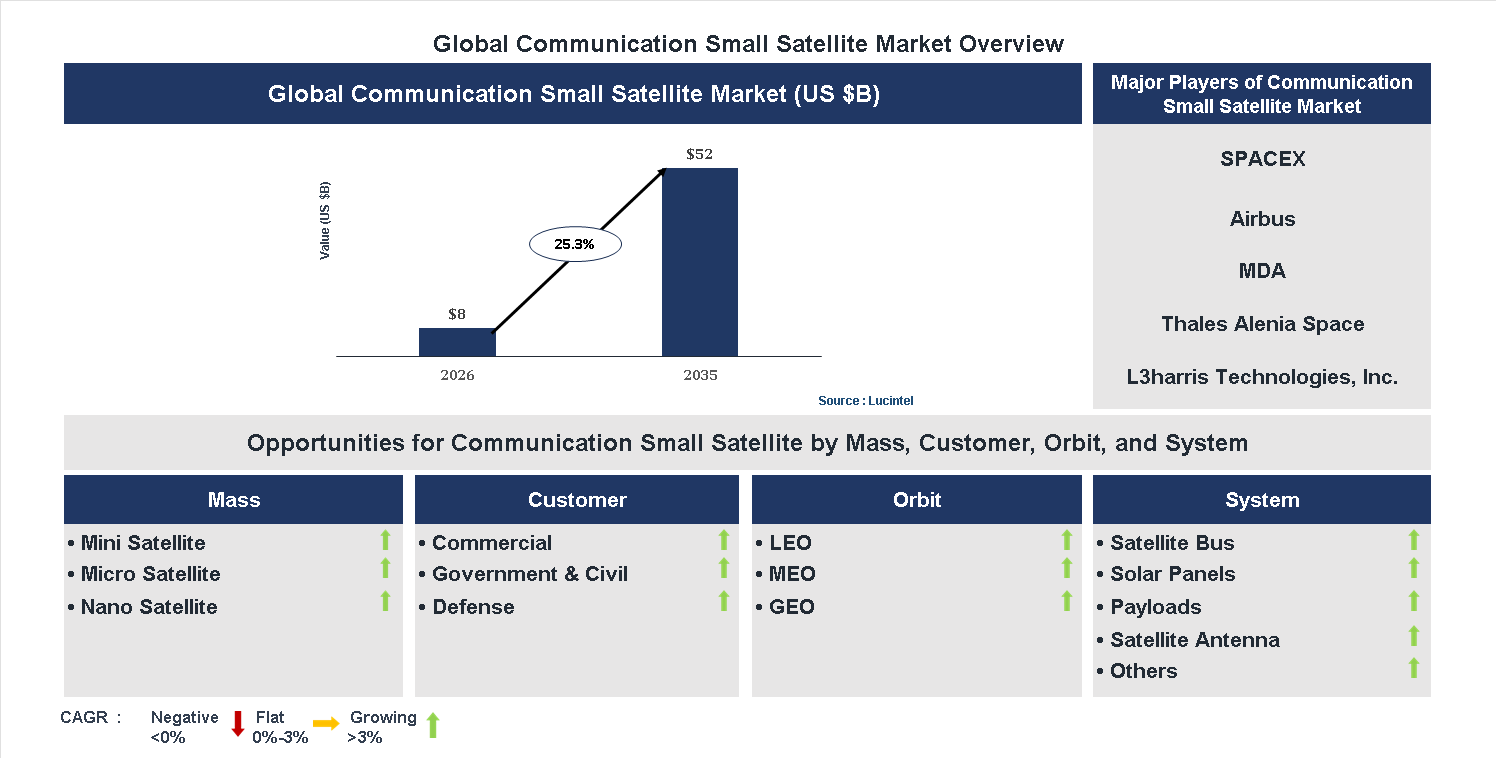
Key data points: The market size in 2035 = $52 billion, growth forecast = 25.3% annually for the next 8 years. Scroll below to get more insights. This market report covers trends, opportunities and forecasts in communication small satellite market to 2035 by mass (mini satellite, micro satellite, and nano satellite), customer (commercial, government & civil, and defense), orbit (LEO, MEO, and GEO), system (satellite bus, solar panels, payloads, satellite antenna, and others), and region (North America, Europe, Asia Pacific, and the Rest of the World)
We'll send your sample report shortly.
• Lucintel forecasts that, within the mass category, nano satellite is expected to witness the highest growth over the forecast period.
• Within the system category, payload is expected to witness the highest growth.
• In terms of region, North America is expected to witness the highest growth over the forecast period. Gain valuable insights for your business decisions with our comprehensive 150+ page report. Sample figures with some insights are shown below.
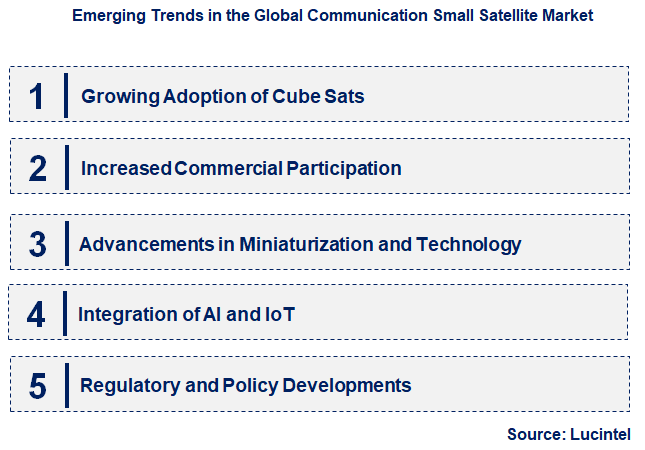
• Growing Adoption of Cube Sats: The rise of CubeSats, small standardized satellites, is revolutionizing the market by offering affordable, rapid deployment options for communication services. Their modular design allows for customization and scalability, making them ideal for various applications such as internet provision, disaster management, and military communications. The decreasing costs and technological advancements are encouraging more organizations to deploy CubeSats, thereby expanding market reach and fostering innovation in satellite communication solutions.
• Increased Commercial Participation: Traditionally dominated by government and defense agencies, the market is now witnessing a surge in commercial players entering the space. Companies are investing heavily in small satellite technology to provide global connectivity, IoT solutions, and data services. This shift is driven by the decreasing costs of satellite manufacturing and launch services, along with the growing demand for satellite-based internet services. The increased commercial participation is fostering competition, driving innovation, and expanding the market’s scope and capabilities.
• Advancements in Miniaturization and Technology: Technological innovations in miniaturization are enabling the development of more powerful, lightweight, and energy-efficient small satellites. These advancements improve satellite performance while reducing costs and launch requirements. Enhanced onboard processing, better sensors, and improved communication payloads are expanding the capabilities of small satellites, making them suitable for more complex and high-demand applications. This trend is significantly boosting the market by enabling more sophisticated and reliable communication services from smaller platforms.
• Integration of AI and IoT: The integration of Artificial Intelligence (AI) and Internet of Things (IoT) technologies with small satellite systems is opening new avenues for market growth. AI enhances satellite data processing, autonomous operations, and predictive maintenance, while IoT connectivity enables real-time data transfer across various sectors. These integrations facilitate smarter, more efficient communication networks, especially in remote or disaster-stricken areas. The synergy of AI, IoT, and small satellites is creating innovative solutions for industries such as agriculture, logistics, and emergency response, thereby broadening the market’s application scope.
• Regulatory and Policy Developments: Evolving regulatory frameworks and policies are shaping the market landscape by streamlining satellite deployment and spectrum allocation processes. Governments and international bodies are establishing guidelines to facilitate the growth of small satellite operations while ensuring space safety and spectrum management. These regulatory developments are reducing entry barriers for new players and encouraging innovation. Clearer policies and streamlined licensing processes are expected to accelerate market growth, foster international collaboration, and ensure sustainable development of small satellite communication services. These trends are collectively reshaping the communication small satellite market by making satellite deployment more affordable, innovative, and accessible. The increased participation of commercial entities, technological advancements, and supportive regulatory environments are driving rapid growth and expanding the market’s potential. As these trends continue to evolve, they will enable more comprehensive, reliable, and global communication networks, transforming how industries and governments connect and operate in the future.
• Growing Demand for Global Connectivity: The increasing need for reliable, affordable communication services worldwide is fueling the deployment of small satellites. These satellites enable coverage in remote and underserved areas, bridging connectivity gaps. As internet penetration expands, especially in developing regions, small satellites offer a cost-effective solution to deliver high-speed data, support IoT applications, and facilitate emergency communications. This trend is expected to accelerate market growth and foster new business models.
• Advances in Miniaturization and Technology: Innovations in miniaturization have led to smaller, more efficient satellite components, reducing launch costs and enabling rapid deployment. Enhanced onboard processing, improved power systems, and miniaturized sensors increase satellite capabilities without increasing size. These technological improvements allow for more complex missions, longer operational lifespans, and increased payload flexibility. As a result, the market benefits from increased affordability and accessibility, encouraging a broader range of players to participate.
• Increased Commercial and Government Collaborations: Partnerships between commercial firms and government agencies are expanding, driven by shared interests in space-based communication infrastructure. Governments seek cost-effective solutions for national security, disaster management, and scientific research, while commercial entities aim to capitalize on new markets. These collaborations facilitate technology transfer, joint missions, and funding opportunities, accelerating innovation and deployment. Such partnerships are vital for scaling small satellite networks and enhancing global communication capabilities.
• Rising Use of Small Satellites for Scientific and Earth Observation: Small satellites are increasingly employed for scientific research, environmental monitoring, and disaster response. Their ability to provide high-resolution imaging, real-time data, and frequent revisit times makes them invaluable for climate studies, agriculture, and urban planning. The affordability and rapid deployment of small satellites enable more frequent data collection, supporting timely decision-making. This diversification of applications broadens market scope and attracts new investment in satellite technology.
• Expansion of Launch Opportunities and Cost Reductions: The emergence of dedicated small satellite launch services and rideshare programs has significantly lowered launch costs. Reusable launch vehicles and innovative deployment methods further reduce expenses, making small satellite deployment more feasible for startups and research institutions. Increased launch availability accelerates market growth by enabling rapid constellation deployment and frequent satellite replacements. This trend enhances market competitiveness and encourages innovation across the industry. These developments are transforming the communication small satellite market by making satellite deployment more affordable, versatile, and accessible. Enhanced technological capabilities, strategic collaborations, and expanded launch options are driving rapid growth and diversification of applications. As a result, the market is poised for increased innovation, global connectivity, and scientific advancements, ultimately shaping a more connected and data-driven future across commercial, governmental, and scientific sectors.
• Growing Demand for Global Connectivity Drives Small Satellite Deployment: The increasing need for reliable, cost-effective communication services worldwide is fueling the deployment of small satellites. These satellites provide coverage in remote and underserved areas, support disaster management, and enable IoT connectivity. As internet penetration expands and data demands surge, satellite operators are investing in small satellite constellations to deliver scalable, flexible, and rapid deployment solutions, creating substantial growth opportunities in both commercial and government sectors.
• Technological Innovations Enhance Small Satellite Capabilities and Cost-Effectiveness: Advances in miniaturization, propulsion, and onboard processing are significantly improving small satellite performance. These innovations reduce manufacturing and launch costs, making small satellites more accessible for diverse applications. Enhanced capabilities such as higher data throughput, longer lifespan, and improved reliability enable new use cases, attracting more customers and encouraging industry growth. Continuous R&D efforts are expected to further lower barriers and expand application scopes.
• Increasing Adoption of Small Satellites in Defense and Security Applications: Governments and defense agencies are increasingly utilizing small satellites for surveillance, reconnaissance, and secure communications. Their quick deployment, lower costs, and ability to form constellations make them ideal for tactical operations and real-time data collection. This trend is driven by geopolitical tensions and the need for resilient, flexible communication networks. The defense sectors adoption is expected to significantly boost market growth, fostering innovation and strategic collaborations.
• Expansion of Commercial Applications in Remote Sensing and IoT Connectivity: Small satellites are increasingly used for remote sensing, environmental monitoring, and supporting IoT infrastructure. Their ability to provide high-resolution imagery and real-time data supports agriculture, urban planning, and disaster response. The proliferation of IoT devices necessitates scalable satellite networks for seamless connectivity. Growing commercial interest and technological advancements are expected to drive market expansion, creating new revenue streams and fostering industry competitiveness.
• Strategic Collaborations and Launch Cost Reductions Accelerate Market Growth: Partnerships between satellite manufacturers, launch service providers, and end-users are facilitating faster market penetration. Reusable launch vehicles and ride-sharing options are significantly reducing launch costs, enabling more frequent and affordable satellite deployments. These collaborations foster innovation, improve supply chain efficiencies, and expand application opportunities. As launch costs decline and strategic alliances strengthen, the market is poised for accelerated growth, attracting new entrants and expanding existing capabilities. The communication small satellite market is poised for substantial growth driven by technological advancements, expanding applications, and strategic collaborations. Increasing demand for global connectivity, defense, and commercial uses will continue to propel industry expansion. Cost reductions and innovative partnerships will further accelerate deployment rates, fostering a highly competitive environment. Overall, these opportunities will shape a dynamic market landscape, enabling stakeholders to capitalize on emerging trends and meet evolving customer and regulatory needs effectively.
• Technological Innovation: The rapid development of miniaturization and advanced payloads has enabled the production of smaller, more efficient satellites. These innovations reduce costs and deployment times, making small satellites attractive for diverse communication applications. Enhanced propulsion, power systems, and onboard processing capabilities further improve satellite performance, expanding their utility in global connectivity, IoT, and disaster management. As technology continues to evolve, the market benefits from increased reliability and functionality, encouraging more players to invest in small satellite communication solutions.
• Cost-Effectiveness and Reduced Launch Expenses: The decreasing costs of satellite manufacturing and launch services significantly boost market growth. Reusable launch vehicles and ride-sharing options have lowered entry barriers for satellite operators. This affordability allows for the deployment of larger satellite constellations, improving coverage and service quality. Cost savings also enable startups and emerging markets to participate, fostering innovation and competition. As launch costs continue to decline, the overall market becomes more accessible, accelerating the adoption of small satellite communication systems worldwide.
• Growing Demand for Global Connectivity: The increasing need for reliable, high-speed communication in remote and underserved regions drives demand for small satellites. They provide cost-effective solutions for bridging digital divides, supporting IoT networks, and enhancing disaster response capabilities. Governments, telecom providers, and private enterprises seek to expand coverage, especially in rural areas and developing countries. The ability of small satellites to quickly deploy and scale makes them ideal for addressing these connectivity gaps, fueling market expansion and technological advancements.
• Regulatory Developments and Spectrum Management: Evolving regulatory frameworks around space operations, spectrum allocation, and orbital debris management influence market dynamics. Governments and international bodies are establishing guidelines to ensure sustainable satellite deployment and minimize interference. Clear regulations facilitate market entry and foster investor confidence, while complex or restrictive policies can hinder growth. Effective spectrum management is crucial for avoiding signal interference, which impacts communication quality. As regulatory environments become more defined and supportive, the market is poised for steady growth with increased collaboration among stakeholders.
• Strategic Collaborations and Commercialization: Partnerships between satellite manufacturers, service providers, and government agencies accelerate market development. Collaborations enable shared expertise, resource pooling, and faster deployment of satellite constellations. Commercialization efforts, including innovative business models and public-private partnerships, expand market reach. These alliances also foster technological innovation and facilitate access to funding. As collaboration becomes more prevalent, the market benefits from increased innovation, reduced costs, and enhanced service offerings, driving overall growth. The challenges facing the communication small satellite market include:
• Space Debris and Orbital Congestion: The proliferation of small satellites raises concerns about space debris and orbital congestion, which threaten satellite safety and sustainability. Managing debris and ensuring safe satellite operations require stringent regulations and active debris removal strategies. Without effective management, the risk of collisions increases, potentially damaging assets and disrupting services. This challenge necessitates international cooperation and innovative solutions to maintain a sustainable space environment, which can add complexity and costs to satellite deployment and operation.
• Regulatory Uncertainty and Spectrum Allocation: The evolving regulatory landscape presents uncertainties that can delay satellite launches and operations. Spectrum allocation conflicts and licensing procedures vary across countries, creating barriers for market participants. Navigating these complex regulatory environments requires significant time and resources, potentially hindering rapid deployment. Additionally, inconsistent policies may limit international cooperation and market expansion, impacting the overall growth prospects of small satellite communication services.
• Technological and Operational Risks: Rapid technological advancements pose risks related to obsolescence and integration. Ensuring compatibility among diverse satellite systems and ground infrastructure can be challenging. Operational risks include satellite failures, cybersecurity threats, and limited lifespan of small satellites. These issues can lead to increased costs, service disruptions, and reduced confidence among users and investors. Overcoming these risks requires continuous innovation, robust testing, and effective risk management strategies, which can be resource-intensive. The communication small satellite market is driven by technological advancements, cost reductions, and increasing demand for global connectivity. However, challenges such as space debris, regulatory complexities, and operational risks pose significant hurdles. The overall impact of these drivers and challenges will shape the market’s future, requiring stakeholders to innovate, collaborate, and adapt to ensure sustainable growth and technological progress in this rapidly evolving industry.
• SPACEX
• Airbus
• MDA
• Thales Alenia Space
• L3harris Technologies, Inc.
• Northrop Grumman
• Surrey Satellite Technology Ltd
• Mitsubishi Electric Corporation
• Lockheed Martin Corporation
• BAE Systems
• Mini Satellite
• Micro Satellite
• Nano Satellite
• Commercial
• Government & Civil
• Defense
• LEO
• MEO
• GEO
• Satellite Bus
• Solar Panels
• Payloads
• Satellite Antenna
• Others
• North America
• Europe
• Asia Pacific
• The Rest of the World
• United States: The US leads in small satellite technology, with significant investments from private firms like SpaceX and OneWeb. Recent advancements include the deployment of large satellite constellations for global internet coverage and increased focus on military applications. Regulatory agencies are streamlining licensing processes to support rapid deployment, and collaborations with international partners are expanding. The US also emphasizes innovation in satellite miniaturization and propulsion systems, maintaining its competitive edge in the global market.
• China: China has rapidly advanced its small satellite capabilities, focusing on both commercial and military applications. The government has launched numerous small satellite missions for Earth observation, communication, and navigation. Recent developments include the successful deployment of large satellite constellations aimed at enhancing domestic connectivity and strategic surveillance. China is also investing in indigenous satellite manufacturing and launch infrastructure, aiming for self-sufficiency and technological independence in this sector.
• Germany: Germany is strengthening its position in the small satellite market through innovative research and development initiatives. The country emphasizes sustainable satellite technologies and international collaborations within the European Space Agency. Recent projects include small satellites for environmental monitoring, scientific research, and secure communications. Germany is also exploring the integration of small satellites into broader European space strategies, focusing on cost-effective and eco-friendly solutions.
• India: India has made significant strides in small satellite technology, driven by government initiatives and private sector participation. The Indian Space Research Organization (ISRO) has launched multiple small satellite missions for communication, Earth observation, and scientific research. Recent developments include the successful deployment of small satellite constellations for rural connectivity and disaster management. India aims to become a key player in the global small satellite market by enhancing manufacturing capabilities and reducing launch costs through indigenous launch vehicles.
• Japan: Japan continues to innovate in the small satellite sector, focusing on advanced communication, scientific research, and disaster management applications. The country has launched several small satellites with cutting-edge sensors and communication systems. Recent advancements include the development of small satellite constellations for secure communication and Earth monitoring. Japan is also investing in international partnerships and commercial ventures to expand its influence and technological capabilities in the global market.


• SPACEX
• Airbus
• MDA
• Thales Alenia Space
• L3harris Technologies, Inc.
• Northrop Grumman
• Surrey Satellite Technology Ltd
• Mitsubishi Electric Corporation
• Lockheed Martin Corporation
• BAE Systems Q6. Which communication small satellite market segment will be the largest in future? Answer: Lucintel forecasts that, within the mass category, nano satellite is expected to witness the highest growth over the forecast period. Q7. In communication small satellite market, which region is expected to be the largest in next 8 years? Answer: In terms of region, North America is expected to witness the highest growth over the forecast period. Q8. Do we receive customization in this report? Answer: Yes, Lucintel provides 10% customization without any additional cost.


Choose a license that fits your team. Instant PDF delivery.
Prices exclude taxes. Instant delivery. Custom licensing available on request.
Market Report · July 31, 2026
Market Report · July 31, 2026
Market Report · July 31, 2026
Trusted partner for strategic intelligence and business growth


Receive a complimentary market analysis tailored to your industry. Our analysts will identify key growth opportunities and competitive dynamics specific to your business.

Market size, growth rate, and key trend analysis for your specific sector.

Top competitor positioning and market share analysis.

Strategic recommendations backed by data-driven insights.
Get curated market intelligence and competitive moves straight to your inbox.
By subscribing, you agree to receive our monthly insights. Unsubscribe anytime.
Receive a complimentary market analysis tailored to your industry. Our analysts will identify key growth opportunities and competitive dynamics specific to your business.
Market size, growth rate, and key trend analysis for your specific sector.
Top competitor positioning and market share analysis.
Strategic recommendations backed by data-driven insights.
Get curated market intelligence, emerging trends, and competitive moves straight to your inbox each month.
By subscribing, you agree to receive our monthly insights. Unsubscribe anytime.
We'll send your sample report shortly.