
Market Report · July 29, 2026

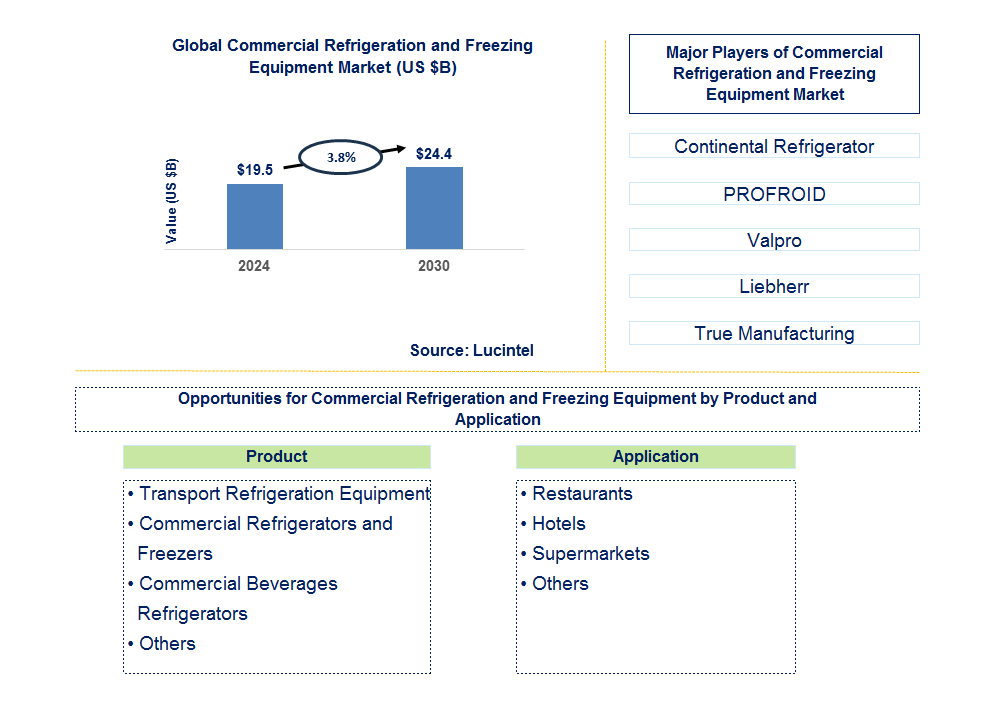
Key data points: The market size in 2030 = $24.4 billion, growth forecast = 3.8% annually for the next 6 years. Scroll below to get more insights. This market report covers trends, opportunities, and forecasts in the global commercial refrigeration and freezing equipment market to 2030 by product (transport refrigeration equipment, commercial refrigerators and freezers, commercial beverages refrigerators, and others), application (restaurants, hotels, supermarkets, and others), and region (North America, Europe, Asia Pacific, and the Rest of the World)
We'll send your sample report shortly.
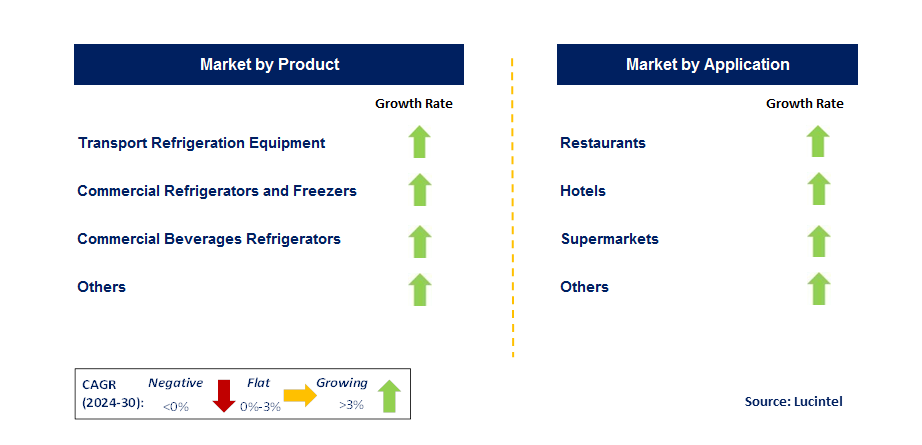
• Lucintel forecasts that, within the product category, commercial refrigerators and freezers will remain the largest segment over the forecast period.
• Within the application category, hotels will remain the largest segment.
• North America is expected to witness the highest growth over the forecast period due to store and preserve perishable goods, the huge and diverse north american food sector, which includes restaurants, fast food chains, grocers, and food service outlets, has a significant demand for commercial refrigeration and freezing equipment. A more than 150-page report is developed to help in your business decisions.
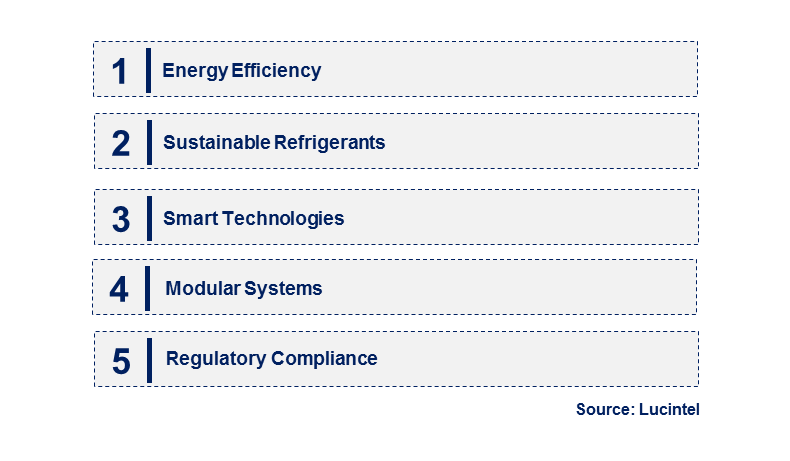
• Energy efficiency: Increased focus on energy-efficient technologies is driving the adoption of advanced refrigeration systems. Businesses are investing in equipment that minimizes energy consumption, not only to reduce costs but also to comply with regulatory standards aimed at lowering carbon emissions.
• Sustainable refrigerants: The shift toward eco-friendly refrigerants is becoming a critical trend. Many countries are phasing out harmful substances like HFCs, pushing manufacturers to develop and adopt natural refrigerants such as CO2 and ammonia, which have lower environmental impacts.
• Smart technologies: The integration of IoT and AI in refrigeration systems is on the rise. Smart refrigeration solutions allow for real-time monitoring and predictive maintenance, enhancing efficiency and reducing operational costs. This trend is particularly important for large-scale operations like supermarkets and food distribution centers.
• Modular systems: There is a growing preference for modular refrigeration systems that can be customized and scaled according to specific business needs. These systems offer flexibility in design and installation, making them suitable for various applications, from restaurants to warehouses.
• Regulatory compliance: Stricter regulations regarding energy efficiency and refrigerant use are influencing market dynamics. Companies are increasingly prioritizing compliance with local and international standards, driving innovation and investment in cleaner technologies. These trends are fundamentally reshaping the commercial refrigeration and freezing equipment market, promoting sustainability, efficiency, and technological advancement.
• Adoption of eco-friendly refrigerants: The market is witnessing a rapid transition to eco-friendly refrigerants as governments impose stricter regulations. This development not only helps reduce greenhouse gas emissions but also encourages manufacturers to innovate and develop more sustainable refrigeration solutions.
• Integration of IoT technologies: The incorporation of IoT in refrigeration equipment is enhancing operational efficiency. Businesses are leveraging smart sensors and data analytics for real-time monitoring, enabling them to optimize performance, reduce energy consumption, and prevent spoilage.
• Investment in energy-efficient systems: Companies are increasingly investing in energy-efficient refrigeration systems. This shift not only lowers operational costs but also supports sustainability goals, positioning businesses favorably in an eco-conscious market.
• Focus on modular solutions: Modular refrigeration systems are gaining traction due to their flexibility and scalability. Businesses can customize their setups to meet specific needs, making them suitable for diverse applications, from small cafes to large grocery chains.
• Enhanced food safety standards: With rising consumer awareness around food safety, businesses are prioritizing refrigeration solutions that extend shelf life and reduce spoilage. This development is pushing manufacturers to innovate in design and technology to meet stringent safety requirements. These developments are significantly impacting the commercial refrigeration and freezing equipment market by driving sustainability, efficiency, and innovation.
• Retail sector: The retail sector offers significant growth potential for advanced refrigeration solutions. As consumers increasingly demand fresh and frozen products, retailers can benefit from energy-efficient and smart refrigeration systems that enhance product quality and reduce waste.
• Foodservice industry: The foodservice industry is rapidly adopting innovative refrigeration technologies. Opportunities lie in providing tailored solutions that improve food safety and streamline operations, particularly in restaurants and catering services where efficiency is paramount.
• Cold chain logistics: With the rise of e-commerce and online food delivery, the cold chain logistics sector is expanding. Investing in advanced refrigeration equipment that maintains temperature integrity throughout the supply chain presents substantial growth opportunities.
• Pharmaceutical industry: The pharmaceutical sector requires precise temperature control for vaccine and medication storage. Developing specialized refrigeration solutions to meet stringent regulatory requirements can unlock significant market potential in this field.
• Sustainability initiatives: Businesses that prioritize sustainability can tap into the growing demand for eco-friendly refrigeration systems. Solutions that utilize natural refrigerants and energy-efficient technologies are increasingly sought after, aligning with global sustainability goals. These growth opportunities are shaping the commercial refrigeration and freezing equipment market, driving innovation and enhancing competitive advantage.
• Increasing Demand for Fresh Produce: Rising consumer demand for fresh and frozen food products is driving the need for advanced refrigeration solutions. Businesses are investing in efficient systems to ensure product quality and minimize spoilage, boosting market growth.
• Regulatory Pressures for Sustainability: Stricter environmental regulations are encouraging companies to adopt eco-friendly refrigeration solutions. Compliance with these regulations is becoming a key driver for innovation in refrigerants and energy-efficient technologies.
• Technological Advancements: Rapid advancements in refrigeration technologies, including IoT and AI, are transforming the market. These technologies improve operational efficiency and enhance monitoring capabilities, enabling businesses to reduce costs and waste.
• Growth of E-commerce: The rise of e-commerce, particularly in the food sector, is increasing the demand for reliable refrigeration in cold chain logistics. This trend presents significant growth opportunities for companies providing innovative refrigeration solutions.
• Consumer Awareness of Food Safety: Growing consumer awareness around food safety is prompting businesses to prioritize high-quality refrigeration solutions. This demand for safe storage methods drives investment in advanced technologies that ensure product integrity. Challenges in the commercial refrigeration and freezing equipment market are:
• High Initial Investment Costs: The cost of advanced refrigeration systems can be a barrier for small and medium-sized enterprises. High initial investments may deter businesses from upgrading to more efficient technologies, impacting overall market growth.
• Regulatory Compliance Complexity: Navigating diverse regulatory requirements across different regions can pose challenges for manufacturers and businesses. Compliance complexities may hinder the swift adoption of new technologies and refrigerants.
• Supply Chain Disruptions: The global supply chain has been affected by various factors, including the pandemic and geopolitical tensions. Disruptions can impact the availability of key components for refrigeration systems, affecting production timelines and costs. These drivers and challenges shape the commercial refrigeration and freezing equipment market, influencing its growth trajectory and the strategies adopted by stakeholders.
• Continental Refrigerator
• PROFROID
• Valpro
• Liebherr
• True Manufacturing
• CKE
• Western Refrigeration
• Faircloth & Reynolds
• Rockwell Industries
• AB Electrolux
• Transport Refrigeration Equipment
• Commercial Refrigerators and Freezers
• Commercial Beverages Refrigerators
• Others
• Restaurants
• Hotels
• Supermarkets
• Others
• North America
• Europe
• Asia Pacific
• The Rest of the World
• United States: In the U.S., advancements in energy-efficient refrigeration systems are at the forefront. The market is witnessing a surge in the adoption of eco-friendly refrigerants, driven by regulatory pressures and consumer demand for sustainable practices. Additionally, smart refrigeration technologies are being integrated to optimize energy use and enhance operational efficiency, particularly in supermarkets and foodservice establishments.
• China: China's commercial refrigeration market is rapidly expanding, with a focus on high-tech solutions. The government is promoting energy-efficient and environmentally friendly refrigeration systems to combat climate change. Innovations such as IoT-enabled refrigerators are gaining traction, enabling better monitoring and management of temperature and energy consumption in retail and food distribution sectors.
• Germany: Germany is leading in the development of innovative refrigeration technologies, particularly in energy efficiency and sustainability. The market is witnessing increased investment in natural refrigerants, and companies are focusing on creating modular systems that can be easily integrated into existing infrastructure. Regulatory frameworks support these initiatives, driving the transition to greener alternatives.
• India: In India, the commercial refrigeration market is growing rapidly due to urbanization and rising consumer demand for perishable goods. Innovations include affordable, energy-efficient cooling solutions tailored to local needs. Government initiatives promoting the use of eco-friendly refrigerants are also gaining momentum, encouraging businesses to adopt sustainable practices in their refrigeration operations.
• Japan: Japan is focusing on advanced refrigeration technologies that incorporate AI and IoT. The market is seeing a shift toward smart refrigeration systems that enhance energy efficiency and improve food safety through better monitoring. Furthermore, there is an emphasis on developing sustainable refrigerants to meet regulatory standards and consumer expectations.
• Continental Refrigerator
• PROFROID
• Valpro
• Liebherr
• True Manufacturing
• CKE
• Western Refrigeration
• Faircloth & Reynolds
• Rockwell Industries
• AB Electrolux Q6. Which commercial refrigeration and freezing equipment market segment will be the largest in future? Answer: Lucintel forecasts that commercial refrigerators and freezers will remain the largest segment over the forecast period. Q7. In commercial refrigeration and freezing equipment market, which region is expected to be the largest in next 5 years? Answer: North America is expected to witness highest growth over the forecast period due to store and preserve perishable goods, the huge and diverse north american food sector, which includes restaurants, fast food chains, grocers, and food service outlets, has a significant demand for commercial refrigeration and freezing equipment. Q.8 Do we receive customization in this report? Answer: Yes, Lucintel provides 10% customization without any additional cost.


Choose a license that fits your team. Instant PDF delivery.
Prices exclude taxes. Instant delivery. Custom licensing available on request.
Market Report · July 29, 2026
Market Report · July 20, 2026
Market Report · July 20, 2026
Trusted partner for strategic intelligence and business growth


Receive a complimentary market analysis tailored to your industry. Our analysts will identify key growth opportunities and competitive dynamics specific to your business.

Market size, growth rate, and key trend analysis for your specific sector.

Top competitor positioning and market share analysis.

Strategic recommendations backed by data-driven insights.
Get curated market intelligence and competitive moves straight to your inbox.
By subscribing, you agree to receive our monthly insights. Unsubscribe anytime.
Receive a complimentary market analysis tailored to your industry. Our analysts will identify key growth opportunities and competitive dynamics specific to your business.
Market size, growth rate, and key trend analysis for your specific sector.
Top competitor positioning and market share analysis.
Strategic recommendations backed by data-driven insights.
Get curated market intelligence, emerging trends, and competitive moves straight to your inbox each month.
By subscribing, you agree to receive our monthly insights. Unsubscribe anytime.
We'll send your sample report shortly.