
Market Report · July 31, 2026

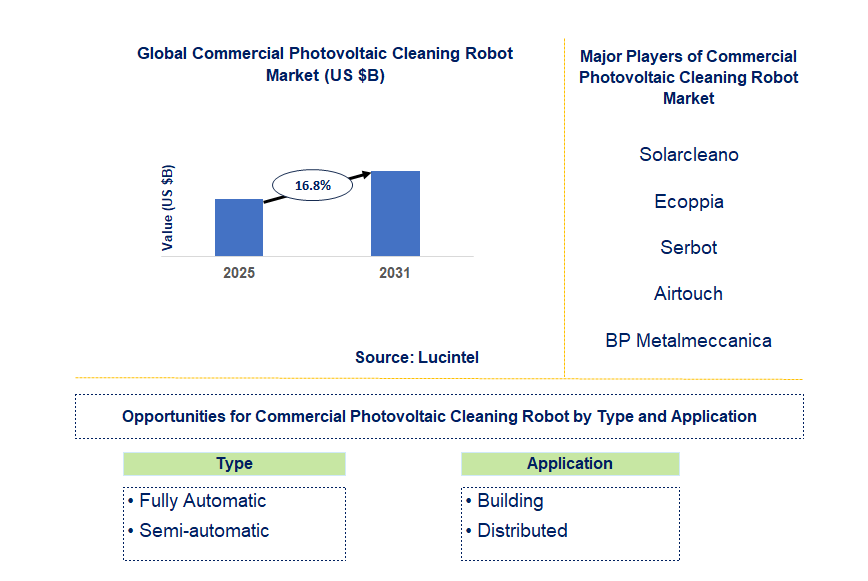
Key data points: The growth forecast = 16.8% annually for the next 7 years. Scroll below to get more insights. This market report covers Trends, opportunities and forecasts in commercial photovoltaic cleaning robot market to 2031 by type (fully automatic and semi-automatic), application (building and distributed), and region (North America, Europe, Asia Pacific, and the Rest of the World)
We'll send your sample report shortly.
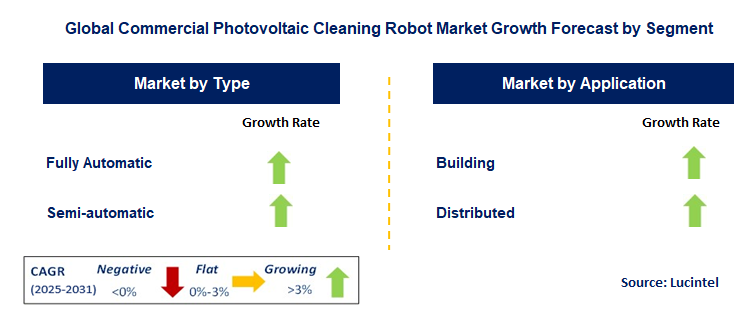
• Lucintel forecasts that, within the type category, fully automatic is expected to witness higher growth over the forecast period due to the increasing demand for automation.
• Within the application category, distributed is expected to witness higher growth due to the growing installation of decentralized solar systems.
• In terms of region, APAC is expected to witness the highest growth over the forecast period due to the rising adoption of solar energy.
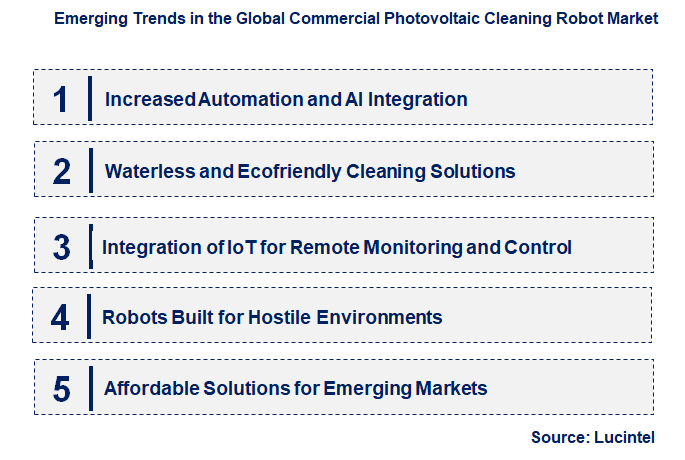
• Increased Automation and AI Integration: Automation and artificial intelligence (AI) are dominating the commercial photovoltaic cleaning robot market. Robots are increasingly being equipped with more intelligence, where AI is employed to scan for panel cleanliness levels and change their cleaning procedure in response. This enables extremely efficient cleaning cycles, maximizing energy harvesting from solar panels. AI-controlled robots have the ability to learn from previous cleaning activities and evolve over time, minimizing the role of humans.
• Waterless and Ecofriendly Cleaning Solutions: As more attention is being placed on sustainability, waterless cleaning options in photovoltaic robots are increasingly in demand. Conventional cleaning processes tend to employ considerable quantities of water, which is not only wasteful but also expensive. Emerging cleaning robots are instead being engineered to perform with no water, employing dry or low-cleaning techniques like brushes or electrostatic cleaning. This environmentally friendly method proves especially useful in desert regions where water is limited.
• Integration of IoT for Remote Monitoring and Control: The incorporation of Internet of Things (IoT) technology into cleaning robots is facilitating remote monitoring and control of cleaning activities. Operators are able to view real-time information from the robots, such as performance data and status reports, remotely. This connectivity facilitates improved management of large-scale solar farms, with optimized cleaning schedules and areas of attention. IoT-enabled robots also facilitate predictive maintenance, minimizing the risk of unplanned failures.
• Robots Built for Hostile Environments: Many commercial photovoltaic cleaning robots are now being designed to operate in harsh environments such as deserts or areas with extreme temperatures. These robots are built with rugged materials and advanced sensors that allow them to function effectively under challenging conditions. This trend is particularly relevant for solar farms located in regions with difficult terrain or environmental factors, ensuring that solar panels remain clean and efficient throughout the year.
• Affordable Solutions for Emerging Markets: There is an increasing trend towards the creation of affordable photovoltaic cleaning robots, particularly in emerging markets like India and Africa. The robots are intended to provide low capital costs and low maintenance, thus being affordable to nations with low budgets for high-tech technologies. Through cost savings on labor and enhanced cleaning efficiency, the robots provide a cost-effective and sustainable solution for solar farms in emerging economies. The market for commercial photovoltaic cleaning robots is being transformed by trends centered on automation, green solutions, and IoT integration. These technologies are enhancing the efficiency, affordability, and versatility of cleaning robots to clean in different environments. With developments such as AI integration, waterless cleaning, and remote monitoring, photovoltaic cleaning robots are becoming more efficient to address the growing needs of the solar sector. These trends are improving the overall performance and sustainability of solar power installations while streamlining cleaning operations to be more efficient and environmentally friendly.
• Introduction of AI-Powered Cleaning Robots: The use of artificial intelligence (AI) in photovoltaic cleaning robots has enhanced their efficiency to a large extent. The robots can now inspect the cleanliness of solar panels and modify their cleaning process based on that. AI-based robots can detect areas of concern, streamline cleaning schedules, and even anticipate maintenance requirements. This is creating increased efficiency and lower operational costs for solar farm operators.
• Development of Waterless Cleaning Technology: Waterless cleaning technology in photovoltaic cleaning robots is a breakthrough. The robots employ dry cleaning technology or electrostatic technology to clean solar panels by removing dust and debris without consuming water, making the cleaning processes more eco-friendly. The innovation is very useful in areas where water is limited, providing a green way of maintaining solar panels.
• Integration of IoT for Real-Time Data Access: Most commercial photovoltaic cleaning robots are now IoT enabled, enabling operators to view the cleaning operation in real time. The integration of IoT gives meaningful information regarding the robots' performance, such as energy usage, cleaning effectiveness, and system status. Solar farm operators can schedule optimal cleaning and detect potential malfunctions prior to them impacting the system's performance using IoT-enabled robots.
• Robots Designed for Extreme Environments: An interesting trend in the market is the development of robots that are meant to perform in extreme conditions like deserts or areas of high temperatures. These robots have specialized sensors and rugged components that allow them to perform in hard environments. This trend is making photovoltaic cleaning robots increasingly applicable to massive solar farms placed in harsh environments.
• Cost-Effective Solutions for Developing Markets: One of the leading advancements in the commercial photovoltaic cleaning robot industry is the development of less expensive robots customized for emerging markets. The economic cleaning robots are built with reduced features that lower the upfront cost for solar farm operators in developing economies. This advance makes robotic cleaning technology more viable to nations with thinner budgets for solar facilities. These new trends are propelling the commercialization of photovoltaic cleaning robots, which become more efficient, cost-effective, and versatile across different environments. Advances in AI, IoT, and waterless cleaning are augmenting robot capability and lowering the cost of solar farm maintenance. As these advances keep unfolding, the commercial market for photovoltaic cleaning robots is set for tremendous growth.
• Expansion in Large-Scale Solar Farms: With more large-scale solar farms, efficient cleaning solutions are becoming ever more in demand. Commercial photovoltaic cleaning robots provide a perfect solution for keeping large arrays of solar panels clean in large solar installations. They minimize manual labor, decrease maintenance costs, and optimize system performance overall, thus making them extremely desirable for large-scale solar projects.
• Integration of Cleaning Robots in Residential and Commercial Solar Installations: The use of photovoltaic cleaning robots is spreading from large-scale farms to residential and commercial solar systems. Robots for smaller systems are becoming more affordable and widely available, making them a feasible option for individual homes and businesses wanting to enhance the efficiency of their solar panels.
• Emerging Markets in Developing Economies: Increasing demand for solar energy in developing economies provides substantial opportunities for photovoltaic cleaning robots. Solar energy systems are being adopted in these markets, especially in countries such as India, Africa, and Latin America. Cheap and effective cleaning robots provide an option to keep solar panels in these economies, delivering high energy yields and low operational costs.
• Improvements in Automated Maintenance Solutions: The automation trend in solar panel maintenance is opening up new opportunities for growth in photovoltaic cleaning robots. These robots can be combined with other automated systems, including solar panel monitoring equipment, to offer an integrated maintenance solution. By automating the entire maintenance process, solar operators can save considerable labor costs and enhance the efficiency of solar power generation.
• Focus on Sustainability and Water Conservation: With growing emphasis on sustainability, the use of waterless cleaning technologies is on the rise. Dry cleaning technology or electrostatic cleaning methods are being embraced by robots in areas where there is a water scarcity problem. This emphasis on water conservation poses a huge business opportunity for makers of photovoltaic cleaning robots to target environmentally sustainable markets. These strategic growth prospects reflect the growing applications and demand for photovoltaic cleaning robots. As the solar energy sector continues to develop and expand, the necessity for efficient and cost-efficient maintenance solutions will further propel innovation in the market, opening up tremendous opportunities for entities in this industry.
• Solarcleano
• Ecoppia
• Serbot
• Airtouch
• BP Metalmeccanica
• PVH
• AX System
• Integra Global
• Solar Cleaning Machinary
• Bladeranger
• Fully Automatic
• Semi-automatic
• Building
• Distributed
• North America
• Europe
• Asia Pacific
• The Rest of the World
• United States: In the United States, the commercial photovoltaic cleaning robot market has seen substantial growth due to the nation's fast-paced solar energy adoption. With more large-scale solar farms being developed, there is a growing need for automated cleaning technologies to improve operational efficiency. The companies are emphasizing the creation of robots that can operate effectively in different weather conditions, including extreme temperatures. Besides, there is increasing emphasis on integrating artificial intelligence (AI) and machine learning in cleaning robots to allow them to work more independently and accurately. Support from the regulatory environment for renewable energy also enhances the market's growth.
• China: China has become a world leader in solar energy production and thus is a prominent participant in the commercial photovoltaic cleaning robot market. The nation is heavily investing in automated cleaning technologies as part of its sustained drive to grow its solar facilities. Chinese makers are launching robots that employ cutting-edge sensors and artificial intelligence to identify and clean solar panels using minimal water and energy. Emphasis on reducing costs and the use of automation is a strong driving factor, particularly in solar installations on large scales in deserts. The Chinese government’s commitment to renewable energy initiatives further strengthens the market’s growth prospects.
• Germany: Germany, a leader in the renewable energy sector, is making notable strides in the commercial photovoltaic cleaning robot market. German companies are developing cutting-edge robots equipped with automated cleaning mechanisms that minimize water usage, which is crucial in regions with limited water resources. The market is also witnessing more synergy between solar technology and robotics companies, leading to the development of more energy-efficient and environmentally compliant cleaning robots. Furthermore, Germany's strong environment protection policies and emphasis on sustainability are compelling cleaner, energy-saving technologies to become part of the solar market, which in turn is accelerating demand for cleaning robots.
• India: India is moving fast to develop its solar power capacity, spurring a wave of demand for commercial photovoltaic cleaning robots. With more solar power installations, the pressure for effective maintenance solutions to clean solar panels becomes increasingly urgent. The Indian market is witnessing the growth of cost-effective, low-maintenance solar panel cleaning robots that meet the requirements of Indian large-scale solar farms. In addition, the application of automation and robotics to solar panel cleaning is decreasing the cost of labor and increasing the efficiency of energy production. Support for renewable energy initiatives from the Indian government further adds to the potential of the market to grow.
• Japan: Japan is experiencing a gradual increase in the use of commercial photovoltaic cleaning robots primarily because of Japan's determination to increase its renewable energy capacity. Japanese companies are focusing on enhancing the efficiency of solar power plants with investments in robotic solutions for cleaning panels in residential and commercial solar installations. Japan is also applying AI and IoT to robotics for improved operational efficiency and remote monitoring. Japan's focus on technological innovation and sustainability positions the country as a target market for developing and deploying photovoltaic cleaning robots.


• Solarcleano
• Ecoppia
• Serbot
• Airtouch
• BP Metalmeccanica
• PVH
• AX System
• Integra Global
• Solar Cleaning Machinary
• Bladeranger Q5. Which commercial photovoltaic cleaning robot market segment will be the largest in future? Answer: Lucintel forecasts that, within the type category, fully automatic is expected to witness higher growth over the forecast period due to the increasing demand for automation. Q6. In commercial photovoltaic cleaning robot market, which region is expected to be the largest in next 5 years? Answer: In terms of region, APAC is expected to witness the highest growth over the forecast period due to the rising adoption of solar energy. Q7. Do we receive customization in this report? Answer: Yes, Lucintel provides 10% customization without any additional cost.


Choose a license that fits your team. Instant PDF delivery.
Prices exclude taxes. Instant delivery. Custom licensing available on request.
Market Report · July 31, 2026
Market Report · July 31, 2026
Market Report · July 31, 2026
Trusted partner for strategic intelligence and business growth


Receive a complimentary market analysis tailored to your industry. Our analysts will identify key growth opportunities and competitive dynamics specific to your business.

Market size, growth rate, and key trend analysis for your specific sector.

Top competitor positioning and market share analysis.

Strategic recommendations backed by data-driven insights.
Get curated market intelligence and competitive moves straight to your inbox.
By subscribing, you agree to receive our monthly insights. Unsubscribe anytime.
Receive a complimentary market analysis tailored to your industry. Our analysts will identify key growth opportunities and competitive dynamics specific to your business.
Market size, growth rate, and key trend analysis for your specific sector.
Top competitor positioning and market share analysis.
Strategic recommendations backed by data-driven insights.
Get curated market intelligence, emerging trends, and competitive moves straight to your inbox each month.
By subscribing, you agree to receive our monthly insights. Unsubscribe anytime.
We'll send your sample report shortly.