
Market Report · July 31, 2026

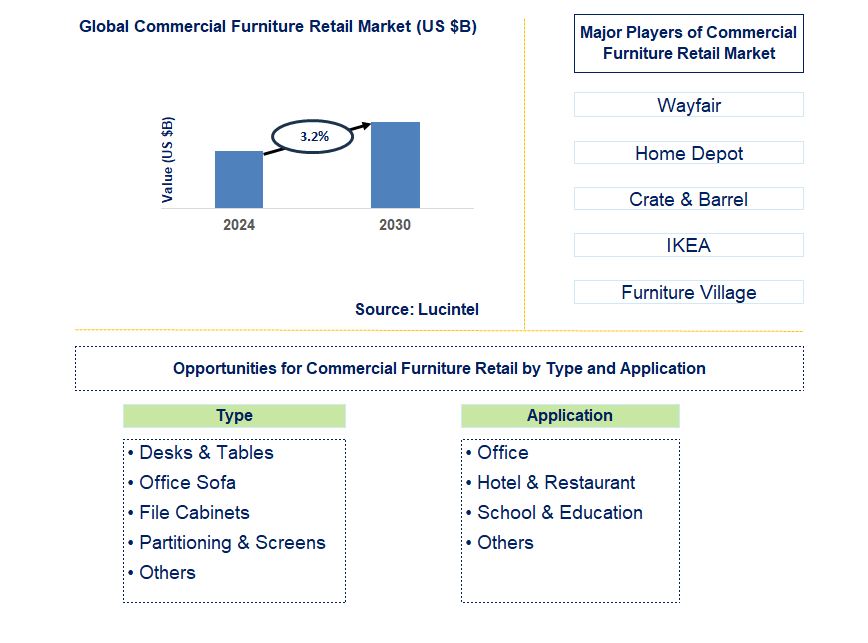
Key data points: The growth forecast = 3.2% annually for the next 6 years. Scroll below to get more insights. This market report covers trends, opportunities, and forecasts in the global commercial furniture retail market to 2030 by type (desks & tables, office sofa, file cabinets, partitioning & screens, and others), application (office, hotel & restaurant, school & education, and others), and region (North America, Europe, Asia Pacific, and the Rest of the World)
We'll send your sample report shortly.
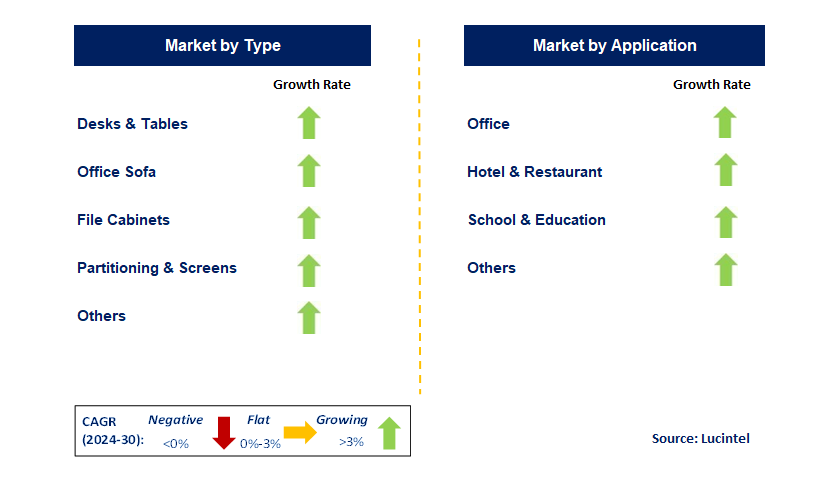
• Lucintel forecasts that, within the type category, desk & table is expected to witness the highest growth over the forecast period.
• Within this application category, office is expected to witness the highest growth.
• In terms of regions, APAC is expected to witness the highest growth over the forecast period. A more than 150-page report is developed to help in your business decisions.
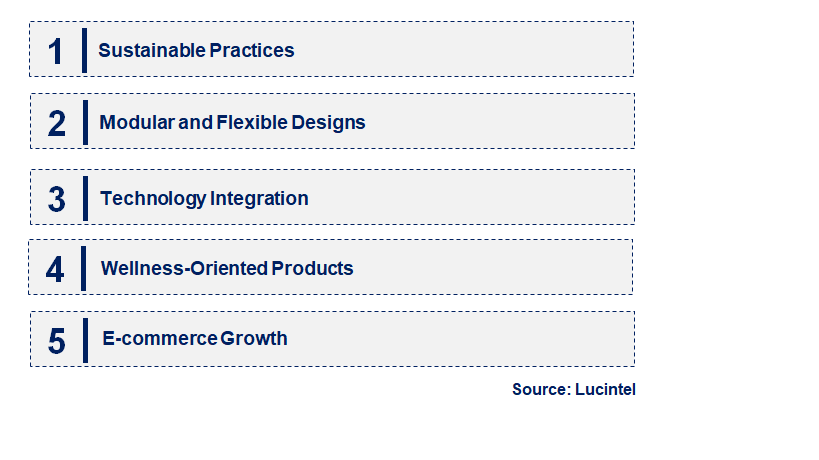
• Sustainable Practices: There is an increasing focus on the use of sustainable materials and processes, as companies aim to lower their effects on the environment and capture the green consumer market.
• Modular and Flexible Designs: There is a growing tendency for furniture to be reorganized into new formations as per requirements, aiding fluid working conditions.
• Technology Integration: Smart furniture, such as those with charging sockets and connectivity, is an added advantage in the modern workplace.
• Wellness-Oriented Products: More furniture that considers ergonomics is on the rise, improving the health and wellness of employees.
• E-commerce Growth: The shift towards online buying is changing the sales chain, helping businesses explore more options and improve purchasing processes. These trends continue to disrupt the commercial furniture retail market by fostering creativity, improving customer interaction, and enhancing internal environmental consciousness.
• Focus on sustainability: Many manufacturers have incorporated sustainable sourcing practices through the use of renewable resources.
• A metaphorical shift in the ways consumers purchase a variety of products: The ease of use of various e-commerce platforms has made online buying of furniture products simple while providing better accessibility to a diverse range of furniture options for businesses.
• Personalized offerings: Business enterprises have started to provide more modular furniture configurations, enabling firms to change designs according to required functionality and style.
• Improved structure usage: A growing awareness of health and wellness in the workplace is increasing the need for socio-ergonomic solutions to enhance workforce satisfaction and effectiveness.
• Agile workzones: Office design is changing with the addition of more open workspaces to foster collaboration and creativity. These advancements have implications for the commercial furniture retail market as they boost creativity, improve the quality of products offered, and enhance customer satisfaction.
• Market penetration in developing parts of the world: Retailers have an opportunity to explore newly developing economies where there is an increase in demand for commercial furniture as a result of rapid economic growth, particularly in fast-growing industries like IT and hospitality.
• Investment in innovative furniture: Creating technologically innovative furniture solutions can improve efficiencies as entities seek to be associated with stylish, modern work environments.
• Focus on customization: Producing and offering products that can be modified to suit the requirements of various enterprises can enhance customer satisfaction and loyalty.
• Leveraging e-commerce: Extending e-commerce helps businesses target wider audiences and facilitate purchasing for manufacturers or retailers.
• Promoting sustainable solutions: Focusing on green products can help diversify the portfolios of brands and target eco-friendly consumers and businesses. These new disruptive opportunities are actively redefining the commercial furniture retail market through enhancements in innovation, market coverage, and customer relationship management.
• Changing nature of work: The growing preference for hybrid work styles has created the need for more versatile furniture that meets the needs of employees who work from home and those who work from the office.
• Technological growth: New methods of production and creation of furniture are improving the product line and productivity of businesses.
• Increasing concern for employee wellness: To improve comfort and productivity levels in the workplace, corporations are focusing on health-friendly and ergonomic furniture, which creates an opportunity for market growth.
• E-commerce boom: The growing trend of purchasing furniture through online commerce is changing the way businesses buy furniture and making it easier to source a variety of such furniture.
• Rising urbanization: The growing phenomenon of urbanization and the development of business activities in developing countries are creating a demand for commercial furnishings. Challenges in the commercial furniture retail market are:
• Supply chain disruptions: Global supply chain challenges can limit product sales or drive up costs, posing challenges for both retailers and manufacturers in most instances.
• Market saturation: An abundance of furniture choices can cause stiff competition, affecting margins and profitability in retailing.
• Regulatory compliance: The commercial side of manufacturing and selling furniture has its own challenges, involving the need to overcome a number of hurdles related to production quality and safety regulations. These drivers and challenges together define the landscape of the commercial furniture retail market and affect decision-making and growth prospects.
• Wayfair
• Home Depot
• Crate & Barrel
• IKEA
• Furniture Village
• Barker & Stonehouse
• Furniture Today
• Luonto Furniture
• Williams-Sonoma
• Star Furniture Company
• Desks & Tables
• Office Sofa
• File Cabinets
• Partitioning & Screens
• Others
• Office
• Hotel & Restaurant
• School & Education
• Others
• North America
• Europe
• Asia Pacific
• The Rest of the World
• United States: In the US commercial furniture market, there is a growing quest for the development of workspaces that accommodate both remote and physical workers. Manufacturers are producing more adaptable furniture in various shapes, enabling diverse office arrangement designs. As environmental awareness increases, the use of greener materials is becoming more common among corporations. Additionally, the growth of online sales is changing how the furniture industry operates. Health and wellness considerations are also becoming essential in design, with an emphasis on ergonomics in products used within work environments.
• China: There is increasing demand for modern furniture in China, driven by rapid urbanization and economic growth. Particularly due to the relocation of businesses, new office spaces are being created that are not just functional but also aesthetically pleasing. The concept of the marketplace is evolving; the Internet provides opportunities to purchase goods more easily and access a wider variety of products. Local producers are increasingly introducing practices that minimize environmental footprints. It is also important to note that work environments are being enhanced with innovative designs that promote creative collaboration.
• Germany: The demand in the commercial furniture market in Germany has been for sustainable and cost-effective solutions. Companies are investing in employee skills to offer quality products that are durable and utilize green resources. Home office furniture has seen increased demand due to remote working, leading to more hybrid products entering the market. Buying habits are also changing; as digitalization continues, businesses are enhancing their websites and virtual consultancy services. PWC has noted that there is also a significant demand for spaces that facilitate active collaboration and lively work activities.
• India: India commercial furniture market is on the rise, especially with the growth of the IT and service sectors. There is increased interest in modern and flexible furniture arrangements that cater to diverse work needs. E-commerce platforms for sourcing office furniture are becoming more prevalent, making it easier for companies. Additionally, there is a shift towards greener products. The increasing trend of flexible working arrangements is impacting design preferences, with a focus on collaborative spaces and multi-purpose furniture.
• Japan: In Japan, commercial furniture tends to be traditional yet functional, often emphasizing utility over minimalist designs. More organizations are investing in ergonomics to enhance employee comfort and productivity. Digitalization is transforming how furniture is sold, leading to increased online sales and virtual displays. There is a growing need for workspaces that are collaborative in nature while also allowing businesses to adapt to changing work patterns.


• Wayfair
• Home Depot
• Crate & Barrel
• IKEA
• Furniture Village
• Barker & Stonehouse
• Furniture Today
• Luonto Furniture
• Williams-Sonoma
• Star Furniture Company Q5. Which commercial furniture retail market segment will be the largest in future? Answer: Lucintel forecasts that desk & table is expected to witness the highest growth over the forecast period. Q6. In commercial furniture retail market, which region is expected to be the largest in next 5 years? Answer: APAC is expected to witness highest growth over the forecast period. Q.7 Do we receive customization in this report? Answer: Yes, Lucintel provides 10% customization without any additional cost.


Choose a license that fits your team. Instant PDF delivery.
Prices exclude taxes. Instant delivery. Custom licensing available on request.
Market Report · July 31, 2026
Market Report · July 31, 2026
Market Report · July 31, 2026
Trusted partner for strategic intelligence and business growth


Receive a complimentary market analysis tailored to your industry. Our analysts will identify key growth opportunities and competitive dynamics specific to your business.

Market size, growth rate, and key trend analysis for your specific sector.

Top competitor positioning and market share analysis.

Strategic recommendations backed by data-driven insights.
Get curated market intelligence and competitive moves straight to your inbox.
By subscribing, you agree to receive our monthly insights. Unsubscribe anytime.
Receive a complimentary market analysis tailored to your industry. Our analysts will identify key growth opportunities and competitive dynamics specific to your business.
Market size, growth rate, and key trend analysis for your specific sector.
Top competitor positioning and market share analysis.
Strategic recommendations backed by data-driven insights.
Get curated market intelligence, emerging trends, and competitive moves straight to your inbox each month.
By subscribing, you agree to receive our monthly insights. Unsubscribe anytime.
We'll send your sample report shortly.