
Market Report · July 31, 2026

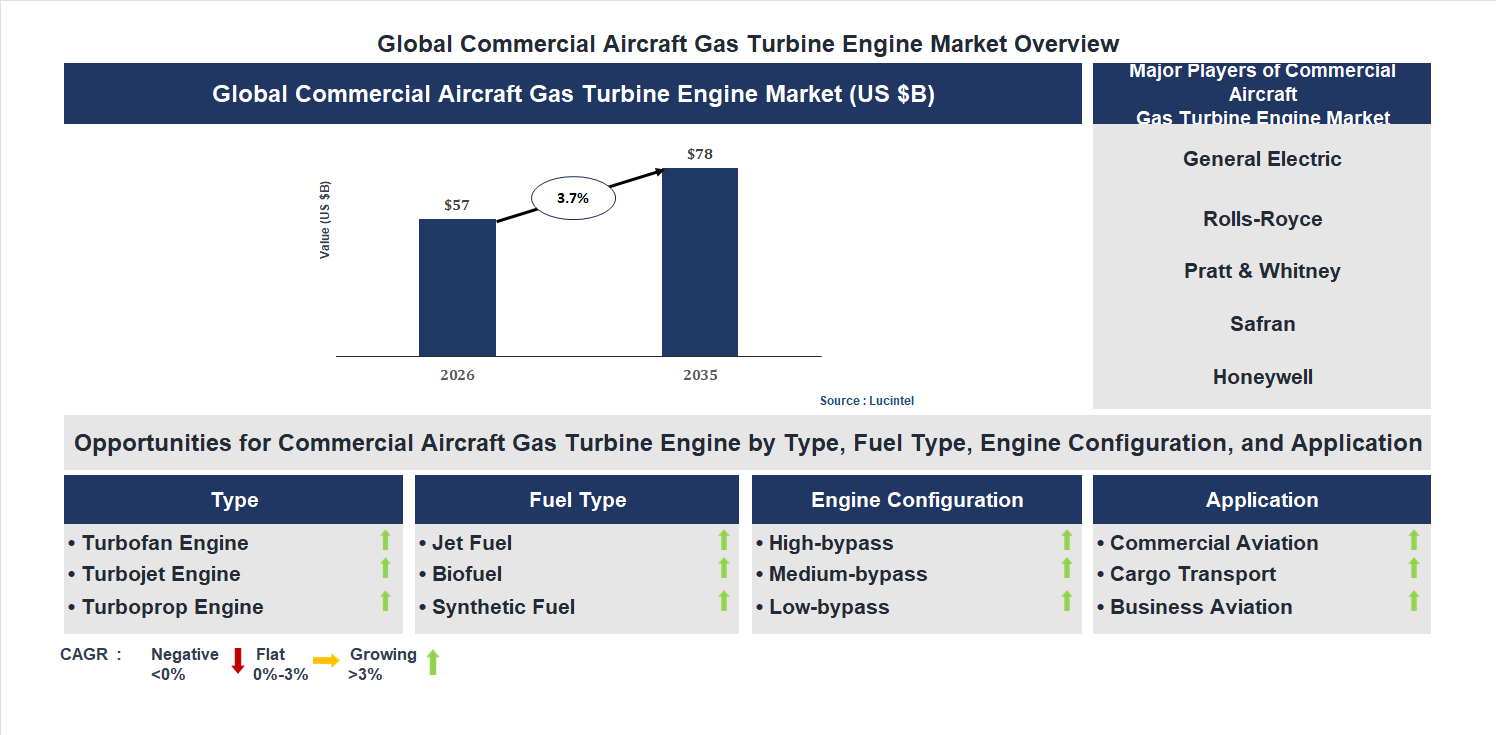
Key data points: The market size in 2035 = $78 billion, growth forecast = 3.7% annually for the next 8 years. Scroll below to get more insights. This market report covers trends, opportunities and forecasts in commercial aircraft gas turbine engine market to 2035 by type (turbofan engine, turbojet engine, and turboprop engine), fuel type (jet fuel, biofuel, and synthetic fuel), engine configuration (high-bypass, medium-bypass, and low-bypass), application (commercial aviation, cargo transport, and business aviation), and region (North America, Europe, Asia Pacific, and the Rest of the World)
We'll send your sample report shortly.
• Lucintel forecasts that, within the type category, turbofan engine is expected to witness the highest growth over the forecast period.
• Within the application category, commercial aviation is expected to witness the highest growth.
• In terms of region, APAC is expected to witness the highest growth over the forecast period. Gain valuable insights for your business decisions with our comprehensive 150+ page report. Sample figures with some insights are shown below.
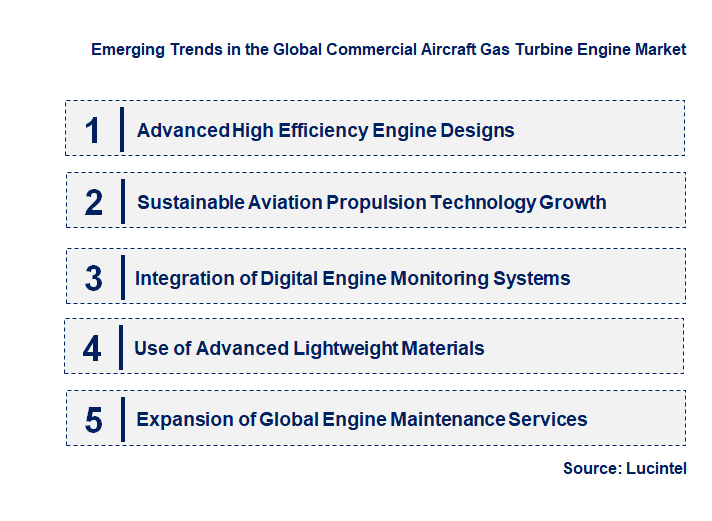
• Advanced High Efficiency Engine Designs: Development of high-bypass and geared turbofan engines is improving fuel efficiency and reducing operating costs.
• Sustainable Aviation Propulsion Technology Growth: Focus on reducing emissions is driving research into alternative fuels and cleaner propulsion systems.
• Integration of Digital Engine Monitoring Systems: Advanced analytics and real-time monitoring are enhancing maintenance efficiency and engine performance.
• Use of Advanced Lightweight Materials: Adoption of composites and high-performance alloys is improving durability and reducing engine weight.
• Expansion of Global Engine Maintenance Services: Growing fleet sizes are increasing demand for maintenance, repair, and overhaul services. These emerging trends are transforming the commercial aircraft gas turbine engine market by enhancing efficiency, reducing environmental impact, and improving operational reliability. Continuous innovation is enabling manufacturers to meet evolving airline and regulatory requirements while strengthening global competitiveness.
• Advancement in Next Generation Turbofan Engines: Development of advanced turbofan technologies is improving efficiency and reducing fuel consumption.
• Integration of Digital Engine Health Monitoring: Real-time data systems are enhancing predictive maintenance and reducing downtime.
• Expansion of Engine Maintenance Repair Overhaul Services: Increasing fleet sizes are driving demand for comprehensive service networks.
• Adoption of High Performance Material Technologies: Advanced materials are improving engine lifespan and performance under extreme conditions.
• Growth in Collaborative Engine Development Programs: Partnerships between global manufacturers are accelerating innovation and reducing development risks. These developments are strengthening the commercial aircraft gas turbine engine market by improving performance, enhancing service capabilities, and supporting the evolving needs of modern aviation.
• Narrow Body Aircraft Engine Application Opportunity: Rising demand for short-haul travel is driving need for efficient engines in narrow body aircraft.
• Wide Body Aircraft Engine Application Opportunity: Long-haul travel growth is supporting demand for high-performance engines.
• Engine Maintenance Repair Overhaul Opportunity: Expanding fleets are creating sustained demand for maintenance services.
• Sustainable Aviation Fuel Integration Opportunity: Adoption of cleaner fuels is creating opportunities for engine adaptation and innovation.
• Regional Aircraft Engine Development Opportunity: Growth in regional connectivity is driving demand for smaller efficient engines. Strategic growth opportunities are expanding across multiple applications. Focus on efficiency, sustainability, and service capabilities is supporting continued market development and innovation in gas turbine engine technologies.
• Increasing Demand for Air Travel: Growing passenger traffic is driving demand for efficient aircraft engines.
• Advancements in Engine Technology Innovation: Continuous improvements are enhancing performance and fuel efficiency.
• Expansion of Global Airline Fleets: Increasing aircraft numbers are driving engine demand.
• Rising Focus on Fuel Efficiency Improvement: Airlines are prioritizing cost reduction through efficient engines.
• Growing Emphasis on Emission Reduction: Environmental concerns are driving development of cleaner engine technologies. The challenges facing the commercial aircraft gas turbine engine market include:
• High Cost of Engine Development: Advanced technologies require significant investment and long development cycles.
• Complexity in Engine Design and Integration: Engineering challenges impact production and maintenance processes.
• Stringent Environmental and Regulatory Requirements: Compliance increases development complexity and costs. The commercial aircraft gas turbine engine market is shaped by strong demand for efficiency, performance, and sustainability alongside notable challenges. While technological advancements and increasing air travel drive growth, addressing high development costs, design complexity, and regulatory pressures remains essential for long-term market expansion and innovation.
• General Electric
• Rolls-Royce
• Pratt & Whitney
• Safran
• Honeywell
• MTU Aero Engines
• Engine Alliance
• Turbofan Engine
• Turbojet Engine
• Turboprop Engine
• Jet Fuel
• Biofuel
• Synthetic Fuel
• High-bypass
• Medium-bypass
• Low-bypass
• Commercial Aviation
• Cargo Transport
• Business Aviation
• North America
• Europe
• Asia Pacific
• The Rest of the World
• United States: The market is driven by strong presence of leading engine manufacturers and continuous innovation in propulsion technologies. Developments focus on high-bypass turbofan engines, advanced materials, and digital engine monitoring systems. Emphasis on fuel efficiency and emission reduction is shaping product development, while partnerships between airlines and manufacturers are supporting performance optimization and lifecycle management solutions.
• China: Rapid expansion of the aviation sector is driving demand for domestically developed gas turbine engines. Developments emphasize indigenous production, improved engine efficiency, and reduced reliance on imports. Government support is encouraging research and development, while integration with local aircraft programs is strengthening China’s capabilities in commercial aircraft engine manufacturing.
• Germany: Strong engineering expertise is driving advancements in high-efficiency engine components and sustainable technologies. Developments include lightweight materials, advanced turbine design, and integration with European aerospace programs. Focus on environmental compliance and fuel efficiency is encouraging innovation, while collaboration across the aerospace value chain is enhancing manufacturing and design capabilities.
• India: Growing aviation demand and expanding airline fleets are driving interest in gas turbine engine development. Developments focus on maintenance, repair, and overhaul capabilities, along with gradual progress in domestic manufacturing. Government initiatives are supporting skill development and infrastructure expansion, while partnerships are enabling technology transfer and strengthening engineering capabilities.
• Japan: Advanced manufacturing and precision engineering are driving innovation in engine components and systems. Developments include high-performance materials, efficient turbine designs, and collaboration with global aerospace companies. Focus on reliability, efficiency, and technological excellence is supporting Japan’s role in the global supply chain for commercial aircraft gas turbine engines.


• General Electric
• Rolls-Royce
• Pratt & Whitney
• Safran
• Honeywell
• MTU Aero Engines
• Engine Alliance Q6. Which commercial aircraft gas turbine engine market segment will be the largest in future? Answer: Lucintel forecasts that, within the type category, turbofan engine is expected to witness the highest growth over the forecast period. Q7. In commercial aircraft gas turbine engine market, which region is expected to be the largest in next 8 years? Answer: In terms of region, APAC is expected to witness the highest growth over the forecast period. Q8. Do we receive customization in this report? Answer: Yes, Lucintel provides 10% customization without any additional cost.


Choose a license that fits your team. Instant PDF delivery.
Prices exclude taxes. Instant delivery. Custom licensing available on request.
Market Report · July 31, 2026
Market Report · July 31, 2026
Market Report · July 31, 2026
Trusted partner for strategic intelligence and business growth


Receive a complimentary market analysis tailored to your industry. Our analysts will identify key growth opportunities and competitive dynamics specific to your business.

Market size, growth rate, and key trend analysis for your specific sector.

Top competitor positioning and market share analysis.

Strategic recommendations backed by data-driven insights.
Get curated market intelligence and competitive moves straight to your inbox.
By subscribing, you agree to receive our monthly insights. Unsubscribe anytime.
Receive a complimentary market analysis tailored to your industry. Our analysts will identify key growth opportunities and competitive dynamics specific to your business.
Market size, growth rate, and key trend analysis for your specific sector.
Top competitor positioning and market share analysis.
Strategic recommendations backed by data-driven insights.
Get curated market intelligence, emerging trends, and competitive moves straight to your inbox each month.
By subscribing, you agree to receive our monthly insights. Unsubscribe anytime.
We'll send your sample report shortly.