
Report Feature
Color CMOS Image Sensor Market Trends and Forecast
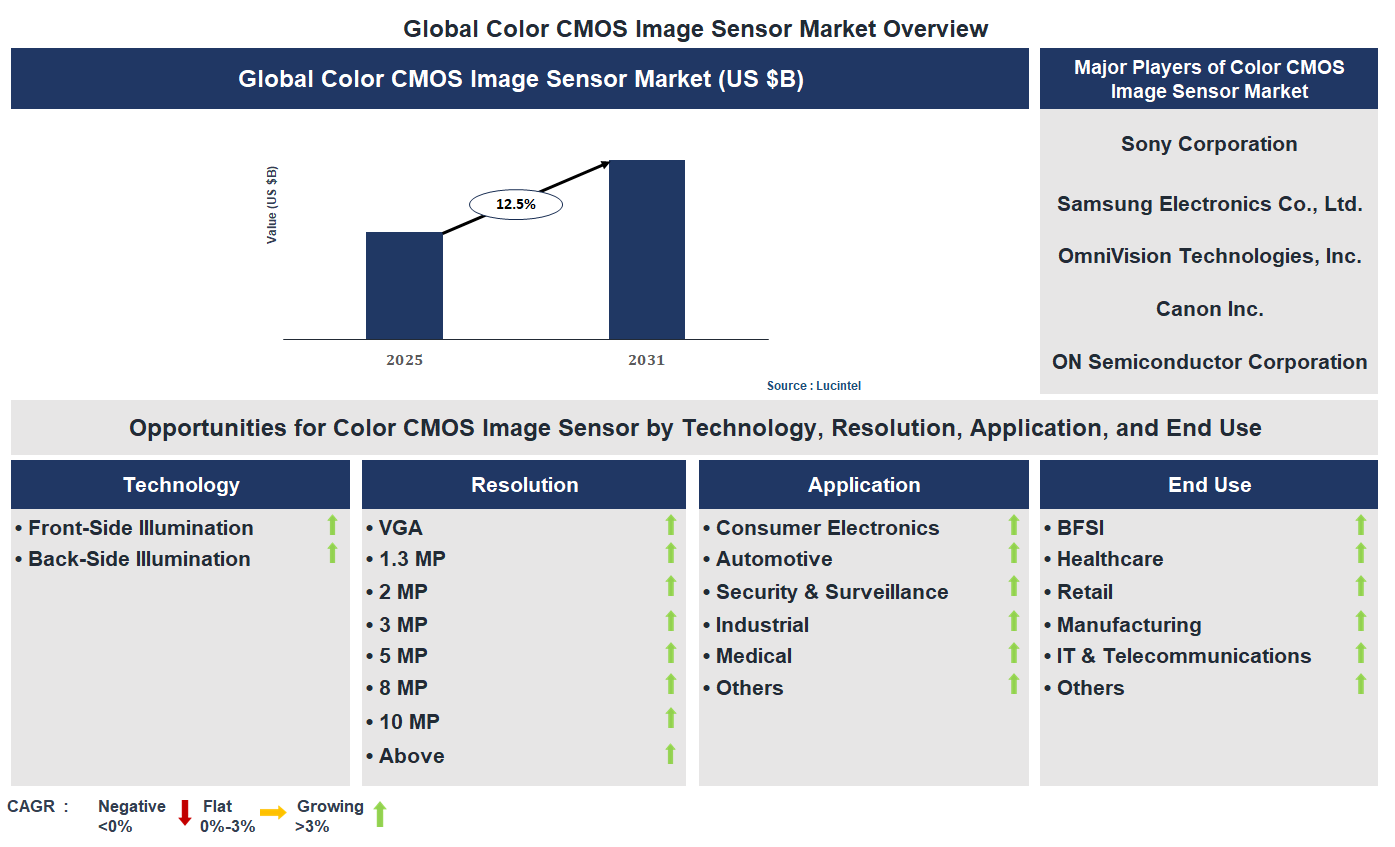
The future of the global color CMOS image sensor market looks promising with opportunities in the BFSI, healthcare, retail, manufacturing, and IT & telecommunication markets. The global color CMOS image sensor market is expected to grow with a CAGR of 12.5% from 2025 to 2031. The major drivers for this market are the increasing demand for high-resolution imaging, the rising use of smartphones & tablets, and the growing need for security surveillance systems.• Lucintel forecasts that, within the technology category, front-side illumination is expected to witness higher growth over the forecast period.
• Within the end use category, BFSI is expected to witness the highest growth.
• In terms of region, APAC is expected to witness the highest growth over the forecast period. Gain valuable insights for your business decisions with our comprehensive 150+ page report. Sample figures with some insights are shown below.
Emerging Trends in the Color CMOS Image Sensor Market
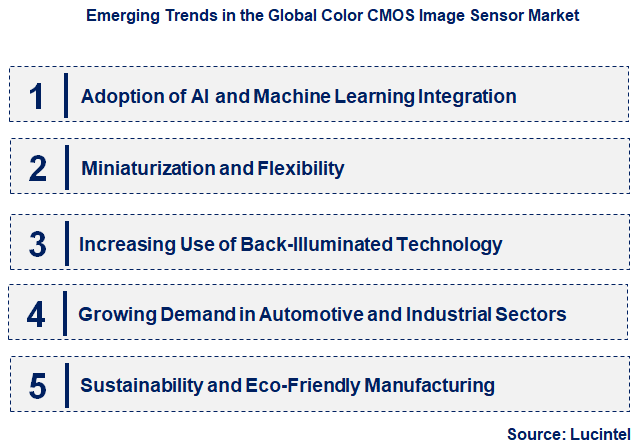
The color CMOS image sensor market is experiencing rapid growth driven by technological advancements, increasing demand across various industries, and evolving consumer preferences. As digital imaging becomes integral to everyday life, innovations in sensor technology are shaping the future landscape of this market. Key trends are emerging that reflect shifts in manufacturing, application areas, and consumer expectations. These developments are not only enhancing performance and efficiency but also expanding the scope of use cases, thereby transforming the competitive dynamics and market strategies. Understanding these trends is crucial for stakeholders aiming to capitalize on new opportunities and navigate the evolving environment effectively.• Adoption of AI and Machine Learning Integration: The integration of AI and machine learning algorithms into CMOS sensors is revolutionizing image processing capabilities. These sensors can now perform real-time image enhancement, object detection, and scene recognition, significantly improving performance in applications like autonomous vehicles, security, and medical imaging. This trend enhances sensor intelligence, reduces post-processing needs, and enables more sophisticated functionalities, thereby expanding market potential and creating new revenue streams for manufacturers.
• Miniaturization and Flexibility: Advances in semiconductor fabrication are enabling the production of smaller, more flexible CMOS sensors. These miniaturized sensors are ideal for wearable devices, smartphones, and IoT applications, where space constraints are critical. Flexibility in sensor design allows integration into unconventional surfaces and form factors, broadening application possibilities. This trend supports the development of innovative products, enhances user experience, and opens new markets, especially in consumer electronics and healthcare.
• Increasing Use of Back-Illuminated Technology: BSI CMOS sensors are gaining popularity due to their superior light sensitivity and low noise performance. This technology allows for better image quality in low-light conditions, making it highly desirable for smartphones, security cameras, and automotive applications. The adoption of BSI technology is driving market growth by enabling high-performance imaging in compact devices, thus meeting consumer demand for high-quality images and supporting the development of advanced imaging solutions.
• Growing Demand in Automotive and Industrial Sectors: The automotive industry’s shift towards autonomous driving and advanced driver-assistance systems (ADAS) is fueling demand for high-resolution, reliable CMOS sensors. Similarly, industrial applications such as machine vision and robotics require robust sensors for quality control and automation. This trend is expanding the market beyond traditional consumer electronics, creating new opportunities for sensor manufacturers and encouraging innovation in rugged, high-performance sensor designs.
• Sustainability and Eco-Friendly Manufacturing: Environmental concerns are prompting manufacturers to adopt sustainable practices in CMOS sensor production. This includes reducing hazardous materials, improving energy efficiency, and recycling components. Eco-friendly manufacturing not only aligns with global sustainability goals but also appeals to environmentally conscious consumers and clients. This trend is influencing supply chain strategies, product design, and corporate responsibility initiatives, ultimately shaping a more sustainable and ethically responsible market landscape. In summary, these emerging trends are significantly reshaping the color CMOS image sensor market by enhancing technological capabilities, expanding application areas, and promoting sustainable practices. They are driving innovation, improving product performance, and opening new avenues for growth, positioning the market for a dynamic and competitive future.
Recent Development in the Color CMOS Image Sensor Market
The color CMOS image sensor market is experiencing rapid growth driven by technological advancements and increasing demand across various industries. Innovations in sensor design, miniaturization, and integration are expanding applications in smartphones, automotive, healthcare, and security sectors. As consumer preferences shift towards higher quality imaging and smarter devices, market players are investing heavily in R&D. These developments are shaping a competitive landscape, creating new opportunities for manufacturers and stakeholders to capitalize on emerging trends and meet evolving consumer needs.• Technological Advancements in Sensor Design: Enhanced pixel architecture and improved sensitivity are enabling higher resolution and better low-light performance, expanding applications in smartphones and professional imaging. These innovations improve image quality, reduce power consumption, and enable compact device designs, thus attracting more consumers and manufacturers to adopt CMOS sensors. The market benefits from increased demand for high-performance imaging solutions, fostering growth and technological leadership among key players.
• Integration of AI and Machine Learning: Incorporating AI algorithms into CMOS sensors allows real-time image processing, object detection, and scene recognition. This integration enhances functionalities in autonomous vehicles, security cameras, and medical imaging, providing smarter and more efficient devices. The impact includes improved user experience, increased safety features, and new revenue streams for sensor manufacturers. As AI-driven sensors become mainstream, market growth accelerates, driven by demand for intelligent imaging solutions.
• Miniaturization and Flexible Sensor Technologies: Advances in flexible and miniaturized CMOS sensors enable their integration into wearable devices, IoT gadgets, and flexible electronics. These developments open new markets for health monitoring, augmented reality, and smart textiles. The ability to embed high-quality sensors into compact, flexible formats enhances product versatility and consumer appeal. This trend drives market expansion into emerging sectors, fostering innovation and creating competitive advantages for early adopters.
• Expansion in Automotive and Autonomous Vehicles: CMOS sensors are critical for ADAS and autonomous driving systems, offering high-resolution imaging for object detection and navigation. Recent developments include ruggedized sensors with enhanced durability and real-time processing capabilities. These improvements increase vehicle safety, enable advanced driver assistance, and support regulatory compliance. The automotive sectors reliance on CMOS sensors is expected to grow significantly, fueling market demand and encouraging further technological innovation in automotive imaging.
• Growth in Healthcare and Medical Imaging: CMOS sensors are increasingly used in medical devices such as endoscopes, diagnostic imaging, and wearable health monitors. Recent innovations focus on higher sensitivity, miniaturization, and integration with other sensors for comprehensive health monitoring. These developments improve diagnostic accuracy, patient comfort, and device portability. The expanding healthcare applications are driving market growth, with increased investments in medical imaging technology and rising demand for non-invasive diagnostic tools. The overall impact of these developments is a dynamic, expanding market characterized by technological innovation, diversified applications, and increased competition. These opportunities are driving growth, enhancing product capabilities, and opening new revenue streams, ultimately shaping a more advanced and competitive color CMOS image sensor market.
Strategic Growth Opportunities in the Color CMOS Image Sensor Market
The color CMOS image sensor market is experiencing rapid expansion driven by technological advancements and increasing demand across various industries. Innovations in imaging technology, rising adoption in consumer electronics, automotive, healthcare, and industrial applications are fueling growth. Market players are focusing on improving sensor performance, reducing costs, and expanding application scopes. This dynamic environment presents numerous strategic opportunities for companies to capitalize on emerging trends and secure competitive advantages in a highly competitive landscape.• Expansion into Autonomous Vehicles and Advanced Driver Assistance Systems: The growing adoption of autonomous vehicles and ADAS relies heavily on high-quality imaging sensors. Color CMOS sensors enable better object detection, lane recognition, and night vision, making them essential for safety and navigation. As automotive manufacturers prioritize safety features and autonomous driving capabilities, the demand for advanced sensors is expected to surge, creating significant growth opportunities for sensor manufacturers to develop specialized, high-resolution, and robust sensors tailored for automotive applications.
• Integration of CMOS Sensors in Consumer Electronics for Enhanced Imaging: The proliferation of smartphones, tablets, and wearable devices continues to drive demand for high-performance imaging solutions. CMOS sensors offer advantages such as lower power consumption, compact size, and cost-effectiveness, making them ideal for consumer electronics. Innovations in pixel technology and sensor miniaturization are enabling manufacturers to deliver superior image quality, augmented reality features, and improved video recording, thus opening new avenues for growth in the consumer segment.
• Adoption of CMOS Sensors in Healthcare Imaging Devices: The healthcare industry is increasingly utilizing CMOS image sensors in medical imaging devices such as endoscopes, digital microscopes, and diagnostic equipment. CMOS sensors provide high-resolution imaging, real-time data processing, and miniaturization benefits, which are critical for minimally invasive procedures and accurate diagnostics. The rising demand for portable, high-quality medical imaging solutions presents substantial opportunities for sensor manufacturers to innovate and expand their presence in the healthcare sector.
• Expansion into Industrial and Security Imaging Applications: CMOS sensors are widely used in industrial inspection, machine vision, and security surveillance due to their durability, high-speed imaging, and cost efficiency. The need for real-time monitoring, quality control, and automated inspection systems is increasing across manufacturing, infrastructure, and public safety sectors. Developing rugged, high-resolution sensors with enhanced low-light performance can help companies tap into these expanding markets, offering improved operational efficiency and security solutions.
• Development of Next-Generation Sensors with Enhanced Performance Features: Continuous innovation in sensor technology, such as back-illuminated pixels, global shutter, and improved color fidelity, presents growth opportunities. These advancements enable better low-light performance, faster image capture, and higher dynamic range, which are critical for emerging applications like virtual reality, augmented reality, and high-speed imaging. Companies investing in R&D to develop next-generation CMOS sensors can differentiate themselves and meet the evolving demands of diverse high-tech markets. The overall market growth is poised to accelerate as these opportunities intersect with technological innovation and expanding application domains, fostering a competitive environment ripe for strategic investments and product development.
Color CMOS Image Sensor Market Driver and Challenges
The color CMOS image sensor market is influenced by a variety of technological, economic, and regulatory factors that shape its growth trajectory. Rapid advancements in imaging technology, increasing demand across consumer electronics, automotive, and industrial sectors, and evolving regulatory standards for safety and data privacy are key drivers. Additionally, economic factors such as rising disposable incomes and decreasing costs of sensor manufacturing contribute to market expansion. However, the market also faces challenges, including technological complexities, high manufacturing costs, and stringent regulatory requirements that can hinder growth. Understanding these drivers and challenges is essential for stakeholders to navigate the evolving landscape effectively. The factors responsible for driving the color CMOS image sensor market include:• Technological Innovation: The continuous development of high-resolution sensors, improved low-light performance, and integration of AI capabilities are fueling market growth. These innovations enable better image quality, faster processing, and new applications in smartphones, autonomous vehicles, and security systems. As technology advances, manufacturers can offer more sophisticated and cost-effective sensors, expanding market reach and consumer adoption.
• Growing Consumer Electronics Demand: The proliferation of smartphones, tablets, and wearable devices has significantly increased the demand for high-quality imaging components. Consumers seek devices with superior camera capabilities, prompting manufacturers to incorporate advanced CMOS sensors. This trend is further supported by the rising popularity of social media and content creation, which rely heavily on high-resolution images and videos.
• Automotive Industry Expansion: The automotive sector is increasingly adopting CMOS image sensors for applications such as ADAS (Advanced Driver Assistance Systems), autonomous driving, and vehicle safety systems. The need for real-time image processing and enhanced safety features drives demand for high-performance sensors, making the automotive industry a major growth driver for the market.
• Regulatory and Environmental Standards: Stringent safety and data privacy regulations are pushing manufacturers to develop sensors that meet higher standards for quality, reliability, and security. Compliance with these standards often involves significant R&D investments but ultimately enhances product credibility and market acceptance, fostering growth in regulated markets. The challenges in the color CMOS image sensor market are:
• Technological Complexities and High Development Costs: Developing advanced CMOS sensors involves complex manufacturing processes and significant R&D investments. Achieving high resolution, better low-light performance, and integration of AI features requires sophisticated technology, which can be costly and time-consuming. These factors can limit entry for smaller players and slow down innovation cycles.
• Manufacturing and Supply Chain Constraints: Producing high-quality CMOS sensors demands precision manufacturing and access to advanced fabrication facilities. Supply chain disruptions, shortages of raw materials, and geopolitical tensions can impact production timelines and costs. These constraints pose risks to consistent supply and can hinder market growth, especially during periods of high demand.
• Stringent Regulatory Environment: Increasing regulations related to data privacy, safety standards, and environmental impact impose compliance burdens on manufacturers. Navigating diverse regulatory landscapes across regions can be complex and costly, potentially delaying product launches and increasing operational expenses. Non-compliance risks also threaten brand reputation and market access. In summary, the color CMOS image sensor market is driven by rapid technological advancements, expanding applications in consumer electronics and automotive sectors, and evolving regulatory standards. However, technological complexities, manufacturing challenges, and regulatory hurdles present significant obstacles. These factors collectively influence the markets growth potential, requiring stakeholders to innovate continuously while managing risks effectively. Overall, the markets future will depend on balancing these drivers and challenges to capitalize on emerging opportunities.
List of Color CMOS Image Sensor Companies
Companies in the market compete on the basis of product quality offered. Major players in this market focus on expanding their manufacturing facilities, R&D investments, infrastructural development, and leverage integration opportunities across the value chain. With these strategies color CMOS image sensor companies cater increasing demand, ensure competitive effectiveness, develop innovative products & technologies, reduce production costs, and expand their customer base. Some of the color CMOS image sensor companies profiled in this report include-• Sony Corporation
• Samsung Electronics Co., Ltd.
• OmniVision Technologies, Inc.
• Canon Inc.
• ON Semiconductor Corporation
• STMicroelectronics N.V.
• Panasonic Corporation
• Toshiba Corporation
• Sharp Corporation
• SK Hynix Inc.
Color CMOS Image Sensor Market by Segment
The study includes a forecast for the global color CMOS image sensor market by technology, resolution, application, end use, and region.Color CMOS Image Sensor Market by Technology [Value from 2019 to 2031]:
• Front-Side Illumination
• Back-Side Illumination
Color CMOS Image Sensor Market by Resolution [Value from 2019 to 2031]:
• VGA
• 1.3 MP
• 2 MP
• 3 MP
• 5 MP
• 8 MP
• 10 MP
• Above
Color CMOS Image Sensor Market by Application [Value from 2019 to 2031]:
• Consumer Electronics
• Automotive
• Security & Surveillance
• Industrial
• Medical
• Others
Color CMOS Image Sensor Market by End Use [Value from 2019 to 2031]:
• BFSI
• Healthcare
• Retail
• Manufacturing
• IT & Telecommunications
• Others
Color CMOS Image Sensor Market by Region [Value from 2019 to 2031]:
• North America
• Europe
• Asia Pacific
• The Rest of the World
Country Wise Outlook for the Color CMOS Image Sensor Market
The color CMOS image sensor market has experienced significant growth driven by advancements in consumer electronics, automotive applications, and industrial imaging. As technology evolves, countries are investing heavily in research and development to enhance sensor performance, reduce costs, and expand application areas. The competitive landscape is shifting with innovations in pixel technology, power efficiency, and integration capabilities. These developments are shaping the future of imaging solutions across various sectors, reflecting the global push towards smarter, more connected devices. Each country’s strategic initiatives and technological progress are contributing uniquely to this dynamic market.• United States: The US leads in innovation with major players like Sony and ON Semiconductor investing in high-resolution sensors and AI integration. The focus is on autonomous vehicles, advanced surveillance, and consumer electronics, with significant R&D funding supporting breakthroughs in low-light performance and energy efficiency.
• China: China is rapidly expanding its manufacturing capacity and investing in domestic R&D to reduce reliance on imports. Companies like OmniVision and GalaxyCore are developing cost-effective sensors for smartphones and automotive applications, emphasizing miniaturization and high-speed data processing.
• Germany: Germany emphasizes industrial and automotive imaging solutions, with a focus on high-performance sensors for automotive safety systems and industrial automation. Leading firms are integrating sensors with AI for predictive maintenance and quality control, advancing precision engineering.
• India: India is witnessing growth driven by the smartphone and automotive sectors. Local startups and established companies are developing affordable CMOS sensors tailored for emerging markets, with a focus on energy efficiency and compact design to cater to budget-conscious consumers.
• Japan: Japan continues to innovate in high-end imaging technology, with companies like Sony leading the market. The focus is on developing sensors with enhanced dynamic range, color accuracy, and integration with 5G and IoT devices, supporting applications in robotics, healthcare, and smart cities.

Features of the Global Color CMOS Image Sensor Market
Market Size Estimates: Color CMOS image sensor market size estimation in terms of value ($B). Trend and Forecast Analysis: Market trends (2019 to 2024) and forecast (2025 to 2031) by various segments and regions. Segmentation Analysis: Color CMOS image sensor market size by various segments, such as by technology, resolution, application, end use, and region in terms of value ($B). Regional Analysis: Color CMOS image sensor market breakdown by North America, Europe, Asia Pacific, and Rest of the World. Growth Opportunities: Analysis of growth opportunities in different technologies, resolutions, applications, end uses, and regions for the color CMOS image sensor market. Strategic Analysis: This includes M&A, new product development, and competitive landscape of the color CMOS image sensor market. Analysis of competitive intensity of the industry based on Porter’s Five Forces model.
FAQ
Q1. What is the growth forecast for color CMOS image sensor market? Answer: The global color CMOS image sensor market is expected to grow with a CAGR of 12.5% from 2025 to 2031. Q2. What are the major drivers influencing the growth of the color CMOS image sensor market? Answer: The major drivers for this market are the increasing demand for high-resolution imaging, the rising use of smartphones & tablets, and the growing need for security surveillance systems. Q3. What are the major segments for color CMOS image sensor market? Answer: The future of the color CMOS image sensor market looks promising with opportunities in the BFSI, healthcare, retail, manufacturing, and IT & telecommunication markets. Q4. Who are the key color CMOS image sensor market companies? Answer: Some of the key color CMOS image sensor companies are as follows:• Sony Corporation
• Samsung Electronics Co., Ltd.
• OmniVision Technologies, Inc.
• Canon Inc.
• ON Semiconductor Corporation
• STMicroelectronics N.V.
• Panasonic Corporation
• Toshiba Corporation
• Sharp Corporation
• SK Hynix Inc. Q5. Which color CMOS image sensor market segment will be the largest in future? Answer: Lucintel forecasts that, within the technology category, front-side illumination is expected to witness higher growth over the forecast period. Q6. In color CMOS image sensor market, which region is expected to be the largest in next 5 years? Answer: In terms of region, APAC is expected to witness the highest growth over the forecast period. Q7. Do we receive customization in this report? Answer: Yes, Lucintel provides 10% customization without any additional cost.
Table of Contents
List of Figures
List of Tables
Methodology
- In-depth interviews of the major players in this market
- Detailed secondary research from competitors’ financial statements and published data
- Extensive searches of published works, market, and database information pertaining to industry news, company press releases, and customer intentions
- A compilation of the experiences, judgments, and insights of Lucintel’s professionals, who have analyzed and tracked this market over the years.


Buy Now
Choose a license that fits your team. Instant PDF delivery.
Prices exclude taxes. Instant delivery. Custom licensing available on request.
Key Questions
- • What are some of the most promising, high-growth opportunities for the color CMOS image sensor market by technology (front-side illumination and back-side illumination), resolution (VGA, 1.3 MP, 2 MP, 3 MP, 5 MP, 8 MP, 10 MP, and above), application (consumer electronics, automotive, security & surveillance, industrial, medical, and others), end use (BFSI, healthcare, retail, manufacturing, IT & telecommunications, and others), and region (North America, Europe, Asia Pacific, and the Rest of the World)?
- • Which segments will grow at a faster pace and why?
- • Which region will grow at a faster pace and why?
- • What are the key factors affecting market dynamics? What are the key challenges and business risks in this market?
- • What are the business risks and competitive threats in this market?
- • What are the emerging trends in this market and the reasons behind them?
- • What are some of the changing demands of customers in the market?
- • What are the new developments in the market? Which companies are leading these developments?
- • Who are the major players in this market? What strategic initiatives are key players pursuing for business growth?
- • What are some of the competing products in this market and how big of a threat do they pose for loss of market share by material or product substitution?
- • What M&A activity has occurred in the last 6 years and what has its impact been on the industry? For any questions related to Color CMOS Image Sensor Market, Color CMOS Image Sensor Market Size, Color CMOS Image Sensor Market Growth, Color CMOS Image Sensor Market Analysis, Color CMOS Image Sensor Market Report, Color CMOS Image Sensor Market Share, Color CMOS Image Sensor Market Trends, Color CMOS Image Sensor Market Forecast, Color CMOS Image Sensor Companies, write Lucintel analyst at email: helpdesk@lucintel.com. We will be glad to get back to you soon.


