
Market Report · July 31, 2026

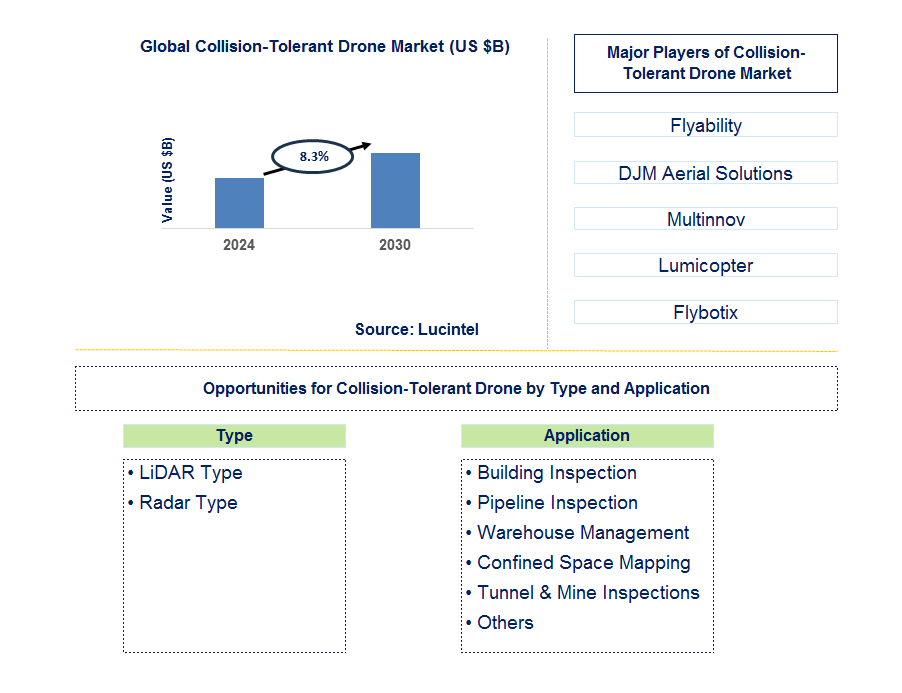
Key data points: The growth forecast = 8.3% annually for the next 6 years. Scroll below to get more insights. This market report covers trends, opportunities, and forecast in the global collision-tolerant drone market to 2030 by type (LiDAR type and radar type), application (building inspection, pipeline inspection, warehouse management, confined space mapping, tunnel & mine inspections, and others), and region (North America, Europe, Asia Pacific, and the Rest of the World)
We'll send your sample report shortly.
• Advanced Sensor Integration: Development of multi-sensor systems, including LIDAR, radar, and cameras, to improve obstacle detection and avoidance.
• AI and Machine Learning: Enhanced use of artificial intelligence and machine learning algorithms for real-time decision-making and navigation.
• Autonomous Navigation: Growth in autonomous flight capabilities, allowing drones to operate safely in complex and dynamic environments.
• Urban Air Mobility: Increasing focus on integrating collision-tolerant drones into urban air mobility systems, including passenger and delivery drones.
• Regulatory Frameworks: Evolution of regulations to accommodate and standardize the use of collision-tolerant drones in various applications.
• Enhanced Durability: Innovations aimed at improving the physical resilience of drones to withstand impacts and harsh conditions.
The collision-tolerant drone market is experiencing significant growth driven by advancements in sensor technology, AI integration, autonomous navigation, urban air mobility, regulatory development, and enhanced durability.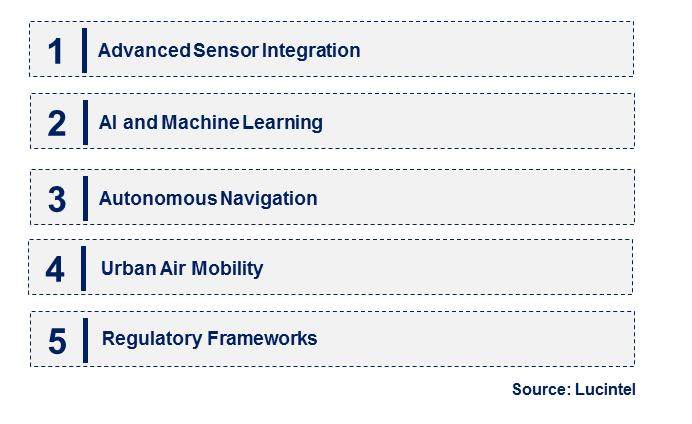
• New Drone Models: Introduction of advanced drone models with integrated collision-avoidance systems using LIDAR, radar, and camera technologies.
• Improved AI Algorithms: Development of sophisticated AI algorithms for better real-time obstacle detection and decision-making.
• Regulatory Changes: Implementation of new regulations by aviation authorities to enable the safe deployment of collision-tolerant drones in various environments.
• Commercial Applications: Expansion of collision-tolerant drones in commercial sectors, such as delivery services, agriculture, and infrastructure inspection.
• Military and Defense: Increasing investment in collision-tolerant drones for military applications, focusing on enhanced safety and operational capabilities.
• Collaborative Projects: Formation of partnerships between technology firms, research institutions, and government bodies to advance drone technology and safety standards.
Recent developments in the collision-tolerant drone market include the introduction of advanced models, improved AI algorithms, regulatory changes, expansion into commercial sectors, military investments, and collaborative projects, driving progress and innovation in the industry.• Urban Air Mobility: Exploring opportunities in urban air mobility solutions, including passenger drones and delivery services, to address growing urban transportation needs.
• Agriculture: Implementing collision-tolerant drones in precision agriculture for monitoring crops, spraying, and other field operations to enhance efficiency and yield.
• Infrastructure Inspection: Utilizing drones for infrastructure inspection in sectors like energy, telecommunications, and transportation, providing safer and more efficient solutions.
• Disaster Response: Developing drones for disaster response and recovery operations, offering improved safety and operational capabilities in emergency situations.
• Smart Cities: Integrating collision-tolerant drones into smart city initiatives for applications such as traffic monitoring, environmental monitoring, and public safety.
• Technological Integration: Investing in the integration of emerging technologies, such as 5G connectivity and advanced data analytics, to enhance drone capabilities and performance.
Strategic growth opportunities in the collision-tolerant drone market include urban air mobility, agriculture, infrastructure inspection, disaster response, smart cities, and technological integration, driving innovation and expanding application areas.• Technological Advancements: Continuous improvements in sensor technology, AI, and machine learning enhance collision-avoidance capabilities and overall performance.
• Increasing Demand: Growing demand for drones in various sectors, such as logistics, agriculture, and infrastructure, drives the need for advanced collision-tolerant systems.
• Regulatory Support: Supportive regulatory frameworks and government initiatives facilitate the adoption and integration of collision-tolerant drones.
• Safety Requirements: Rising emphasis on safety and operational efficiency in drone operations boosts the demand for collision-tolerant technologies.
• Urbanization: Urbanization trends create opportunities for collision-tolerant drones in smart city applications and urban air mobility.
Challenges in the collision-tolerant drone market are:• High Costs: The high cost of advanced collision-tolerant drone systems and technologies can be a barrier to widespread adoption.
• Regulatory Hurdles: Navigating complex and evolving regulatory requirements can pose challenges for manufacturers and operators.
• Technological Limitations: Existing limitations in sensor accuracy and AI performance may impact the effectiveness of collision-avoidance systems.
• Market Competition: Intense competition among drone manufacturers can drive up costs and impact profit margins.
• Public Perception: Concerns about privacy and safety may affect public acceptance and regulatory approvals for drone operations.
• Integration Challenges: Integrating collision-tolerant drones with existing systems and infrastructure can hinder their adoption.
The collision-tolerant drone market is driven by technological advancements, increasing demand, regulatory support, safety requirements, urbanization, and military applications, while facing challenges related to high costs, regulatory hurdles, technological limitations, market competition, public perception, and integration issues.• Flyability
• DJM Aerial Solutions
• Multinnov
• Lumicopter
• Flybotix
• Skydio
• Panton McLeod
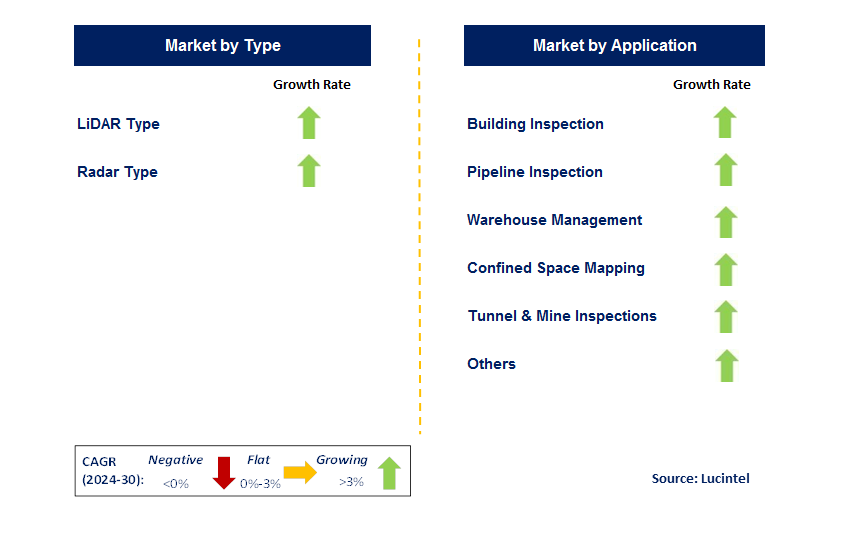
• LiDAR Type
• Radar Type
• Building Inspection
• Pipeline Inspection
• Warehouse Management
• Confined Space Mapping
• Tunnel & Mine Inspections
• Others
• North America
• Europe
• Asia Pacific
• The Rest of the World
• USA: In the United States, the collision-tolerant drone market is advancing rapidly with significant technological and regulatory developments. Companies like Skydio and DJI are leading innovations in autonomous navigation and obstacle avoidance, incorporating advanced sensors and AI algorithms. Recent FAA regulations are also paving the way for broader commercial use of these drones, particularly in urban environments and complex settings. The U.S. military is investing in collision-tolerant drones for reconnaissance and logistics, emphasizing resilience and safety in dynamic scenarios. Furthermore, academic institutions are developing new algorithms to enhance the drones' ability to navigate in cluttered environments.
• Germany: Germany is at the forefront of the collision-tolerant drone market in Europe, with a strong focus on integrating advanced sensor technologies and AI into commercial and industrial drones. Companies such as Quantum Systems and Wingcopter are working on drones that can autonomously avoid obstacles and operate in challenging environments. The German government supports these advancements through funding and collaboration with research institutions. Germany is also developing standards and regulations to ensure the safety and interoperability of collision-tolerant drones, particularly for applications in smart cities and logistics.
• China: China is making substantial strides in the collision-tolerant drone market, driven by major players like DJI and EHang. Chinese companies are focusing on enhancing the robustness of drone systems through improved obstacle detection and avoidance capabilities. Recent developments include the use of advanced LIDAR and computer vision technologies to enable drones to operate safely in crowded urban areas. The Chinese government is also actively supporting the integration of collision-tolerant drones into its smart city initiatives and logistics networks, aiming to boost efficiency and safety.
• India: In India, the collision-tolerant drone market is emerging with significant growth potential, supported by increasing investments in drone technology and infrastructure. Companies like IdeaForge and Quidich are developing drones with advanced collision-avoidance systems for applications in agriculture, surveillance, and infrastructure inspection. The Indian government is promoting the adoption of collision-tolerant drones through policy reforms and incentives for technology development. Additionally, Indian research institutions are exploring new technologies to improve drone safety and reliability in densely populated areas.
• Japan: Japan is actively advancing its collision-tolerant drone technology, focusing on safety and reliability in both commercial and residential applications. Japanese companies such as Yamaha and NEC are developing drones with sophisticated collision-avoidance systems that utilize a combination of radar, LIDAR, and visual sensors. The Japanese government is facilitating this growth through regulatory frameworks that support the safe integration of drones into national airspace. Moreover, Japan is exploring the use of collision-tolerant drones in disaster response and urban planning, aiming to enhance operational efficiency and safety.


• Flyability
• DJM Aerial Solutions
• Multinnov
• Lumicopter
• Flybotix
• Skydio
• Panton McLeod
Q5. Which collision-tolerant drone market segment will be the largest in future?

Choose a license that fits your team. Instant PDF delivery.
Prices exclude taxes. Instant delivery. Custom licensing available on request.
Market Report · July 31, 2026
Market Report · July 31, 2026
Market Report · July 22, 2026
Trusted partner for strategic intelligence and business growth


Receive a complimentary market analysis tailored to your industry. Our analysts will identify key growth opportunities and competitive dynamics specific to your business.

Market size, growth rate, and key trend analysis for your specific sector.

Top competitor positioning and market share analysis.

Strategic recommendations backed by data-driven insights.
Get curated market intelligence and competitive moves straight to your inbox.
By subscribing, you agree to receive our monthly insights. Unsubscribe anytime.
Receive a complimentary market analysis tailored to your industry. Our analysts will identify key growth opportunities and competitive dynamics specific to your business.
Market size, growth rate, and key trend analysis for your specific sector.
Top competitor positioning and market share analysis.
Strategic recommendations backed by data-driven insights.
Get curated market intelligence, emerging trends, and competitive moves straight to your inbox each month.
By subscribing, you agree to receive our monthly insights. Unsubscribe anytime.
We'll send your sample report shortly.