
Report Feature
Cold Flow Improver Market Trends and Forecast
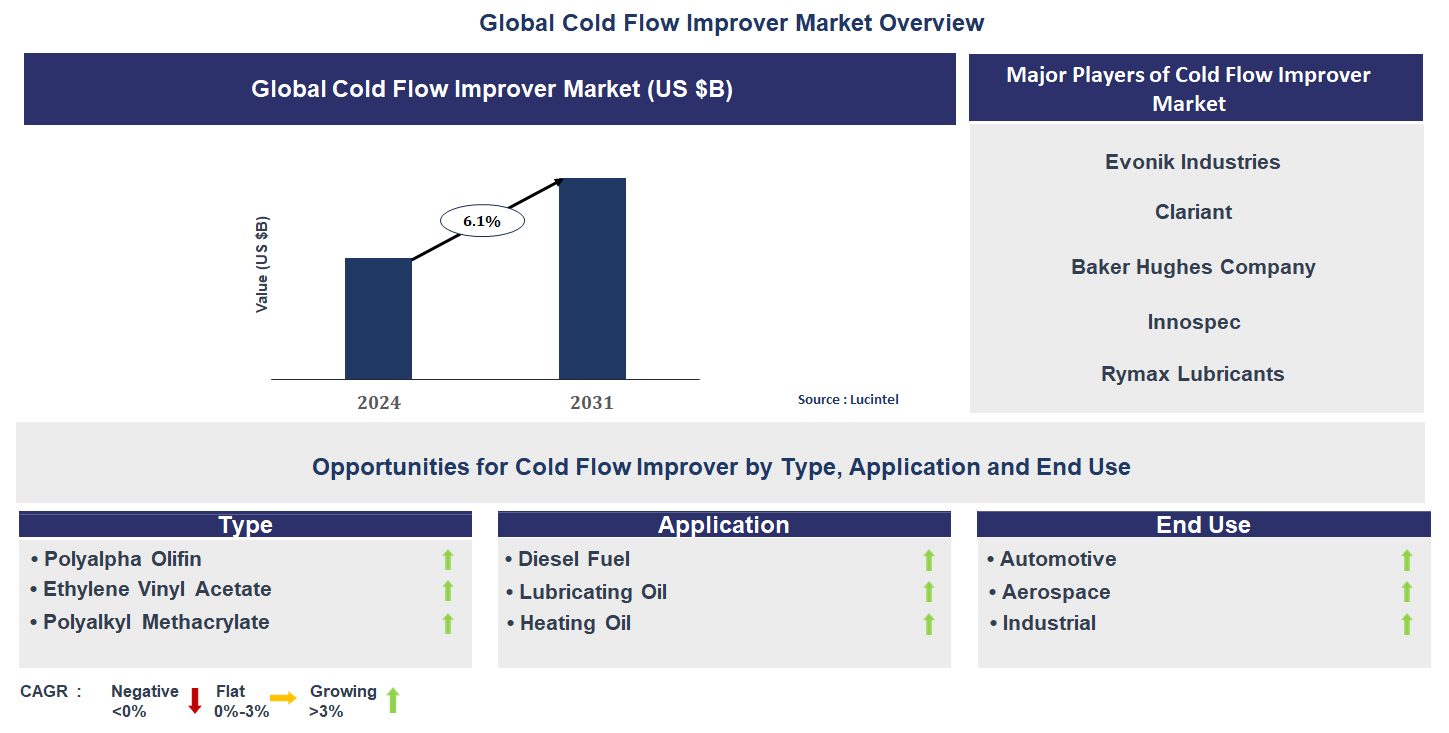
The future of the global cold flow improver market looks promising with opportunities in the automotive, aerospace, and industrial markets. The global cold flow improver market is expected to grow with a CAGR of 6.1% from 2025 to 2031. The major drivers for this market are the increasing demand for fuel efficiency, the rising need for low-temperature performance, and the growing adoption in diesel fuel additives.• Lucintel forecasts that, within the type category, polyalpha olifin is expected to witness the highest growth over the forecast period.
• Within the end use category, automotive is expected to witness the highest growth.
• In terms of region, APAC is expected to witness the highest growth over the forecast period. Gain valuable insights for your business decisions with our comprehensive 150+ page report. Sample figures with some insights are shown below.
Emerging Trends in the Cold Flow Improver Market
The market for cold flow improver is undergoing a seismic shift as a result of an interplay between technology, environmental concerns, and economics. The classic paraffinic products are now being accompanied by more advanced, customized offerings. Major trends involve a robust drive towards sustainable and bio-based additives, creation of multi-functional products that provide benefit in addition to cold flow, and adoption of digital technology in production and supply chain management.• Increasing Demand for Bio-Based Additives: Bio-based cold flow improvers are becoming increasingly popular with rising environmental consciousness and stricter regulations to decrease carbon footprints. These additives have been sourced from renewable materials, including vegetable oils and other biological matter, which provide a greener option compared to petroleum-based products. Their creation is a direct result of worldwide initiatives to introduce cleaner fuels and a circular economy.
• Trend towards Multi-Functional Additives: One of the main trends is creating additives that are multi-functional, providing additional benefits beyond cold flow enhancement. These multifunctional products may also perform as lubricity additives, corrosion inhibitors, and detergents. This strategy is a more all-encompassing solution to fuel treatment that enhances the overall performance and life of engines and streamlines the supply chain of additives to fuel manufacturers.
• Polymer and Nanotechnology Breakthroughs: Breakthroughs in cold flow improver chemistry are occurring with greater intensity through the application of cutting-edge polymers and nanotechnology. New generation formulations like PAMA-based and novel copolymers are exhibiting better performance at a molecular scale, inhibiting the tendency to form large wax crystals. Nanotechnology is also being utilized to produce more effective results in the form of wax dispersants.
• Integration with Alternative Fuels: The extensive use of alternative fuels, particularly biodiesel and their blends, is a foremost trend influencing the market for cold flow improvers. Biodiesel possesses various cold flow characteristics than traditional diesel, necessitating proprietary additives to avoid gelling. Manufacturers are working to create cold flow improvers tailored for biodiesel and its blends, allowing these cleaner fuels to be reliably utilized in cold weather.
• Supply Chain and Production Digitalization: The industry is also witnessing the deployment of digitalization to maximize production and supply chain management. Firms are leveraging data analytics and automated systems for demand forecasting, inventory management, and process optimization for production. This aids in reacting quickly to seasonal variations in demand and making timely shipments of products. Digital tools also facilitate traceability and quality control. These new trends are essentially transforming the cold flow improver market. The movement towards sustainability is propelling the creation of bio-based additives, while technology is resulting in more efficient multi-functional products. The emergence of alternative fuels is opening up new market segments and prompting application-specific solutions. At the same time, digitalization adoption is optimizing operations and enhancing market responsiveness. As a combination, these trends are driving the market towards more specialized, more efficient, and more environmentally friendly products.

Recent Development in the Cold Flow Improver Market
The cold flow improver market has been marked by a number of significant trends fueled by global efforts toward cleaner fuels and better engine efficiency. These recent trends reflect a market that is becoming increasingly advanced and attuned to particular industry demands. The innovations vary from technological advancements in product formulation to strategic business planning by dominant market players and greater emphasis on environmentally friendly solutions.• Technological Innovation in Product Formulation: The latest innovations have centered around developing more potent and efficient cold flow improvers. For instance, there have been developments in polymer chemistry, which have given way to successive generations of additives like polyallelic methacrylate’s (PAMA) and ethylene vinyl acetate (EVA), which are more effective at wax crystal modification. These new additivities are formulated to function within the particular chemical makeup of ultra-low sulfur diesel (ULSD) and biodiesel blends.
• Enhanced Production Capacity of Major Players: In order to match increasing world demand, a number of market leading companies have announced or achieved capacity expansion. For example, industry giants such as Evonik and BASF have invested in production facilities to boost production of high-performing cold flow improvers. Such strategic investments are made to strengthen their market positions and provide uninterrupted supplies of additives to their key markets, such as Europe and North America, where the demand is highest owing to seasonal climate change and tight regulatory norms.
• Transition to Sustainable and Bio-Based Solutions: One major trend is the growing emphasis on sustainability. Spurred by increasing environmental and regulatory pressures, there is a definite drift toward creating and marketing cold flow improvers from renewable resources. Bio-based additives have a lower carbon emissions signature and are suitable for the expanding biofuels market. This trend keeps pace with the greater global shift toward a circular and bio-based economy.
• Synergy with the Biodiesel Market: The high rate of expansion in the global biodiesel market has been a key driving force for innovation in cold flow improvers. As nations implement policies to boost the use of biofuels, demand for additives that can address the cold flow problems of biodiesel has picked up pace. New developments involve the development of specialized additives with broad performance in a range of biodiesel blends, such as B20 and B100.
• Regional Market Expansion and Consolidation: The market is also experiencing a mix of regional expansion and industry consolidation. Firms are looking to increase their footprints in growth-generating areas such as the Asia-Pacific, with a specific focus on China and India, where the transportation and automotive industries are booming. Concurrently, there have also been strategic acquisitions and partnerships focused on building up product portfolios and market coverage. These steps are a reaction to competition pressures and the requirement to provide a full line of products and services to a global market. These are having a significant influence on the cold flow improver market. Technology advances are producing more efficient and more specialized products, and capacity increases ensure supply keeps up with demand. Its emphasis on sustainability is transforming the very essence of products being provided, and the emergence of biodiesel is opening up new avenues for development and innovation. Both together are nudging the market toward a future defined by high-performance, sustainable, and application-specific products.
Strategic Growth Opportunities in the Cold Flow Improver Market
There are a number of strategic growth opportunities in the cold flow improver market across a variety of applications, resulting from the convergence of technological improvements, changing standards for fuels, and the desire for consistent performance under extreme conditions. These opportunities do not have to cost sector-traditional diesel applications but may also find their way into newer and future-looking segments. The emphasis is on using innovation to produce high-value, application-specific products that tackle the distinct issues of unemployment sector.• Biodiesel and Biofuel Blends: Perhaps the most promising opportunity is in the expanding biodiesel and biofuel market. As governments around the globe encourage the use of cleaner, renewable fuel, demand for additives that can remedy the cold flow problems of these blends is skyrocketing. Biodiesel has a higher cloud point than traditional diesel, so it gels at warmer temperatures. This makes a compelling demand for proprietary cold flow improvers.
• Aviation and Jet Fuel: Aviation industry, especially in cold climates, is a very profitable growth segment. Aviation fuel, such as Jet A-1, needs to retain its fluidity at very low temperatures found at high altitudes. Although less susceptible to gelling than diesel, keeping jet fuel’s pour point intact is essential to flight safety and engine operation. Formulation of specialized cold flow improvers for jet fuel to ensure reliable operation under such conditions is an area to pursue.
• Marine and Bunker Fuel: Another prominent use of cold flow improvers is in the marine sector. Ships that sail in colder oceans, especially around the Arctic and Antarctic seas, need bunker fuel that will work reliably without gelling. The cold flow improver demand in this application is motivated by increasing polar shipping routes and the requirement for round-the-clock, unintermittent operations. Formulating additives with the capability to tackle the special characteristics of heavy marine fuels and the adverse operating conditions of the marine environment presents an enormous growth potential for specialty chemical firms.
• Heating Oil and Residential Use: For residential and commercial uses, heating oil is an important application, particularly in the colder winter climates. Cold flow improvers are added to heating oil to inhibit gelling of the oil in fuel lines and storage tanks, which could result in system breakdowns. With increasingly changing climate patterns, the need for dependable heating systems is on the rise.
• Power Generation and Industrial: Power generation and industrial usage consume vast amounts of diesel fuel. In cold conditions, fluidity preservation of this fuel is critical for avoiding loss of time and for uninterrupted operations. For example, backup generators in data centers in cold climates use diesel fuel that should be available for immediate use at any time. The creation of high-performance, high-strength cold flow improvers for such uses presents a strategic growth direction, especially as industries focus on reliability and efficiency in operations. These strategic growth opportunities will heavily influence the cold flow improver market. The emergence of biofuels and the particular requirements of niche markets such as aviation, maritime, and industrial use are forcing the market beyond its historical mainstream orientation in automotive diesel. Focusing on these premium segments, corporations can not only spread their revenues but also stimulate creativity in product innovation. This focused growth strategy will remake the market, producing more specialized, technologically sophisticated, and economically significant products that are necessary to the global energy landscape.
Cold Flow Improver Market Driver and Challenges
Major drivers and challenges in the cold flow improver market are driven by a delicate interaction of influences. The main drivers are the worldwide need for stable fuels in winter climates, universal use of alternative fuels, and tough environmental regulations. At the same time, the market has important challenges, including fluctuating raw material prices, growth of electric vehicles, and competition from alternative technologies. The factors responsible for driving the cold flow improver market include: 1. Growing Demand for Diesel and Biofuel in Cold Weather: Dependence on diesel fuel in such sectors as transportation, farming, and power generation, particularly in cold-winter regions, is a key driver. In cold weather, diesel is prone to gelation and can create wax crystals that block fuel filters and lines, leading to engine failure. Cold flow improvers are critical to maintaining the consistent performance of diesel engines in these environments. 2. More Rigorous Environmental Regulations: Governments and regulatory agencies globally are enforcing more stringent emission regulations and fuel quality requirements. These standards typically mandate the use of low-sulfur diesel and a higher percentage of biofuels. Because these fuels are of a different character and are more prone to cold flow problems, they make an intensified demand for good cold flow improvers. 3. Biodiesel Market Growth: The worldwide movement toward renewable energy has driven increased production and consumption of biodiesel. Being a vegetable oil-based fuel, biodiesel has a greater cloud point and higher tendency to gel at a warmer temperature than standard diesel. This inherent property means cold flow improvers are an essential component if biodiesel is to be a safe and acceptable fuel in most climates. 4. Developments in Additive Technology: Ongoing research and development of polymer chemistry and nanotechnology have resulted in the development of more efficient and effective cold flow improvers. These new products can treat a broader range of fuels and have improved performance at lower temperatures and under different conditions. This technology innovation not only addresses current demand but also opens up new prospects by allowing for the use of fuels that were previously inapplicable for cold climates. 5. Growth in the Automotive and Transport Industries: Ongoing expansion of the automotive and commercial transport industries, particularly in the emerging markets, is a core driver. The rise in the number of diesel engines, trucks, and heavy equipment, along with the requirement for consistent performance in varying climatic conditions, guarantees a consistent demand for cold flow improvers. Challenges in the cold flow improver market are: 1. Volatility in Raw Material Costs: The manufacturing of cold flow improvers is dependent on petrochemical feedstocks like ethylene and methacrylate. The raw material costs are exposed to the volatility of the crude oil market. Shocks from the market can affect manufacturing expenses as well as profit margins, which can make stable pricing and investment decisions challenging for firms. 2. Electric and Alternative Vehicle Growth: The growing use of electric cars and other alternative-fuel vehicles, like hydrogen fuel cell-powered cars, represents a long-term threat to the cold flow improver business. With the transition of the world’s vehicle fleet away from internal combustion engines, demand for conventional fuels and their additives will ultimately dwindle. The trend necessitates players in the market expanding their product offerings and seeking new markets outside the automotive industry. 3. Alternative Technologies Competition: Though cold flow improvers are a main solution, alternative solutions exist to deal with cold weather fuel, like fuel heating systems and blend optimization. Though these technologies are limited themselves, they pose a possible threat to the industry. Cold flow improvers must be sustained by ongoing innovation so that they are always the least expensive and most effective remedy against fuel gelling. The cold flow improver market is charting a multifaceted environment characterized by both strong drivers of growth and major challenges. Growing demand worldwide for stable fuels, the development of biofuels, and strict legislation are driving the market forward, promoting innovation and growth. Yet outside pressures such as fluctuating raw material prices and the long-term switch to electric and alternative vehicles present significant dangers.List of Cold Flow Improver Companies
Companies in the market compete on the basis of product quality offered. Major players in this market focus on expanding their manufacturing facilities, R&D investments, infrastructural development, and leverage integration opportunities across the value chain. With these strategies cold flow improver companies cater increasing demand, ensure competitive effectiveness, develop innovative products & technologies, reduce production costs, and expand their customer base. Some of the cold flow improver companies profiled in this report include-• Evonik Industries
• Clariant
• Baker Hughes Company
• Innospec
• Rymax Lubricants
• Infineum International Limited
• Afton Chemical
• Valvoline Global Operations
• Dorf Ketal Chemicals
• Bell Performance
Cold Flow Improver Market by Segment
The study includes a forecast for the global cold flow improver market by type, application, end use, and region.Cold Flow Improver Market by Type [Value from 2019 to 2031]:
• Polyalpha Olifin
• Ethylene Vinyl Acetate
• Polyalkyl Methacrylate
Cold Flow Improver Market by Application [Value from 2019 to 2031]:
• Diesel Fuel
• Lubricating Oil
• Heating Oil
Cold Flow Improver Market by End Use [Value from 2019 to 2031]:
• Automotive
• Aerospace
• Industrial
Cold Flow Improver Market by Region [Value from 2019 to 2031]:
• North America
• Europe
• Asia Pacific
• The Rest of the World
Country Wise Outlook for the Cold Flow Improver Market
The cold flow improver market is dynamic, fueled by growing global demand for high-performance fuels, particularly in cold climate regions. Such chemical additives help to avoid fuel gelling and filter clogging at low temperatures, allowing the engine to run smoothly. New developments indicate a trend towards greener, more efficient, and application-oriented solutions. Critical developments are guided by technological advancements, changing fuel specifications, and development of emerging economies.• United States: The United States market is dominated by stringent environmental regulations and the ubiquitous use of ultra-low sulfur diesel (ULSD). Innovation centers on improving the efficiency of cold flow improvers in ULSD and biodiesel blends. Companies are investing in research to produce additives to inhibit wax crystallization at cooler temperatures. The growth in the automotive industry, especially for heavy-duty trucks and commercial vehicles, has driven the demand for cold-weather performance to be ensured reliably.
• China: The Chinese cold flow improver market is growing rapidly due to fast-paced industrialization, urbanization, and growth in the vehicle fleet. There is growing demand for premium diesel in industries like transportation, agriculture, and construction. A focus on the reduction of carbon emissions and government programs also promote the use of more efficient fuels and additives. These developments encompass a high regard for local production and the implementation of sophisticated formulations with compatibility to the nation’s distinctive fuel blends.
• Germany: Germany’s market for cold flow improvers is mature and highly developed, with tight European Union regulations and a strong automotive sector. Latest trends focus on sustainability and high-performance products. There is increasing need for eco-friendly and bio-based additives in synchronization with the nation’s green energy initiatives. German firms like BASF and Evonik are leading the development by boosting production capacities for high-performance additives.
• India: The Indian cold flow improver market is also expected to grow substantially based on a thriving automotive industry and increased demand for diesel fuel in the transport and agriculture sectors. The National Biofuel Policy, promoting the utilization of biodiesel, has generated a demand for proper additives to remedy the cold flow problem of these fuels. Key trends are a concentration on cost-saving options and the increase in domestic production to cater to the growing demand.
• Japan: The Japanese cold flow improver market is mature and technologically advanced and places a strong emphasis on high-quality and dependable fuel solutions. It is spurred by a highly advanced automotive sector and high fuel quality standards. More recent advancements include the creation of highly specialized additives for various applications of fuels, such as aviation and marine fuels. There is a persistent drive to develop new formulations that maximize fuel efficiency as well as minimize emissions.

Features of the Global Cold Flow Improver Market
Market Size Estimates: Cold flow improver market size estimation in terms of value ($B). Trend and Forecast Analysis: Market trends (2019 to 2024) and forecast (2025 to 2031) by various segments and regions. Segmentation Analysis: Cold flow improver market size by type, application, end use, and region in terms of value ($B). Regional Analysis: Cold flow improver market breakdown by North America, Europe, Asia Pacific, and Rest of the World. Growth Opportunities: Analysis of growth opportunities in different types, applications, end uses, and regions for the cold flow improver market. Strategic Analysis: This includes M&A, new product development, and competitive landscape of the cold flow improver market. Analysis of competitive intensity of the industry based on Porter’s Five Forces model.
FAQ
Q1. What is the growth forecast for cold flow improver market? Answer: The global cold flow improver market is expected to grow with a CAGR of 6.1% from 2025 to 2031. Q2. What are the major drivers influencing the growth of the cold flow improver market? Answer: The major drivers for this market are the increasing demand for fuel efficiency, the rising need for low-temperature performance, and the growing adoption in diesel fuel additives. Q3. What are the major segments for cold flow improver market? Answer: The future of the cold flow improver market looks promising with opportunities in the automotive, aerospace, and industrial markets. Q4. Who are the key cold flow improver market companies? Answer: Some of the key cold flow improver companies are as follows:• Evonik Industries
• Clariant
• Baker Hughes Company
• Innospec
• Rymax Lubricants
• Infineum International Limited
• Afton Chemical
• Valvoline Global Operations
• Dorf Ketal Chemicals
• Bell Performance Q5. Which cold flow improver market segment will be the largest in future? Answer: Lucintel forecasts that, within the type category, polyalpha olifin is expected to witness the highest growth over the forecast period. Q6. In cold flow improver market, which region is expected to be the largest in next 5 years? Answer: In terms of region, APAC is expected to witness the highest growth over the forecast period. Q7. Do we receive customization in this report? Answer: Yes, Lucintel provides 10% customization without any additional cost.
Table of Contents
List of Figures
List of Tables
Methodology
- In-depth interviews of the major players in this market
- Detailed secondary research from competitors’ financial statements and published data
- Extensive searches of published works, market, and database information pertaining to industry news, company press releases, and customer intentions
- A compilation of the experiences, judgments, and insights of Lucintel’s professionals, who have analyzed and tracked this market over the years.


Buy Now
Choose a license that fits your team. Instant PDF delivery.
Prices exclude taxes. Instant delivery. Custom licensing available on request.
Key Questions
- • What are some of the most promising, high-growth opportunities for the cold flow improver market by type (polyalpha olifin, ethylene vinyl acetate, and polyalkyl methacrylate), application (diesel fuel, lubricating oil, and heating oil), end use (automotive, aerospace, and industrial), and region (North America, Europe, Asia Pacific, and the Rest of the World)?
- • Which segments will grow at a faster pace and why?
- • Which region will grow at a faster pace and why?
- • What are the key factors affecting market dynamics? What are the key challenges and business risks in this market?
- • What are the business risks and competitive threats in this market?
- • What are the emerging trends in this market and the reasons behind them?
- • What are some of the changing demands of customers in the market?
- • What are the new developments in the market? Which companies are leading these developments?
- • Who are the major players in this market? What strategic initiatives are key players pursuing for business growth?
- • What are some of the competing products in this market and how big of a threat do they pose for loss of market share by material or product substitution?
- • What M&A activity has occurred in the last 5 years and what has its impact been on the industry? For any questions related to Cold Flow Improver Market, Cold Flow Improver Market Size, Cold Flow Improver Market Growth, Cold Flow Improver Market Analysis, Cold Flow Improver Market Report, Cold Flow Improver Market Share, Cold Flow Improver Market Trends, Cold Flow Improver Market Forecast, Cold Flow Improver Companies, write Lucintel analyst at email: helpdesk@lucintel.com. We will be glad to get back to you soon.


